-
-
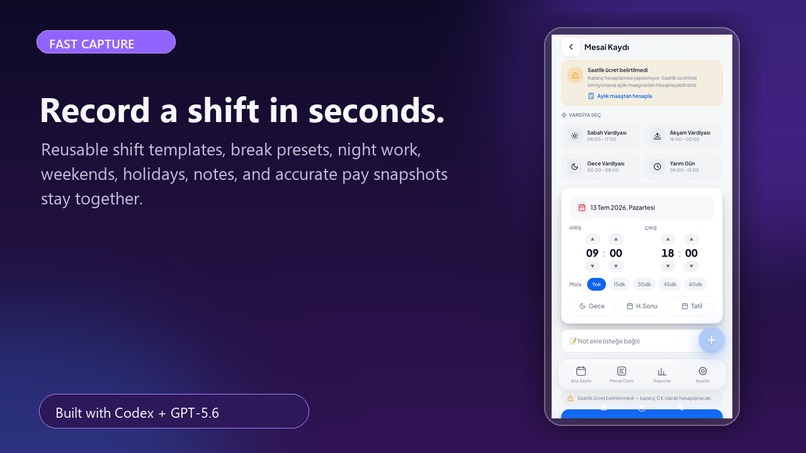
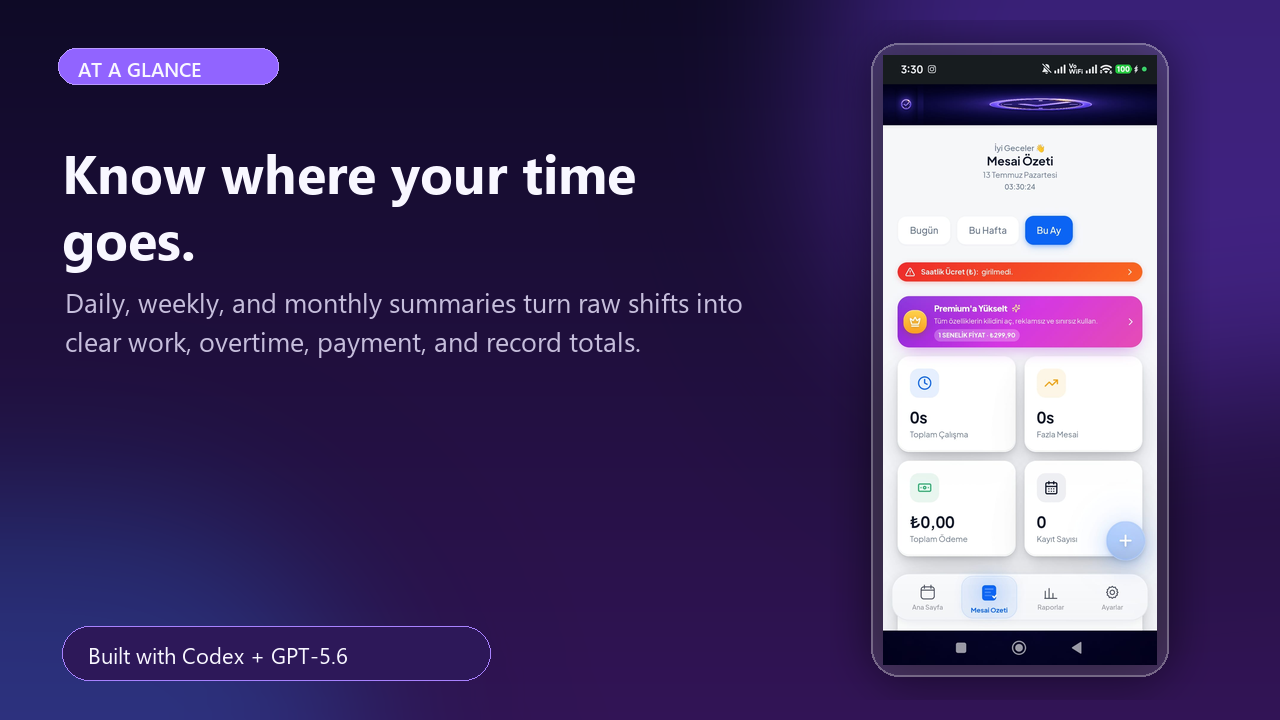
Monthly overtime and earnings summary
-
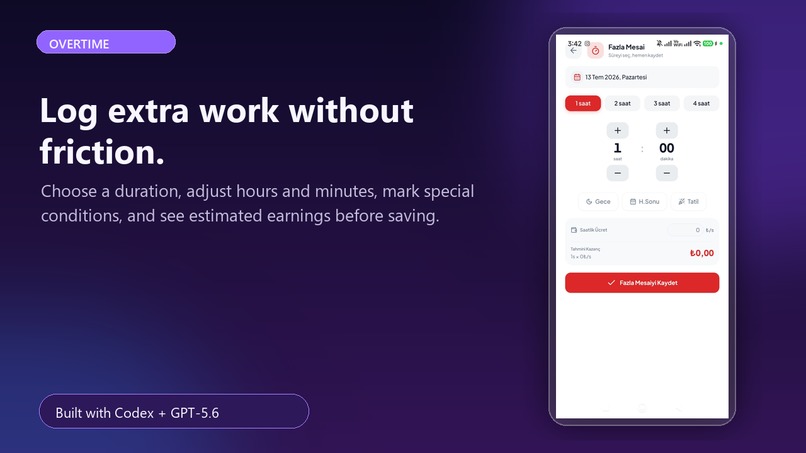
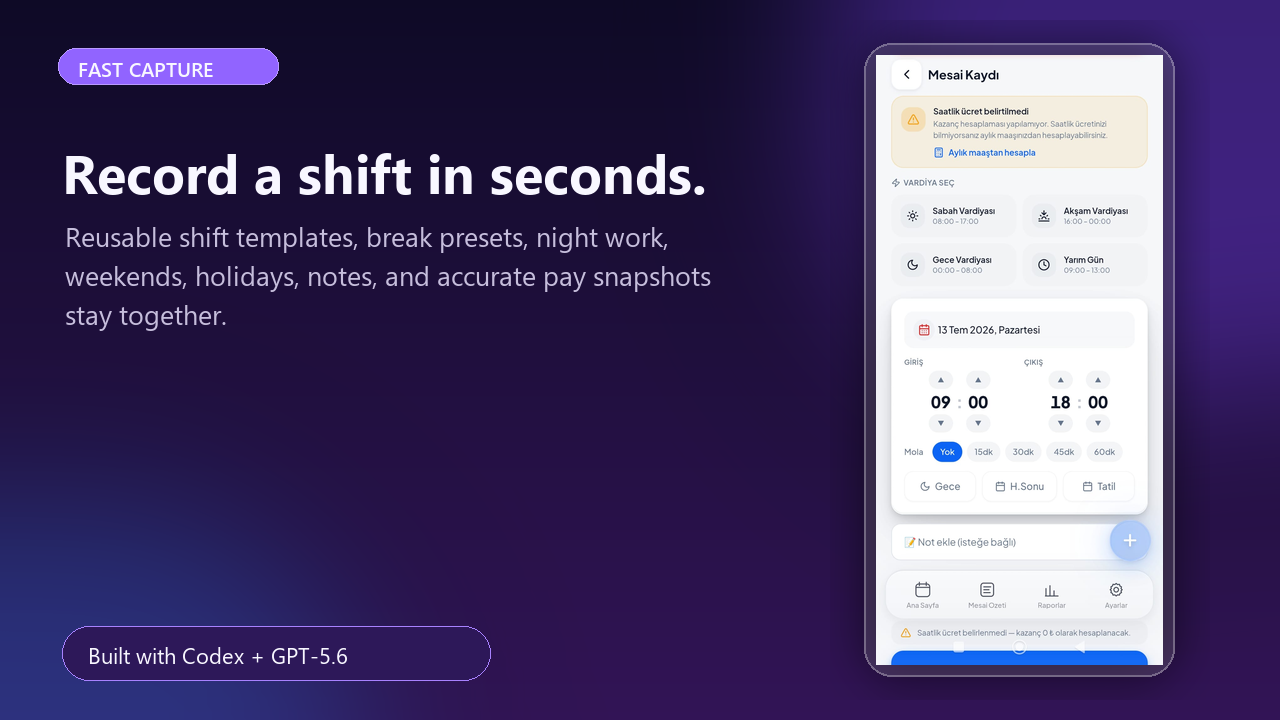
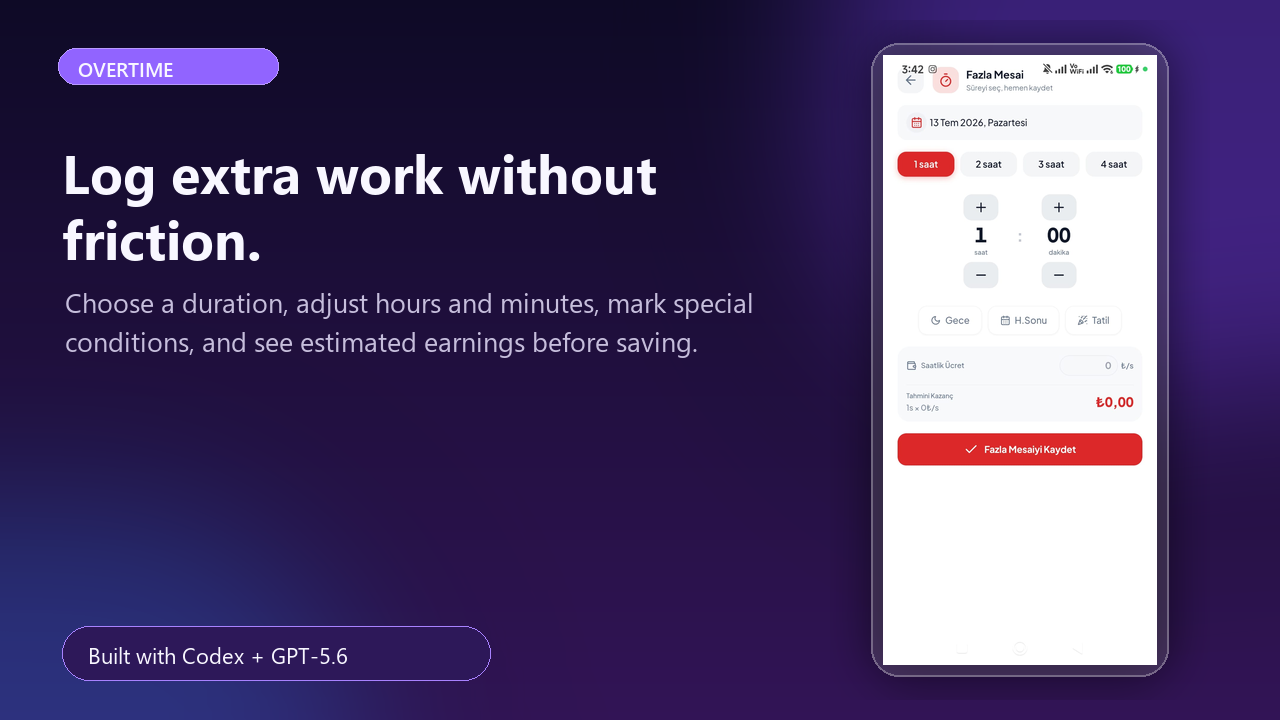
Fast overtime entry with shift details
-
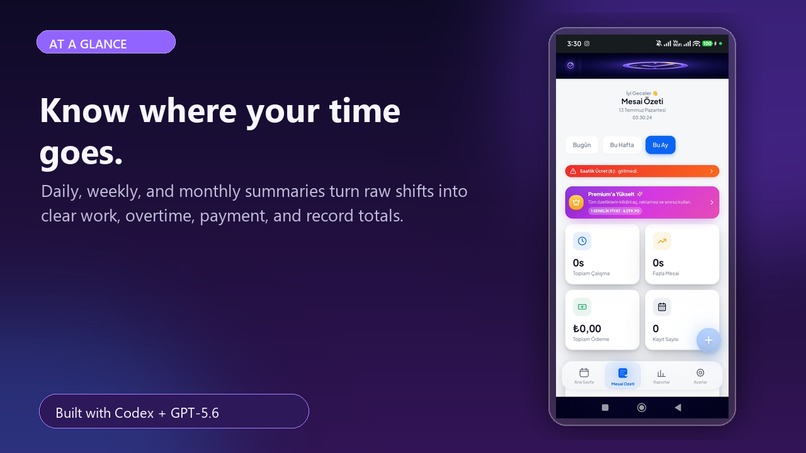
Mesai Cepte — mobile onboarding and language selection
-
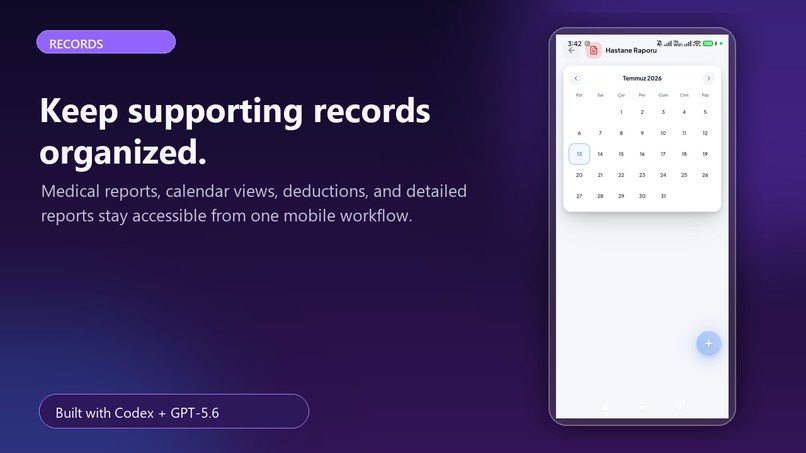
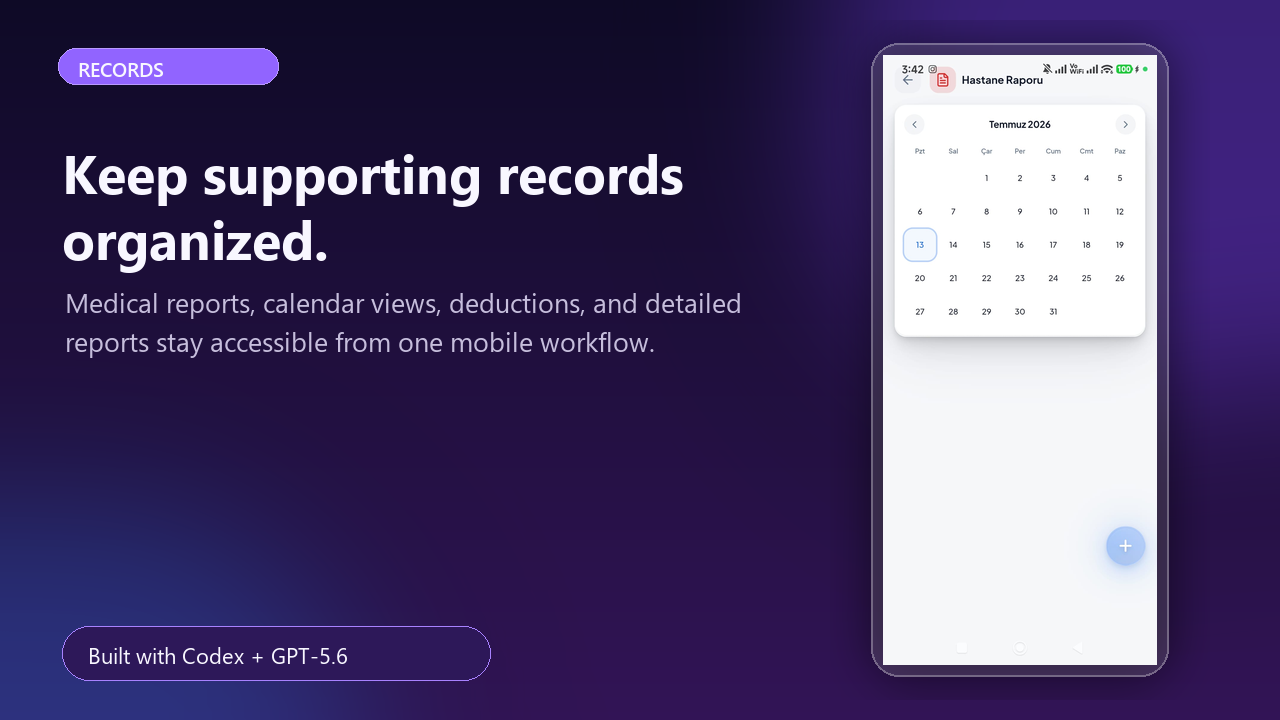
Reports and calendar-based work history
Inspiration
Work hours and overtime are often scattered across notes, messages, and spreadsheets. That makes it difficult for employees to verify their time and understand how night shifts, weekends, holidays, breaks, and changing hourly rates affect what they earn. Mesai Cepte turns those daily records into one clear mobile workflow.
My broader goal is to make everyday life easier through simplicity that many comparable tools overlook. I built Mesai Cepte while managing multiple chronic health conditions, so conserving time and energy was not an abstract design principle: logging a shift, checking overtime, or understanding earnings had to take only a few clear steps.
What it does
Mesai Cepte is a multilingual Android work-hours, overtime, and earnings tracker with Turkish and English support. Users can record regular shifts or overtime in seconds, reuse shift templates, track breaks, mark night/weekend/holiday work, preserve compensation snapshots, add deductions and medical reports, and review daily, weekly, and monthly summaries.
The app is local-first, so core tracking keeps working offline. With Google sign-in, user-owned records and theme preferences synchronize through Supabase across devices. Device PIN and biometric preferences intentionally stay local.
How we built it
The mobile UI is built with React, TypeScript, Vite, Tailwind CSS, and shadcn/ui, then packaged for Android with Capacitor. Supabase Auth uses Google OAuth with PKCE. Postgres stores user-scoped synchronization records protected by Row Level Security. Local mutations are queued, coalesced, and reconciled incrementally when the app reconnects, returns to focus, or the user requests a sync.
RevenueCat handles subscription entitlements, AdMob provides rewarded temporary access, and Vitest plus Testing Library cover calculations, storage, cloud queues, PIN protection, premium access, warnings, and navigation regressions.
How Codex and GPT-5.6 helped
During OpenAI Build Week, Codex with GPT-5.6 acted as an engineering partner across the existing codebase. It traced end-to-end data flows, implemented Google authentication and secure Supabase synchronization, reviewed RLS and account deletion, diagnosed Android safe-area issues from real-device screenshots, integrated store and notification assets, added rewarded access and RevenueCat identity linkage, fixed a floating-action navigation race, expanded regression tests, verified Android builds, and prepared the signed Play Store bundle and submission documentation.
GPT-5.6 was particularly valuable for multi-file reasoning: checking whether one user action updated every dependent view and following a record from UI interaction through local persistence, queued mutation, and cloud reconciliation.
Challenges
The hardest parts were keeping a local-first app predictable across authentication changes, multiple devices, offline mutations, Android browser-history behavior, and changing compensation settings. We also needed to protect device-only security settings while synchronizing the rest of the account safely.
Accomplishments
- Incremental, user-scoped cloud sync with offline mutation queues
- Google OAuth with PKCE on Android
- RLS-protected per-user data
- Historical compensation snapshots
- Rewarded 24-hour access and RevenueCat entitlement identity
- A tested, signed Android App Bundle ready for Google Play
What we learned
Reliable mobile software is not one feature; it is the complete path between UI behavior, persistence, cloud ownership, authentication, platform packaging, and recovery from offline or interrupted states. Codex helped us inspect and validate that whole path.
What's next
Next steps include Apple sign-in, richer payroll exports, broader automated device testing, improved onboarding, and additional privacy-preserving insights.
Built With
- admob
- android
- capacitor
- codex
- gpt-5.6
- postgresql
- react
- revenuecat
- supabase
- tailwind
- typescript
- vite
- vitest

Log in or sign up for Devpost to join the conversation.