-
-
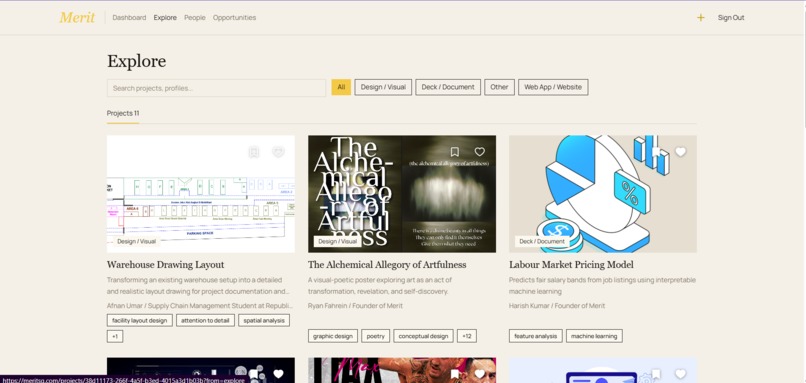
Discovery Page
-
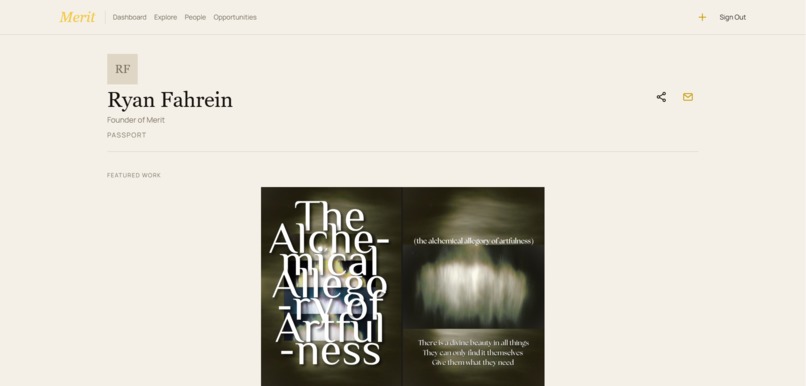
Passport Page
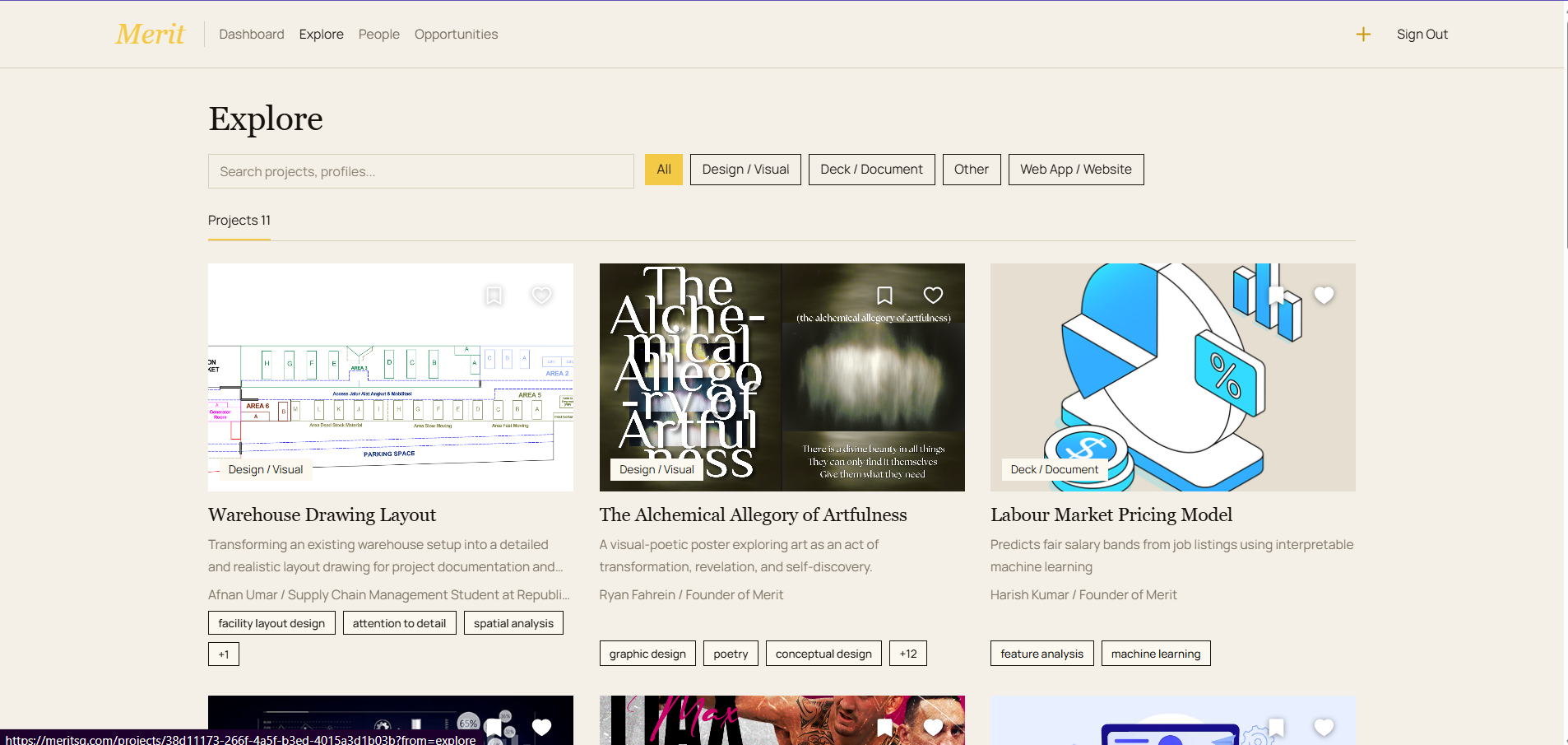
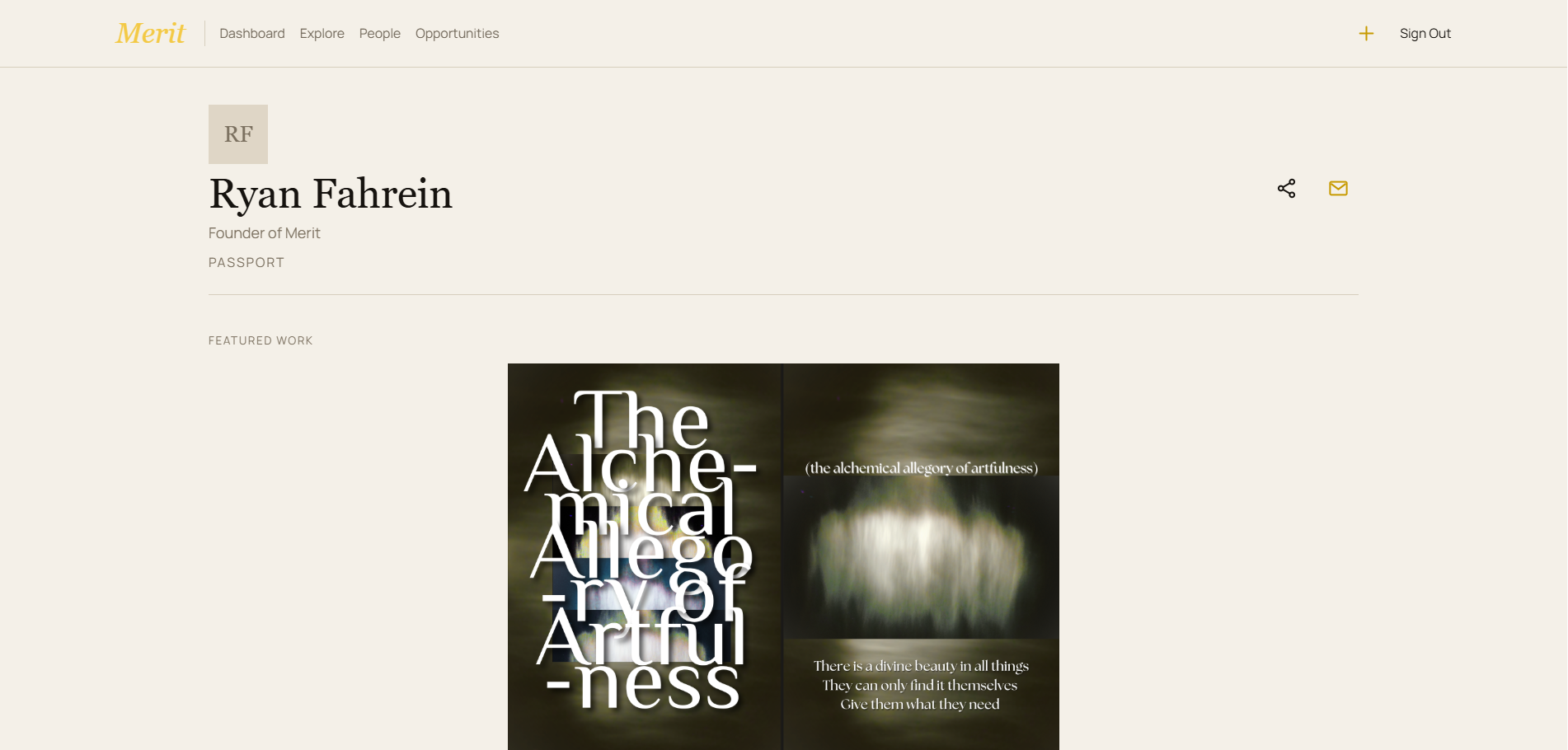
About the Project
Inspiration
The idea for Merit came from a frustrating reality we experienced firsthand.
While applying for internships, we realized that hiring decisions often depended on weak signals like GPA, school name, and résumé polish. One of our founders was rejected shortly after being asked for a single number: his GPA. It wasn't a reflection of what he had built, only what fit neatly onto a form.
At the same time, AI has made creating impressive résumés easier than ever. As credentials become easier to generate, they're becoming less useful for identifying genuine talent.
We believe the future of hiring should be based on proof, not pedigree.
What it does
Merit helps students build verified proof-of-work passports by showcasing real projects, skills, achievements, and evidence of what they've actually created.
Alongside this, we built Merit Scout, an AI-powered recruiter platform that lets hiring teams describe their ideal candidate in natural language. Instead of filtering by keywords or résumés, Merit Scout understands the required skills, weighs them based on recruiter priorities, and ranks candidates using demonstrated project evidence.
Every recommendation is explainable, allowing recruiters to see exactly why a candidate matches the role.
How we built it
We built Merit as a modern web application using AI throughout both development and the product itself.
Our platform combines structured candidate profiles with project evidence, allowing AI to understand not only what someone claims to know, but what they have actually demonstrated through their work.
For recruiters, we developed an AI matching pipeline that:
- Extracts hiring intent from natural language.
- Identifies the most important skills and priorities.
- Compares candidates based on demonstrated evidence.
- Produces transparent rankings backed by real projects.
Throughout development, we rapidly iterated on the product using continuous user feedback from students, recruiters, and startup mentors.
Challenges we ran into
The hardest challenge wasn't building AI. It was designing trust.
We had to rethink what "proof" actually means in hiring. A GitHub repository, design portfolio, hackathon project, research paper, or leadership experience all look completely different, yet each can demonstrate real ability.
Another challenge was balancing AI automation with transparency. Recruiters need recommendations they can trust, so every ranking must be explainable rather than being another black-box score.
Finally, building an early-stage startup meant validating assumptions quickly while simultaneously designing, building, pitching, and speaking with users.
What we learned
Building Merit taught us that hiring is fundamentally a trust problem.
Students already produce valuable work, but that evidence is scattered across different platforms and difficult for recruiters to evaluate at scale.
We also learned that AI becomes most useful when it augments human decision-making instead of replacing it. Rather than making hiring decisions automatically, our goal is to surface the strongest evidence so recruiters can make better, faster, and fairer decisions.
What's next for Merit
We're continuing to improve both sides of the platform.
For students, we're making it easier to build rich, verified proof-of-work passports that reflect real capability.
For recruiters, we're expanding Merit Scout with better AI matching, richer candidate insights, and larger talent datasets so companies can discover exceptional people who would otherwise be overlooked.
Our vision is simple:
A world where opportunities are earned through demonstrated ability, not inherited credentials.
Built With
- and-backend-services-*-**openai-api**-for-ai-powered-candidate-understanding
- github
- next.js
- openai-api
- postgresql
- postgresql-database
- project-analysis
- react
- storage
- supabase
- tailwind-css
- typescript
- vercel


Log in or sign up for Devpost to join the conversation.