Inspiration
Early-career hiring is broken in a subtle but powerful way. It doesn’t lack talent — it lacks visibility. Students are building real skills and projects, but their proof is scattered across PDFs, portfolios, and links, making it hard for employers to actually see what they can do. At the same time, recruiters are overwhelmed and default to proxies like GPA, school brand, and résumé polish.
We were inspired to build Merit to fix this gap — not by creating more content, but by making existing capability visible, structured, and trusted.
What it does
Merit is a proof-first career-readiness and talent discovery platform.
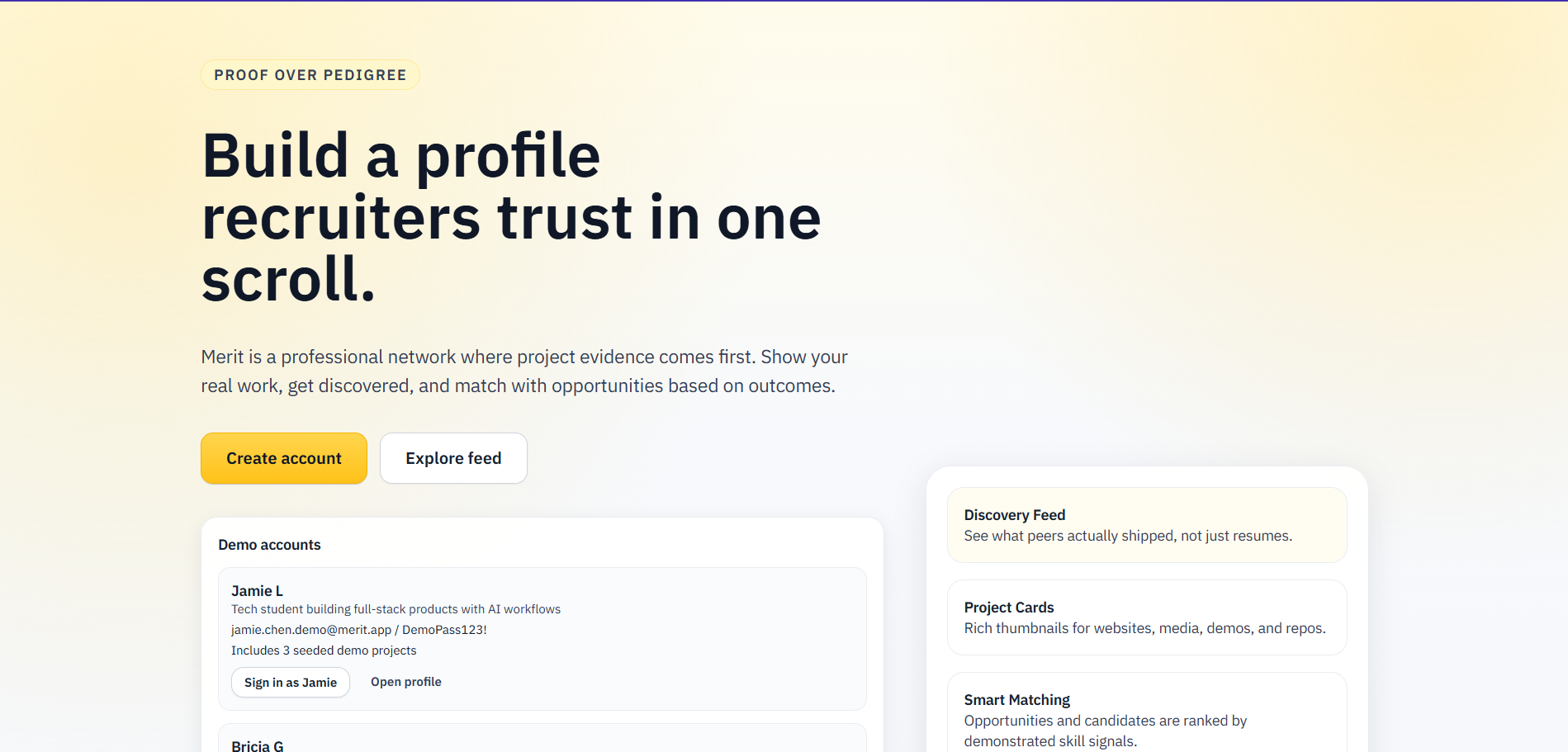
It allows students to build a Merit Passport — a dynamic, role-aware profile that includes skills, projects, proof of work, and a readiness score. Instead of a static résumé, it shows what a student can actually do.
On top of that, Merit uses AI to:
Benchmark users against target roles Identify skill and proof gaps Recommend the next best steps to improve
For employers, Merit provides a better discovery system — allowing them to filter candidates by readiness, skills, and actual work instead of relying on weak résumé signals.
How we built it
We designed Merit as a full-stack product system, not just a thin AI wrapper.
Backend: Supabase (Auth, Postgres, Storage) to manage users, profiles, and project artifacts Core logic: Custom matching engine to compare users against role requirements using skill overlap and proof signals AI layer: Readiness analysis + career copilot for gap detection and next-step recommendations Frontend: Structured UI for building passports, uploading proof, and visualizing readiness
The system flows from: Choose role → Build passport → Upload projects → Gap analysis → AI guidance
Challenges we ran into
One major challenge was translating an abstract idea — “proof over pedigree” — into something structured and measurable.
Defining what “readiness” actually means across different roles Designing a system that works across sectors, not just for tech (unlike GitHub) Avoiding generic AI outputs and making recommendations actionable Structuring scattered student work into a clean, comparable format
Another challenge was balancing simplicity with depth — making the product usable while still powerful enough to matter.
Accomplishments that we're proud of Built a clear end-to-end product loop from ambition to employability Designed a Merit Passport that is actually stronger than a résumé or portfolio Created a system that solves both sides of the market — students and recruiters Turned a vague problem into a structured, product-ready solution with real logic behind it Scoped an MVP that is realistic to ship, not just conceptual What we learned The real problem isn’t lack of effort — it’s lack of structure and visibility Students don’t just need tools, they need direction Recruiters don’t need more applicants, they need better signals AI is most powerful when embedded into workflows, not used as a standalone chatbot Building something meaningful requires clarity on both user sides, not just one What's next for Merit
We’re focused on turning this into a real, scalable product.
Next steps include:
Adding verification layers to make proof more trusted Building employer tools like candidate comparison and shortlist systems Integrating with schools and career offices for cohort-level insights Expanding the AI copilot into a stronger action engine Developing skill-cluster search and matching improvements Launching pilot users to validate real-world usage
The long-term vision is to become the proof-first infrastructure for early-career hiring — where students are judged by what they can do, not where they come from.
Built With
- eslint
- next.js
- node.js
- openai
- postcss
- react
- supabase
- tailwind
- typescript
- vitest


Log in or sign up for Devpost to join the conversation.