-
-

Productize Feature
-
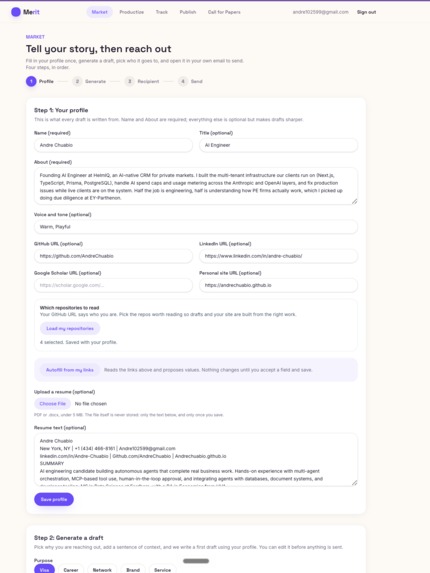
Market Feature
-

O-1 tracking Feature
-
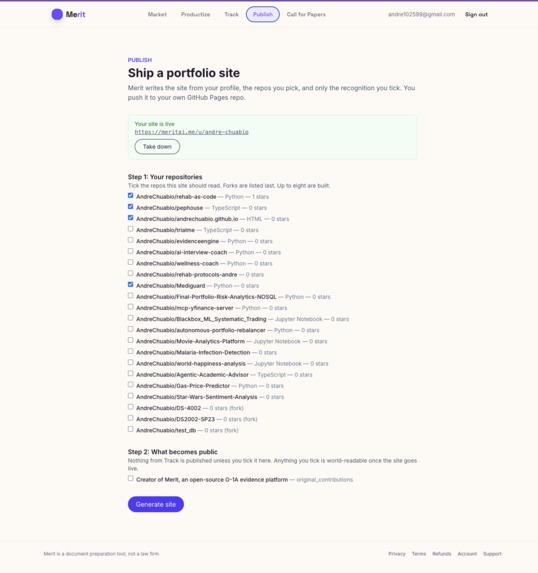
Publish Feature
-
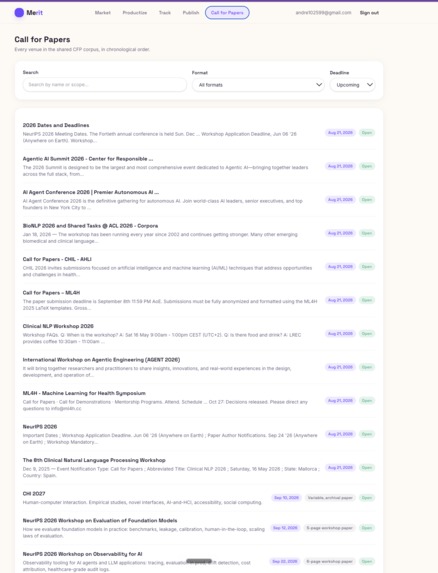
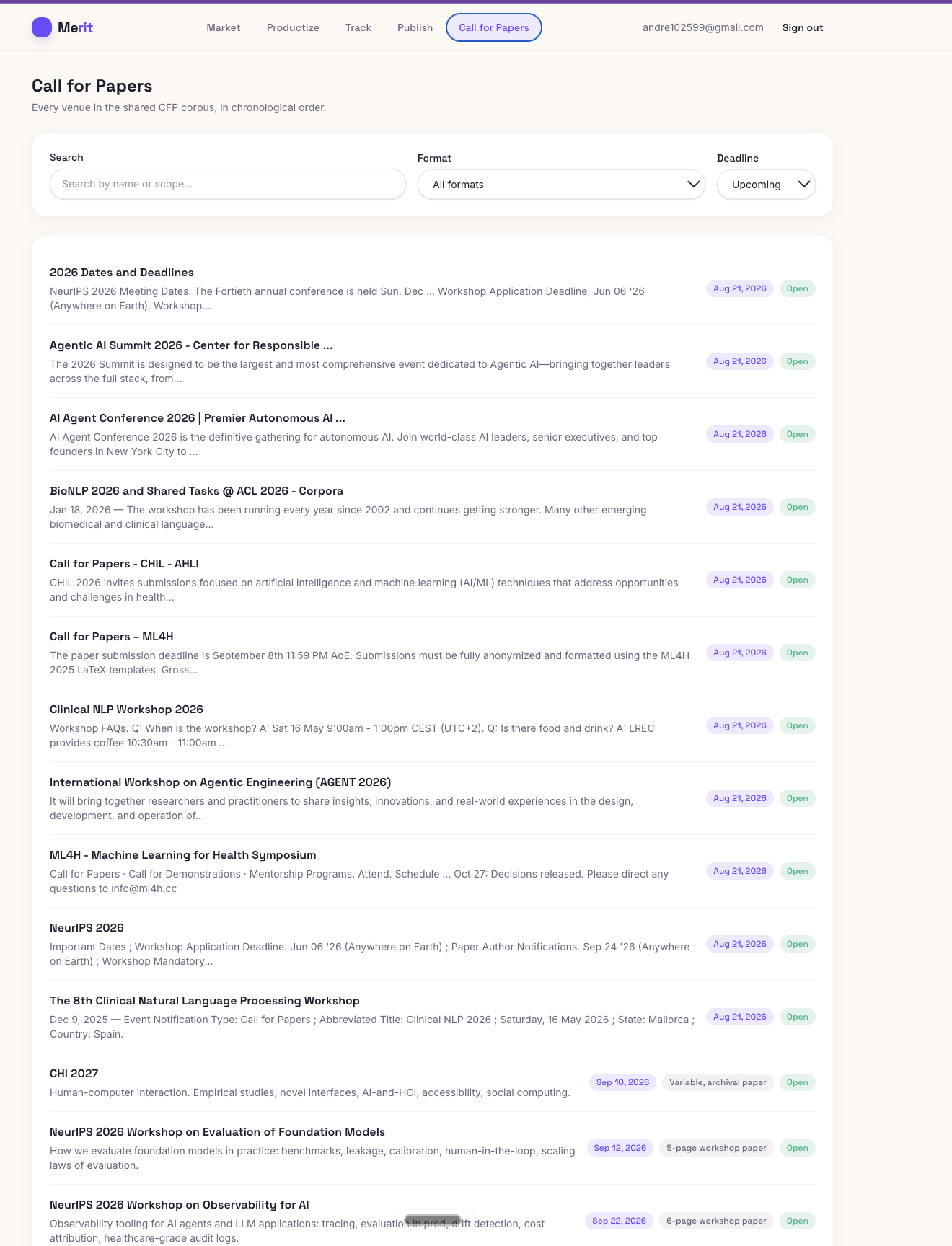
Call for Papers Feature

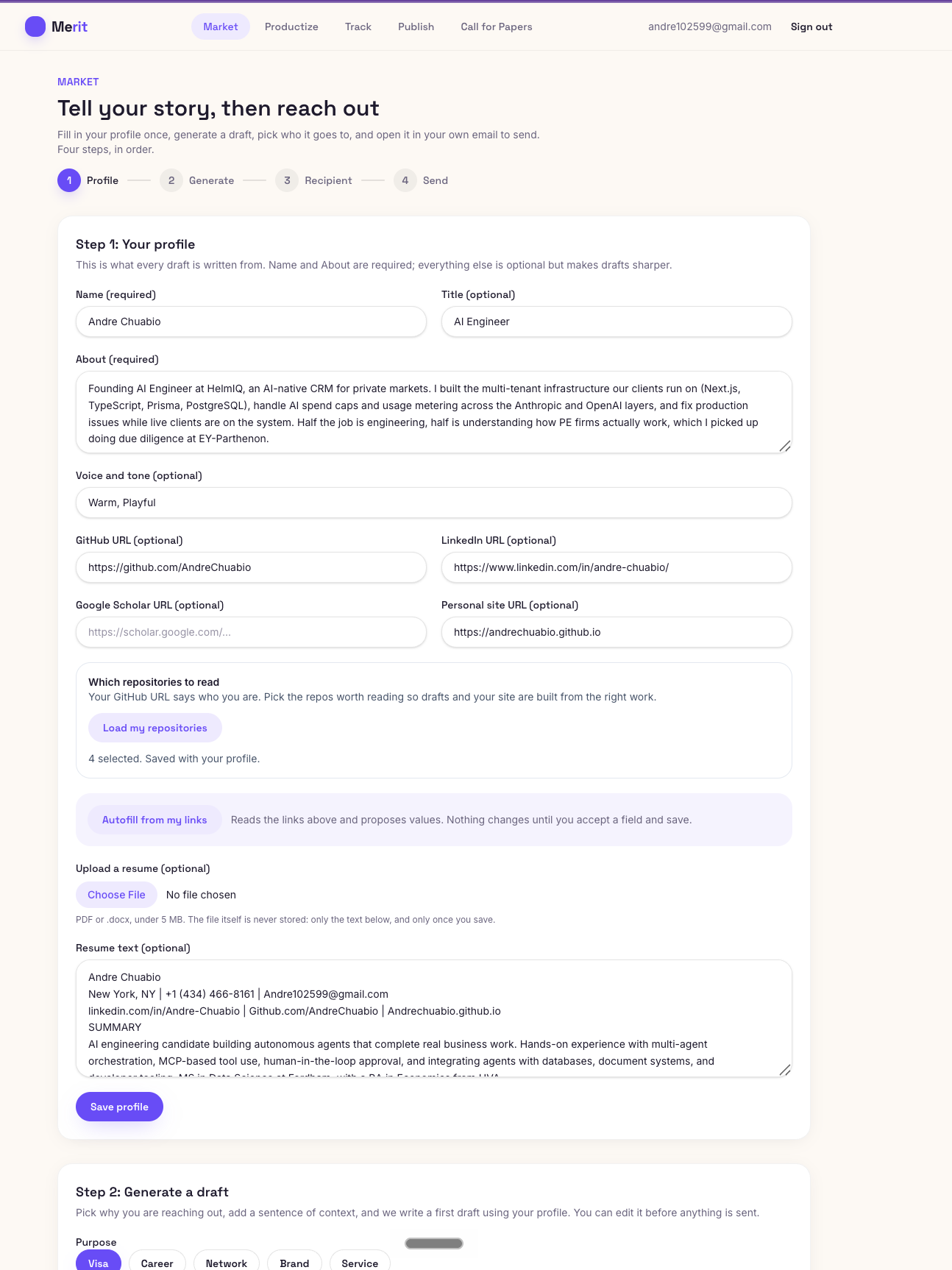

Inspiration
Every year thousands of researchers and engineers qualify on paper for the O-1A extraordinary-ability visa but never file, because the evidence work sits behind a wall of professional-services cost. A credible petition means organizing a career against eight specific USCIS criteria, writing petition-quality narratives for each, and packaging it so an attorney can review and file. Firms charge five to fifteen thousand dollars for that preparation labor — and most of it is document work: reading a candidate's actual output, mapping it to criteria, writing it up. That labor is exactly what modern AI does well, and exactly what immigrants early in their careers cannot afford to buy.
What it does
Merit is a live product at meritai.me that turns a researcher's real work into organized O-1A evidence across four connected surfaces:
- Track: an evidence ledger structured around the eight USCIS criteria. Record real accomplishments, watch coverage build toward the three-criteria minimum, and draft a petition-quality narrative for any criterion in one click.
- Productize: point it at a GitHub repository. Gemini, first-party on Vertex AI inside Merit's Google Cloud project, reads the repo and distills its research story; from that summary Merit matches publication venues, drafts a submittable paper, and packages the same repo as an installable Claude Code plugin — each a genuine piece of evidence.
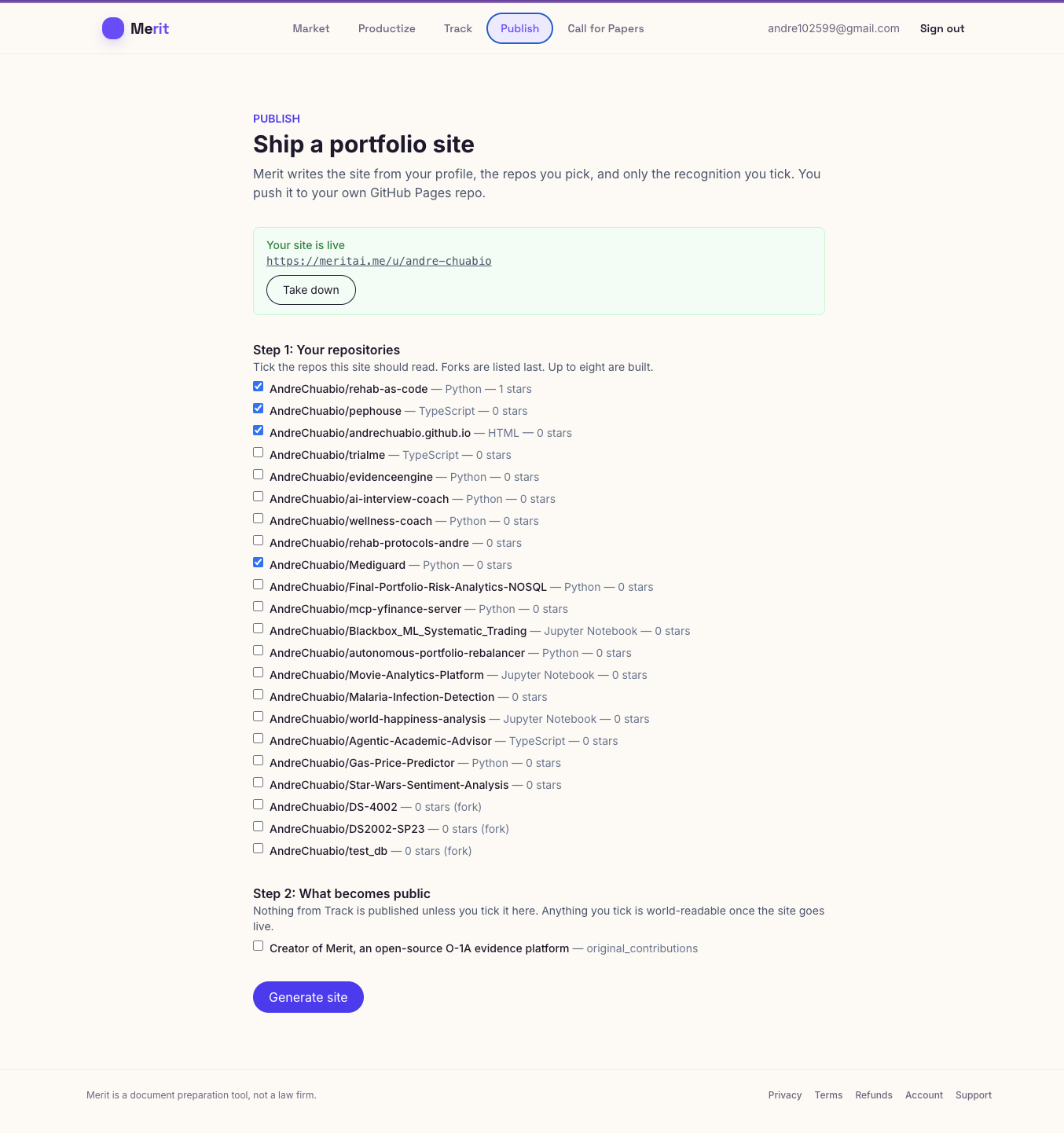
- Publish: builds and hosts a public portfolio site from the user's repositories and selected evidence at their own meritai.me/u/ address.
- Market: drafts outreach in the user's own voice to the people who write recommendation letters and extend judging invitations.
The free tier covers the ledger and narratives; the attorney-ready dossier PDF, which assembles everything by criterion for legal review, is a one-time $99 purchase. Merit is deliberate about what it is not: a document-preparation tool, not a law firm. Every generated document is labeled a draft for attorney review, it makes no visa-outcome promises, and terms, privacy, refund policy, and full data export/deletion shipped before the first ad ran.
How we built it (built with Gemini + Google Cloud)
Repository ingestion — the heaviest AI operation in the product — runs first-party on Gemini through Vertex AI in Merit's Google Cloud project, as does the in-product help assistant that coaches users through the O-1A criteria. Every Vertex call writes a row to a production usage table recording timestamp, surface, model, and token counts, so the claim is auditable rather than asserted — the demo video queries that table live, seconds after an on-camera ingest. Merit is multi-model by design, with Gemini reading and grounding at the core of the pipeline. Stack: FastAPI + a shared Python pipeline package, Next.js frontend, Supabase Postgres/pgvector for auth and data, Stripe for live payments, Railway (API) and Vercel (frontend) for hosting, with per-user quotas and cost tracing on every AI surface.
An AI-native business, not just an AI feature
Merit runs through AI at three layers. Value delivery: reading repos, drafting narratives and papers, building portfolios, and writing outreach are all live production AI operations with real cost controls — admission quotas that fail closed under load so a traffic spike cannot disengage spending limits. Build: the codebase was engineered, reviewed, and hardened by orchestrated AI agents, including an automated QA loop that exercised every feature on production as a real user, found genuine defects, and drove fixes into deploys within hours. Marketing: Merit's Instagram launched this week with an AI-generated, clearly disclosed presenter and an AI content pipeline — a human approves every post.
Business viability, stated honestly
Merit went from repository to revenue-capable in the competition window. Payments are live today: real Stripe live-mode checkout at $99, webhook-granted entitlements verified end to end, a 14-day no-questions refund policy, complete legal surfaces. The founder is the product's first real published user — his portfolio at meritai.me/u/andre-chuabio was built by Merit from his actual repositories. We are at the very start of the revenue curve and make no claims beyond what our Stripe records document. What the window proved is the hard part: a stranger can arrive from an ad, build real evidence for free, and pay $99 for a deliverable that previously cost thousands — every step live and audited today.
Challenges we ran into
- A Stripe library upgrade removed dict semantics from webhook objects, so the webhook 500'd on every delivery and no purchase could grant — caught and rewritten with a self-sufficient grant path and a "paid but not granted" alert.
- An outreach personalization bug wrote every user's drafts as the founder (his resume was in a shared style KB) — fixed with a per-caller identity guard and tests.
- Spend safety on the paid Vertex path: quotas that fail closed (503) rather than open, so a spike can't bypass limits.
What we learned
Shipping a real, paid, legally-careful product in a competition window is mostly the unglamorous parts — billing correctness, tenant isolation, spend caps, and trust surfaces — and AI agents are genuinely good at driving those to done when held to tests and a QA loop on production.
What's next for Merit
First paying customers from the live funnel; finishing the Stripe public-business-name setup; deepening per-criterion narrative quality and evidence coverage; and expanding beyond the founder's account to the researchers the O-1A exists to welcome.
Built With
- claude
- fastapi
- gemini
- google-cloud
- next.js
- pgvector
- postgresql
- python
- railway
- stripe
- supabase
- tailwindcss
- typescript
- vercel
- vertex-ai

Log in or sign up for Devpost to join the conversation.