-
-
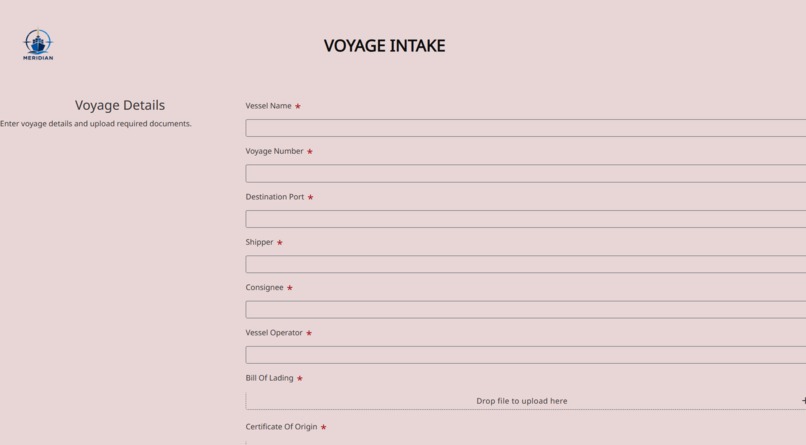
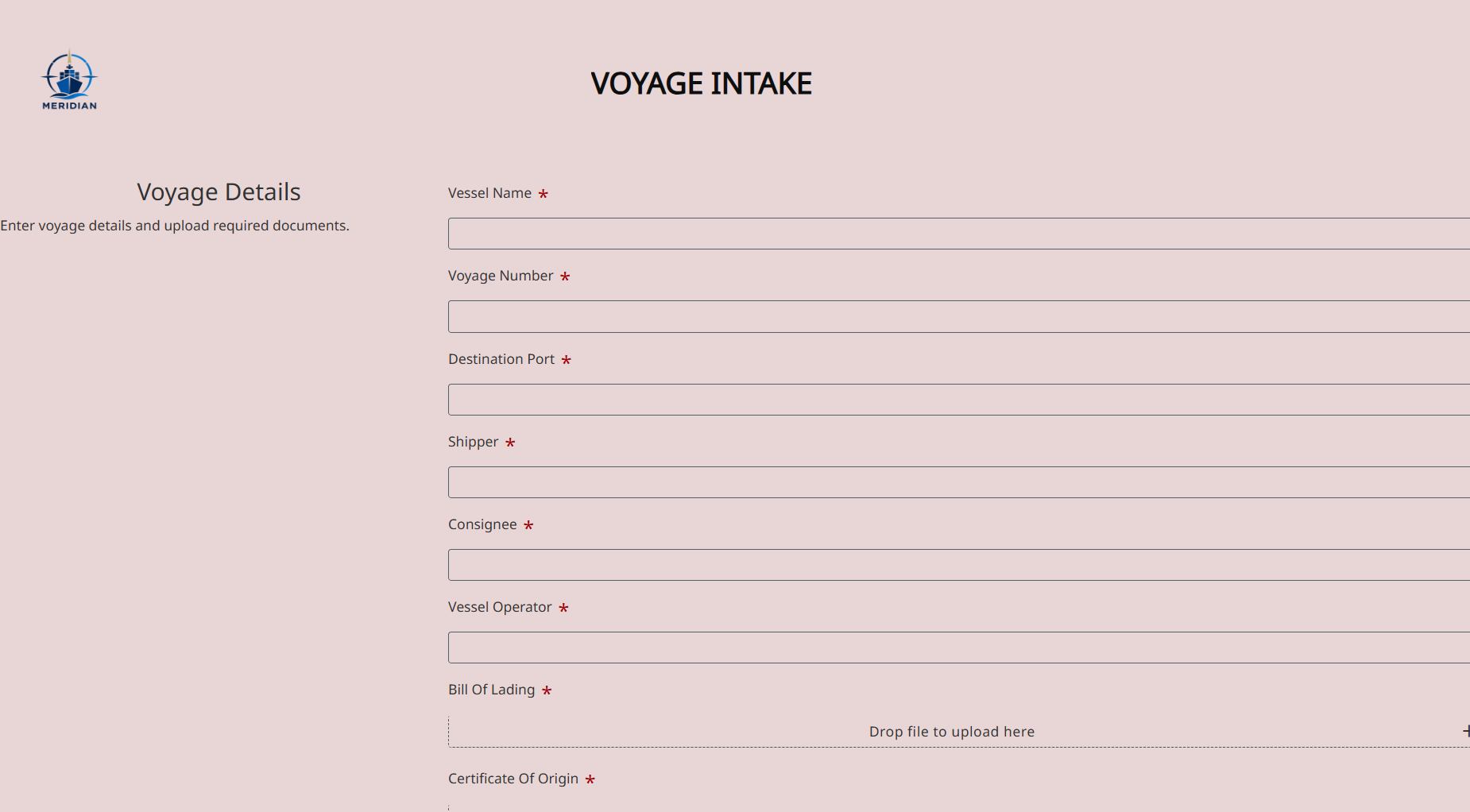
Intake App
-
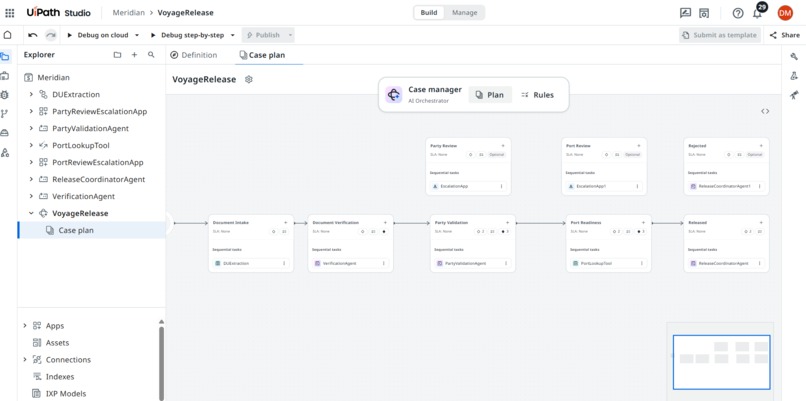
Maestro Implementation
-
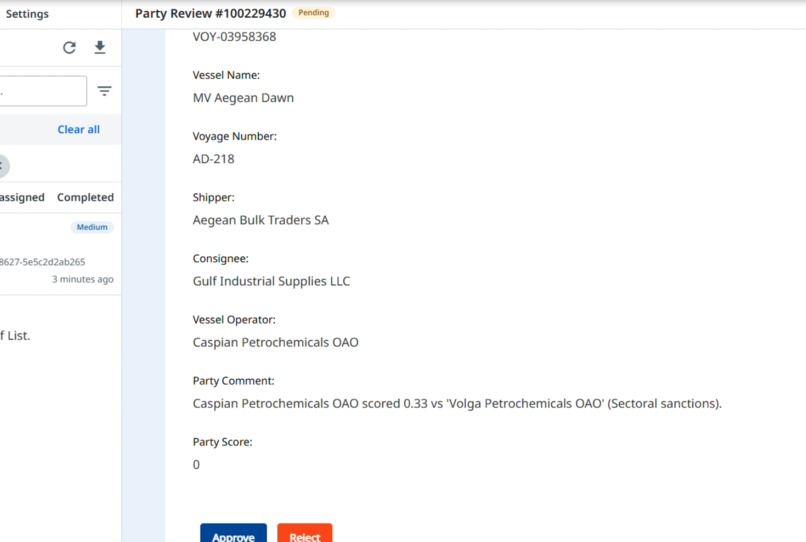
Approval form
Inspiration
Global trade moves on ships — but ships don't move until the paperwork clears compliance. Before a cargo vessel is released for a voyage, three things must be confirmed: the trade documents are internally consistent, none of the parties are on a sanctions or denied-party list, and the destination port is open.
Today this is done by three different people, in three different tools, with no shared record. A document analyst reads PDFs. A compliance officer searches a watchlist. Someone emails the port agent. A voyage can sit for hours or days waiting on checks that individually take minutes — and when release is finally granted, there's no single auditable answer to the one question a regulator cares about: who approved this, and why?
That gap — high stakes, real cost, still stitched together by hand — is exactly what agentic automation is for. Not replacing people, but orchestrating the whole process and pulling a human in only where judgment is genuinely required. That's Meridian.
What it does
Meridian turns maritime voyage release into one intelligent case on UiPath Maestro.
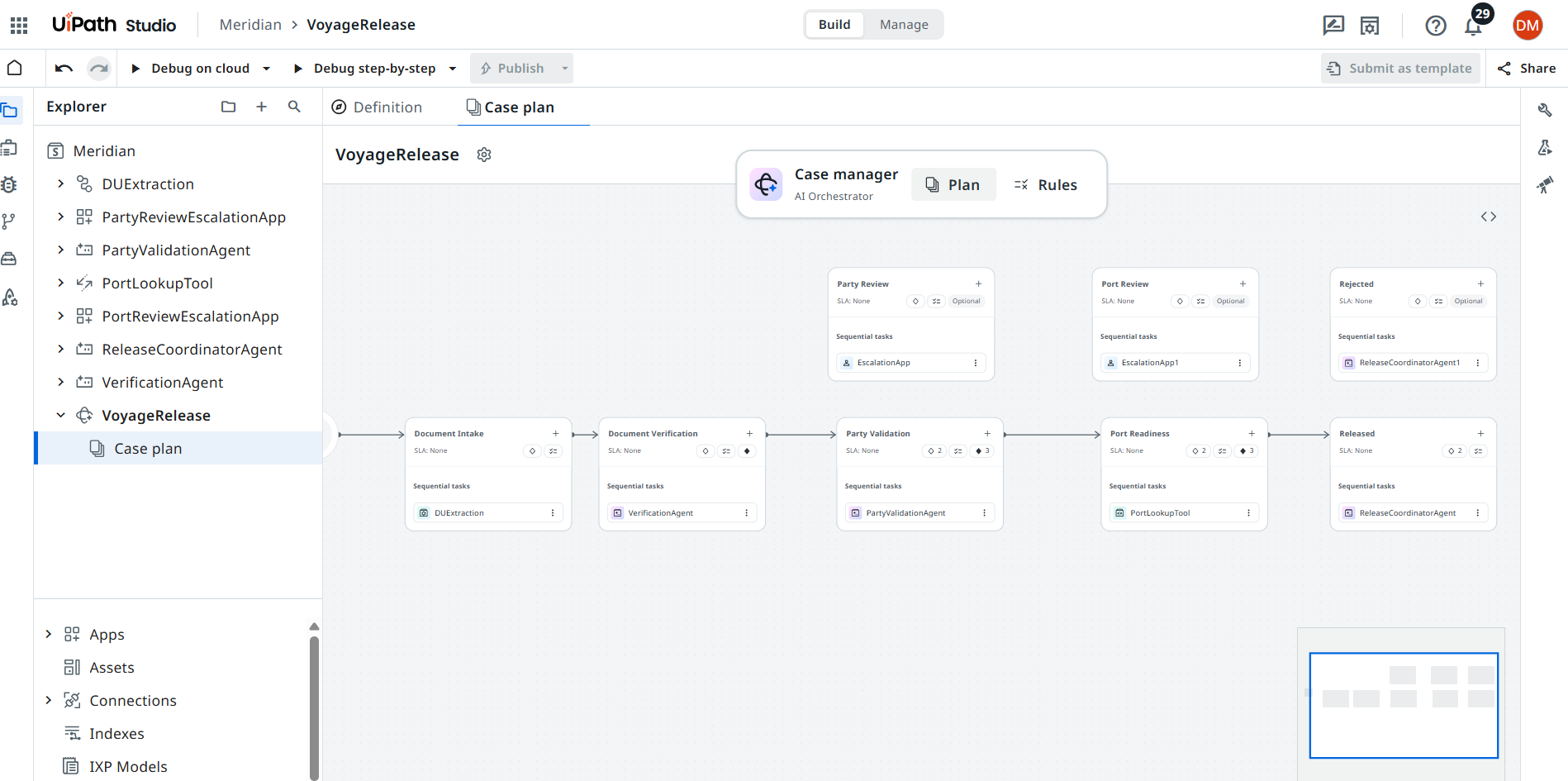
A coordinator submits a voyage through a UiPath App — vessel and party details plus five trade documents (bill of lading, cargo manifest, certificate of origin, insurance certificate, quality certificate). That submission creates a case, and the case runs itself through four checks:
- Document Intake — Document Understanding extracts structured data from the five files into one packet.
- Document Verification — an AI agent runs five consistency checks (field matching, weight tolerance within 2%, completeness, amendment propagation, date sanity).
- Party Validation — a coded agent screens shipper, consignee, and vessel operator against a denied-party list.
- Port Readiness — an API workflow confirms the destination port is open.
Every check returns one of three verdicts:
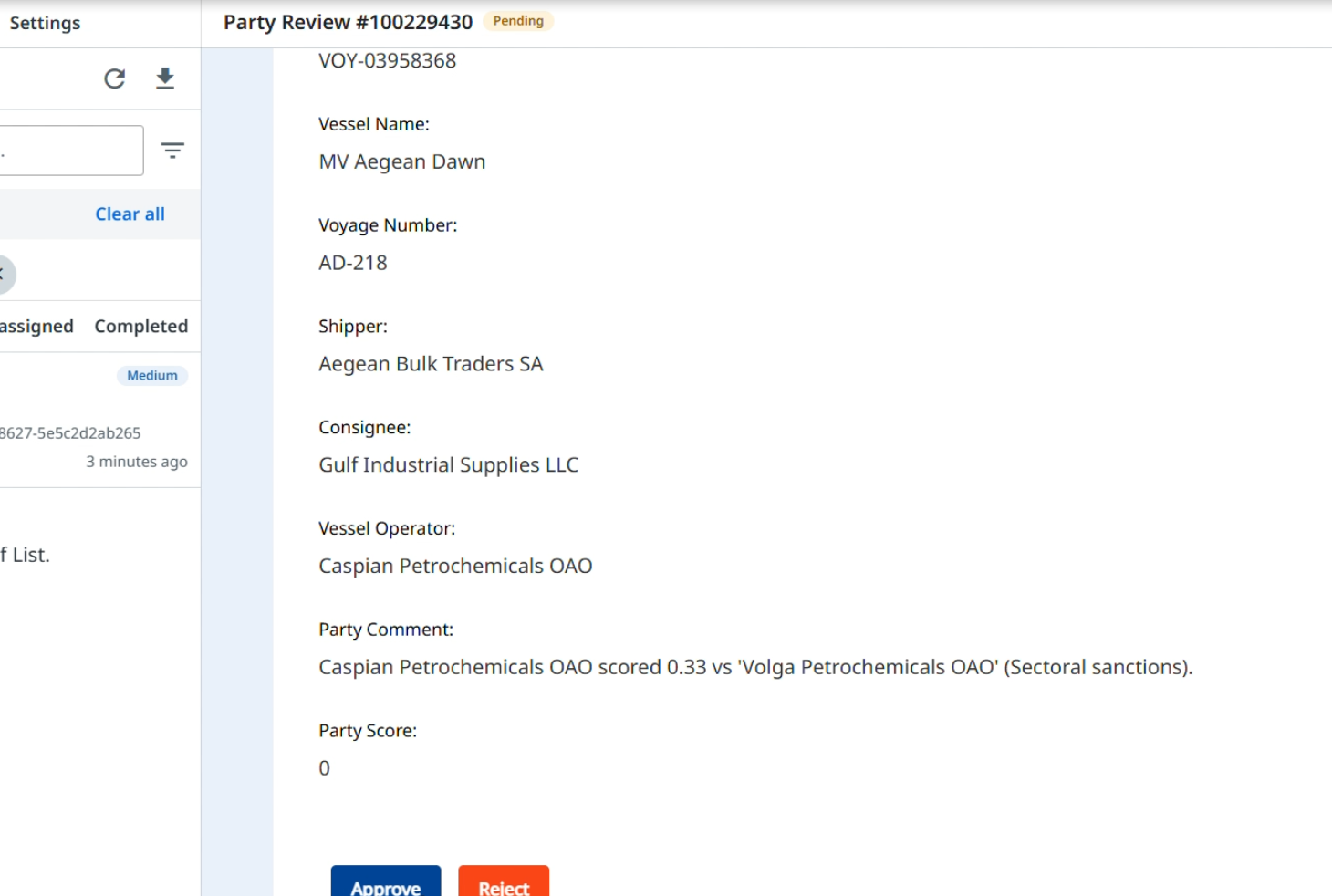
PASS→ continue to the next checkFAIL→ route straight to RejectedREVIEW→ pause and route to a human reviewer, who sees exactly what was flagged and why, then decides — and the case resumes the instant they approve
When everything clears, an AI Release Coordinator agent writes a plain-English closure summary and the case closes with one recorded outcome: RELEASED, RELEASED_WITH_OVERRIDE (a human approved a flagged check), or REJECTED — each with a full audit trail.
Compliance that runs itself where it can, escalates to people only where judgment is needed, and produces an audit-ready record every time.
How we built it
The core is a UiPath Maestro case that owns the full lifecycle. Around it sit specialized components:
| Component | Type | Role |
|---|---|---|
| Intake App | UiPath App | Captures voyage + document uploads; the record triggers the case |
| DUExtraction | RPA + Document Understanding | Extracts five documents into one JSON packet |
| VerificationAgent | Low-code agent (Claude Sonnet) | Five document-consistency checks → verdict |
| PartyValidationAgent | Coded agent (Python / LlamaIndex, Claude Haiku) | Denied-party screening via token-set matching |
| PortLookupTool | API workflow | Destination port status |
| Human Review Apps | UiPath Apps | Human-in-the-loop approve/reject on flagged checks |
| ReleaseCoordinatorAgent | Low-code agent (Claude Sonnet) | Writes the closure summary |
Two design decisions made the whole thing work:
Flat, scalar contracts. Instead of agents returning rich nested JSON that the case has to parse, every component emits flat values — a result (PASS/FAIL/REVIEW), a one-sentence comment, and a score. That single choice turned every Maestro routing rule into a one-liner (docResult == "PASS") with zero script tasks and zero JSON parsing in the case.
A unified vocabulary. Each check has its own domain language internally — the party agent thinks in CLEAR/POSSIBLE_MATCH/CONFIRMED_MATCH, the port tool in OPEN/RESTRICTED. We mapped all of them to the same three words: PASS, FAIL, REVIEW. Because every check speaks the same language, every stage routes identically and the human-review pattern is reusable across all of them.
For human-in-the-loop, we used Maestro secondary (interrupting) stages with return-to-origin exits: a REVIEW verdict diverts the case into a review stage, pauses for a human, and returns it to the exact stage it came from. Underpinning everything is one flat Data Fabric entity — every component reads from and writes back to it, so the case never holds hidden state.
Challenges we ran into
Routing loops. When a human approved a flagged review, the case returned to its originating stage — but the agent's verdict was still REVIEW, so the stage tried to route back into the review lane again. An infinite loop. The fix was subtle: mark the check task run-only-once, so on re-entry it doesn't re-evaluate — the human's decision, not the stale verdict, drives the case forward.
A matching quirk we had to be honest about. Our party screening uses token-set matching with a stopword list that strips company suffixes (ltd, holdings, co). We found this collapses two genuinely different firms — "Caspian Cargo Ltd" and denied "Caspian Cargo Holdings" — to identical tokens and a perfect match. With clean demo data, nothing landed in the middle REVIEW band, so the human-review path would never fire. We computed real scores against the actual list to find inputs (an operator scoring $0.33$) that genuinely produce a borderline match — and kept the quirk documented, since over-flagging is the safe direction for compliance.
Two competing routing patterns. Midway we had both destination-carrying exit rules and entry rules on target stages layered together — they collided everywhere. The conflicts vanished the moment we committed to one orchestration pattern and applied it consistently.
Scope discipline. We designed an ambitious version with cost-savings math, an assumption ledger, and a document-rework loop. As the deadline closed, we cut what added risk without adding demo clarity and kept the core airtight: three checks, human review, three outcomes.
Accomplishments that we're proud of
- A genuinely agentic case, not a linear script. Four AI/automation components make real decisions, and the case orchestrates them event-driven — stages fire on conditions, not a fixed sequence.
- A working human-in-the-loop loop that actually resumes. The case pauses, hands a person the exact context they need, and picks up cleanly — no lost or double-counted state. This is the hard part of case management, and it works.
- Three distinct, auditable outcomes —
RELEASED,RELEASED_WITH_OVERRIDE,REJECTED— each with an AI-written closure summary, so every release answers "who approved this and why." - A clean, reusable architecture — the flat-contract + unified-vocabulary design means every check wires in identically, and new checks or review lanes drop in without touching the case logic.
- Fully UiPath-native — Maestro, Apps, Document Understanding, coded and low-code Agents, Data Fabric, and RPA working as one system.
What we learned
Contracts matter more than cleverness. Our first design had agents returning detailed objects and a versioned ledger — elegant on paper, a nightmare to wire. Flattening every output to scalars made the system buildable and debuggable. Design the interface between components before you build the components.
Event-driven orchestration is a different mental model. Maestro stages fire when their conditions become true against the entity — you reason about state, not sequence. Our worst bugs came from thinking sequentially when we should have been thinking in conditions.
Human-in-the-loop is a design pattern, not a feature. The real engineering wasn't the AI checks — it was the return path: pausing, handing off with the right context, and resuming without corrupting state.
What's next for Meridian
- Multi-review audit trail — log each human decision as its own ledger entry so multi-step approvals are fully traceable, rather than a single last-decision field.
- Document-rework loop — let a reviewer re-upload a corrected document and re-run extraction automatically (designed; a natural next stage).
- Cost & savings surfacing — quantify delay avoided and selective-recheck savings versus re-running every check.
- Executive sign-off gate — an optional final approval and notification for leadership before high-value releases close.
Each layers on top of the working core without touching the flat contracts underneath — which was the whole point.
Built With
- apiworkflow
- codedagents
- documentunderstanding
- javascript
- lowcodeagents
- maestro
- roboticprocessautomation
- uipath
- uipathapps
- uipathdatafacric


Log in or sign up for Devpost to join the conversation.