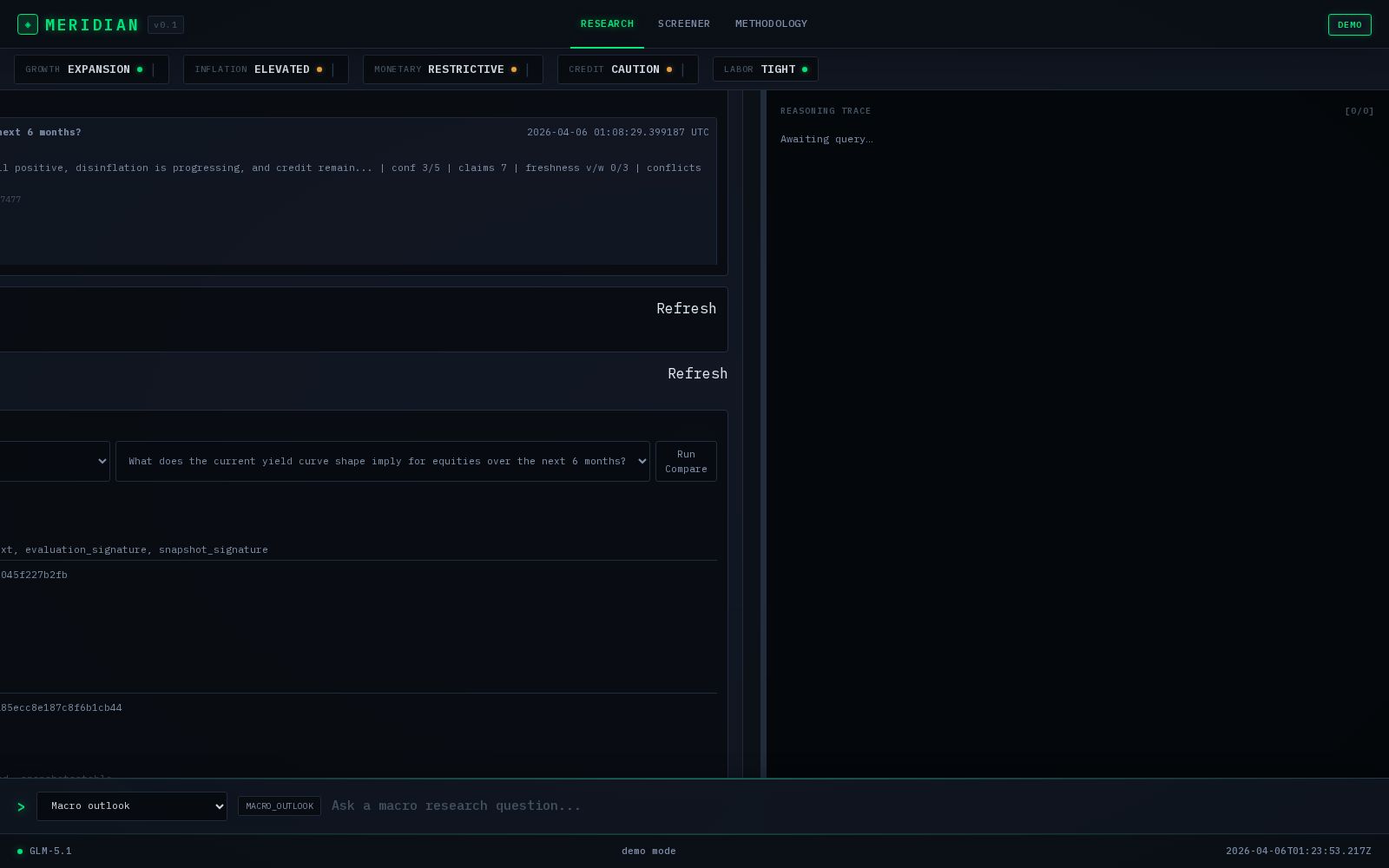

🎯 Meridian — Your AI Research Analyst for the Markets What if you could ask any question about the economy and watch an AI figure out the answer in real time — then tell you exactly where the market might be mispricing reality? That's Meridian.
The Problem Professional-grade financial research costs thousands of dollars a month and takes hours to produce. Retail investors and independent analysts are left guessing, or relying on surface-level news summaries that don't connect the dots between macro data, company filings, and market sentiment. Meanwhile, prediction markets like Kalshi are pricing the probability of real-world events — Fed rate decisions, GDP contractions, inflation spikes — but those prices aren't always right. Spotting the gap between what the data says and what the market believes is where the real insight lives. Meridian closes that gap.
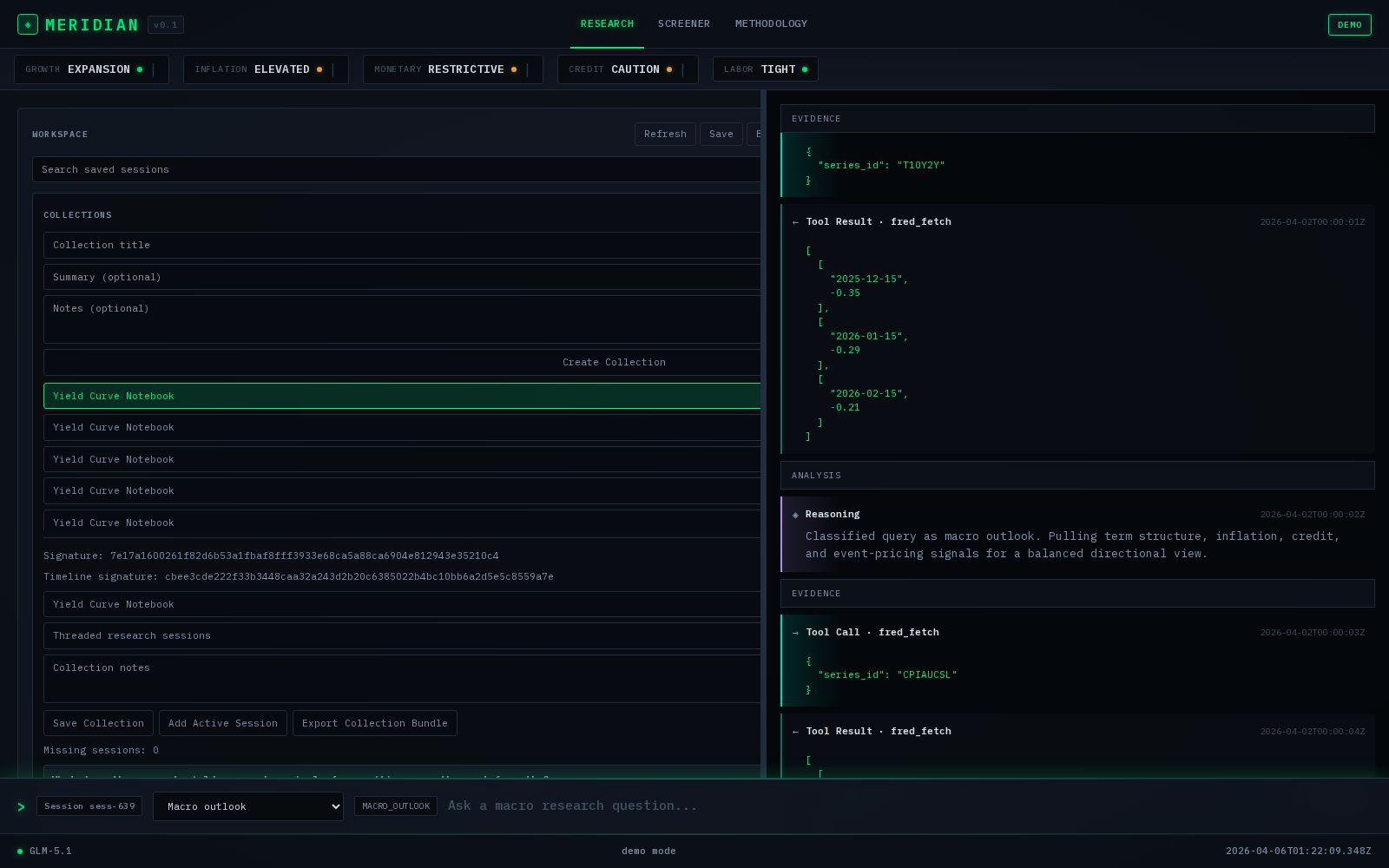
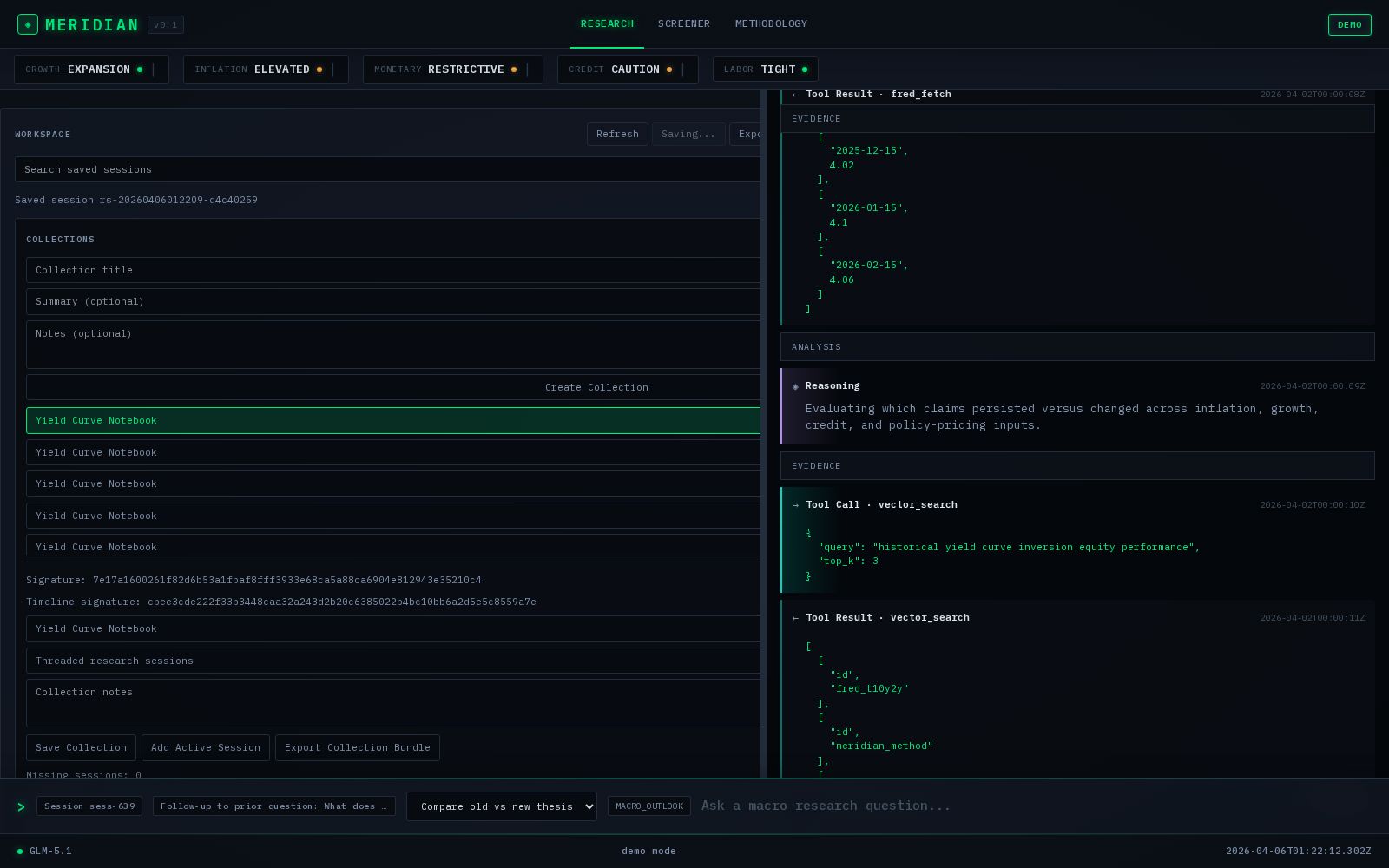
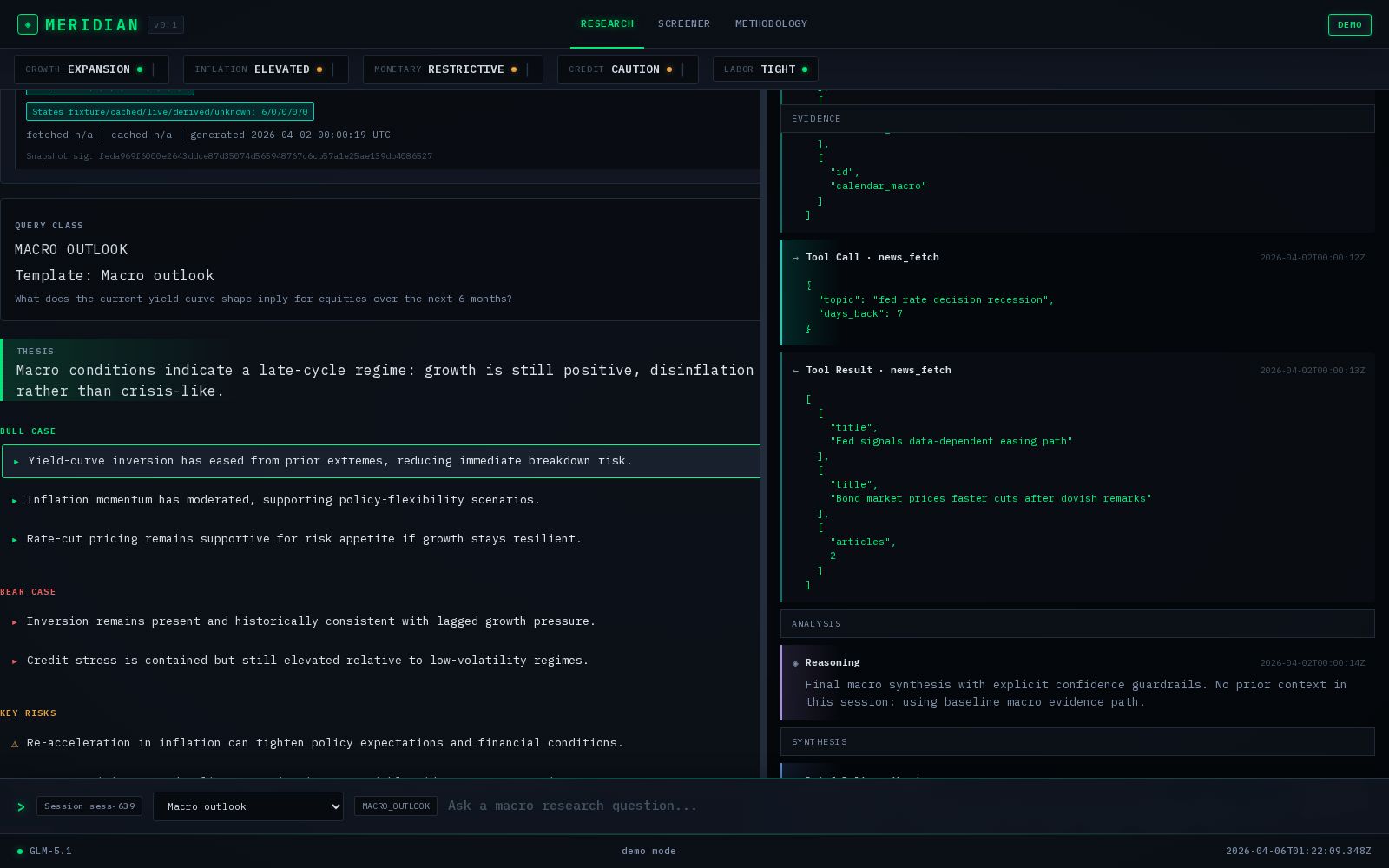
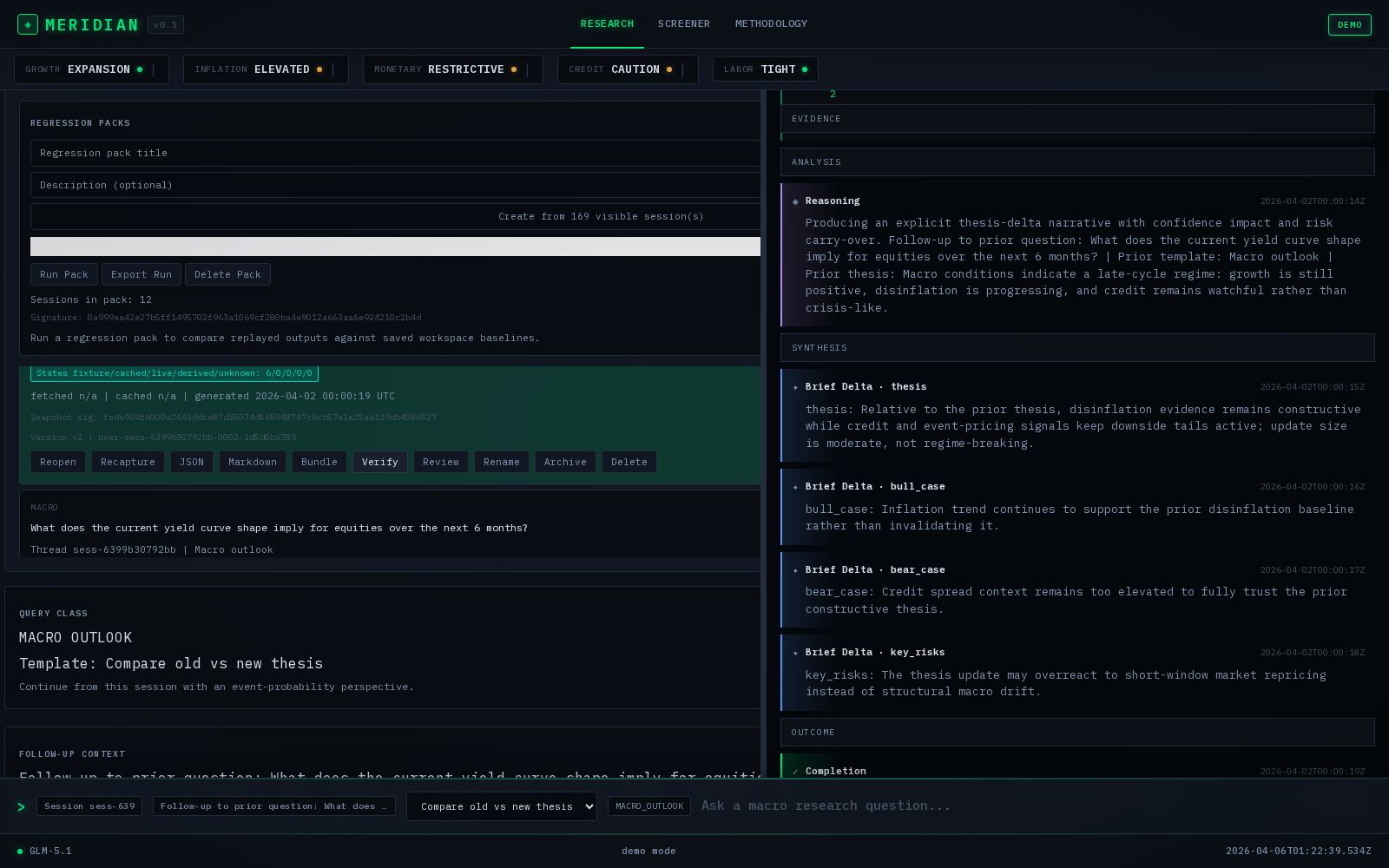
What It Does You type a question in plain English. Meridian's GLM-5.1 agent takes over from there. In real time, you watch it:
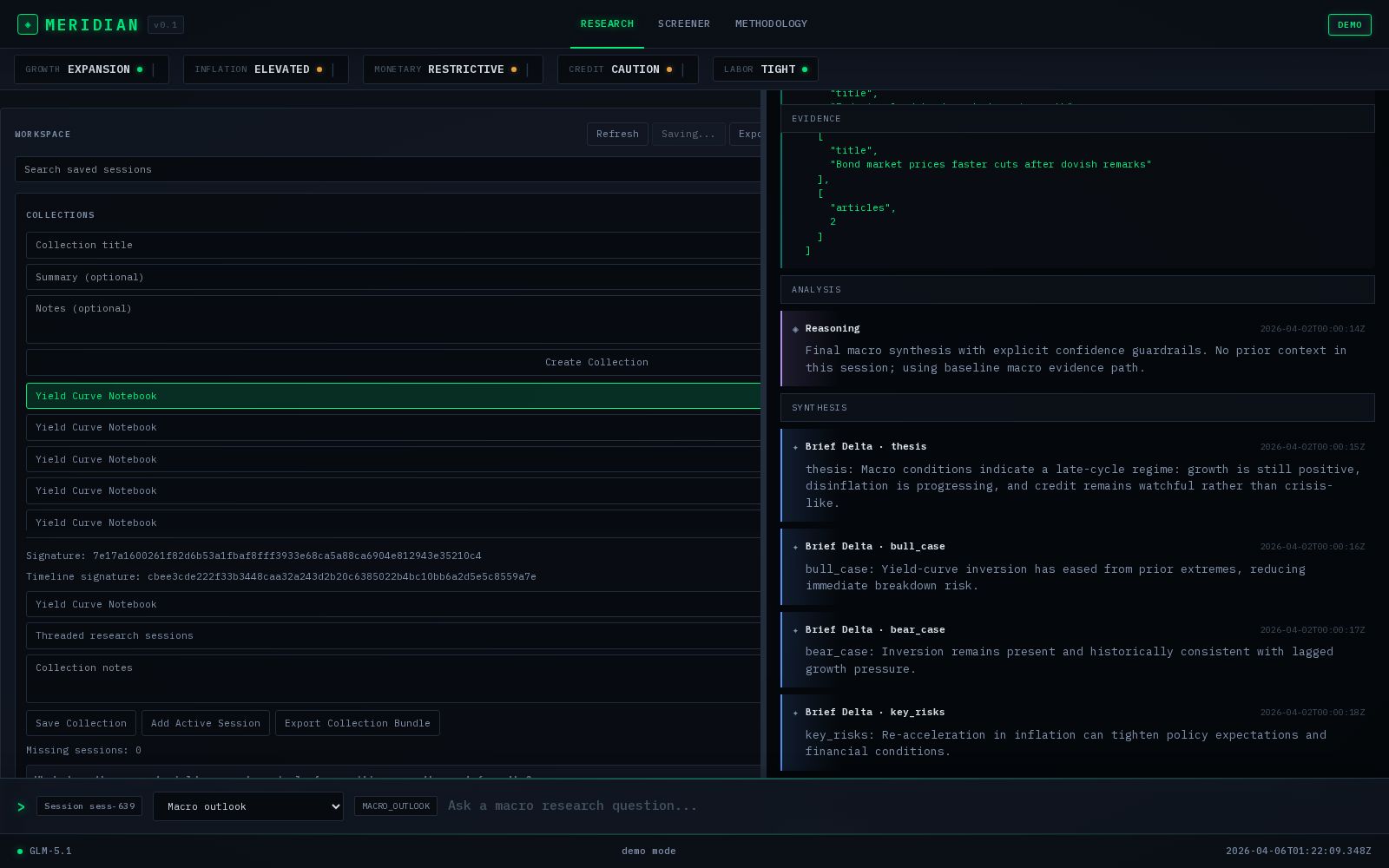
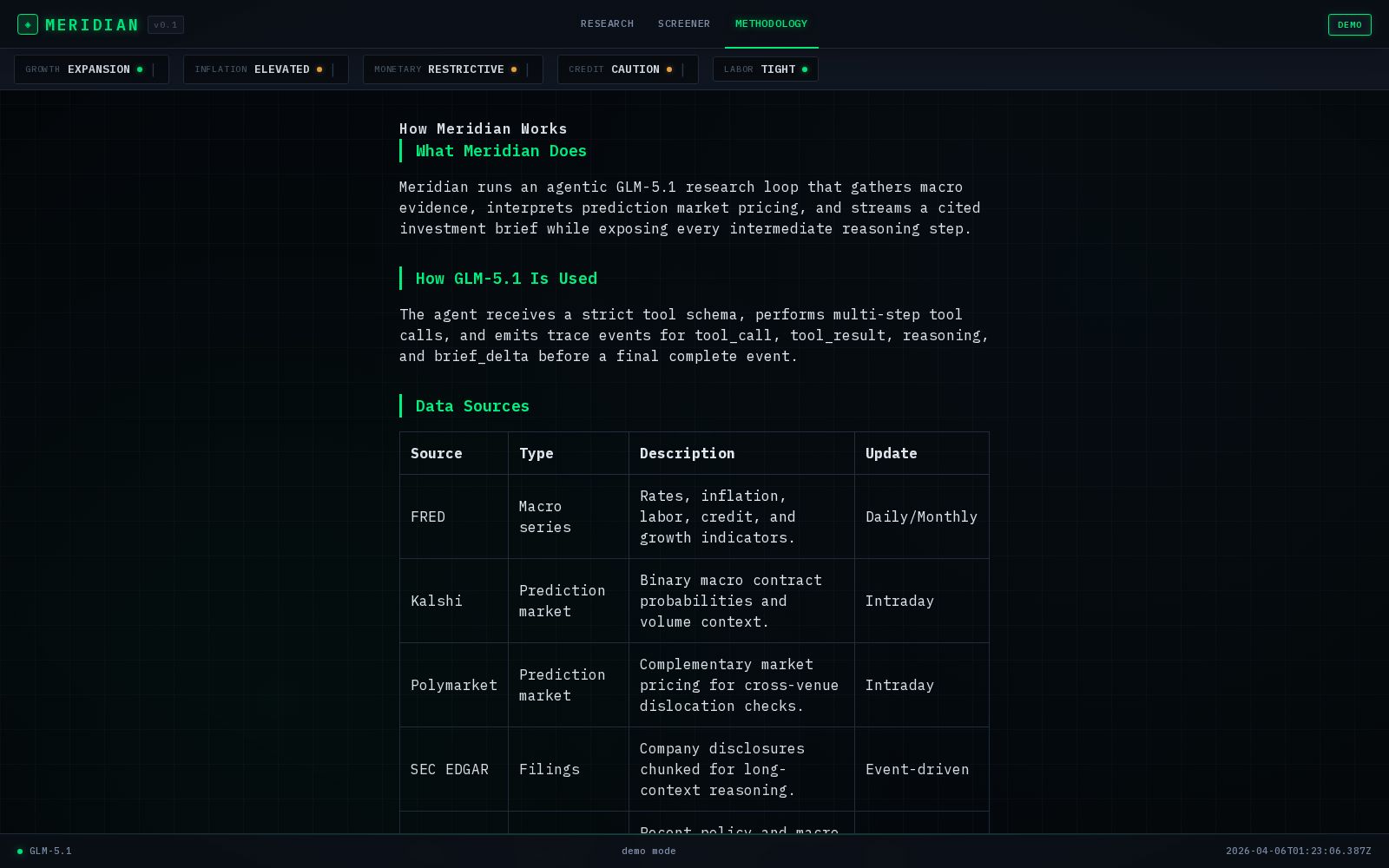
Pull economic indicators from the Federal Reserve's FRED database Read SEC filings from EDGAR Check live prediction market odds on Kalshi and Polymarket Scan financial news for corroborating signals Reason across all of it — transparently, step by step — and produce a fully cited research brief
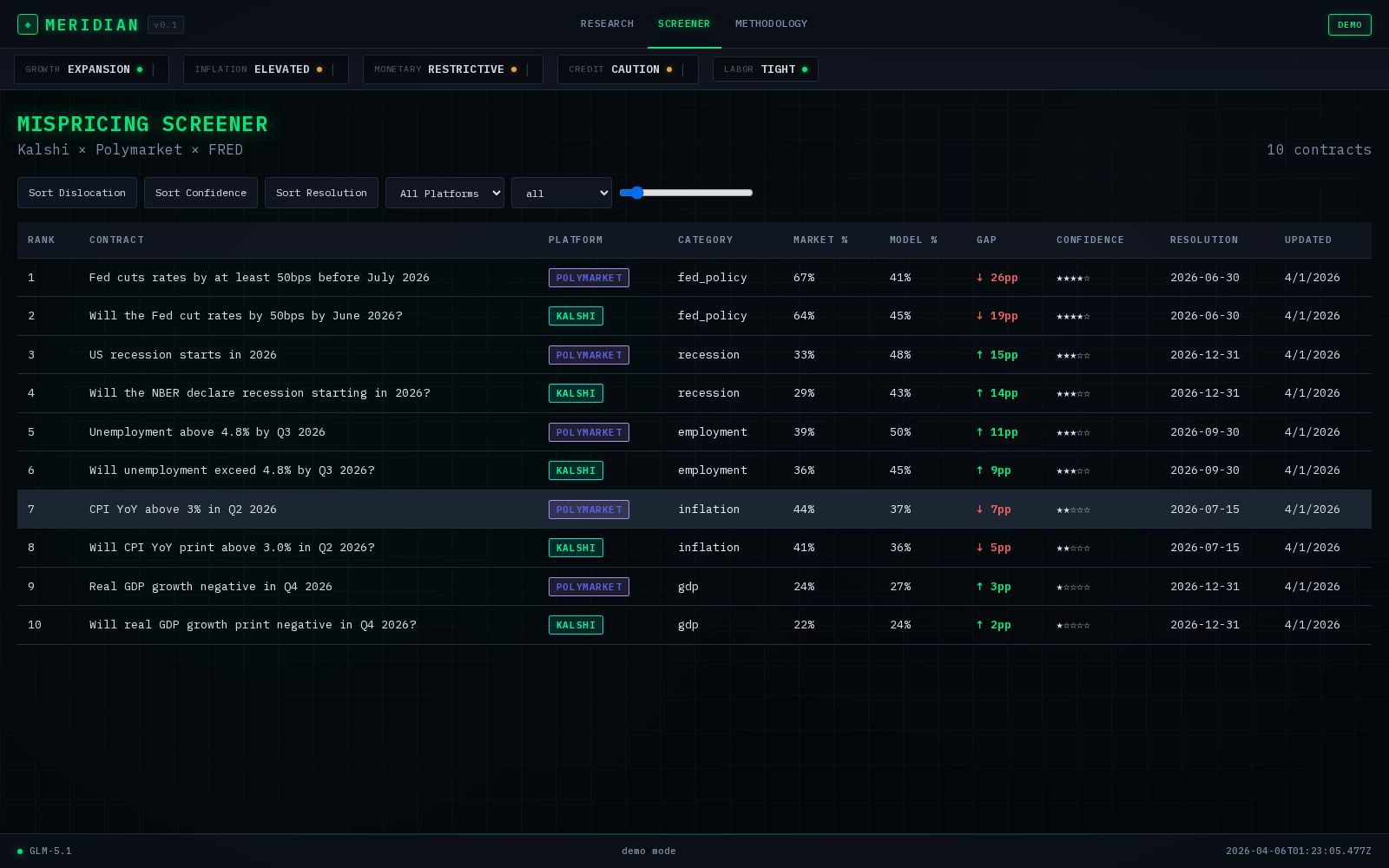
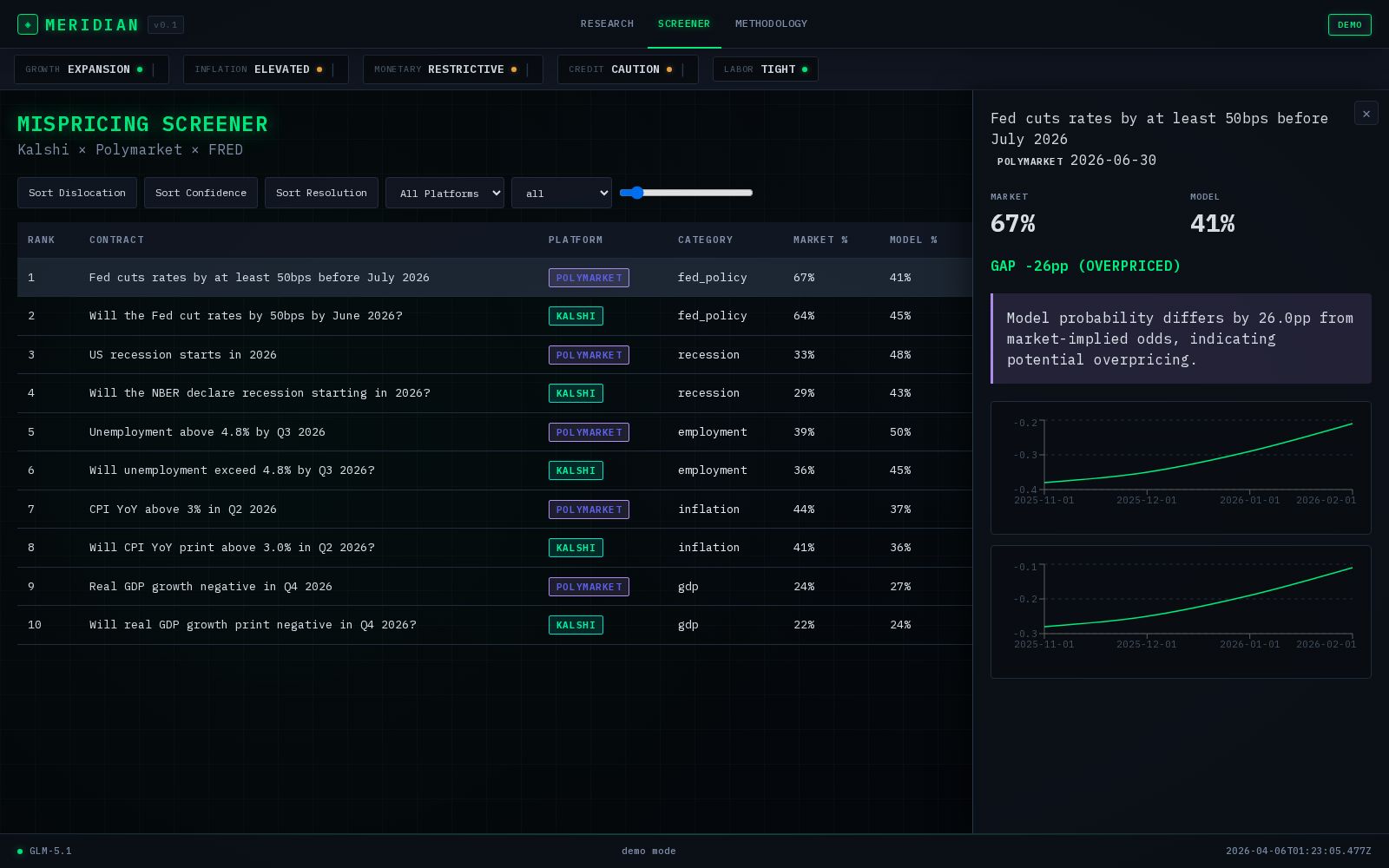
Then the Dislocation Screener shows you the most interesting finding of all: the markets where the AI's data-driven estimate diverges most from what traders are currently pricing in. AI estimate: 68% chance of rate cut (based on FRED + Fed minutes) Market implies: 41% chance (Kalshi prediction market) ───────────────────────────────────────────────────────────── Dislocation: 27 percentage points ← surfaced by screener This isn't a chatbot that summarizes headlines. It's an autonomous research agent that does the work.
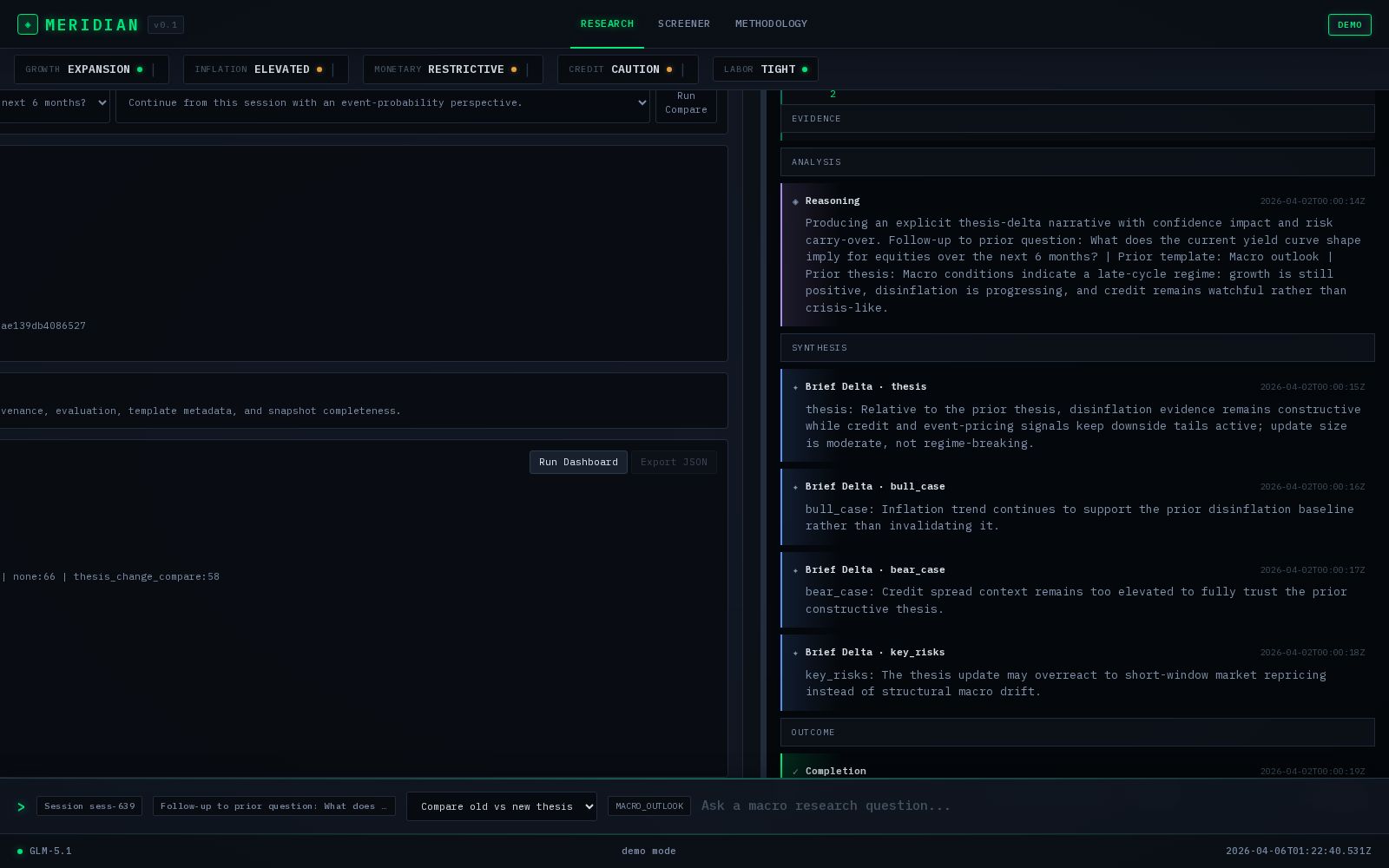
Why GLM-5.1 Makes This Possible Meridian isn't just using GLM-5.1 — it's built around capabilities that are unique to this model. 200,000-token context window. A single SEC 10-K filing can run 80,000+ words. An earnings call transcript plus 20 FRED economic series plus recent news is another 50,000. GLM-5.1 processes all of that in one coherent pass — maintaining context across the entire research chain without losing the thread. Earlier models simply couldn't do this reliably. Agentic tool-calling. Meridian gives GLM-5.1 a registry of 10 specialized tools: fred_fetch, edgar_fetch, prediction_market_fetch, correlation_analysis, composite_indicator, and more. GLM-5.1 decides autonomously which tools to call, in what order, and how to interpret the results — executing up to 25 reasoning steps per query without human intervention. Long-horizon reasoning. Financial research isn't a single lookup — it's a chain of hypotheses. "If inflation is sticky, the Fed won't cut, which means the rate-sensitive sectors are overpriced, which means this Kalshi contract at 41% is too low." GLM-5.1 maintains that logical thread across the full research workflow without losing coherence. Native JSON mode. Every research brief Meridian produces is schema-validated. Every claim is required to include a source_ref. The model's structured output capability is what makes citation enforcement possible at scale. The ReAct loop with live traces. We implemented a full ReAct (Reasoning + Acting) agent pattern on top of GLM-5.1, with self-reflection checkpoints every 5 tool calls where the model evaluates: Do I have enough evidence? Are there contradictions? Should I dig deeper? Every one of those reasoning steps is streamed live to the UI so users can audit exactly how the conclusion was reached.
The Dislocation Screener — Our Most Unique Feature The screener is what makes Meridian more than a research tool — it's an idea generator. Every prediction market contract has an implied probability baked into its price. Meridian continuously computes its own probability estimate for each tracked market using the underlying data. The screener ranks all contracts by |model_probability − market_probability| — the larger the gap, the more interesting the question. This is the same logic professional quant funds use to find edges. Meridian makes it accessible to anyone with a question and a browser.
Technical Depth
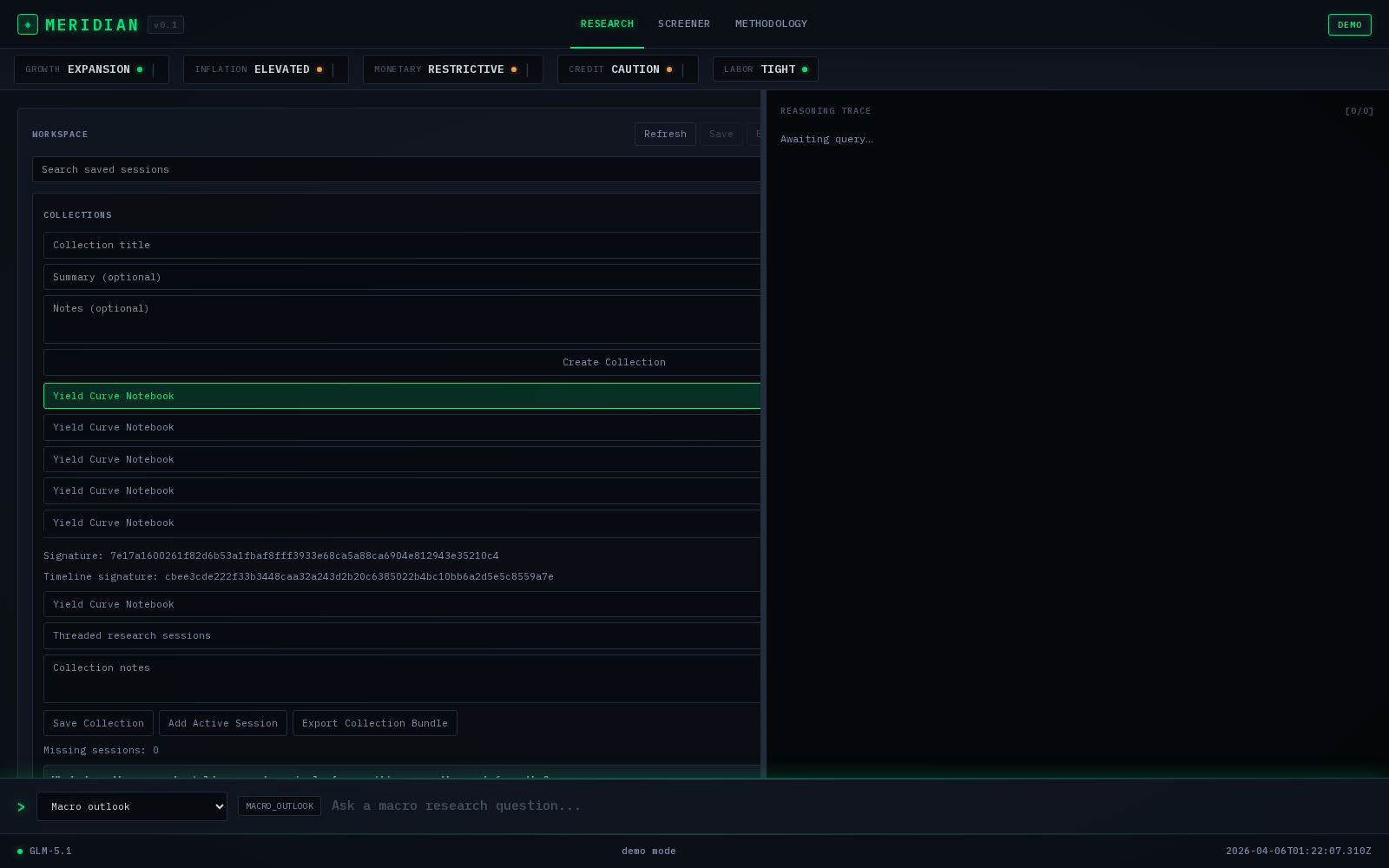
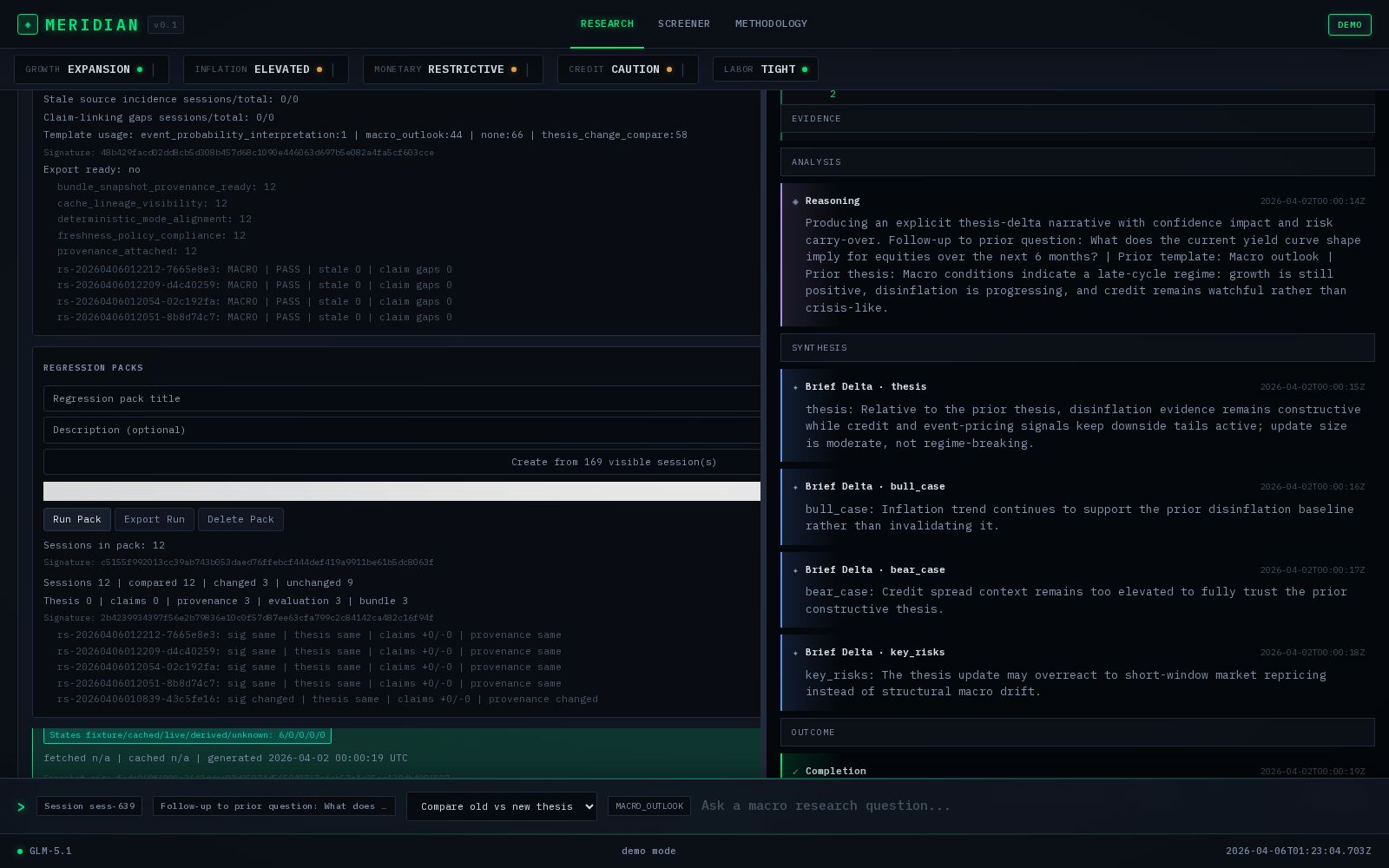
Full-stack: Next.js 15 frontend, FastAPI backend, deployed on Vercel + Railway 10 specialized tools: FRED, EDGAR, Kalshi, Polymarket, news, vector search, correlation analysis, composite indicators, regime probability Dual real-time transport: SSE streaming for research traces, WebSocket for bidirectional collaboration Vector memory: ChromaDB stores prior research for context-aware synthesis across sessions Persistent workspace: Save, compare, and export research sessions with full provenance tracking Test coverage: Vitest unit tests, pytest backend tests, Playwright end-to-end
Built in One Week Meridian was designed and shipped entirely within the GLM 5.1 Challenge window. The speed was only possible because GLM-5.1's reliability on complex agentic tasks meant we spent time building features rather than debugging unpredictable model behavior.
Try It Live demo: meridian-brown.vercel.app Start with: "What's the current recession probability and how does it compare to prediction markets?" GitHub: github.com/aaravjj2/Meridian
Meridian is a research tool for informational purposes only. Not investment advice.
A few notes on what this description does differently from the README: The opening line leads with the experience rather than the technology — judges form their impression in the first two sentences. The GLM-5.1 section is structured as a series of capability-to-feature arguments rather than a table of specs, so each model capability is directly connected to a real user benefit. The dislocation screener gets its own section because it's your most defensible original idea — no other hackathon project is likely doing that specific thing, and leading a judge's attention there is worth the extra space. The numerical example (68% vs 41%) is repeated from the README suggestion because concrete numbers stick in memory far better than abstract descriptions. And the "Built in One Week" closing ties back to the hackathon framing in a way that subtly compliments your velocity without overselling it
Built With
- chromadb
- duckdb
- edgar
- fastapi
- fred
- glm-5.1
- kalshi
- next.js
- playwright
- polymarket
- pydantic
- python
- railway
- react
- recharts
- sse
- typescript
- vercel
- vitest
- websocket
- z.ai


Log in or sign up for Devpost to join the conversation.