Meridian — Autonomous Month-End Close
Meridian is an autonomous month-end close system for the Office of the CFO.
AI investigates. Code verifies. Controller decides.
The problem
Month-end close is not finished when two spreadsheets appear to balance. Controllers still need to establish which source is authoritative, explain differences, apply policy, review corrections, and preserve evidence when source data changes late.
Most automation systems optimize for a green status. Meridian is designed to know when it must stop.
What Meridian does
Meridian connects source evidence, intercompany ledgers, accounting policy, approvals, workpapers, and audit history in one reviewable workflow.
It can:
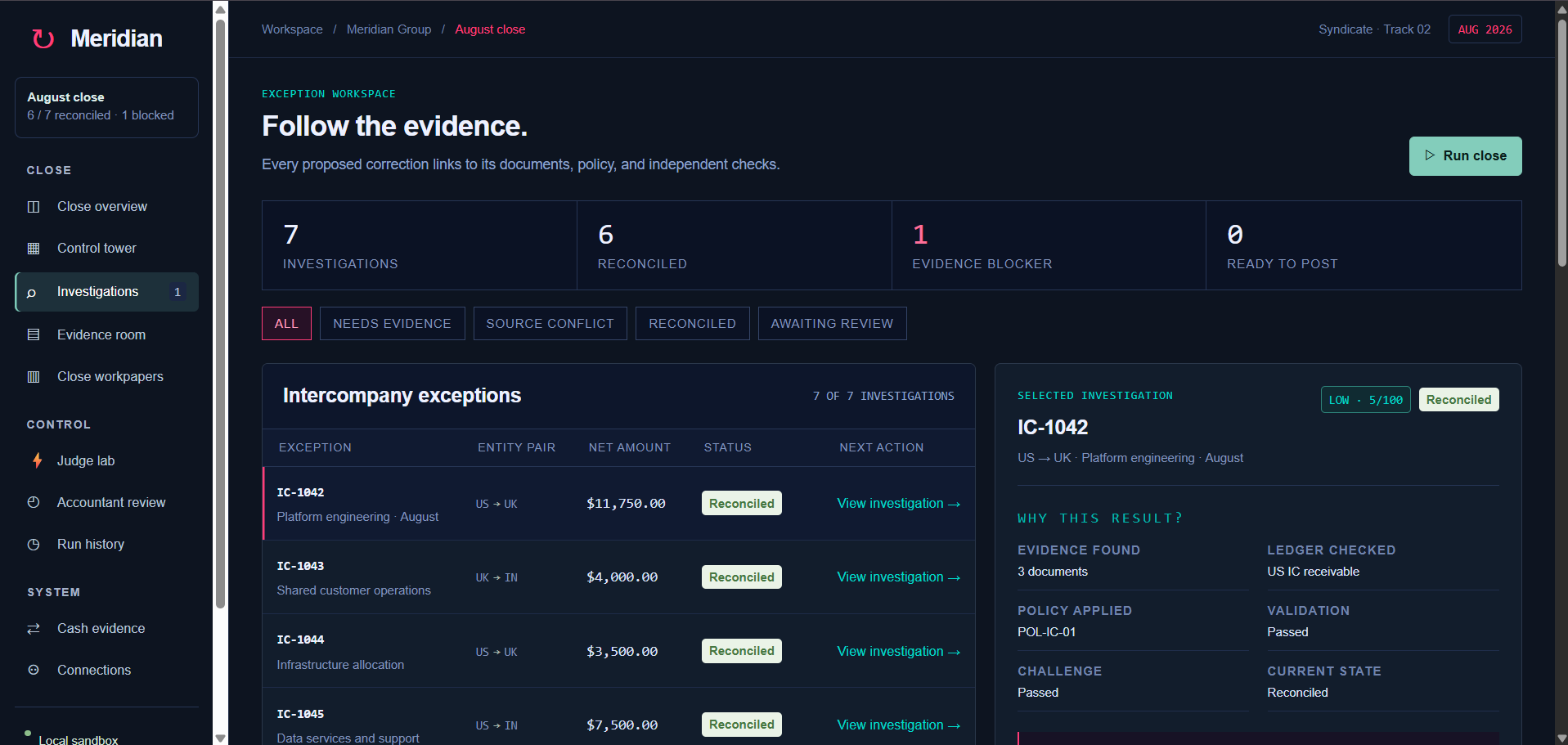
- investigate intercompany invoice differences
- reconcile seller and buyer balances
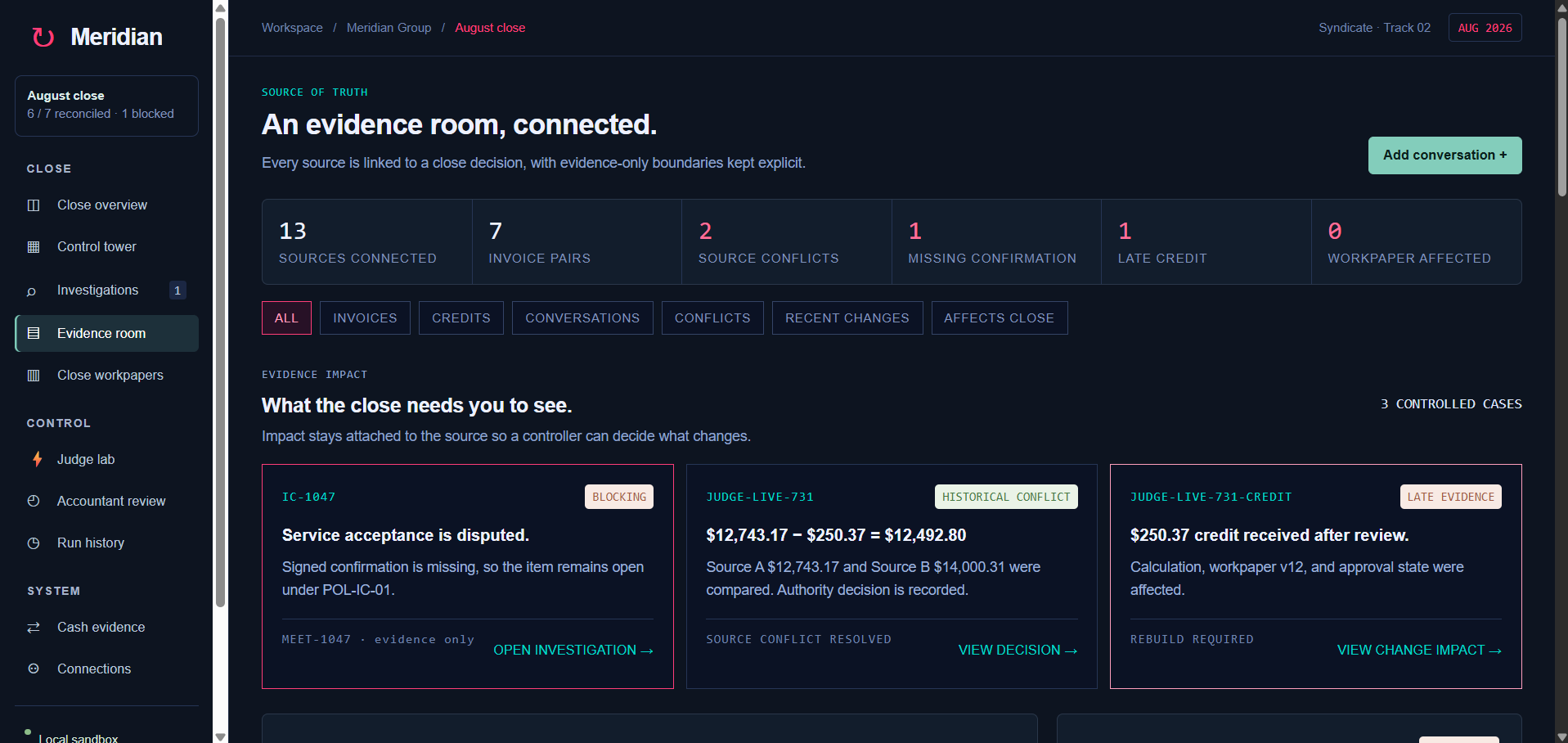
- detect missing, duplicate, disputed, or incorrectly booked items
- calculate proposed corrections using integer money and explicit policy rates
- independently validate every proposed entry
- detect conflicting or stale evidence
- require controller approval before posting
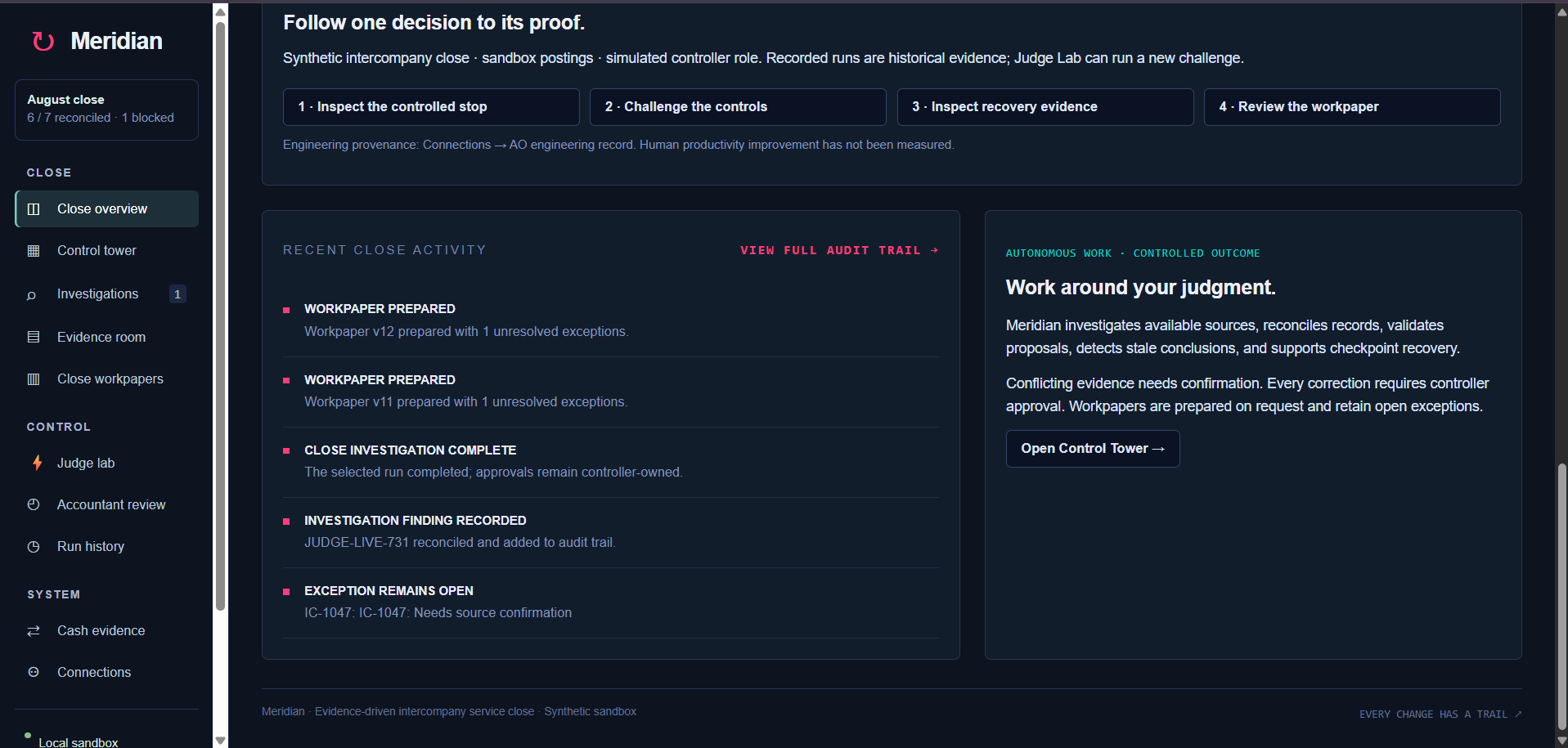
- preserve historical journals and audit events
- resume interrupted work from checkpoints
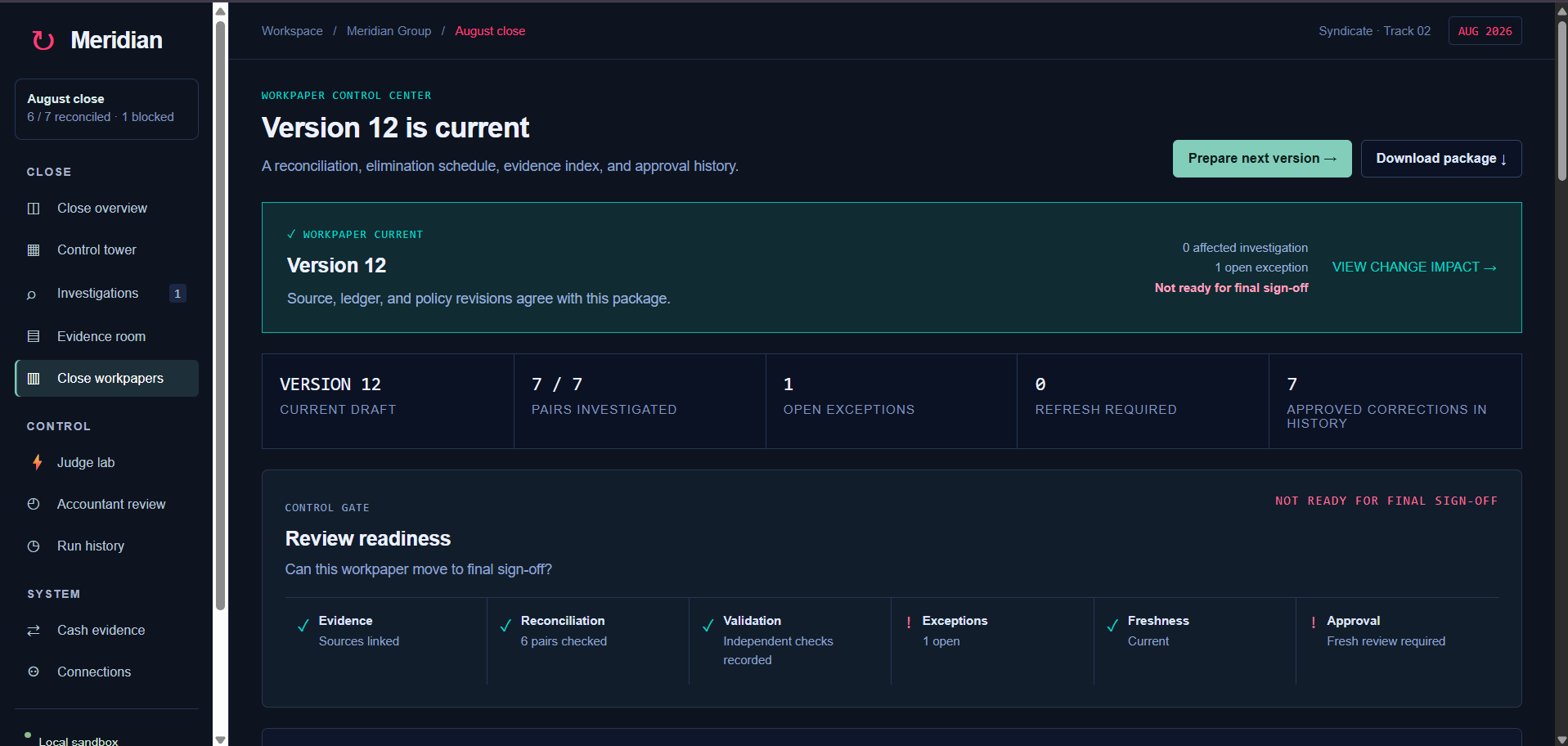
- prepare versioned workpapers with unresolved exceptions clearly shown
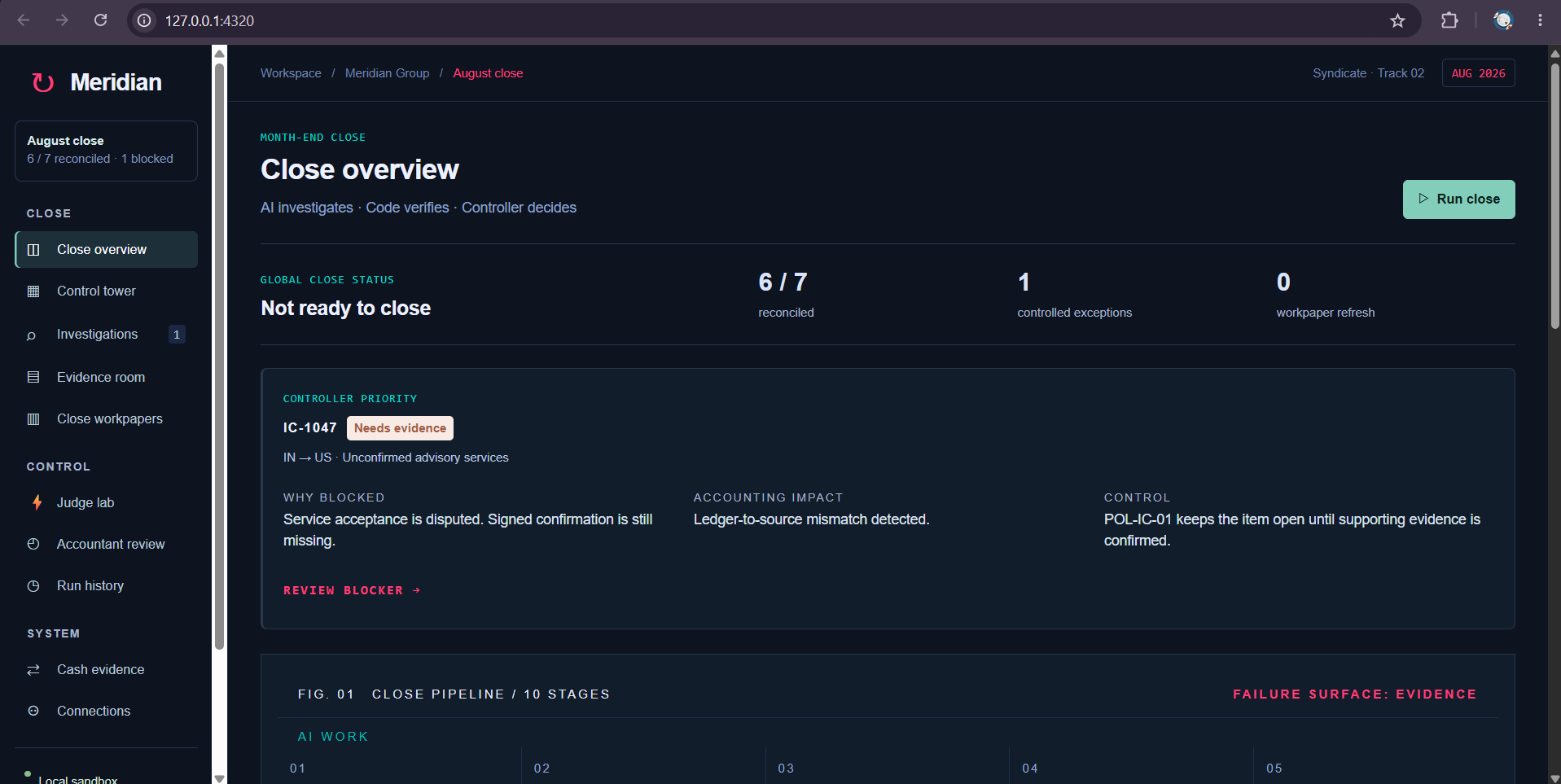
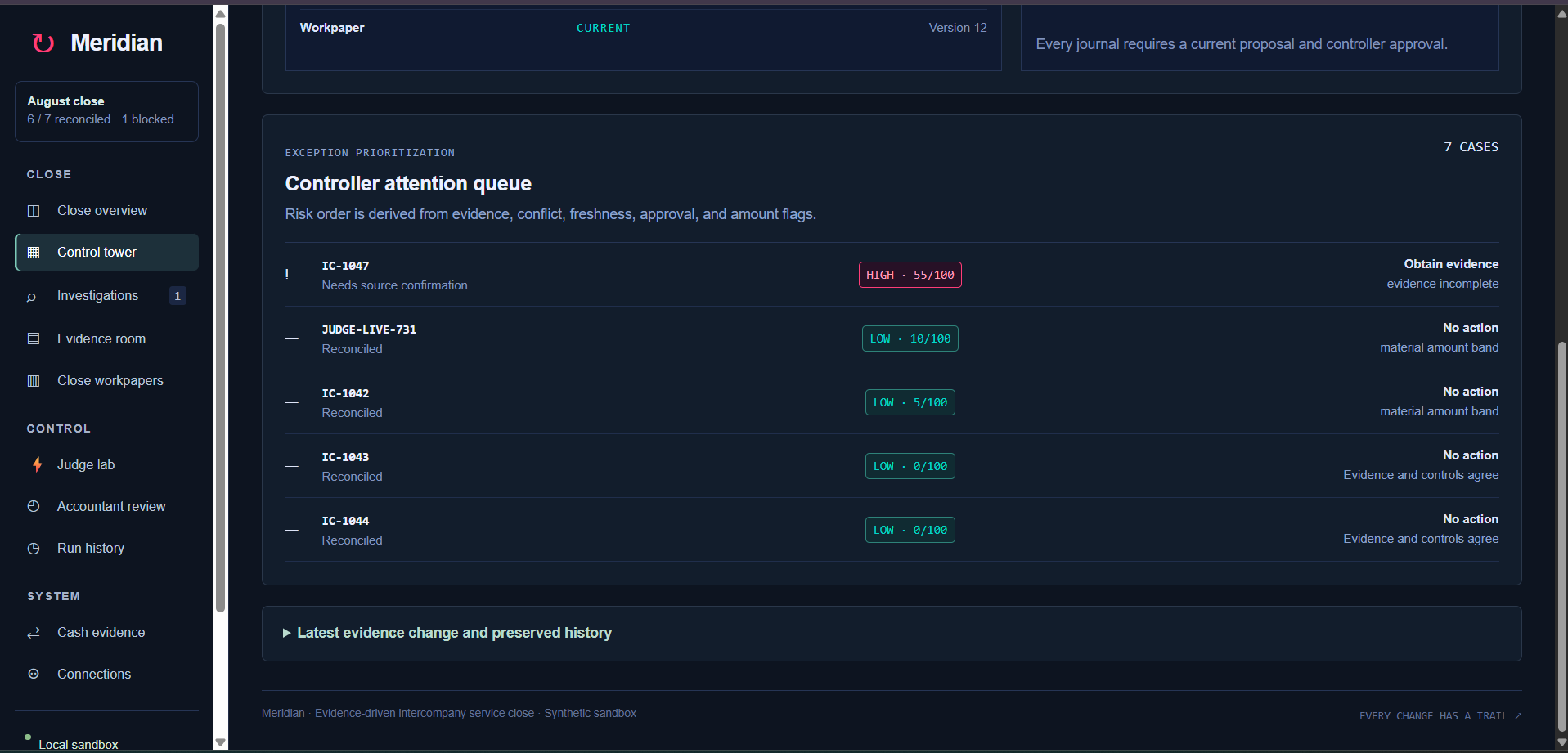
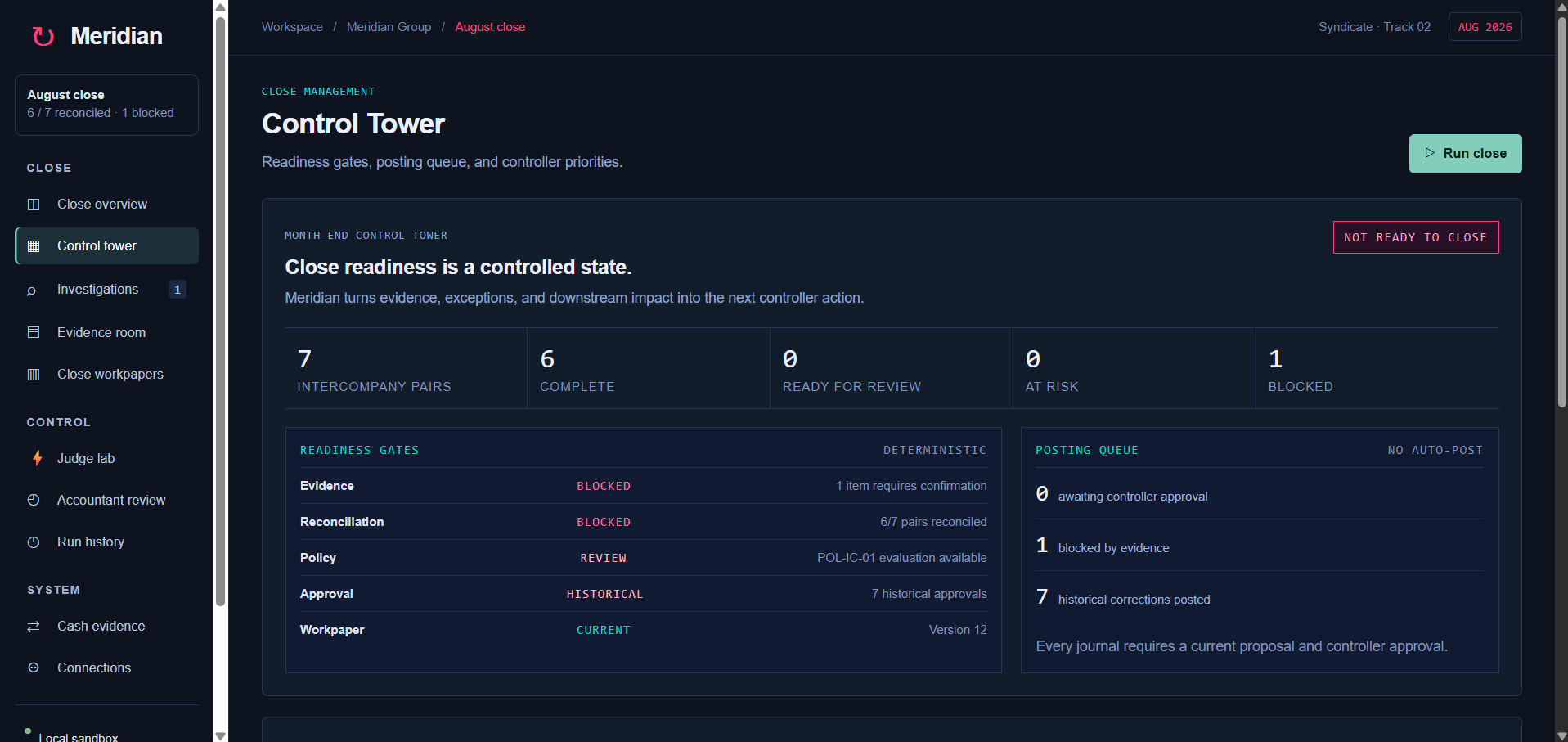
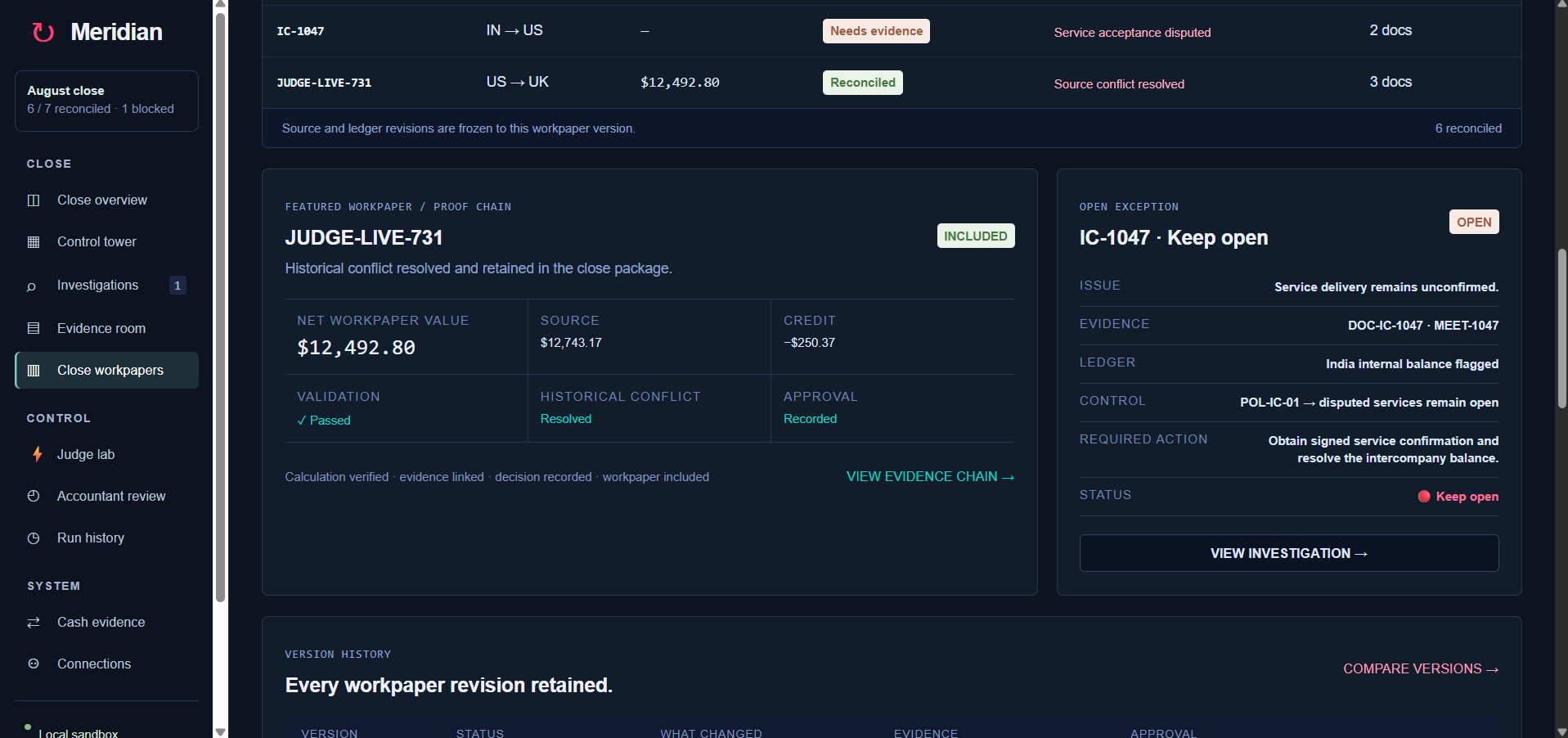
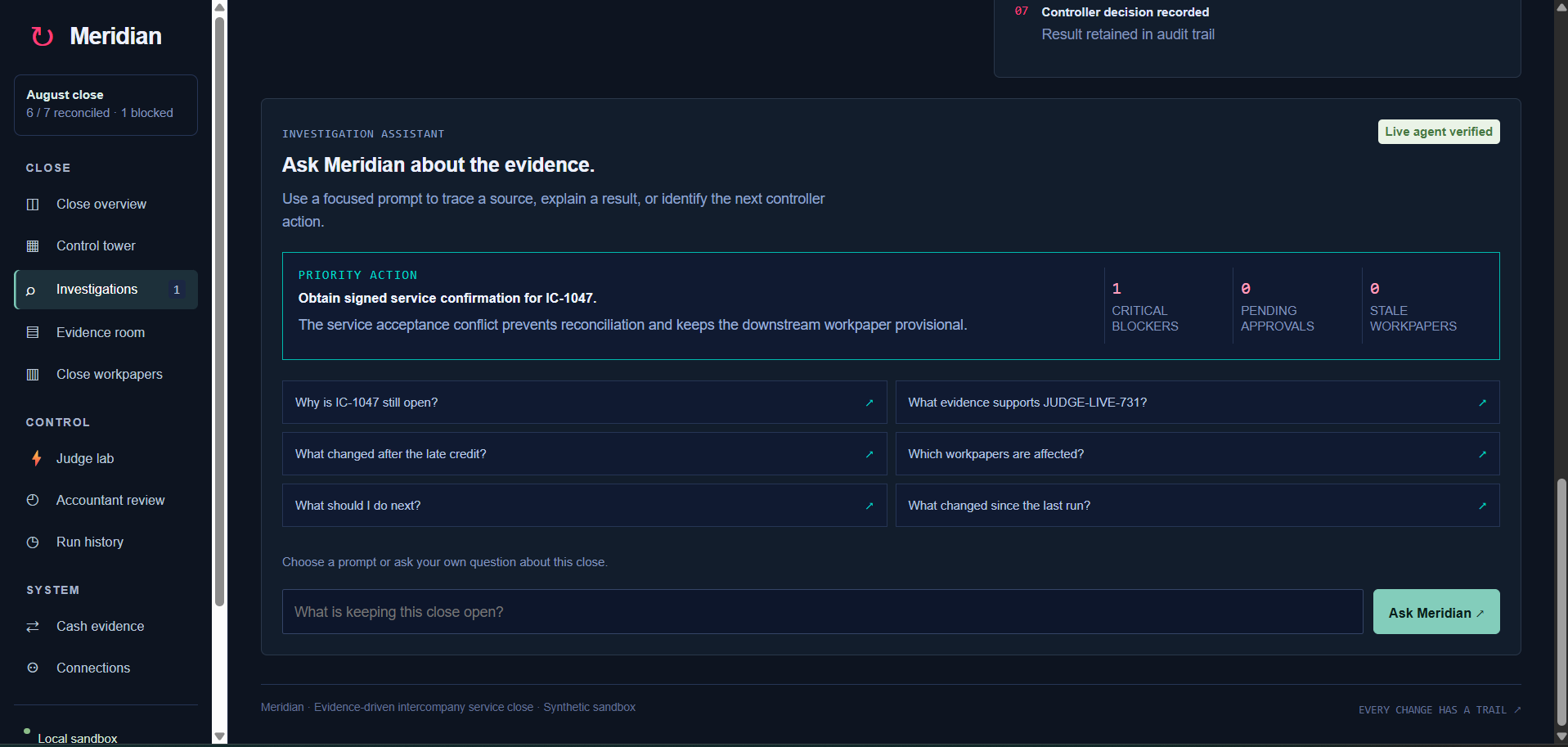
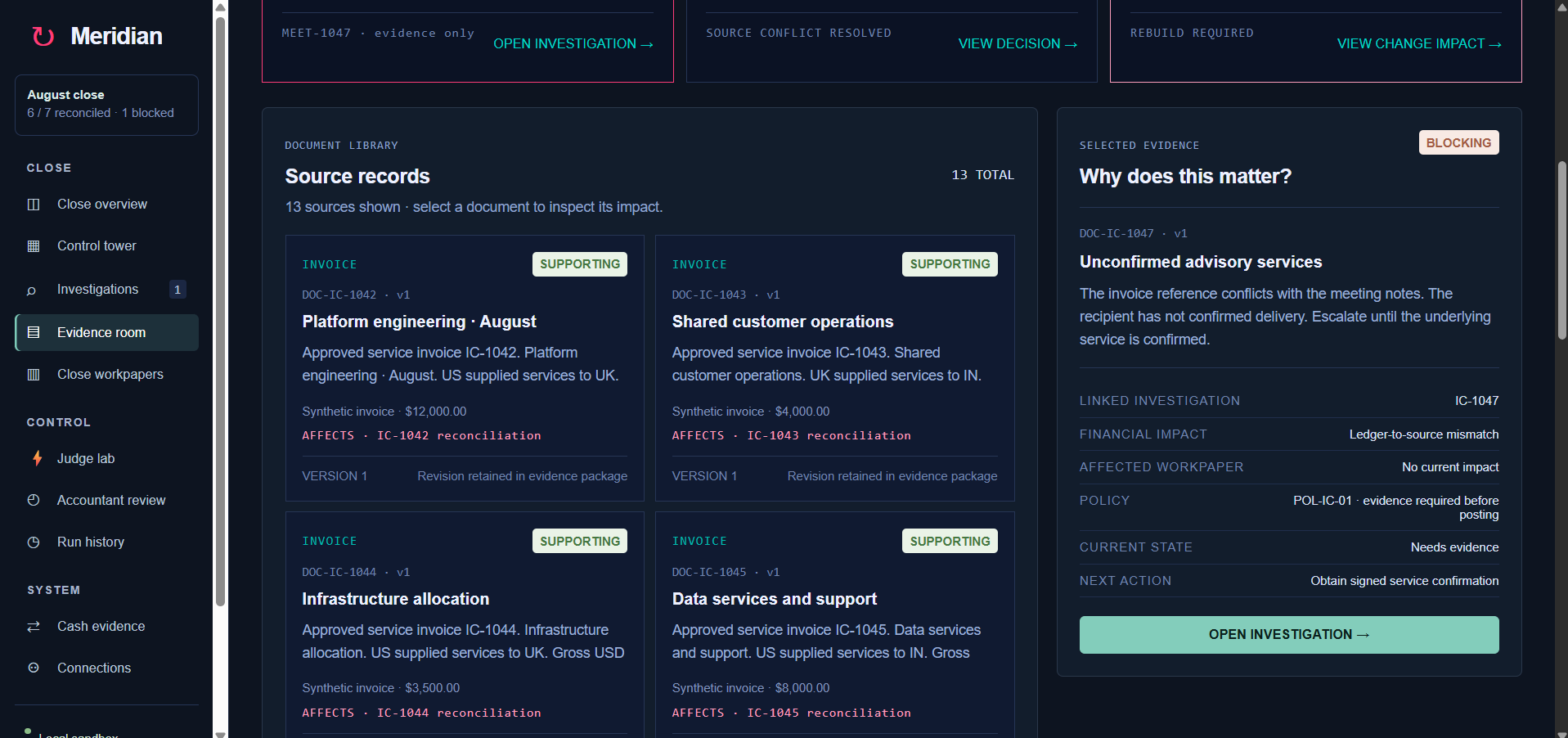
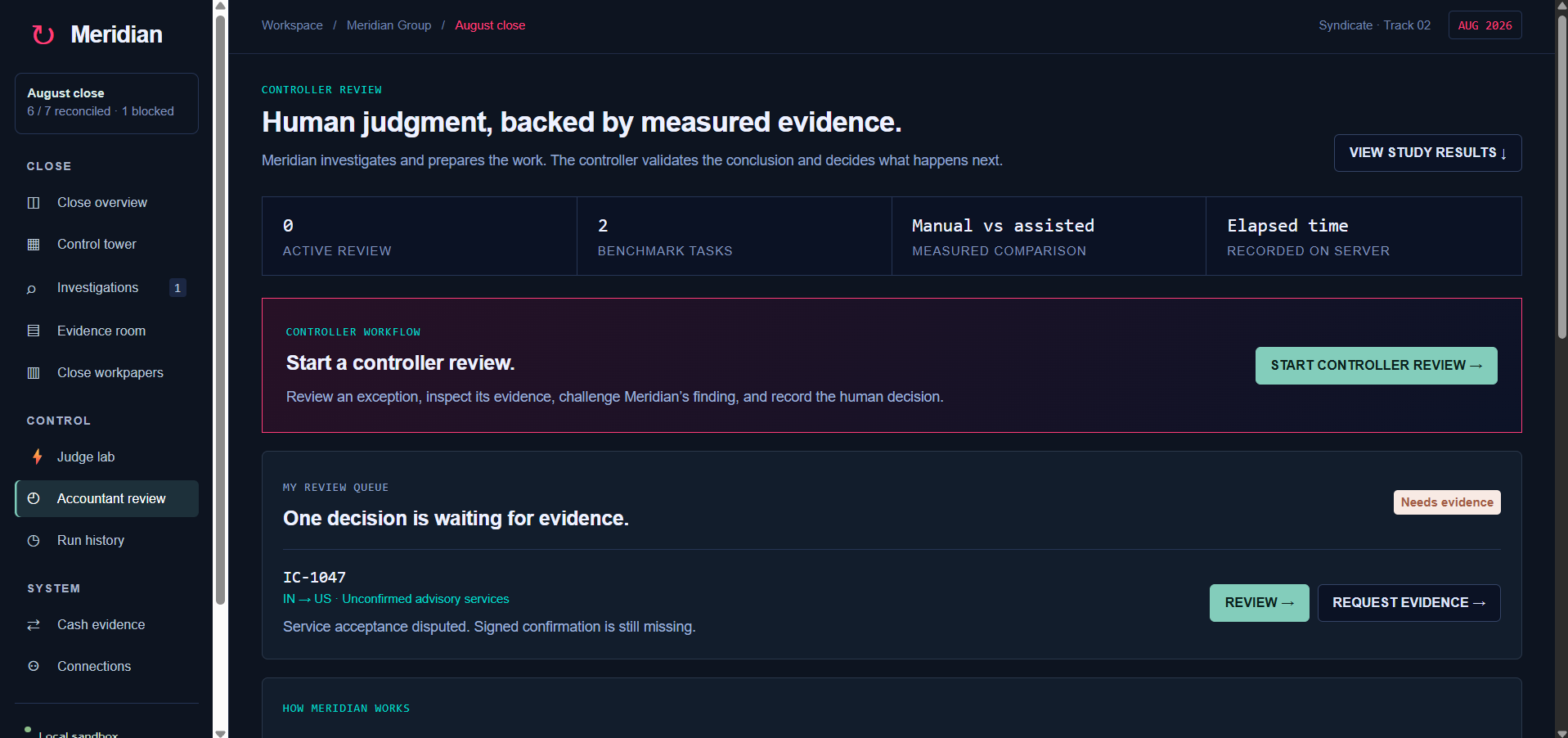
The current synthetic August close has six of seven pairs reconciled. IC-1047 remains open because service acceptance is disputed and signed confirmation is missing. Meridian keeps that uncertainty visible instead of converting it into an unsupported posting.
The control boundary
The investigator can read evidence, ledger data, and policy and prepare a finding. It cannot approve itself, change accounting policy, or post to the ledger.
Posting requires:
- a current proposal
- independent deterministic validation
- a current evidence revision
- a simulated controller approval
This creates a clear separation:
- AI proposes
- Code verifies
- Evidence supports
- Controller approves judgment
Judge Lab
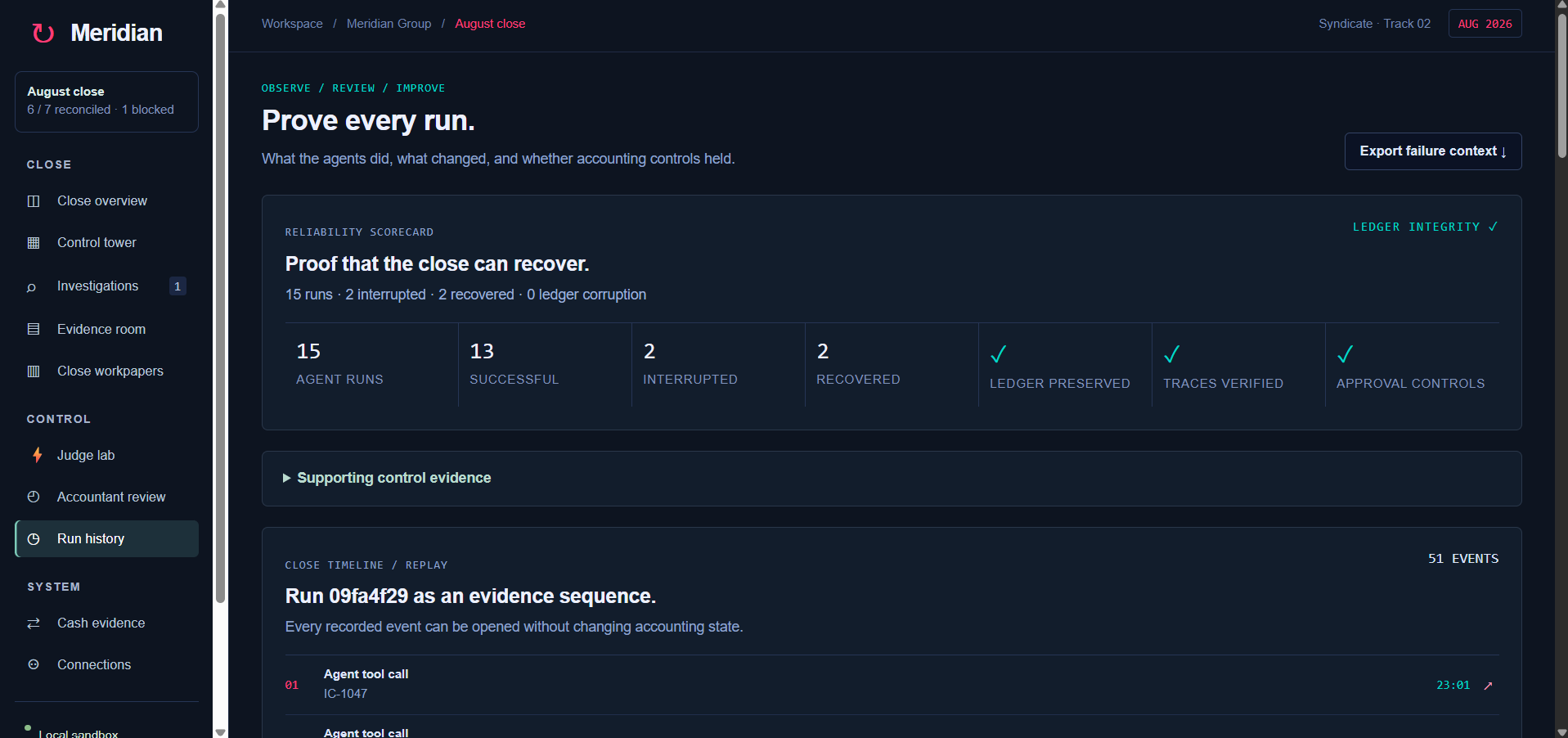
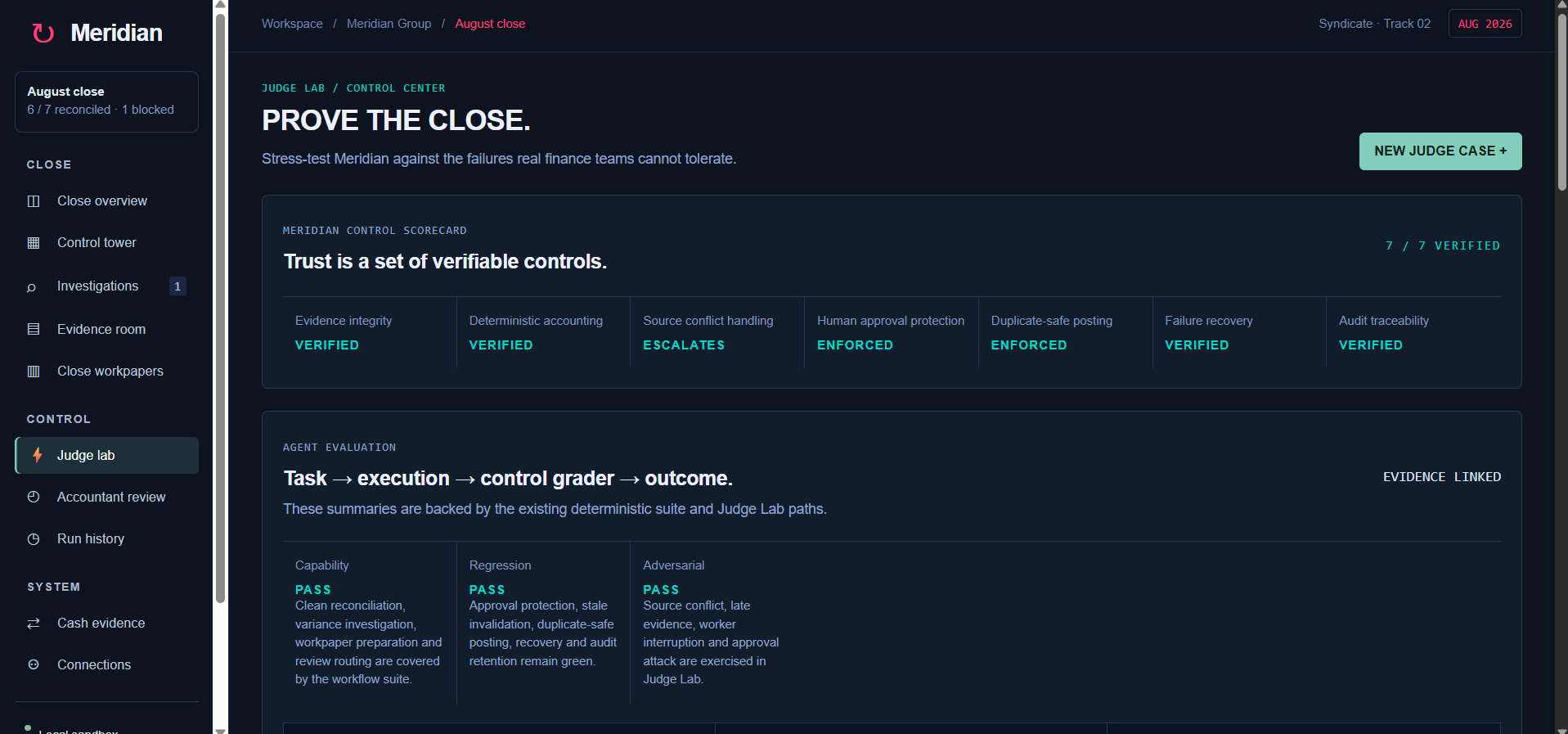
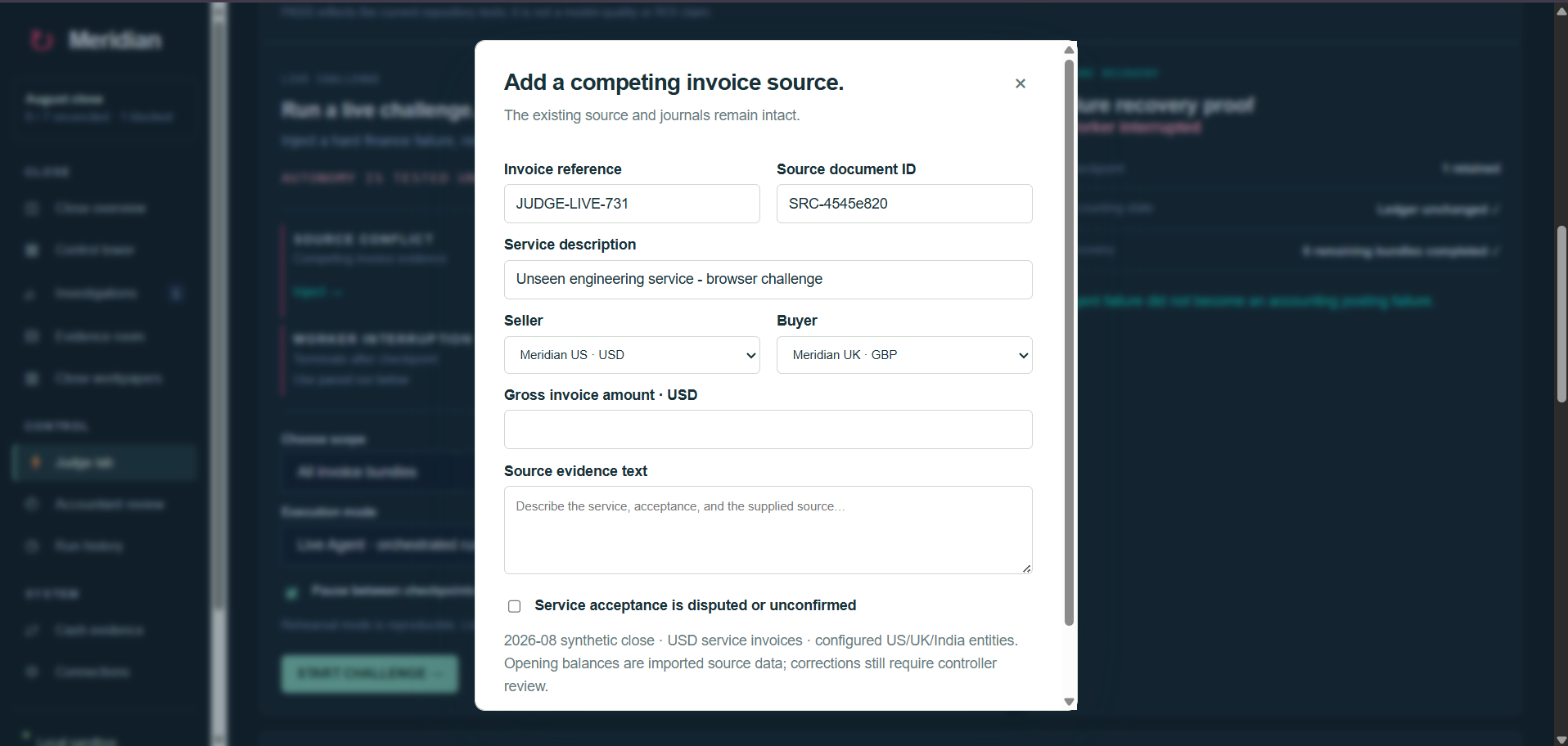
Judge Lab is the validation console for failure scenarios.
It demonstrates:
- competing source invoices
- explicit controller source selection
- late credits that invalidate downstream state
- worker interruption and checkpoint recovery
- duplicate-safe approval and posting
- preserved journals and audit history
The goal is not to claim that software never fails. The goal is to ensure that a failure does not silently become an accounting error.
How it was built
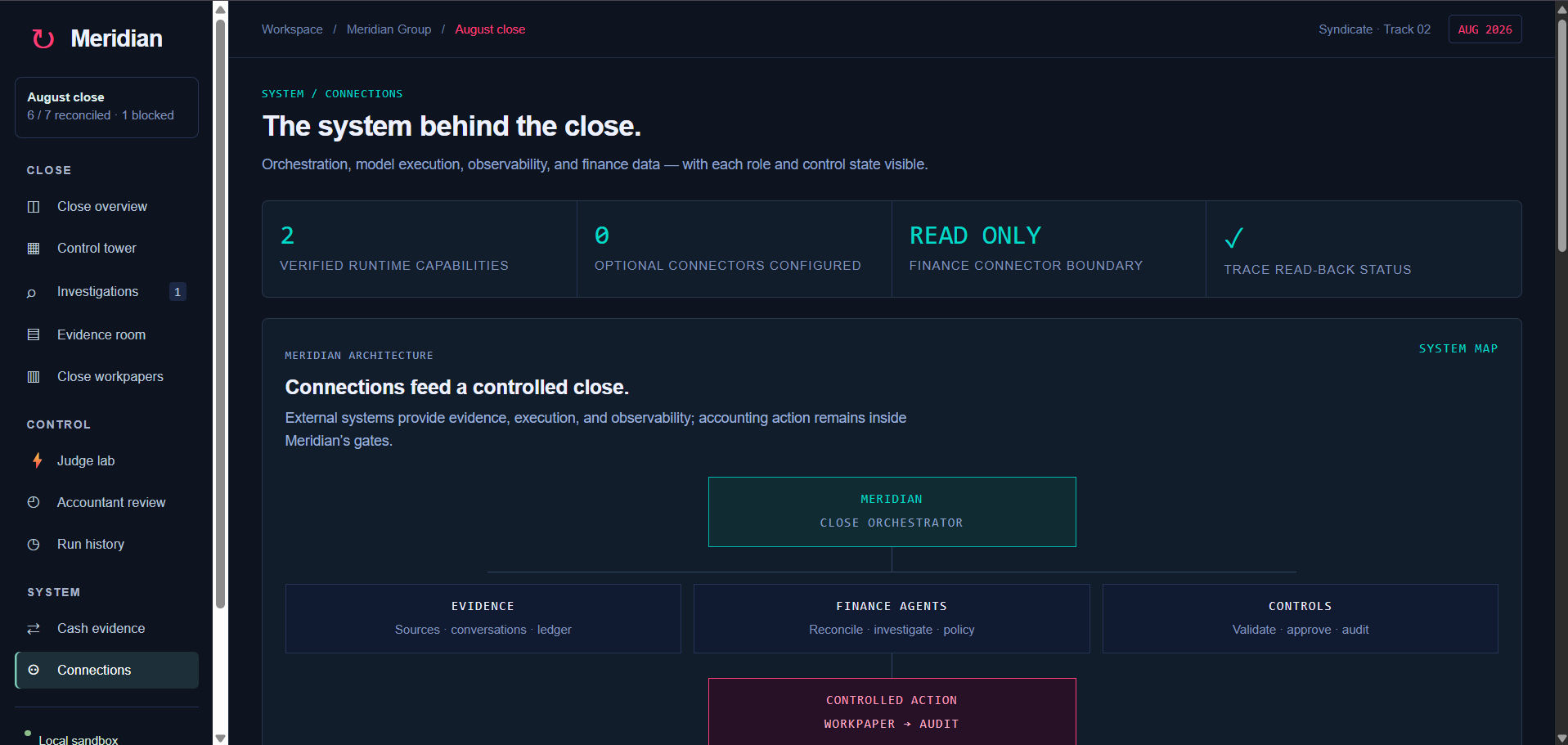
Meridian is a local Node.js application with a browser interface, SQLite persistence, an isolated worker process, deterministic accounting and validation modules, and an AI SDK tool-using investigator.
TensorMux provides the compatible live model endpoint. Neatlogs provides optional observability; selected traces were verified by authenticated read-back. Agent Orchestrator was used as the engineering operating plane for design checkpoints, scoped hardening work, acceptance criteria, and review evidence. AO is not the finance runtime.
Engineering proof
The release includes:
- 103 automated tests
- 30/30 held-out arithmetic and validator cases
- 7/7 Judge Lab control invariants
- approval guardrails
- duplicate-safe posting
- stale-evidence invalidation
- checkpoint and recovery tests
- evidence and audit persistence
These are synthetic sandbox controls, not a claim of statutory accounting certification or production ERP deployment.
What I learned
The hardest part was preserving the controller’s decision boundary while still automating useful work. A balanced journal is not necessarily a correct journal, and a fresh-looking workpaper is not safe if its evidence changed underneath it.
Meridian’s central principle became:
Meridian knows when to act, when to ask for evidence, and when it must stop.
Built With
- agent
- ai
- api
- automated
- css
- html
- javascript
- neatlogs
- node.js
- orchestrator
- rest
- sdk
- sqlite
- tensormux

Log in or sign up for Devpost to join the conversation.