-
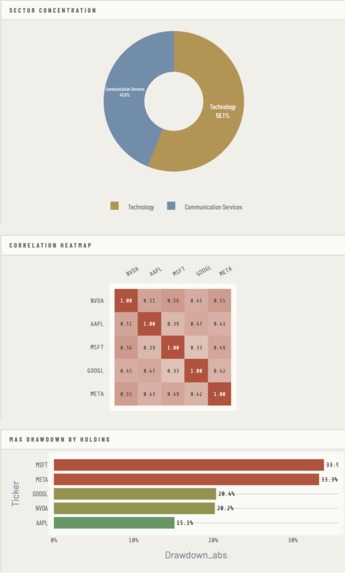
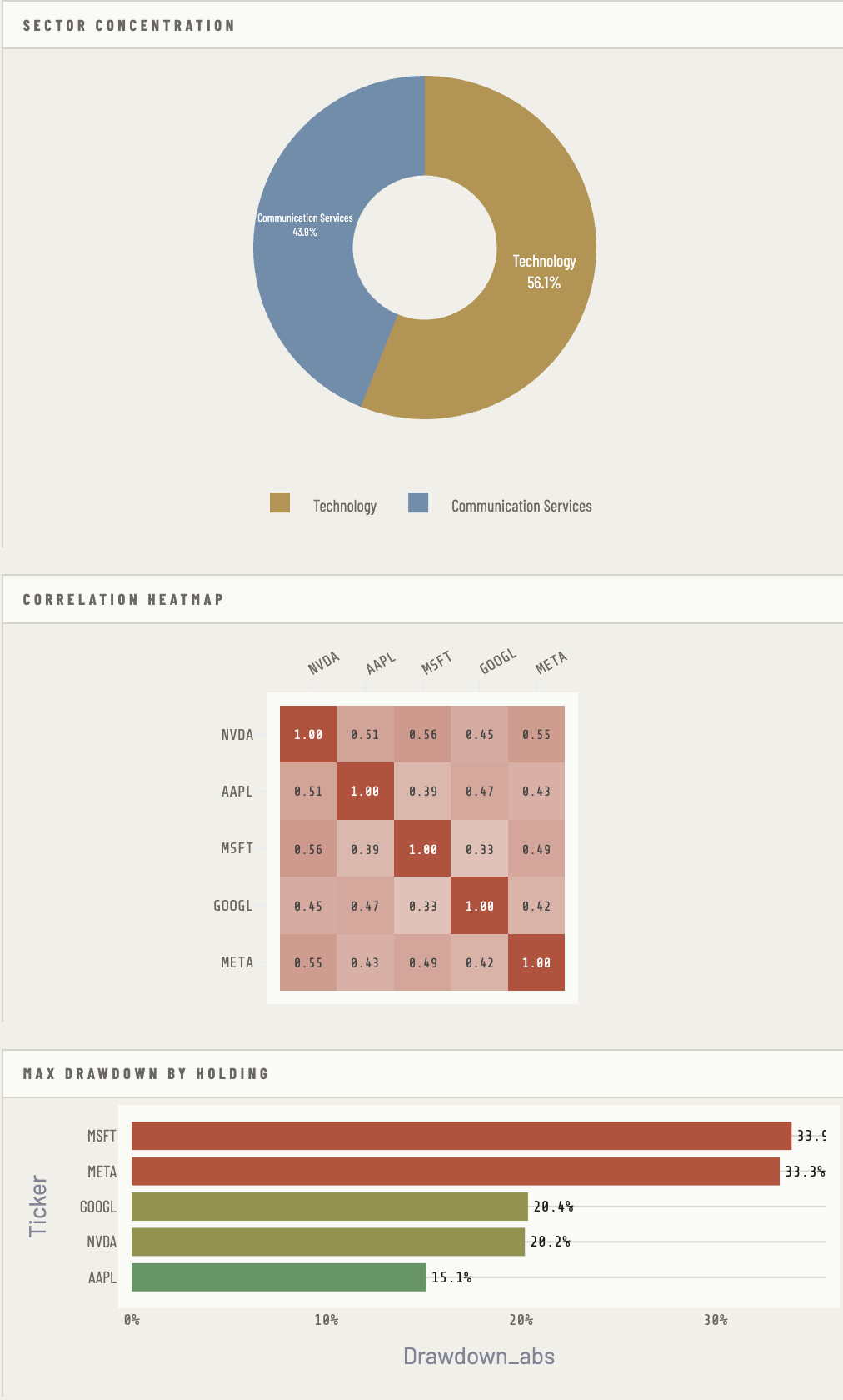
Graphes providing visuals for math calculations
-
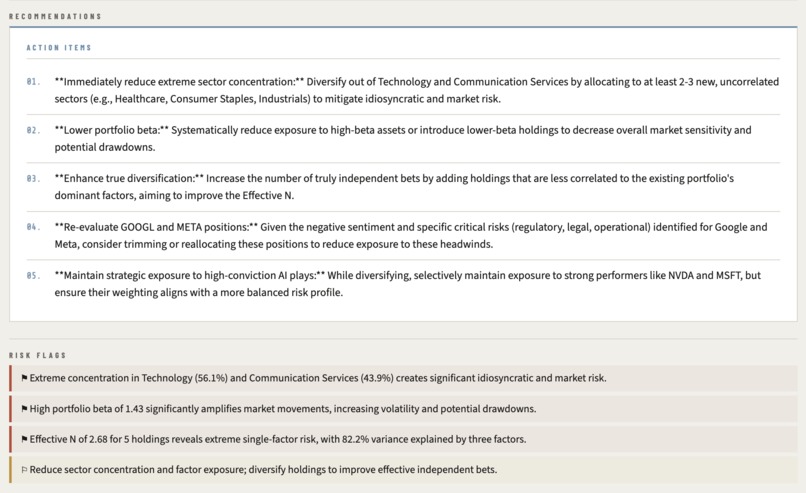
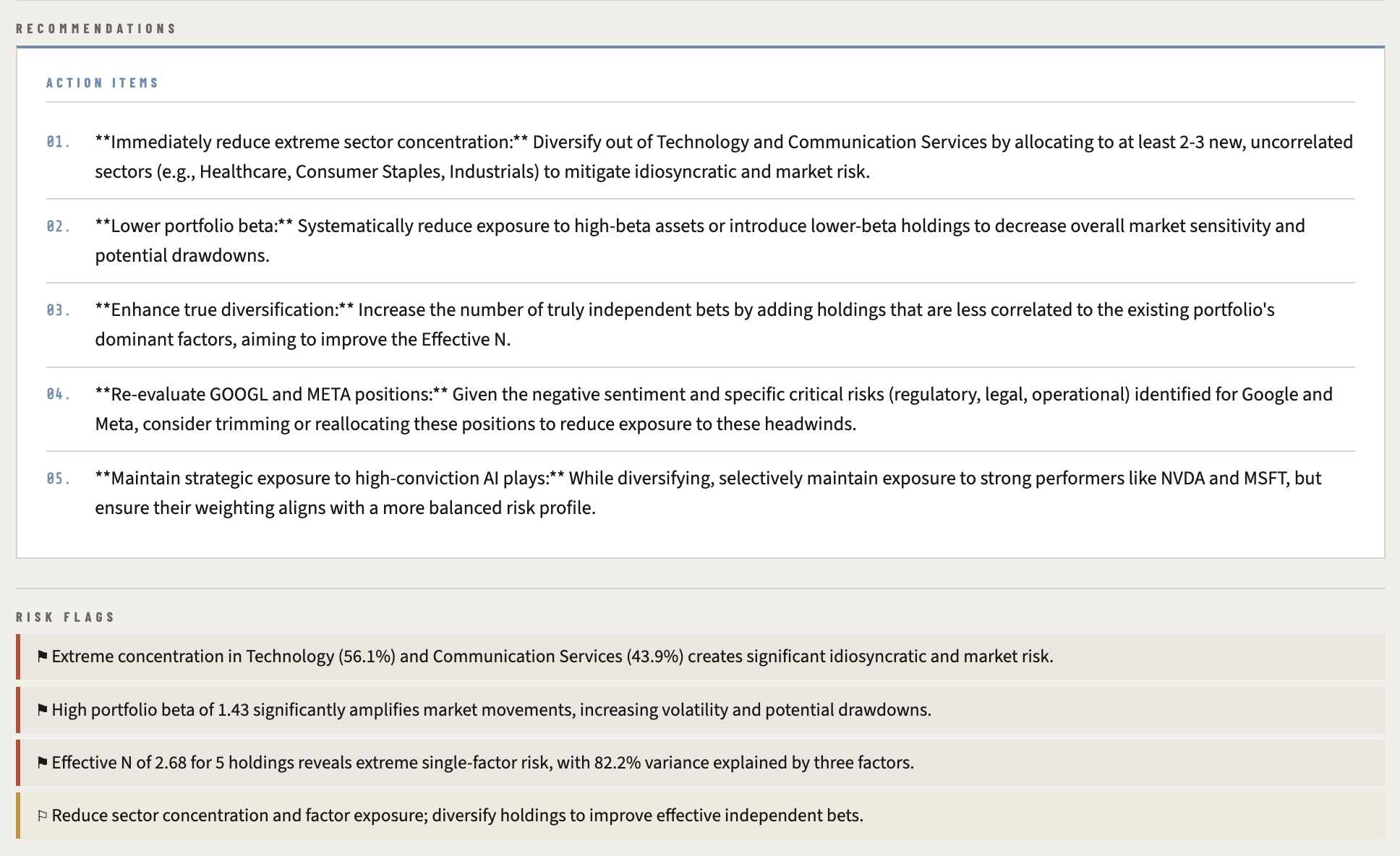
Recommendations and risk flags
-
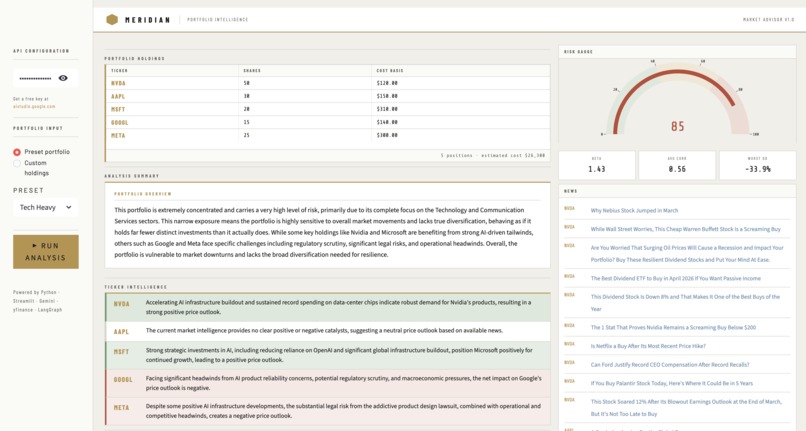
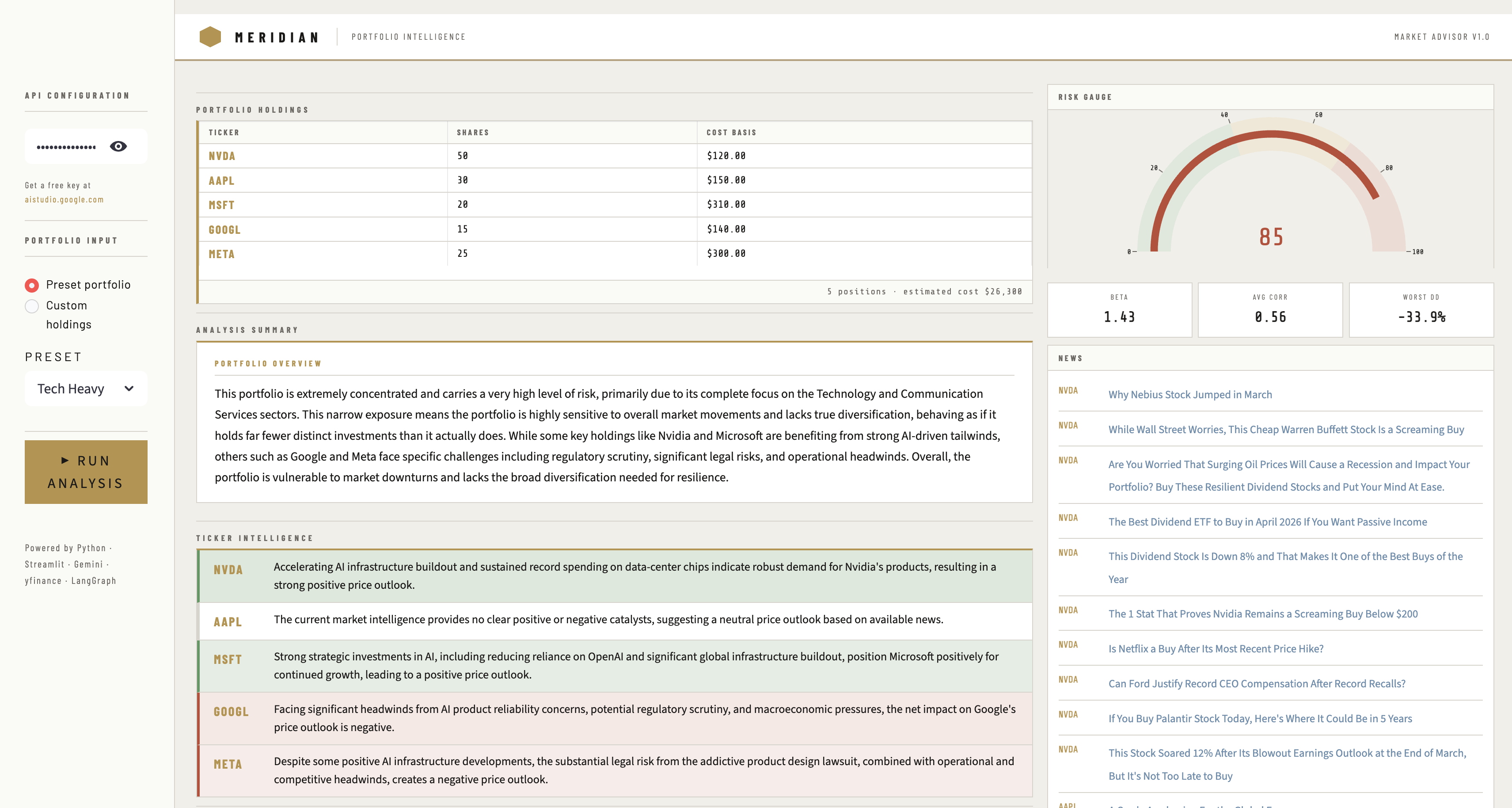
A general layout of the site
Inspiration
What it does
How we built it
Challenges we ran into
Accomplishments that we're proud of
What we learned
What's next for Meridian
MERIDIAN — Our Story
Inspiration
Most investors know what they own. Very few know how much real risk they're actually taking. When markets dropped in 2022, portfolios that looked diversified on paper lost nearly as much as pure tech funds, because the holdings were silently correlated all along.
How We Built It
Three collaborating agents:
Stage 1 — Risk Math. Sector deviation, weighted beta, drawdowns, and a 252-day pairwise correlation matrix. The piece we're proudest of is the Factor Compression Engine, which decomposes the correlation matrix via eigenvalue analysis to compute Effective N, the true number of independent risk factors:
$$N_{\text{eff}} = \frac{\left(\sum_i \lambda_i\right)^2}{\sum_i \lambda_i^2}$$
Sixteen stocks with $N_{\text{eff}} = 3.8$ aren't diversified. They're concentrated in ~4 hidden factors. Greedy agglomerative clustering then labels which stocks form each cluster.
Stage 2 — News Intelligence. Live news per ticker, graded $[-3, +3]$ by evidence strength alone. Analyst hype scores 0. A confirmed earnings miss scores $-3$. Portfolio sentiment is position-weighted across all holdings.
Stage 3 — Synthesis. Both signals feed Gemini 2.5 Flash, which produces a single coherent risk narrative tuned to your specific portfolio.
Challenges
The hardest problem wasn't the math, it was making the LLM understand it. Early versions hallucinated risks, flagged missing sectors as threats, and gave identical scores to wildly different portfolios. Explicit guard rails fixed this: hard thresholds before anything gets flagged, no inferring risk from absent data.
The news layer had a similar issue: financial writing is designed to provoke, not inform. Teaching the agent to ignore confident tone and grade only on materiality took several prompt iterations.
What We Learned
Diversification is mostly an illusion, and eigenvalues prove it faster than any chart. In financial AI, the most important design decision isn't the model you choose. It's the constraints you give it. Unconstrained LLMs are confidently wrong. Constrained ones are actually useful.


Log in or sign up for Devpost to join the conversation.