-

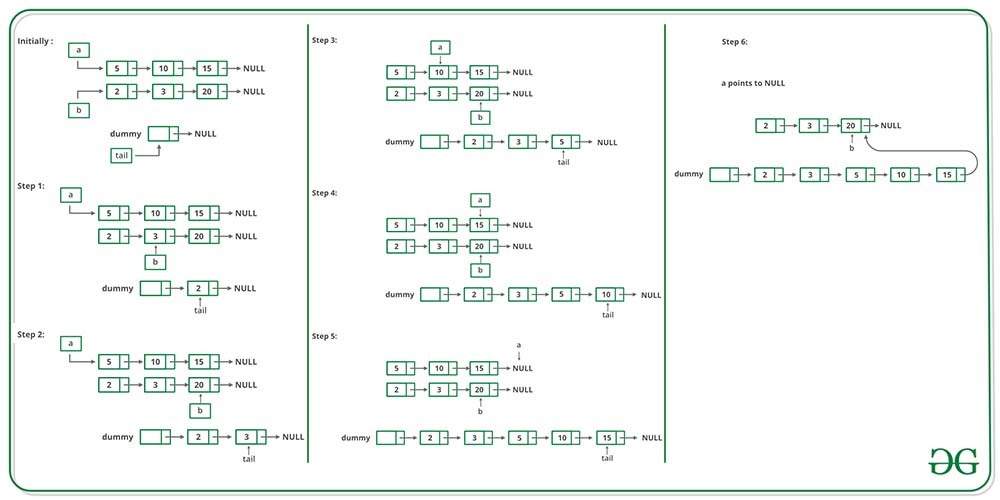
Follow the above illustration for a better understanding:
Inspiration
Merging Two Sorted linked List
What it does
Given two sorted linked lists consisting of N and M nodes respectively. The task is to merge both of the lists (in place) and return the head of the merged list.
How it works
Follow the steps below to solve the problem:
First, make a dummy node for the new merged linked list
Now make two pointers, one will point to list1 and another will point to list2.
Now traverse the lists till one of them gets exhausted.
If the value of the node pointing to either list is smaller than another pointer, add that node to our merged list and increment that pointer.
Examples:

Input: a: 5->10->15, b: 2->3->20
Output: 2->3->5->10->15->20

Input: a: 1->1, b: 2->4
Output: 1->1->2->4
How we built it
The idea is to use a temporary dummy node as the start of the result list. The pointer Tail always points to the last node in the result list, so appending new nodes is easy.
Challenges we ran into
Code block
/* C++ program to merge two sorted linked lists */
#include <bits/stdc++.h>
using namespace std;

/* Link list node */
class Node {
public:
    int data;
    Node* next;
};

/* pull of the front node of
the source and put it in dest */
void MoveNode(Node** destRef, Node** sourceRef);

/* Takes two lists sorted in increasing
order, and splices their nodes together
to make one big sorted list which
is returned. */
Node* SortedMerge(Node* a, Node* b)
{
    /* a dummy first node to hang the result on */
    Node dummy;

    /* tail points to the last result node */
    Node* tail = &dummy;

    /* so tail->next is the place to
    add new nodes to the result. */
    dummy.next = NULL;
    while (1) {
        if (a == NULL) {
            /* if either list runs out, use the
            other list */
            tail->next = b;
            break;
        }
        else if (b == NULL) {
            tail->next = a;
            break;
        }
        if (a->data <= b->data)
            MoveNode(&(tail->next), &a);
        else
            MoveNode(&(tail->next), &b);

        tail = tail->next;
    }
    return (dummy.next);
}

/* UTILITY FUNCTIONS */
/* MoveNode() function takes the
node from the front of the source,
and move it to the front of the dest.
It is an error to call this with the
source list empty.

Before calling MoveNode():
source == {1, 2, 3}
dest == {1, 2, 3}

After calling MoveNode():
source == {2, 3}
dest == {1, 1, 2, 3} */
void MoveNode(Node** destRef, Node** sourceRef)
{
    /* the front source node */
    Node* newNode = *sourceRef;
    assert(newNode != NULL);

    /* Advance the source pointer */
    *sourceRef = newNode->next;

    /* Link the old dest of the new node */
    newNode->next = *destRef;

    /* Move dest to point to the new node */
    *destRef = newNode;
}

/* Function to insert a node at
the beginning of the linked list */
void push(Node** head_ref, int new_data)
{
    /* allocate node */
    Node* new_node = new Node();

    /* put in the data */
    new_node->data = new_data;

    /* link the old list of the new node */
    new_node->next = (*head_ref);

    /* move the head to point to the new node */
    (*head_ref) = new_node;
}

/* Function to print nodes in a given linked list */
void printList(Node* node)
{
    while (node != NULL) {
        cout << node->data << " ";
        node = node->next;
    }
}

/* Driver code*/
int main()
{
    /* Start with the empty list */
    Node* res = NULL;
    Node* a = NULL;
    Node* b = NULL;

    /* Let us create two sorted linked lists
    to test the functions
    Created lists, a: 5->10->15, b: 2->3->20 */
    push(&a, 15);
    push(&a, 10);
    push(&a, 5);

    push(&b, 20);
    push(&b, 3);
    push(&b, 2);

    /* Remove duplicates from linked list */
    res = SortedMerge(a, b);

    cout << "Merged Linked List is: \n";
    printList(res);

    return 0;
}
Built With
- cpp


Log in or sign up for Devpost to join the conversation.