Our vision is to make payment intelligence more accessible to small businesses, helping them move beyond simply accepting payments toward understanding their business and making more informed decisions.
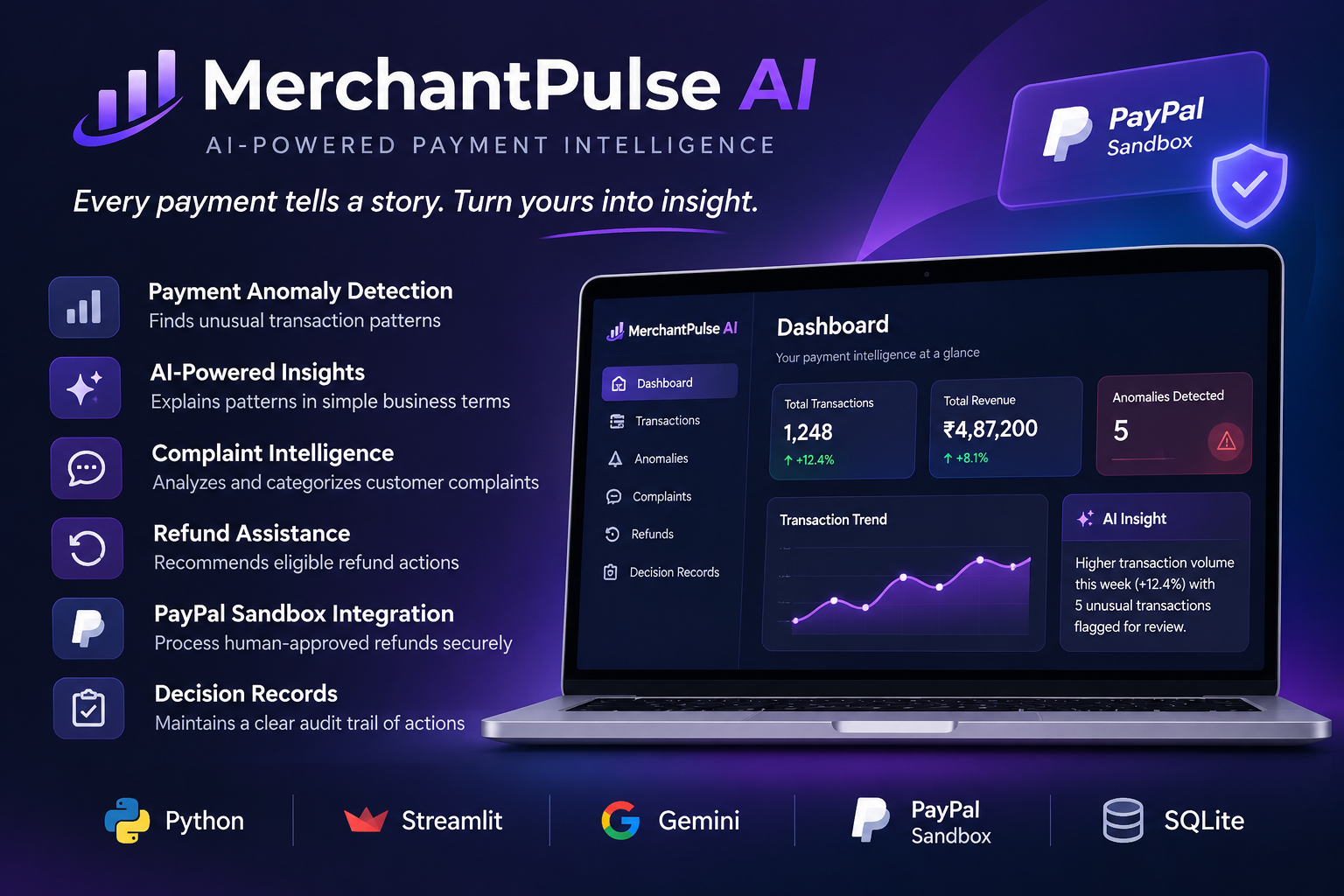
MerchantPulse AI — Every payment tells a story. Turn yours into insight.
What it does
MerchantPulse AI is an AI-powered payment intelligence platform that helps merchants understand transaction patterns, identify unusual activity, and manage customer complaints.
Its key capabilities include:
- Payment anomaly detection: Identifies unusual transaction patterns and potential issues using statistical detection methods.
- AI-powered insights: Uses Google Gemini to explain detected patterns and turn analytical findings into understandable business insights.
- Complaint intelligence: Analyzes customer complaints and categorizes them to help merchants understand the underlying issues.
- Refund assistance: Recommends eligible refund actions while keeping the final decision with the merchant.
- Human-approved PayPal refunds: Connects to the PayPal Sandbox API to process approved full refunds, with safeguards against duplicate or ineligible refunds.
- Decision records: Maintains an audit trail of important refund decisions and actions.
How we built it
We built MerchantPulse AI using Python and Streamlit, with separate modules for transaction analysis, anomaly detection, complaint handling, and refund workflows.
Google Gemini powers the explanation of analytical findings. PayPal Sandbox provides the payment and refund integration, while SQLite maintains the local payment ledger and application records.
A key design principle was keeping AI assistance separate from financial decisions. AI-generated content is treated as untrusted input, and refund actions are validated against application rules. A merchant must explicitly approve a refund before the application sends the request to PayPal.
Challenges we ran into
One of our biggest challenges was integrating AI-generated insights with actual payment workflows without allowing AI to make financial decisions.
We also had to handle PayPal order creation, approval, capture, and refund operations reliably. Preventing duplicate refunds, validating refund eligibility, managing local payment records, and handling different application states required careful testing.
Another challenge was making the interface understandable enough for a merchant to follow the complete journey from identifying a problem to reviewing and approving an action.
Accomplishments that we're proud of
We are proud to have developed an integrated working prototype that brings payment analytics, AI-powered explanations, complaint triage, and PayPal Sandbox refund processing into one application.
We implemented a human-approval workflow with safety checks and decision records, rather than allowing an AI system to independently move money.
The V11 release passed 78 automated tests in our local validation, and we also manually tested the PayPal Sandbox payment and refund workflow.
What we learned
We learned that building useful AI applications requires more than connecting a language model to an interface. Financial workflows need clear boundaries, validation, traceability, and human oversight.
We also gained practical experience integrating external APIs, managing application state, designing safety checks, and testing a multi-component application.
Limitations and future scope
MerchantPulse AI is currently a hackathon prototype. Its analytics use synthetic demonstration transaction data, and its payment integration uses the PayPal Sandbox. The current implementation supports full refunds rather than partial refunds. It does not yet include production payment webhooks or individual merchant authentication.
Future improvements could include live transaction ingestion, more advanced detection models, partial refunds, and production-grade merchant access controls.
