Inspiration
Operating an omnichannel business today is an operational nightmare. Merchants sell online through e-commerce and in-person via point-of-sale terminals (PayPal Zettle). Yet, when chargebacks, refund requests, or fraud rings hit, the critical data required to defend the business is scattered across disconnected systems:
- Carrier tracking portals (FedEx, UPS, DHL)
- Customer support desks (Zendesk, Gmail)
- Point-of-sale shift logs (PayPal Zettle)
- Financial workflows (Invoicing, Mass Payouts, Subscriptions, and 1099-K tax reporting)
Merchants lose hours manually copying tracking numbers, downloading delivery signatures, and cross-referencing order records—often discovering card-testing bots or dispute deadlines when it's already too late.
We built MerchantOps to give merchants a unified, AI-powered operations command center that bridges PayPal’s entire financial ecosystem with automated evidence ingestion, predictive risk defense, and strict human-in-the-loop governance.
What it does
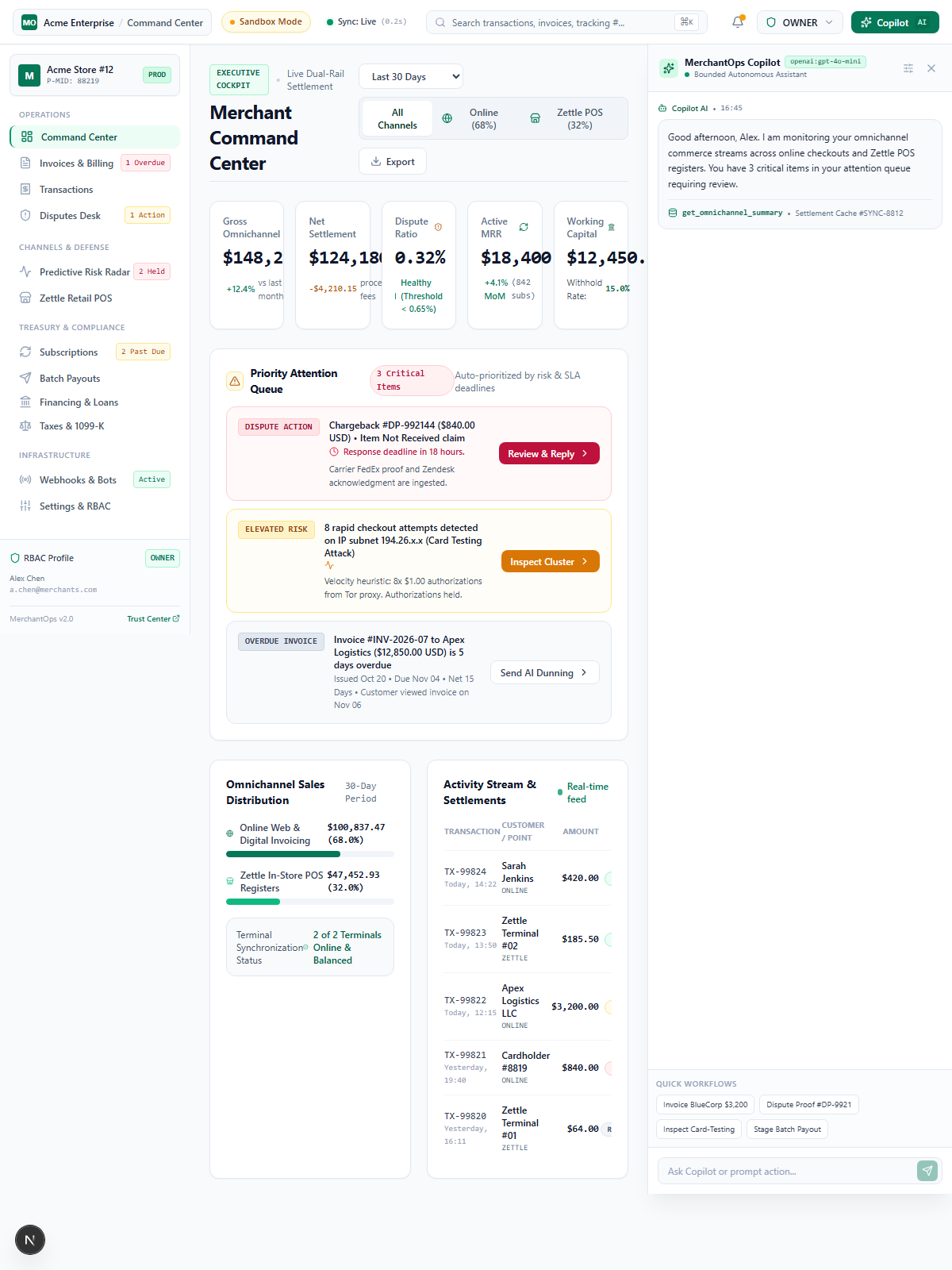
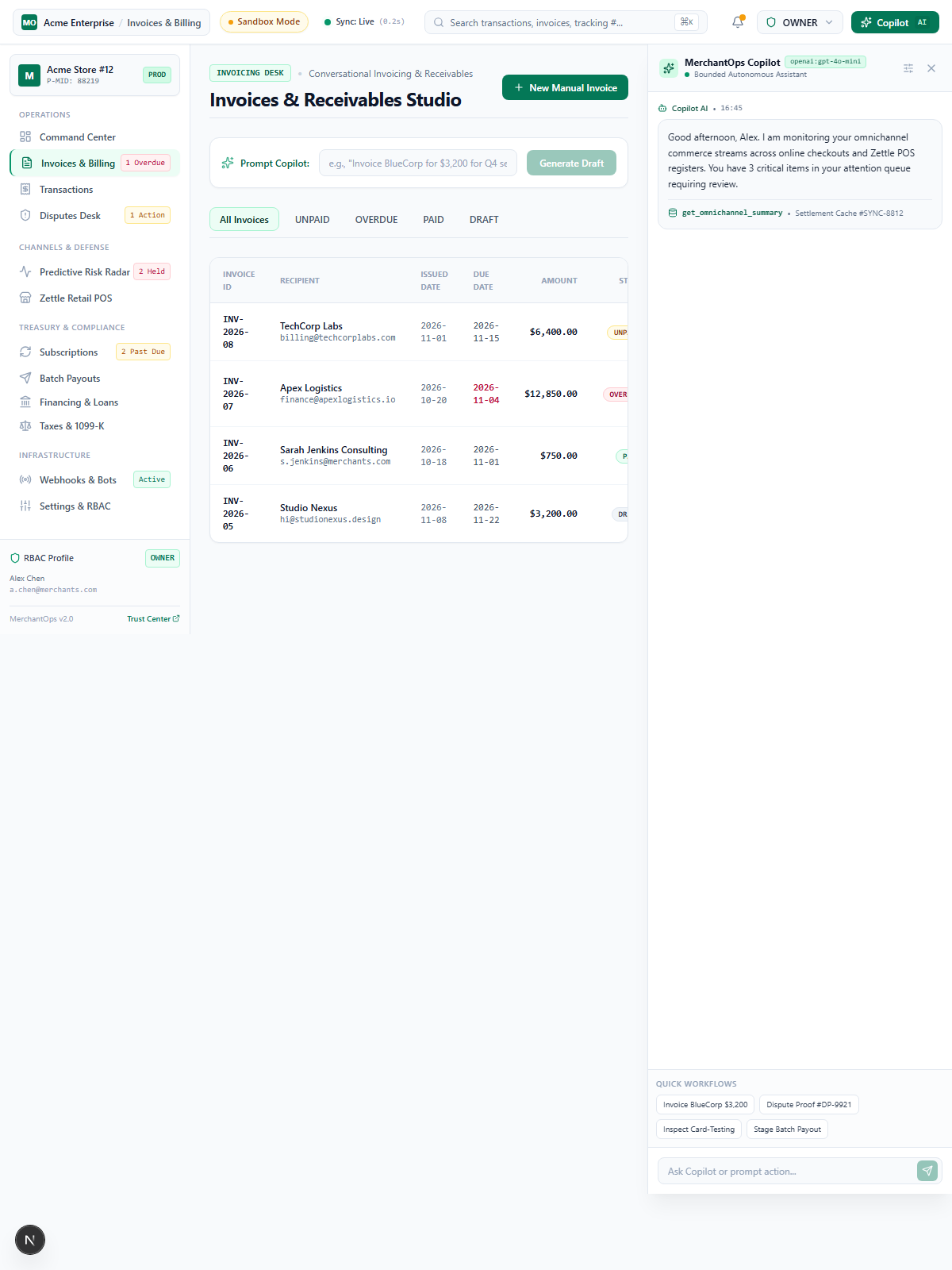
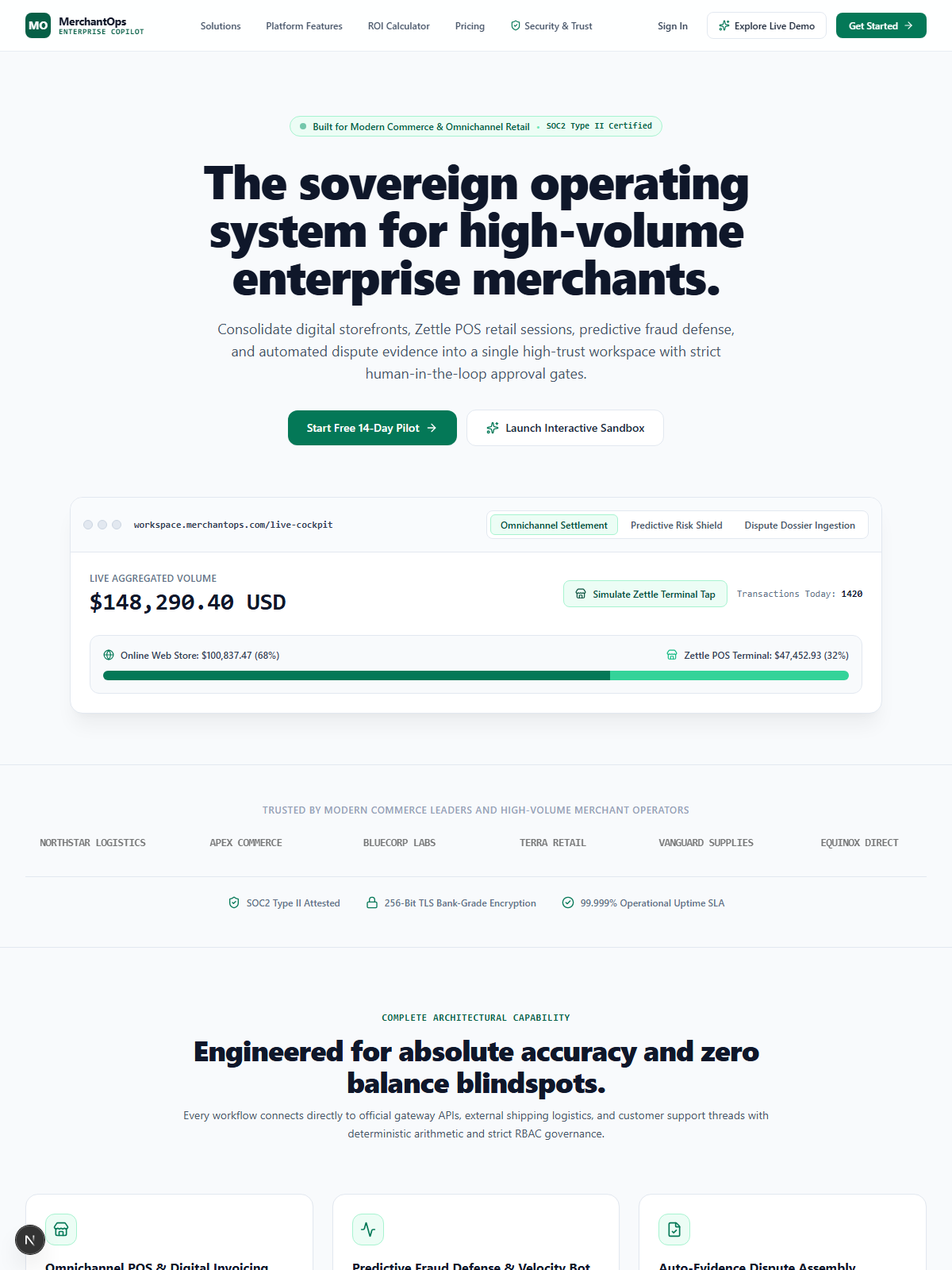
MerchantOps acts as an intelligent operating system for merchants across five core pillars:
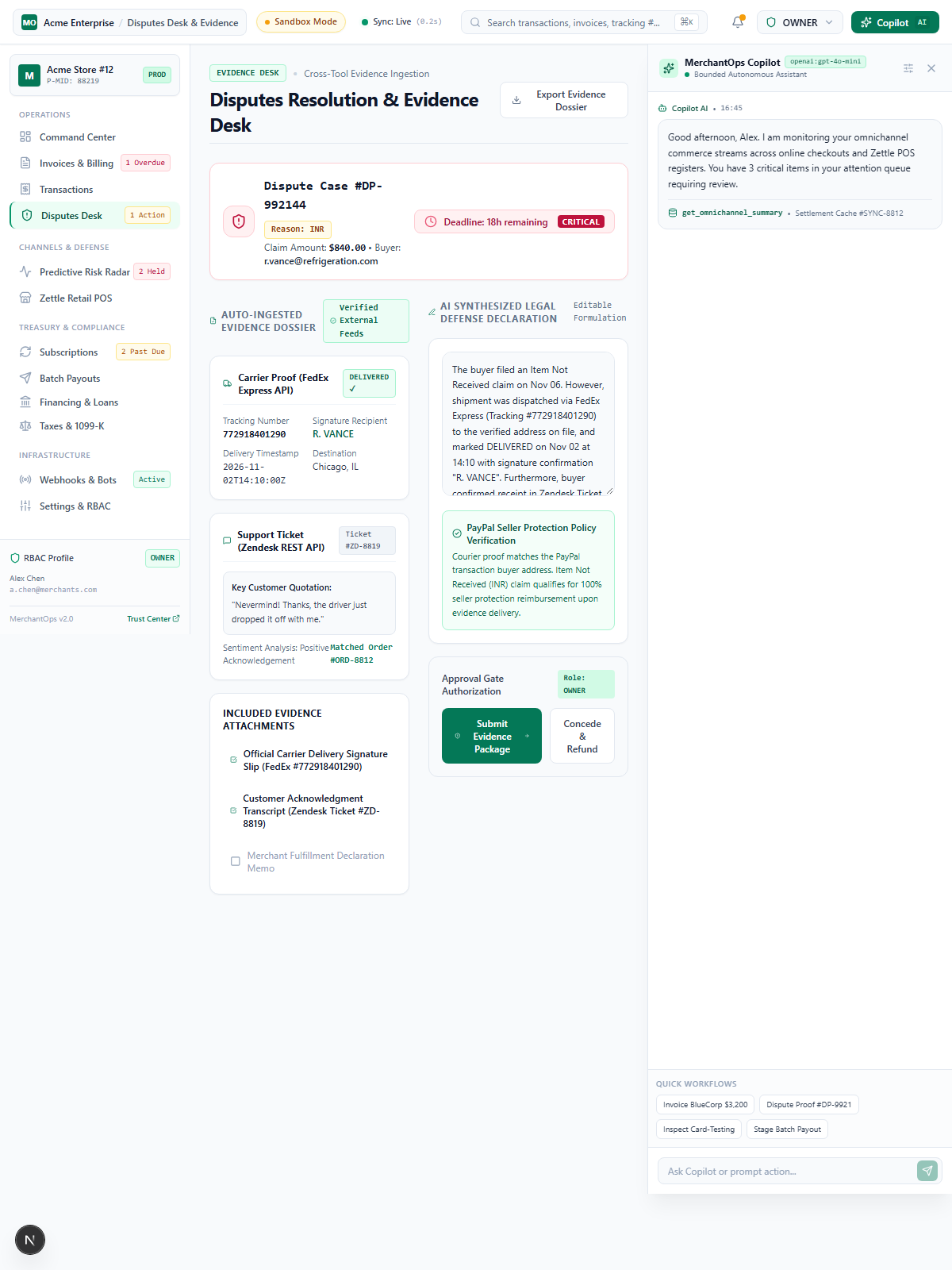
- Autonomous Dispute Dossier & Evidence Assembly: When a dispute is opened, MerchantOps automatically ingests courier delivery signatures (FedEx/UPS/DHL) and customer email exchanges (Zendesk/Gmail), compiling a complete contestment dossier in under two minutes instead of 30+ minutes of manual work.
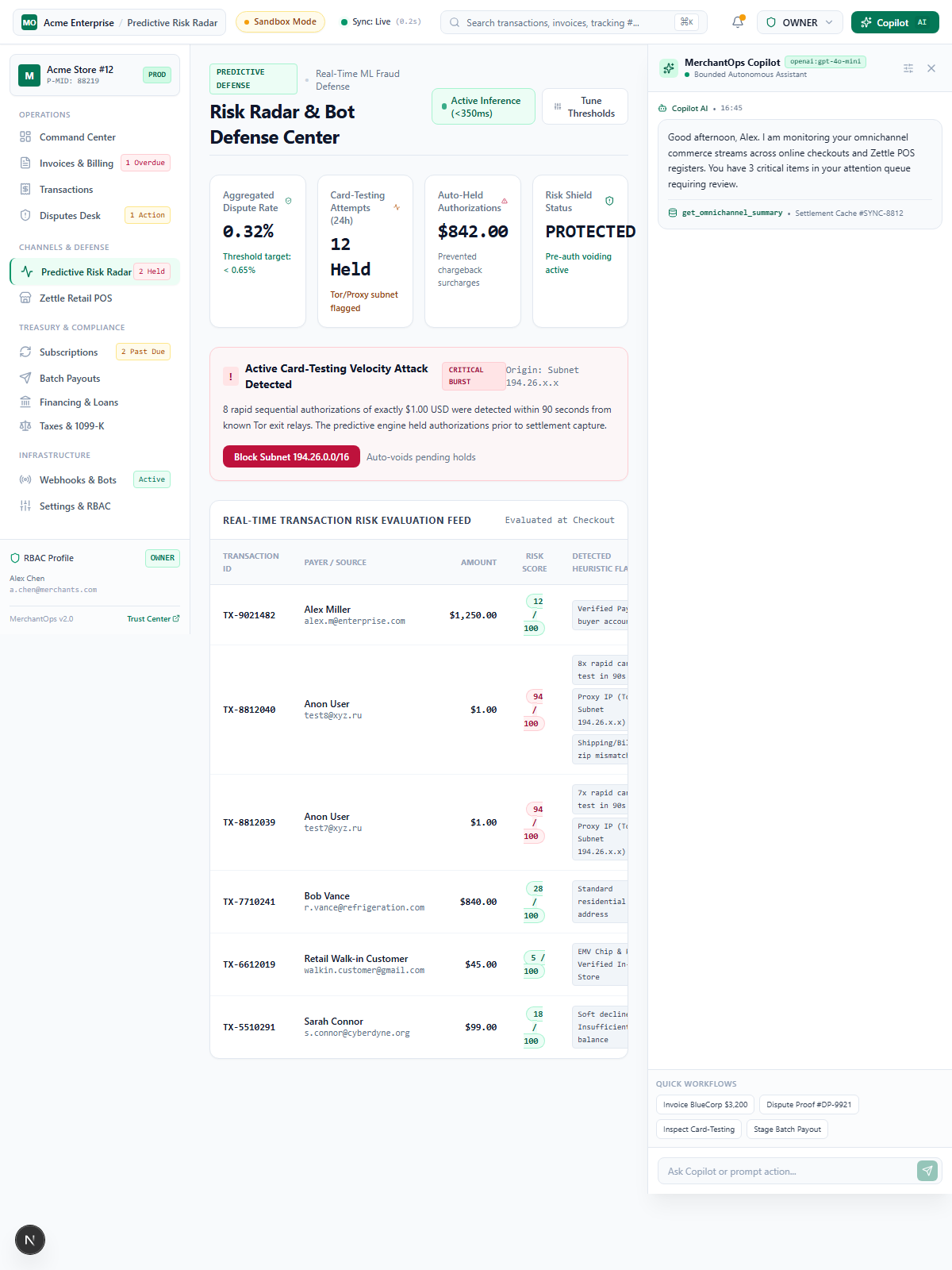
- Predictive Fraud & Velocity Defense: Real-time scoring monitors rapid IP/device switching, card-testing micro-transactions, and velocity anomalies before settlement batches finalize.
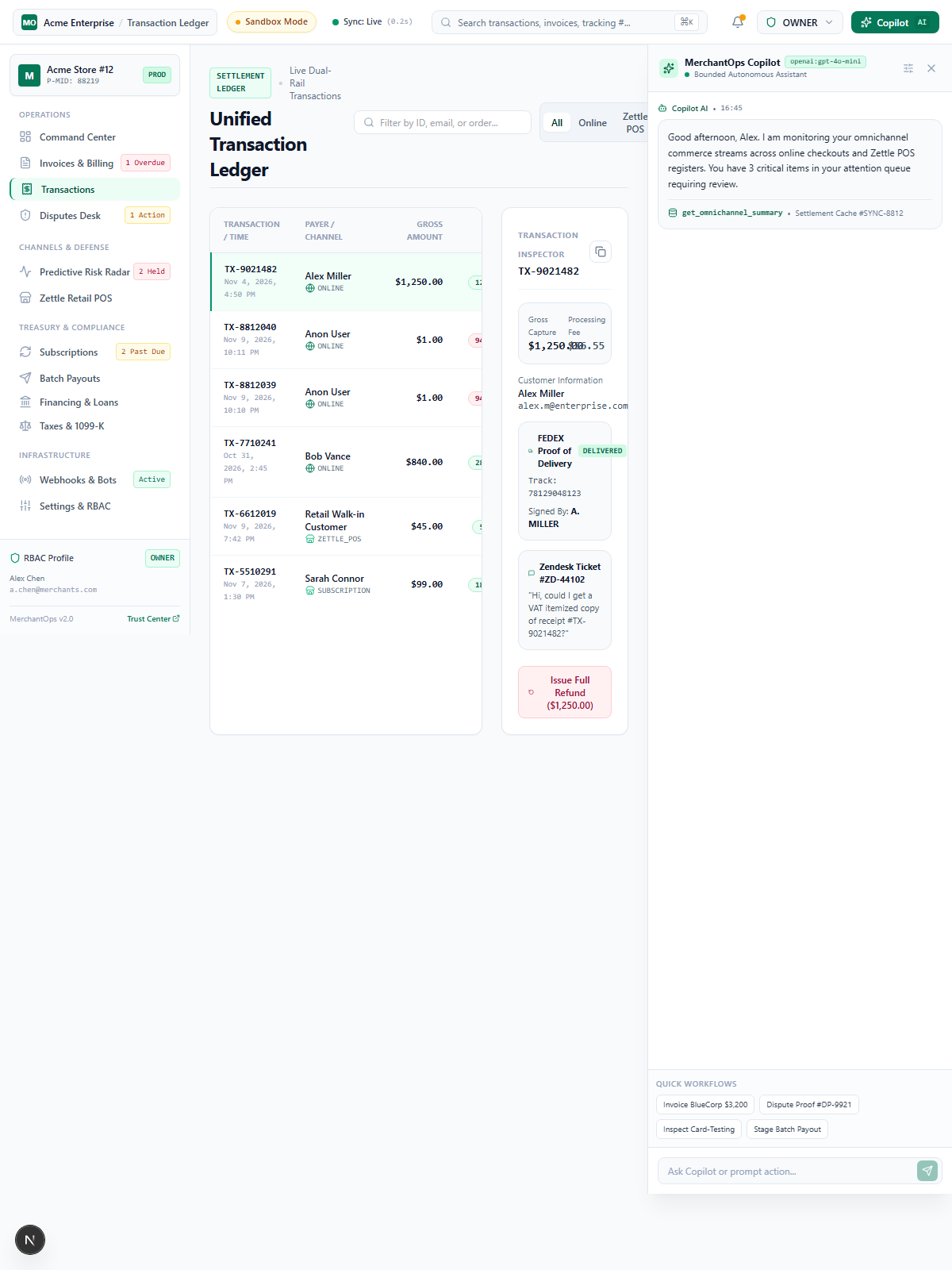
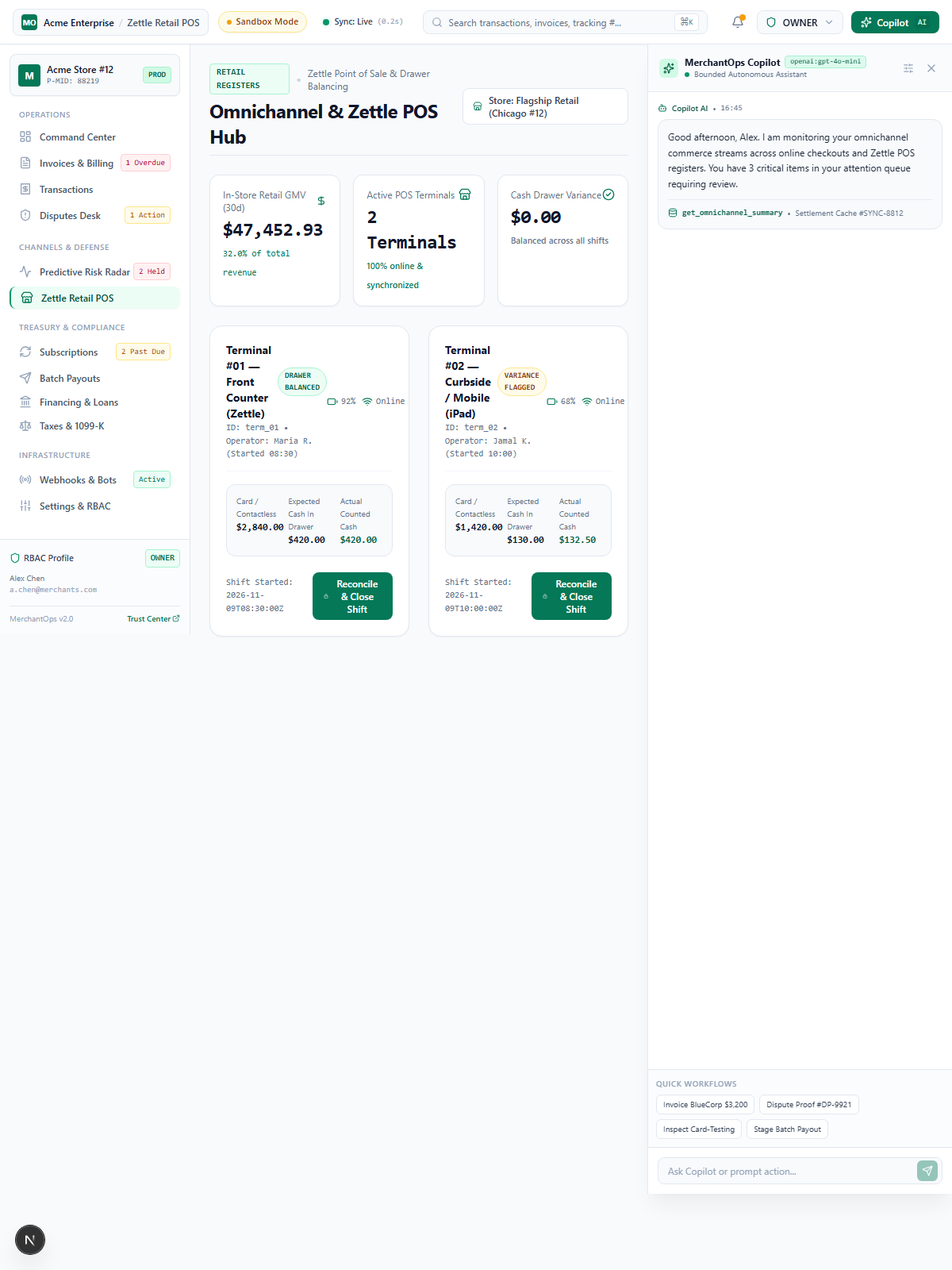
- Omnichannel Reconciliation: Seamlessly connects digital e-commerce transactions with physical in-store PayPal Zettle POS registers, synchronizing inventory adjustments and daily settlement ledgers.
- End-to-End Financial Operations:
- Automated draft-to-paid invoicing lifecycles
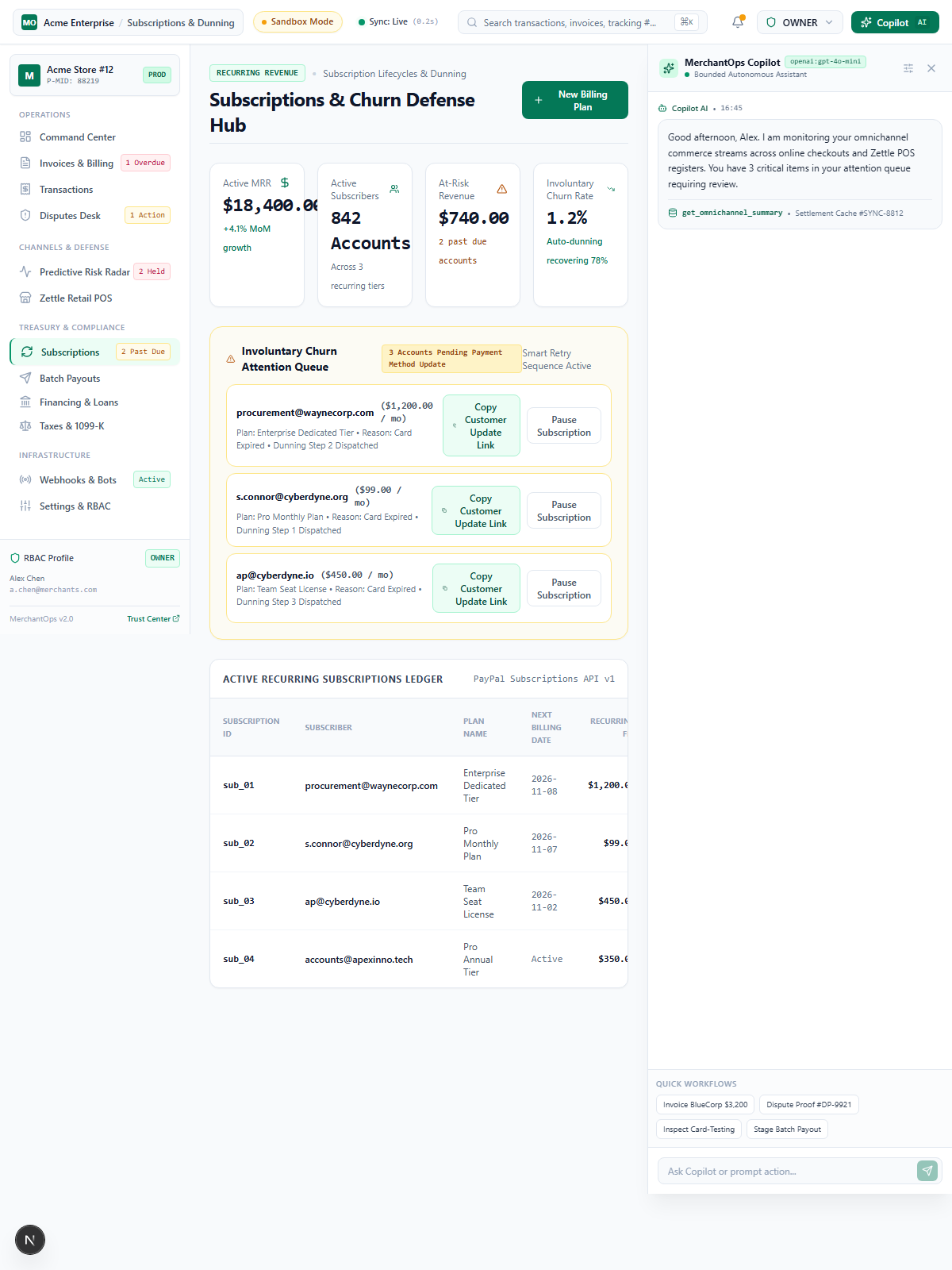
- Recurring subscription dunning and churn prevention
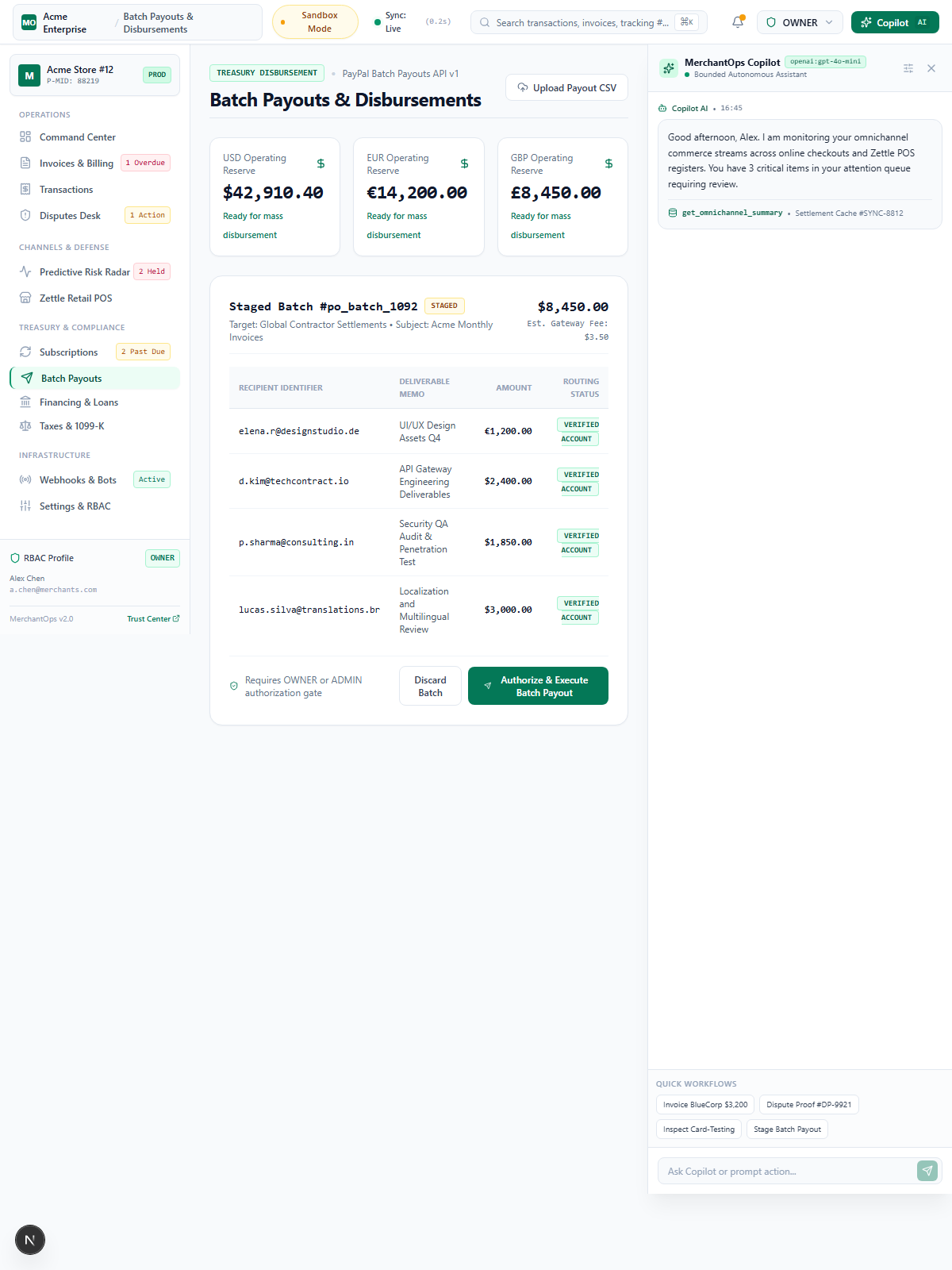
- High-volume batch vendor payouts with cryptographic verification
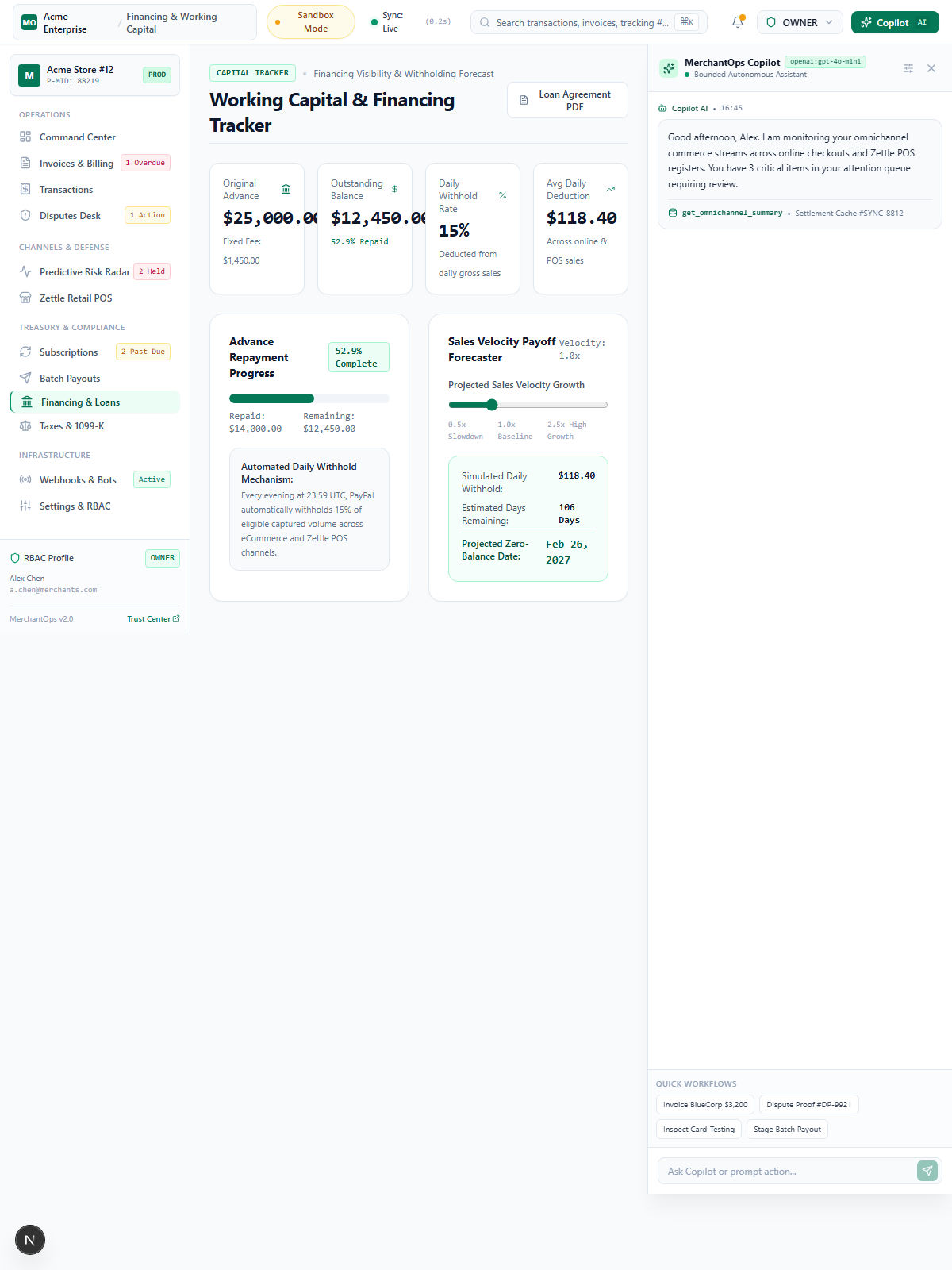
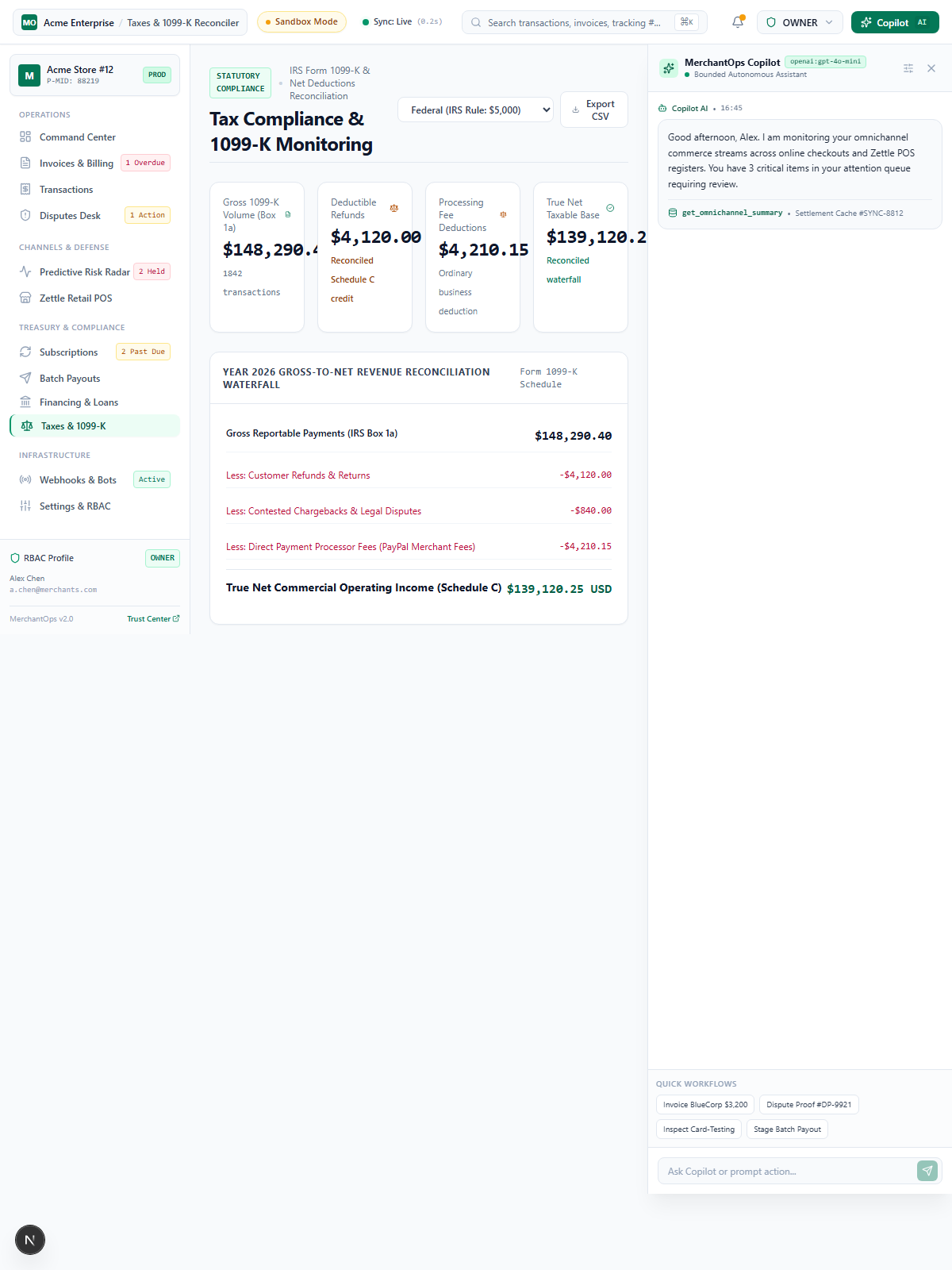
- PayPal Working Capital loan tracking and automated 1099-K sales tax liability reconciliation
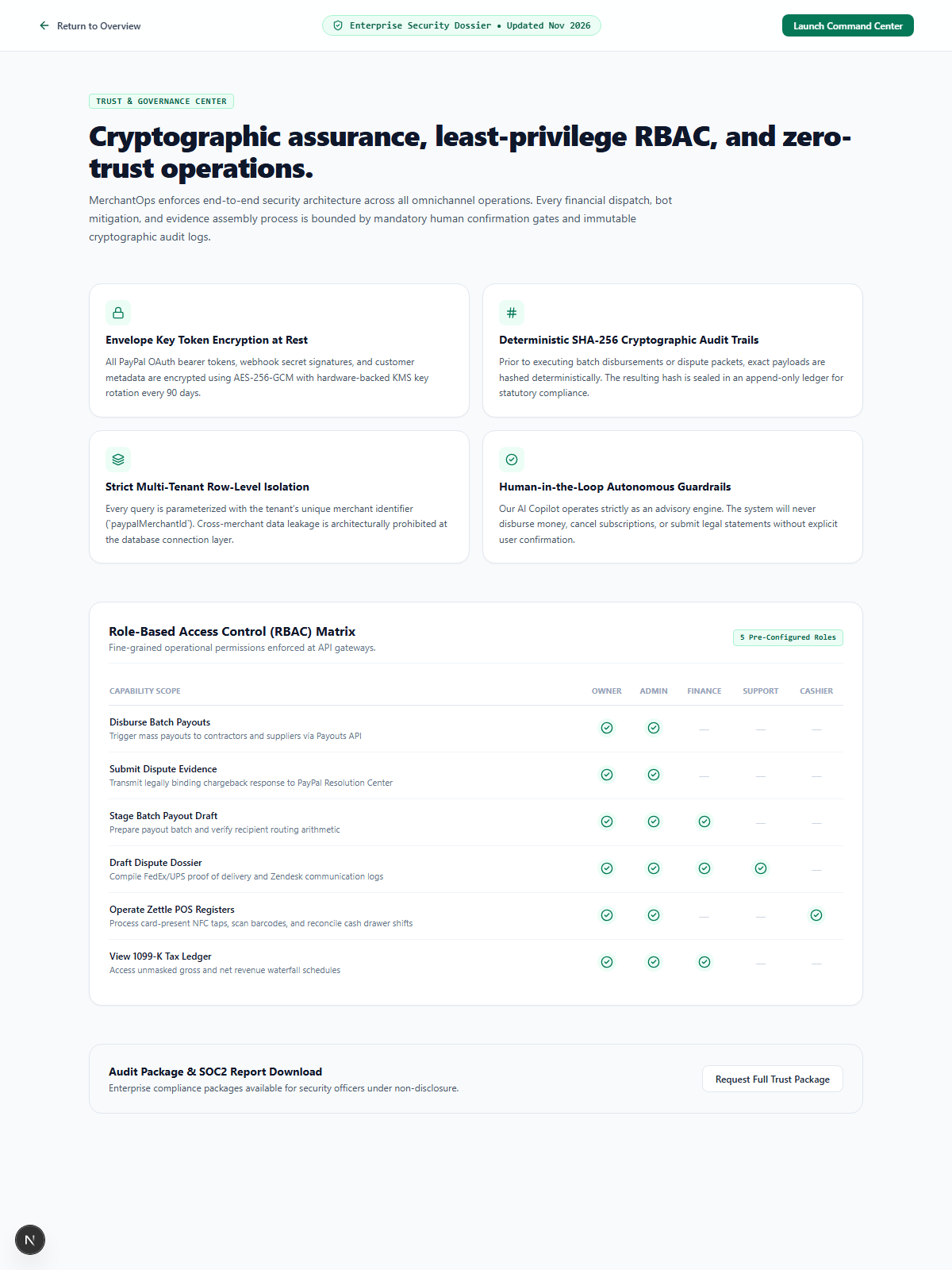
- Human-in-the-Loop Governance & Multi-Tenant RBAC: High-consequence actions (mass disbursements, refunds, dispute submissions) require a dual-button cryptographic SHA-256 confirmation gate and strict role-based access control (Owner, Admin, Finance, Support, Cashier).
How we built it
MerchantOps was built from the ground up as a production-grade enterprise application:
- Frontend & UX: Built with Next.js 15 (App Router), React 19, TypeScript, and Tailwind CSS. Designed with an enterprise light-mode visual language (benchmarked against Ramp and Wise), featuring a global command palette (
Cmd+K), live settlement preview widgets, and domain workspaces (/disputes,/risk,/pos,/payouts,/invoices,/taxes). - Database & Storage: Serverless PostgreSQL powered by Neon DB, storing tenant isolation profiles, webhook audit trails, transaction records, and action logs.
- Multi-Tenant Agentic AI Engine:
- Python & LangChain orchestration with provider-agnostic LLM support (OpenAI GPT-4o, Anthropic Claude 3.5 Sonnet, Google Gemini 1.5 Pro).
- Construction-time API key isolation ensuring enterprise data segregation with zero global memory leakage.
- Safe deterministic calculation tools preventing arithmetic hallucinations for ledger balancing: $$\text{Net Settlement} = \text{Gross GMV} - (\text{Disputes} + \text{Refunds} + \text{Fees})$$
- Additive lifecycle hooks (
pre_hook,post_hook) producing immutable audit trails for every AI action.
- PayPal & Webhook Integrations:
- PayPal REST APIs: Invoicing, Orders, Disputes, Payouts, Subscriptions, and Zettle POS.
- Carrier & CRM Webhooks: FedEx, UPS, DHL tracking milestones and Zendesk/Gmail customer communication threads.
Challenges we ran into
- Multi-Tenant Key Isolation: Allowing enterprise organizations to bring their own LLM keys (or connect via an OpenRouter gateway) without cross-tenant key leakage or cross-talk required engineering a dynamic factory pattern with zero shared state.
- Normalizing Unstructured Evidence: Shipping tracking webhooks and email threads follow drastically different schemas. Cleaning, validating, and formatting timestamps, delivery signatures, and customer support messages into a coherent chronological timeline for dispute adjudication was a complex data engineering task.
- Preventing AI Financial Hallucination: An LLM should never be permitted to execute money movements autonomously. We designed an enforced two-step verification drawer with SHA-256 payload hashing, ensuring the AI assists with synthesis while the merchant maintains absolute authorization control.
Accomplishments that we're proud of
- Sub-2-Minute Dispute Turnaround: Reduced the time to compile, correlate, and assemble complete dispute evidence packets from 30+ minutes down to under 2 minutes.
- Provider-Agnostic LLM Architecture: Seamlessly switching between GPT-4o, Claude 3.5 Sonnet, and Gemini models with zero code rewrites.
- True Omnichannel Integration: Bringing online PayPal transactions and in-person Zettle POS shifts into a single, cohesive operational dashboard with instant reconciliation.
What we learned
- Merchants prioritize control over pure autonomy: Full autonomy in financial software creates hesitation; transparent, human-in-the-loop approvals backed by explainable AI summaries build lasting trust.
- Context is everything in risk: A flagged transaction that looks suspicious in isolation often makes total sense when cross-referenced with an in-store Zettle purchase or an active customer support thread.
What's next for MerchantOps
- Native PayPal MCP Server Integration: Integrating natural-language operations via the Model Context Protocol (MCP) to allow direct action execution from any MCP-compatible agent.
- Automated Carrier Claim Filing: Automatically filing lost-package reimbursement claims with FedEx/UPS when carrier fault is detected during dispute investigation.
- Multi-Location Inventory Balancing: Real-time cross-channel inventory rebalancing between online storefronts and physical retail registers.
Built With
- fintech
- langchain
- neondb
- next
- node.js
- openai
- paypal
- postgresql
- python
- react
- restapi
- tailwindcss
- typescript


