-
-
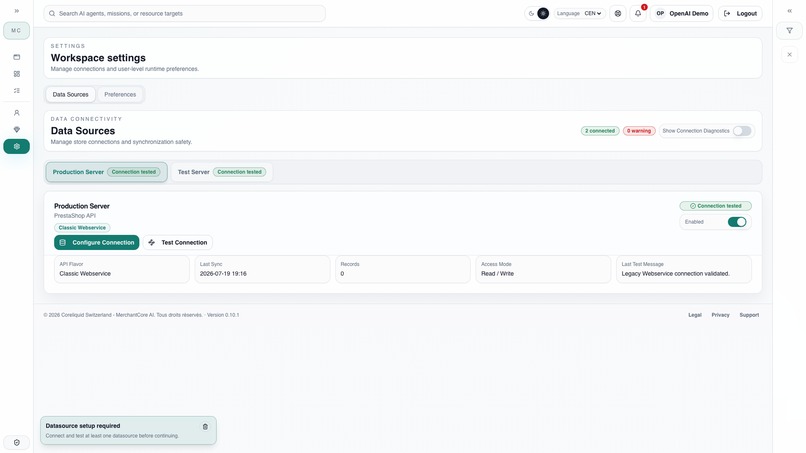
Discover three working commerce AI Agent experiences through search and tags, with an open-ended catalog designed for future workflows.
-
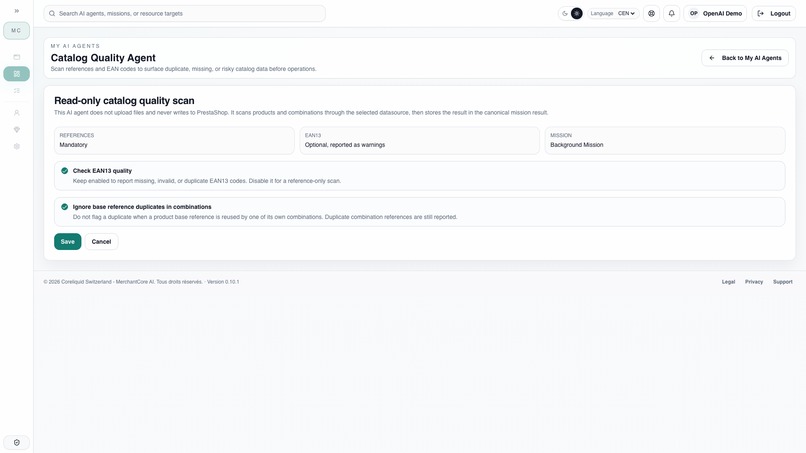
Configure the store and execution intent, then choose Preview, Test, or Production with explicit human oversight.
-
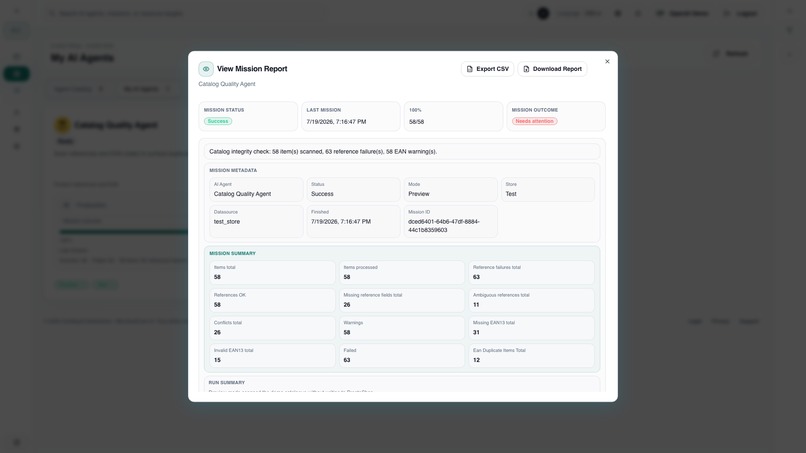
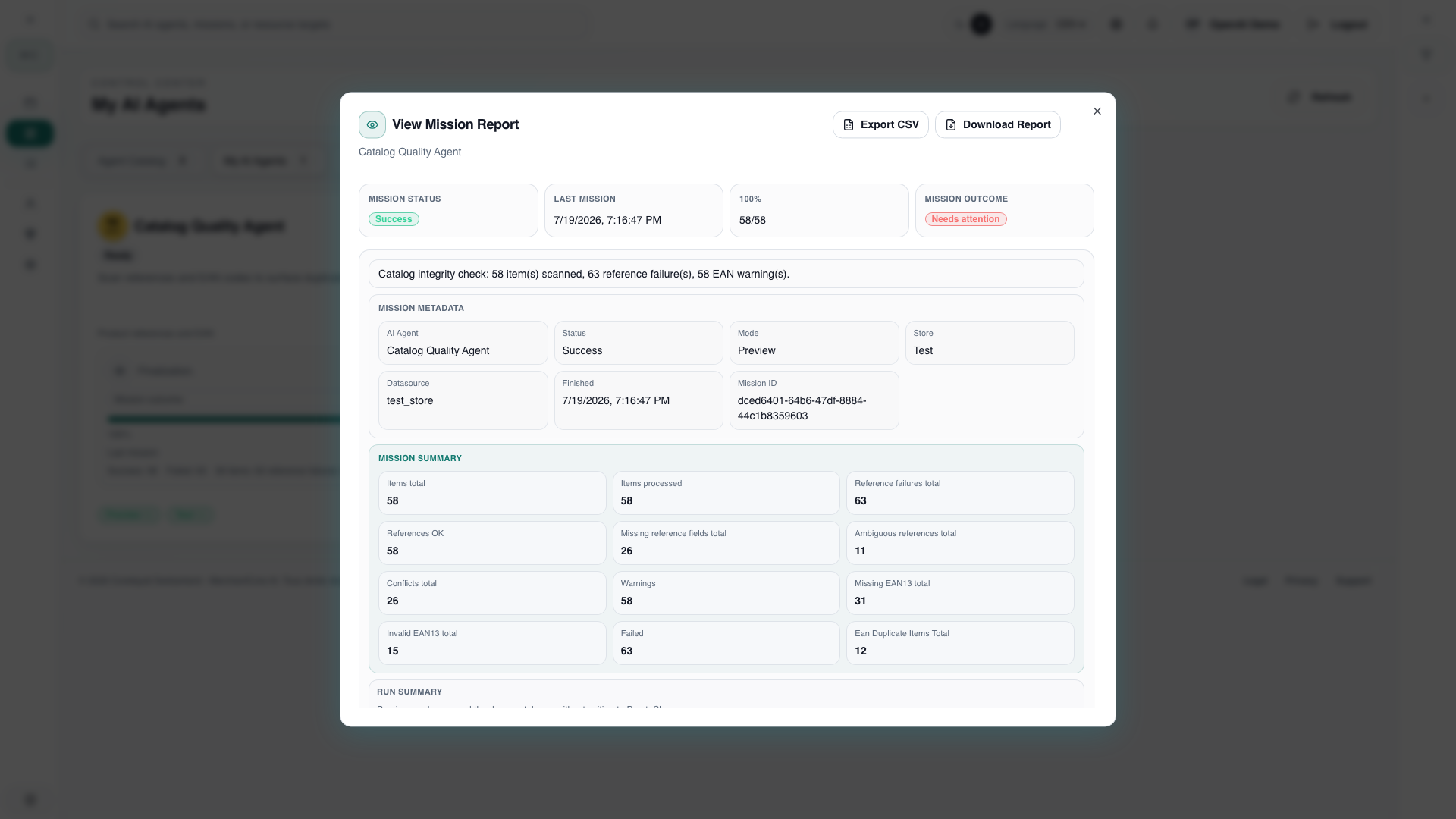
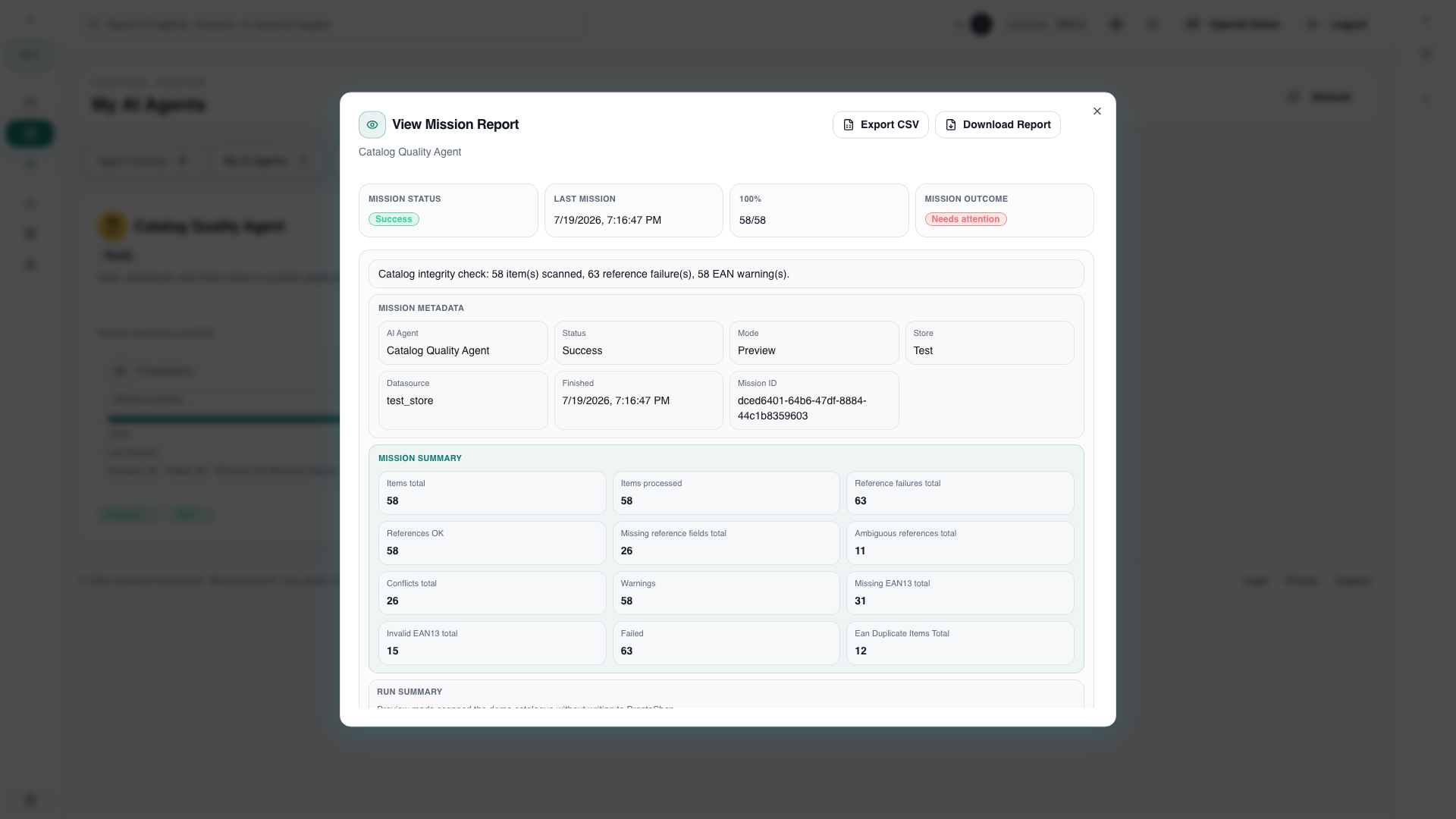
Review technical completion separately from business outcome, with accurate counters and actionable catalog findings.
-
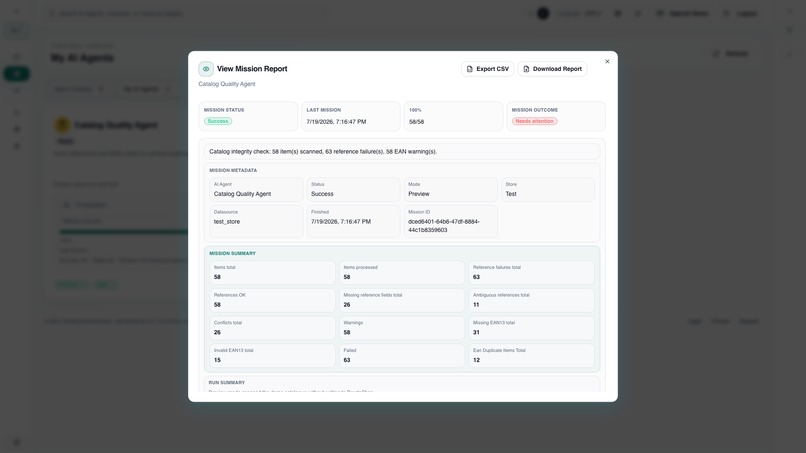
Inspect detailed reference and EAN issues, download a readable PDF report, or export a repair-ready CSV.
-
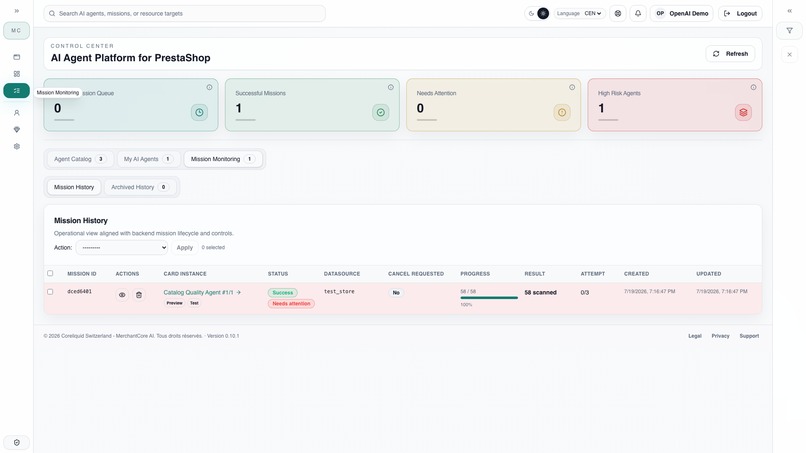
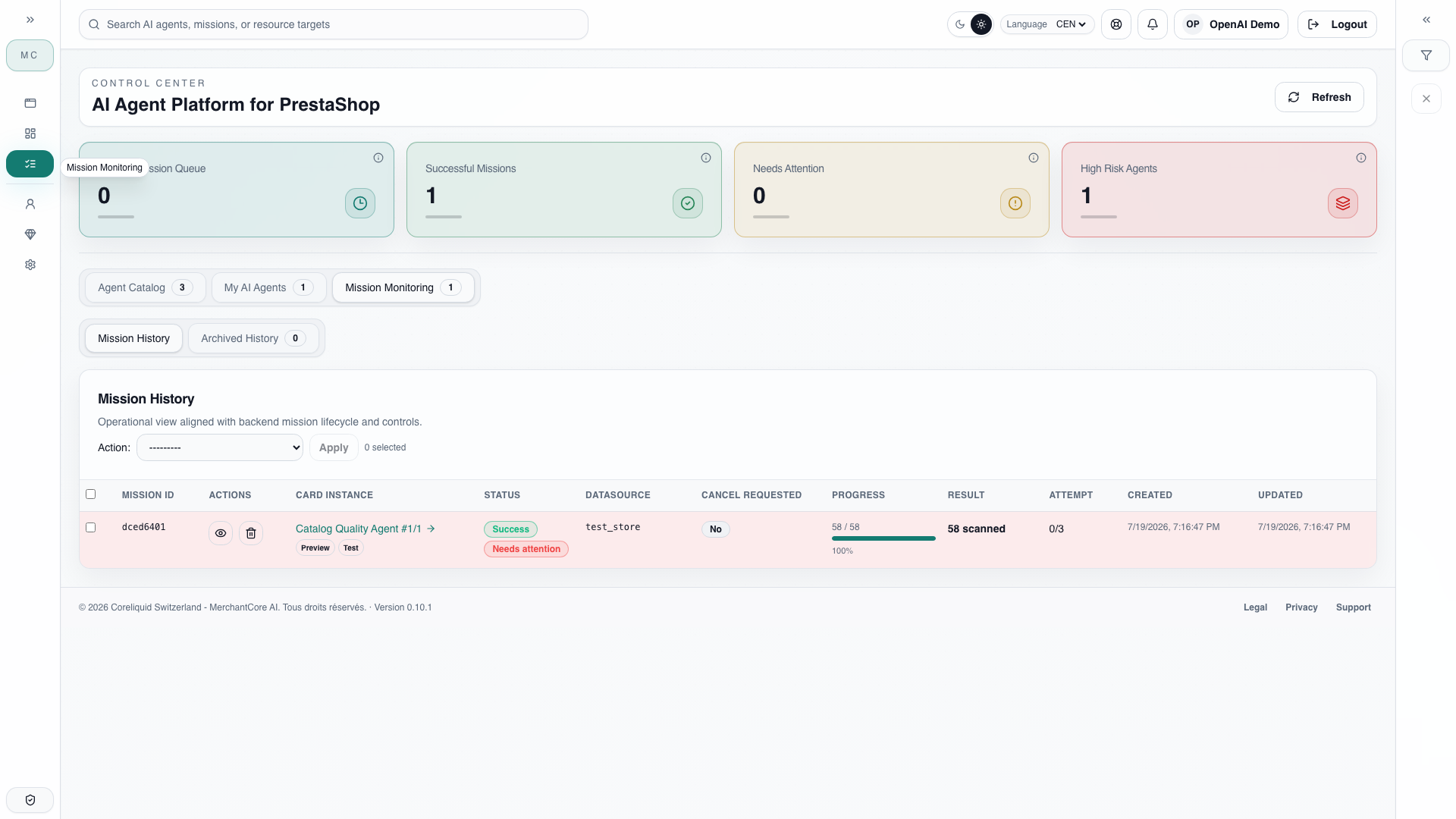
Follow backend-owned missions through live progress, structured results, execution context, and detailed logs.
-
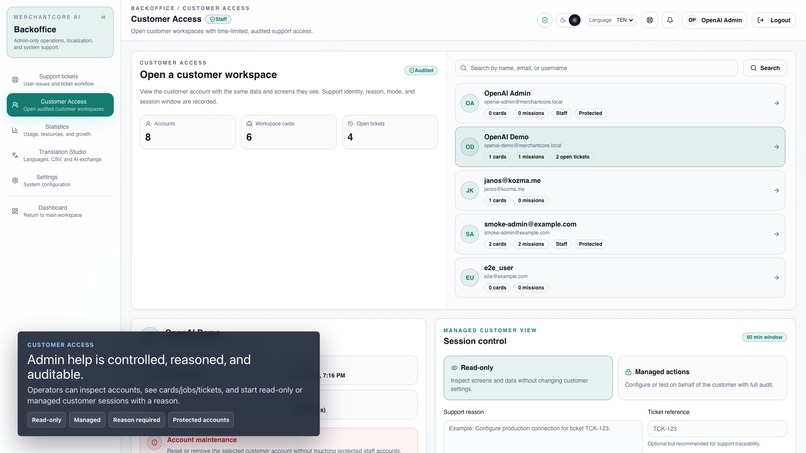
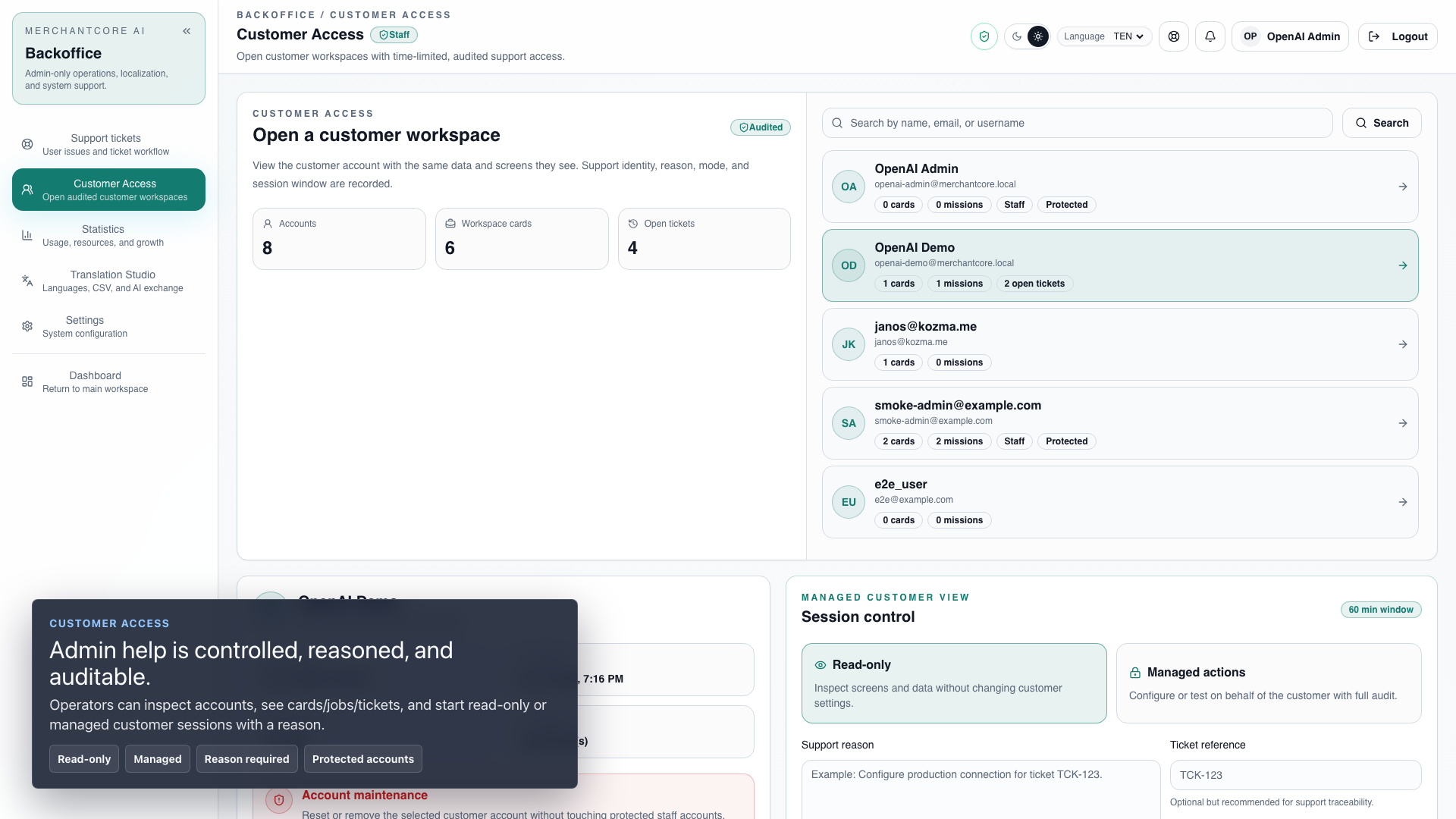
Authorized staff can support customers through a clearly marked, permission-controlled Customer View without requesting their passwords.
-
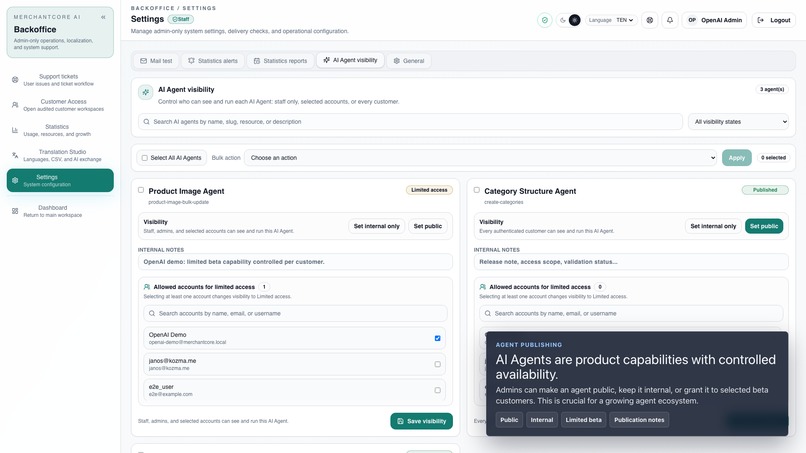
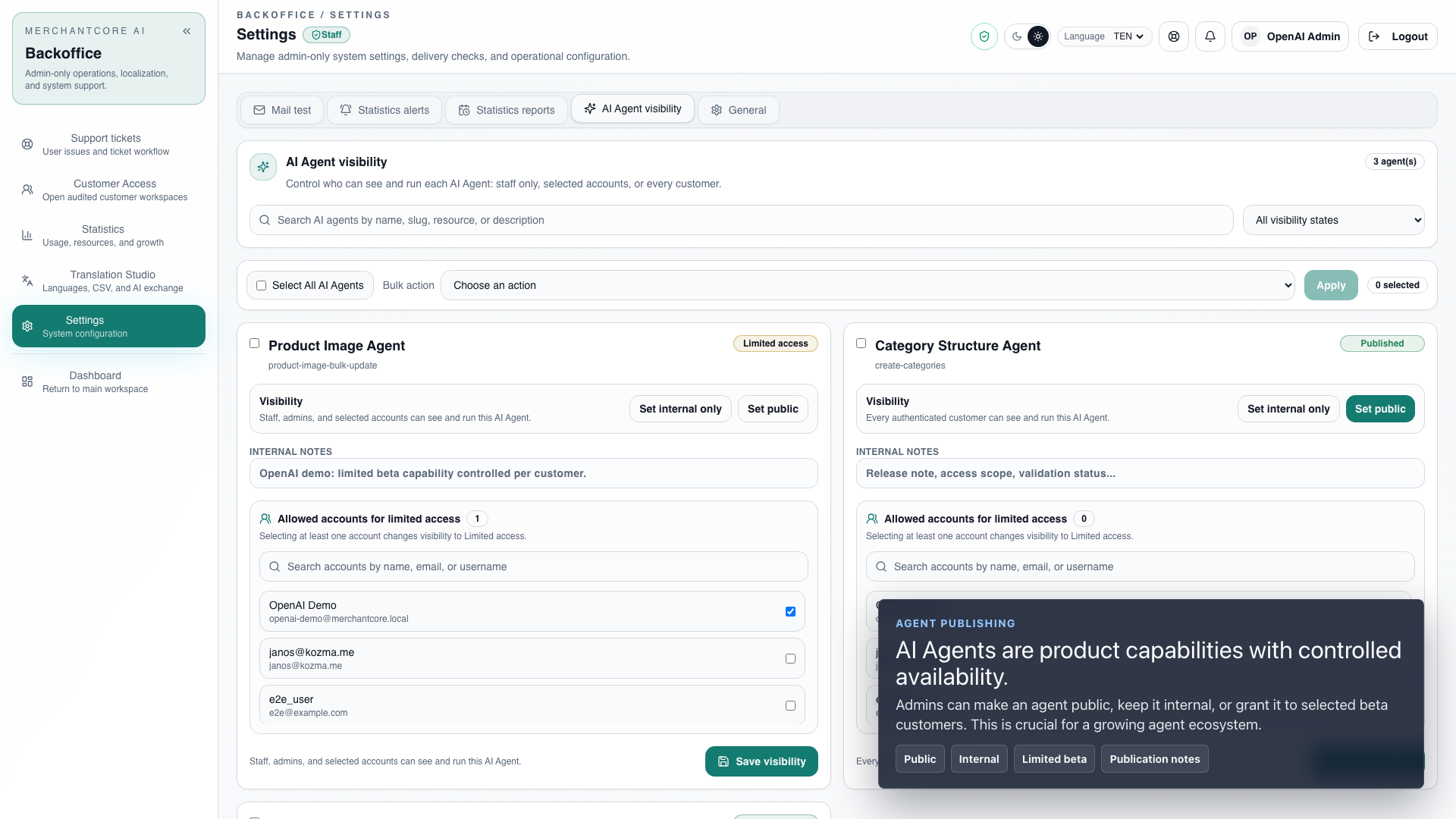
Keep new agents internal, release them to selected customers, or publish them broadly through controlled rollout states.
-
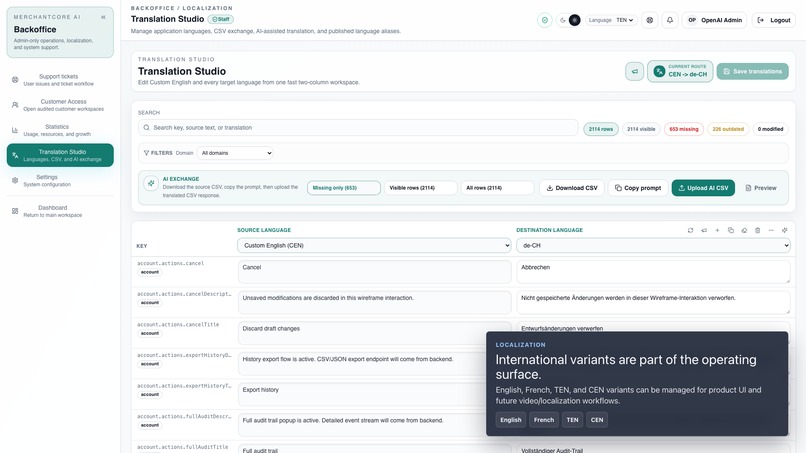
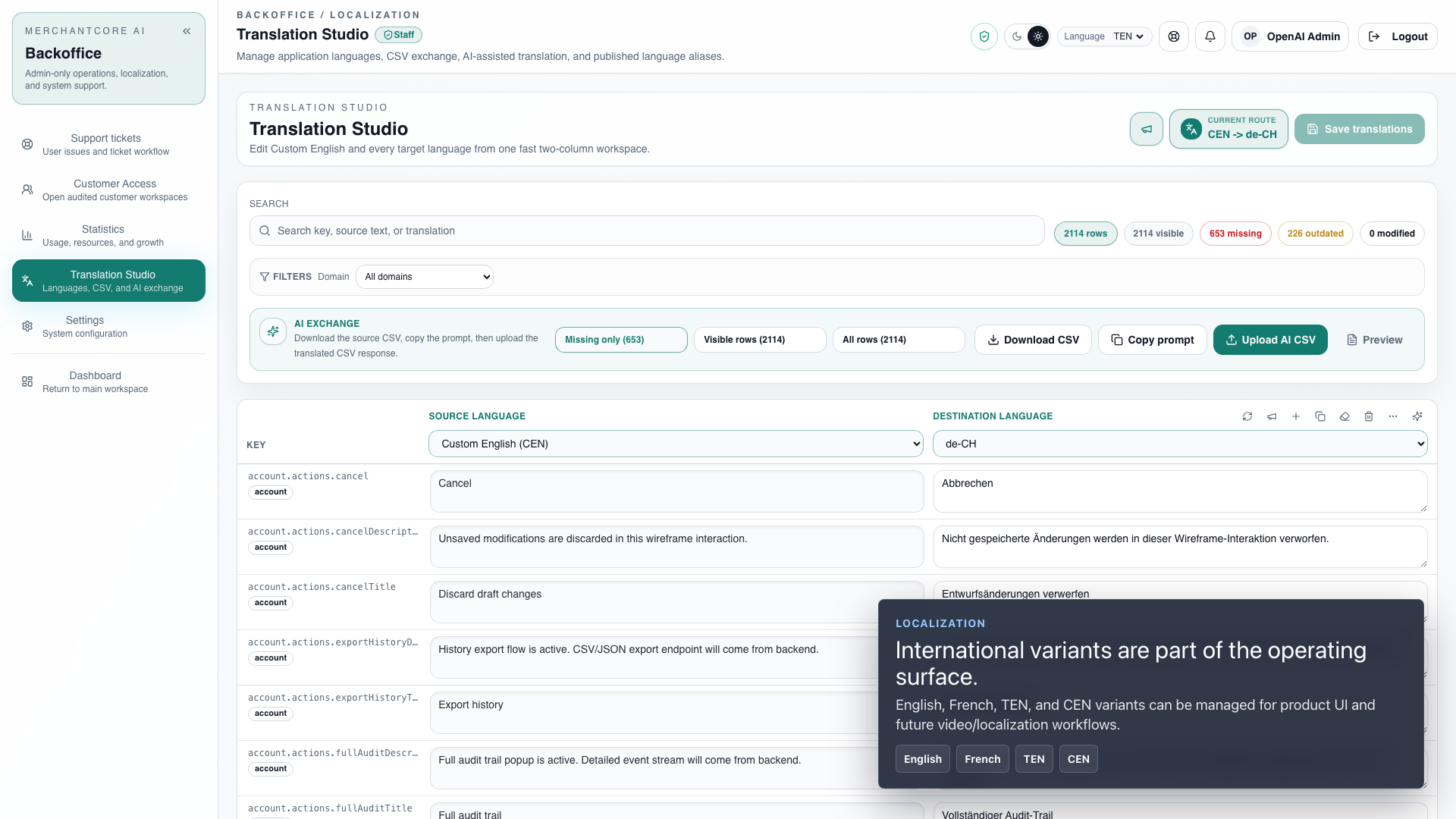
Manage Technical English, Custom English, and country-specific locales through a review-first multilingual workflow.
-
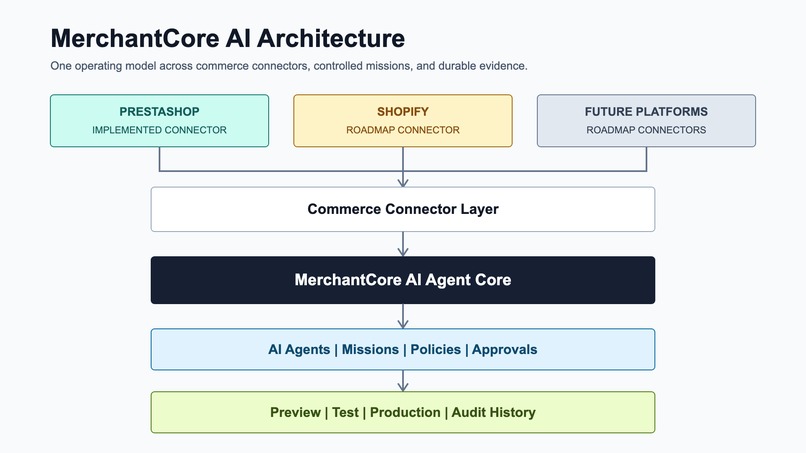
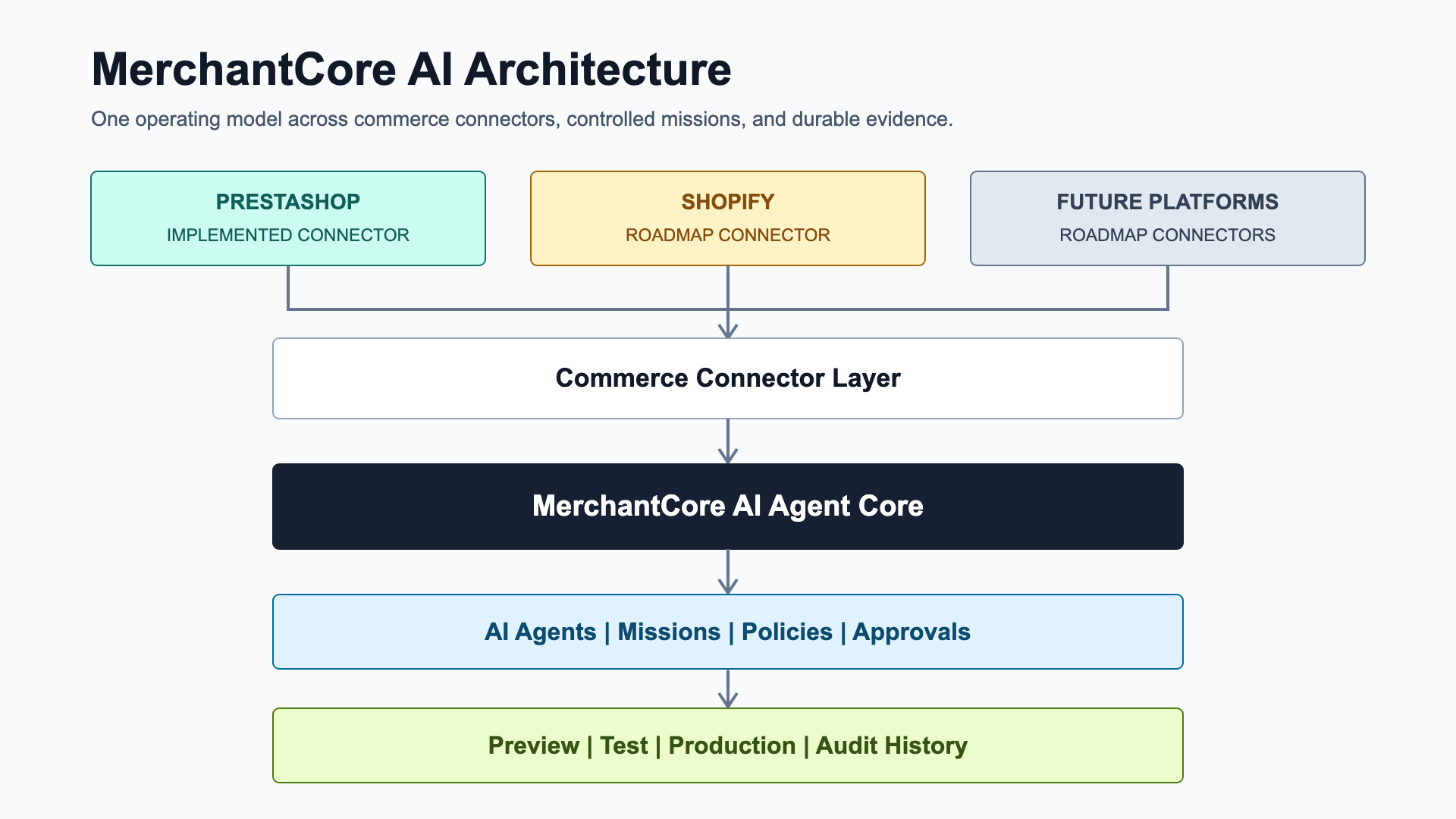
PrestaShop is implemented today, while the connector layer and open-ended Agent Core are designed to support more platforms and AI Agents.
-
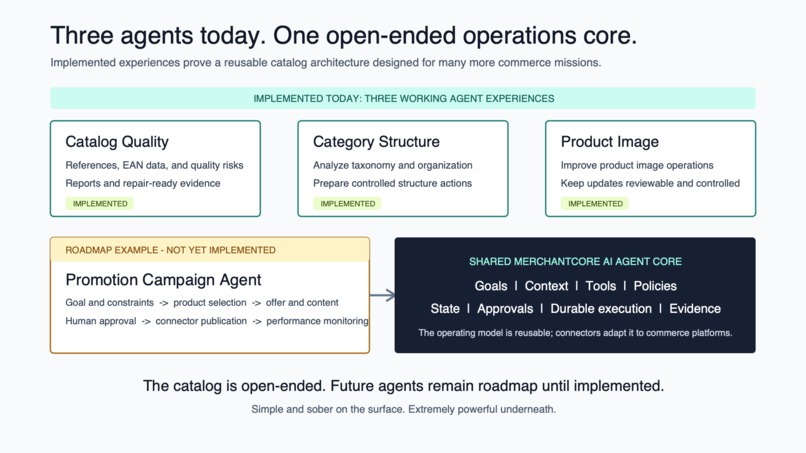
PrestaShop is implemented today, while the connector layer and open-ended Agent Core are designed to support more platforms and AI Agents.
MerchantCore AI Project Story
Inspiration
Commerce teams repeatedly face operational work that is simple in isolation but risky at scale: finding inconsistent product identifiers, repairing category structures, improving images, maintaining translations, and monitoring changes across a live store. These jobs are often handled through spreadsheets, one-purpose modules, scripts, or direct API operations. That makes it difficult to preview the impact, apply consistent controls, understand partial outcomes, or preserve reliable evidence of what happened.
We wanted to create an operating layer around commerce automation rather than another isolated utility. The guiding principle became: simple and sober on the surface, extremely powerful underneath. A merchant should be able to find the right capability, configure a mission, preview it, and understand the result without needing to think like a developer or infrastructure operator.
What it does
MerchantCore AI is an agentic operations SaaS platform for commerce merchants. It provides a searchable catalog of ready-to-run AI Agents and a personal My AI Agents workspace where teams can configure and launch controlled missions.
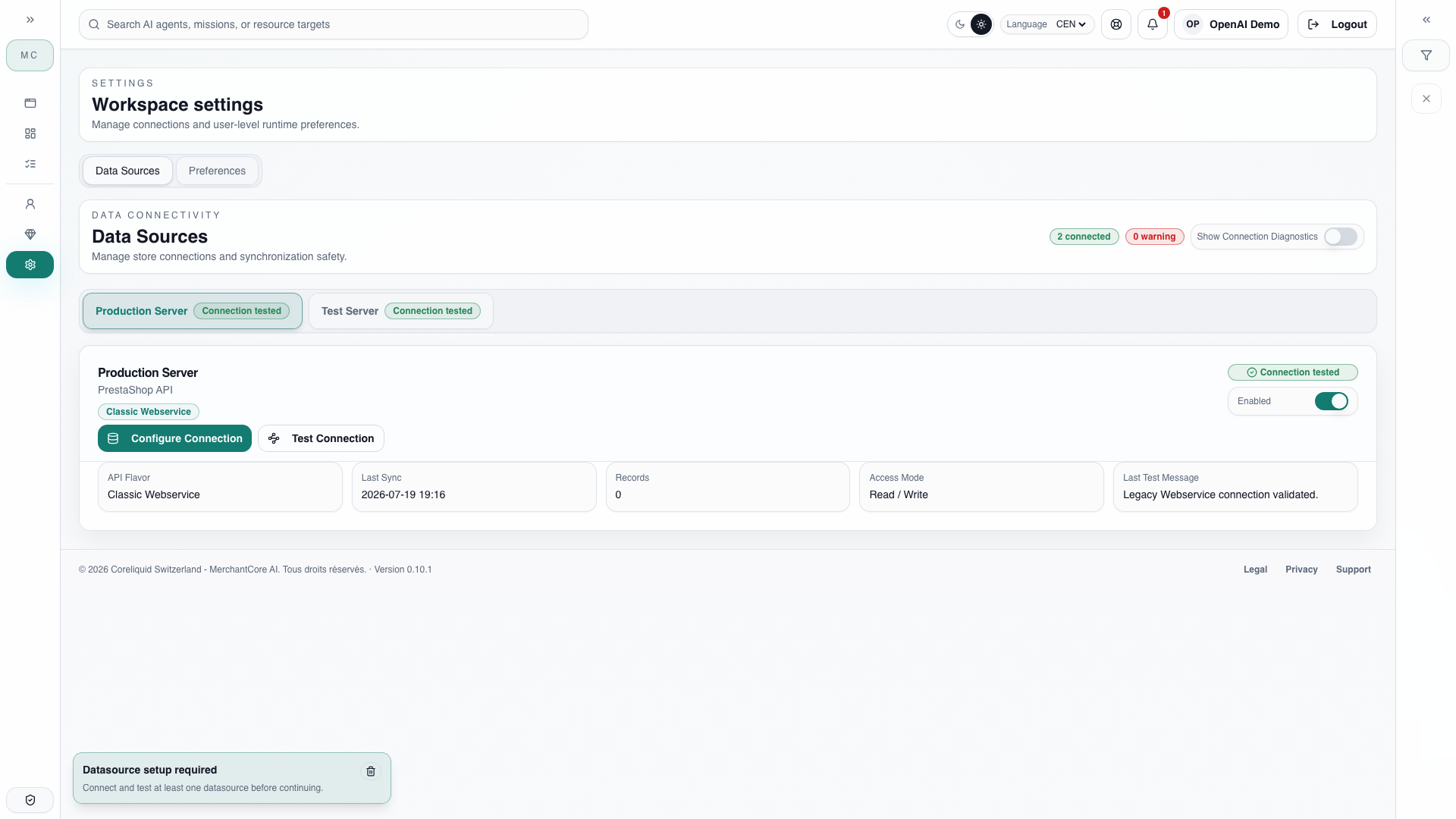
PrestaShop is the first and currently implemented commerce connector. A merchant connects and tests a store, chooses an agent, and selects an explicit Preview, Test, or Production path. Long-running missions continue in the backend while the interface reports live progress, accurate counters, technical status, and business outcome.
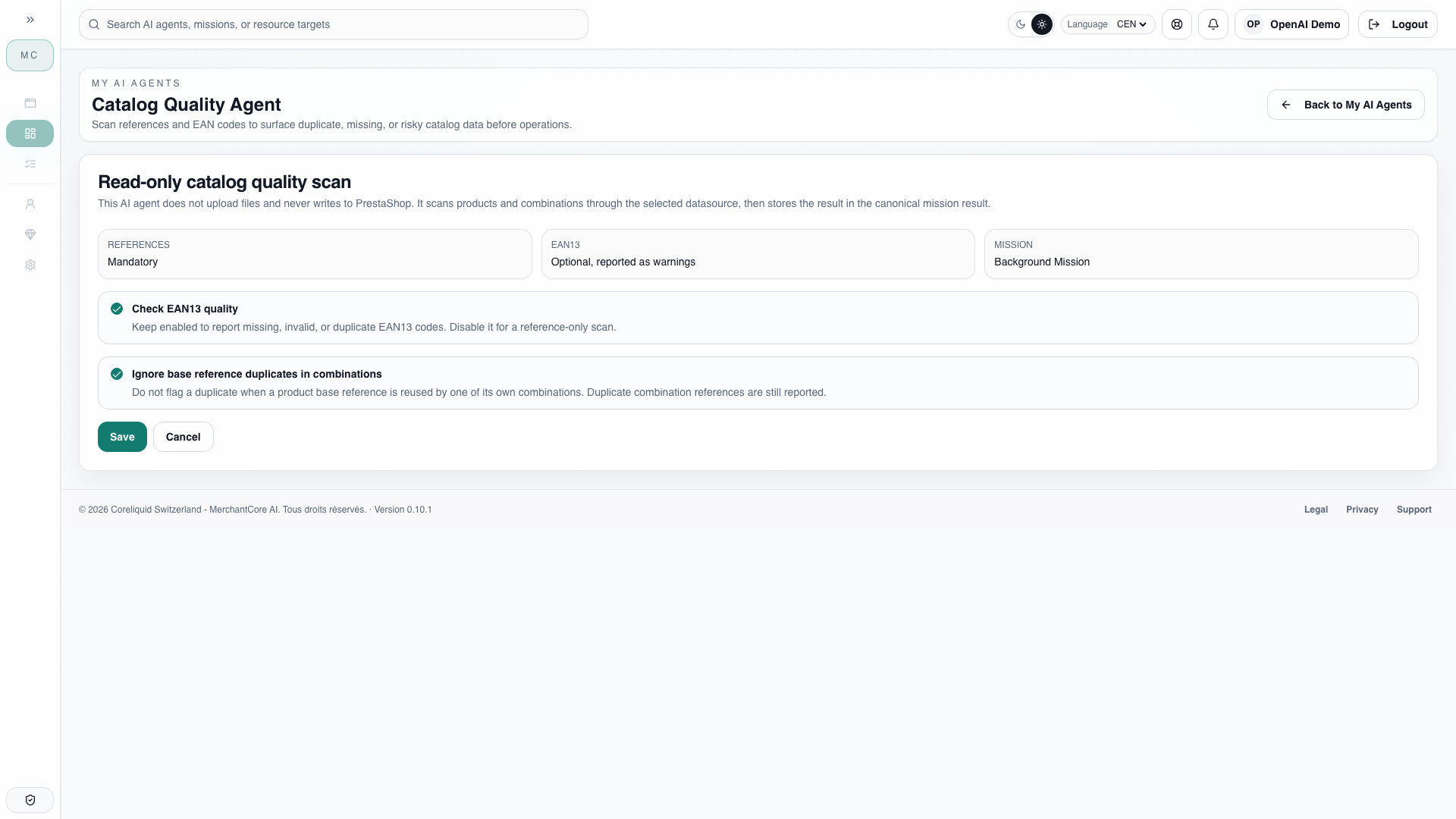
The demonstrated Catalog Quality Agent examines product references and EAN data, surfaces actionable issues, and produces both a readable PDF report and a repair-ready CSV export. MerchantCore AI also includes Category Structure and Product Image agent experiences, Mission Monitoring, detailed results and logs, immutable execution history, customer-specific agent publication, progressive rollout controls, an audited Customer View for support, account setup gating, and a multilingual TEN/CEN/country-locale architecture.
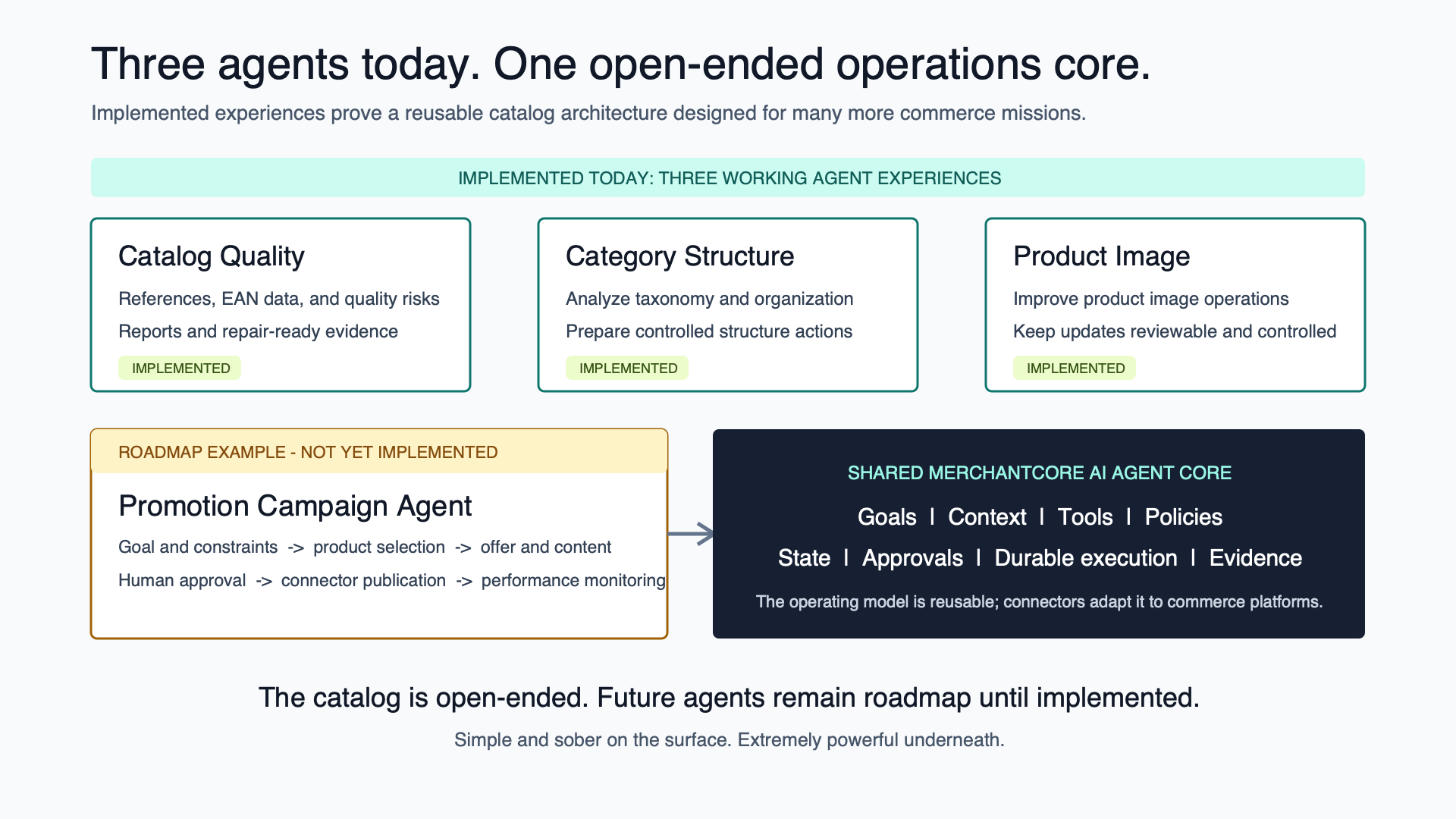
Today, the working catalog contains three AI Agent experiences: Catalog Quality, Category Structure, and Product Image. They are the first capabilities built on the platform, not a fixed product boundary. The reusable agent, mission, and publication architecture is designed for an open-ended catalog, allowing a production version to grow from three agents to many more commerce workflows without changing the merchant's core operating model.
The platform keeps important boundaries visible. A mission can complete technically while still finding catalog problems that require attention. Staff can keep an agent internal, grant it to selected customers, or publish it more broadly. Human oversight remains part of the workflow.
How we built it
The frontend is built with React, TypeScript, Vite, Tailwind CSS, Radix primitives, TanStack Query, React Hook Form, Zod, i18next, Framer Motion, Vitest, and Playwright. Django and Django REST Framework provide authentication, permissions, durable application state, APIs, reports, and audit records. Celery and RabbitMQ execute long-running missions asynchronously.
The core runtime rule is that the browser creates a mission once and then
becomes an observer. A persistent Django Job owns the mission lifecycle, the
Celery worker owns execution, and Job.summary_json.run_result is the shared
source of truth for summaries, counters, detailed findings, PDF reports, CSV
exports, and archived history. This keeps missions running even when the browser
is refreshed or closed.
The connector boundary isolates commerce-platform communication from agent logic. The current implementation uses a PrestaShop Legacy Webservice adapter; the same boundary is designed to support future connectors without changing the merchant's operating model.
Codex with GPT-5.6 was our engineering partner throughout development. It helped reconstruct and document the architecture, translate product requirements into backend models and frontend workflows, trace asynchronous bugs across the browser, Django, Celery, RabbitMQ, and PrestaShop, improve result contracts, expand regression coverage, and prepare the submission package. The current mission runtime does not claim to call an OpenAI model API; GPT-5.6 was used through Codex in the development workflow.
Challenges we ran into
The hardest challenge was maintaining one coherent truth across queued work, worker phases, connectivity failures, cancellation, live progress, aggregate counters, per-product findings, reports, and archived history. A background task being marked complete was not enough; every surface needed to agree about what actually happened.
We also had to separate technical success from business success. A catalog scan can execute without infrastructure errors and still discover dozens of problems. Treating those as different outcomes made the interface, monitoring, and reports more honest and useful.
Another challenge was balancing power with merchant trust. Preview, Test, and Production modes had to be explicit. Support access needed to be visible, permission-gated, time-limited, and audited. Agent publication needed progressive controls so unfinished capabilities could remain internal or reach selected customers first.
Finally, multilingual operations required a clear distinction between immutable Technical English, editable Custom English, and published country-specific locales, while keeping translation drift and human review manageable.
Accomplishments that we're proud of
We are proud that MerchantCore AI is a coherent full-stack product experience, not a disconnected collection of demonstrations. A merchant can discover an agent, add it to a workspace, launch a durable controlled mission, monitor it, understand both technical and business outcomes, inspect detailed evidence, and export the result for the next step.
The Catalog Quality workflow produces accurate structured findings, a readable PDF report, and a repair-ready CSV. Mission Monitoring preserves progress, results, logs, and execution context. Terminal missions can be archived into immutable history. Staff can publish agents progressively and support customers through a clearly marked Customer View without requesting their passwords.
We are also proud of the validation work around the product: focused Django, frontend, and browser tests; staging and production builds; data-source safety gating; and a submission demo based on real product behavior rather than a mocked marketing interface.
What we learned
An AI Agent needs an operating system around it. Identity, data readiness, execution environments, policies, progress, approvals, business outcomes, support access, and history are as important as the automation itself. Agentic operations become trustworthy only when those parts agree.
We learned that a reusable result contract has compounding value. When the UI, reports, exports, monitoring, and history consume the same structured result, the product becomes easier to explain, test, and extend.
We also learned that progressive publication is part of product quality. A capability can be technically available without being ready for every customer. Internal, selected-customer, and published states allow product learning without hiding the rollout decision.
Codex was most valuable as a persistent engineering collaborator: exploring a large codebase, challenging assumptions, connecting behavior across layers, and turning discoveries into implementation and tests rather than stopping at advice.
What's next for MerchantCore AI
PrestaShop remains the implemented foundation. Next, we plan to expand the connector layer to Shopify and other commerce platforms, add more AI Agents, and introduce richer approval policies, rollback workflows, scheduling, and operational safeguards.
The long-term catalog is intentionally open-ended. New agents can target additional catalog, content, marketing, monitoring, data-quality, and operational workflows. Rather than defining a fixed maximum number of agents, MerchantCore AI provides the shared mission controls, publication rules, results, and audit layer needed to keep expanding the catalog safely.
We also plan an Agency workspace where one account can manage multiple merchant customers and store connections while preserving strict customer boundaries, permissions, approvals, and audit history.
The Translation Studio's current review-first CSV exchange is designed for later OpenAI API automation while keeping human review mandatory. Additional work will include PostgreSQL production validation, stronger secret-at-rest protection, broader integration coverage, and continued extraction of reusable mission runtime components.
The long-term goal is a growing operations platform where commerce teams can add new stores, connectors, and agents without learning a new control model each time: connect, choose an agent, preview, run, monitor, and retain the evidence.

Log in or sign up for Devpost to join the conversation.