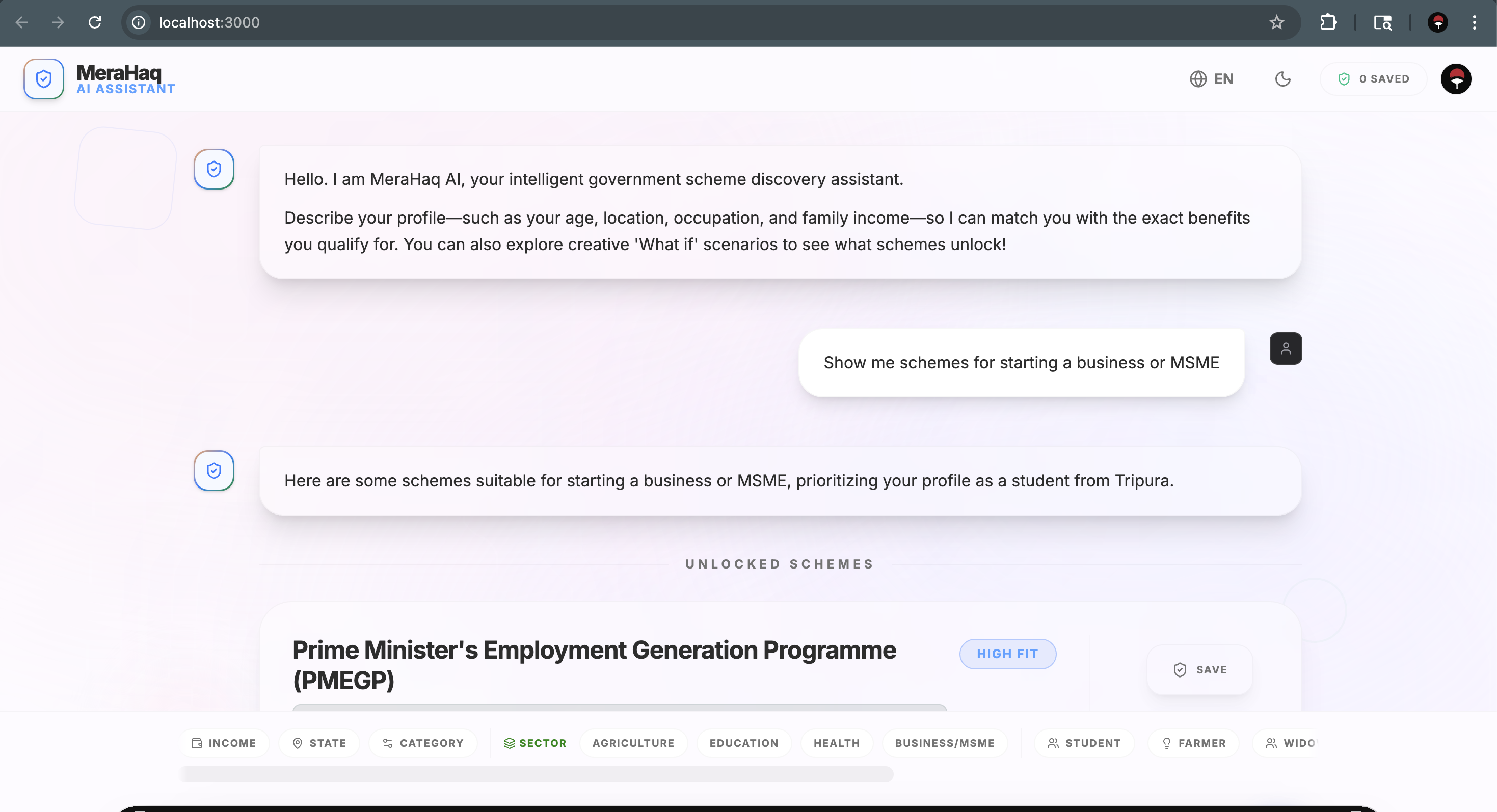
Inspiration Millions of citizens in India are unaware of the beneficial government schemes designed specifically for them. Even if they are aware, navigating the complex eligibility criteria, required documents, and fragmented application portals is incredibly overwhelming. We wanted to build an accessible, intelligent companion to bridge this gap, ensuring every citizen can easily discover and claim their rightful benefits—hence the name "MeraHaq" (My Right). What it does MeraHaq AI is a personalized, AI-powered civic assistant that dynamically matches citizens with relevant government schemes based on their demographic profile (Age, Gender, Caste/Category, State, Income, and Occupation). Users can chat naturally with the AI or use smart suggestion chips to find benefits in sectors like Agriculture, Education, Health, and MSME. The AI doesn't just list schemes; it provides a structured, step-by-step application guide, a fit score, expert tips to improve approval chances, and direct links to official documentation and application portals. Users can also save schemes to their personal dashboard for future reference. How we built it We designed a mobile-first, highly animated user interface using React, TypeScript, and Tailwind CSS. For smooth micro-interactions and transitions, we utilized Framer Motion. The core intelligence of the application is powered by the Google Gemini API (Gemini 2.5 Flash). We engineered a contextual prompt system that feeds the user's saved profile data into the AI in real-time, allowing Gemini to filter schemes and generate personalized, structured JSON responses containing detailed application steps. The entire backend—including secure Google Sign-In and database management for user profiles and saved schemes—is handled seamlessly by Firebase (Authentication & Firestore). Challenges we ran into One of the most significant challenges was crafting the perfect system prompts for the Gemini AI so it reliably outputs structured, parseable JSON data (for the Scheme Cards and Application Steps) instead of raw conversational text. Additionally, managing the context window to ensure the AI remembers the user's profile details (Income, Caste, State) while dynamically switching between different scheme domains required careful state management. Designing a mobile interface that handles dense, text-heavy government information without overwhelming the user also took several design iterations. Accomplishments that we're proud of We are incredibly proud of the seamless conversational interface that feels like talking to a knowledgeable guide rather than filling out a boring, endless form. The dynamic generation of application steps alongside practical AI-driven tips sets a new benchmark for accessible e-governance. We also successfully built a beautiful, robust frontend that feels premium, fluid, and highly responsive. What we learned Building MeraHaq AI gave us deep insights into leveraging Large Language Models (LLMs) for structured data generation and contextual conversational UX. We learned how to effectively utilize the Gemini API for highly specific tasks and gained valuable experience in designing inclusive UI patterns in React that handle complex data flows, user states, and asynchronous AI calls gracefully. What's next for MeraHaq AI Moving forward, we plan to implement multilingual support to cater to all Indian regional languages and add voice-to-text input to make the app accessible to citizens with lower literacy levels. We also want to integrate an AI-powered document scanner that can verify if a user has all the required documents ready before they even start their application. Finally, we aim to integrate push notifications to alert users when a newly announced government scheme matches their profile.
MeraHaq AI
MeraHaq AI:Claim What's yours
Updates

Leave feedback in the comments!
Log in or sign up for Devpost to join the conversation.