

Inspiration
Short-form videos make every skill look deceptively simple: a perfect omelette flip, a stable yoga pose, a smooth guitar strum. But when we try it ourselves, we quickly realize that mimicry without feedback leads nowhere. There is no guidance, no correction, and no progress tracking. MENURA was created to close that gap. We wanted a world where learning from videos isn’t passive watching but active, AI-guided improvement. A world where your phone or laptop becomes a personal coach that evolves with every attempt.
What it does
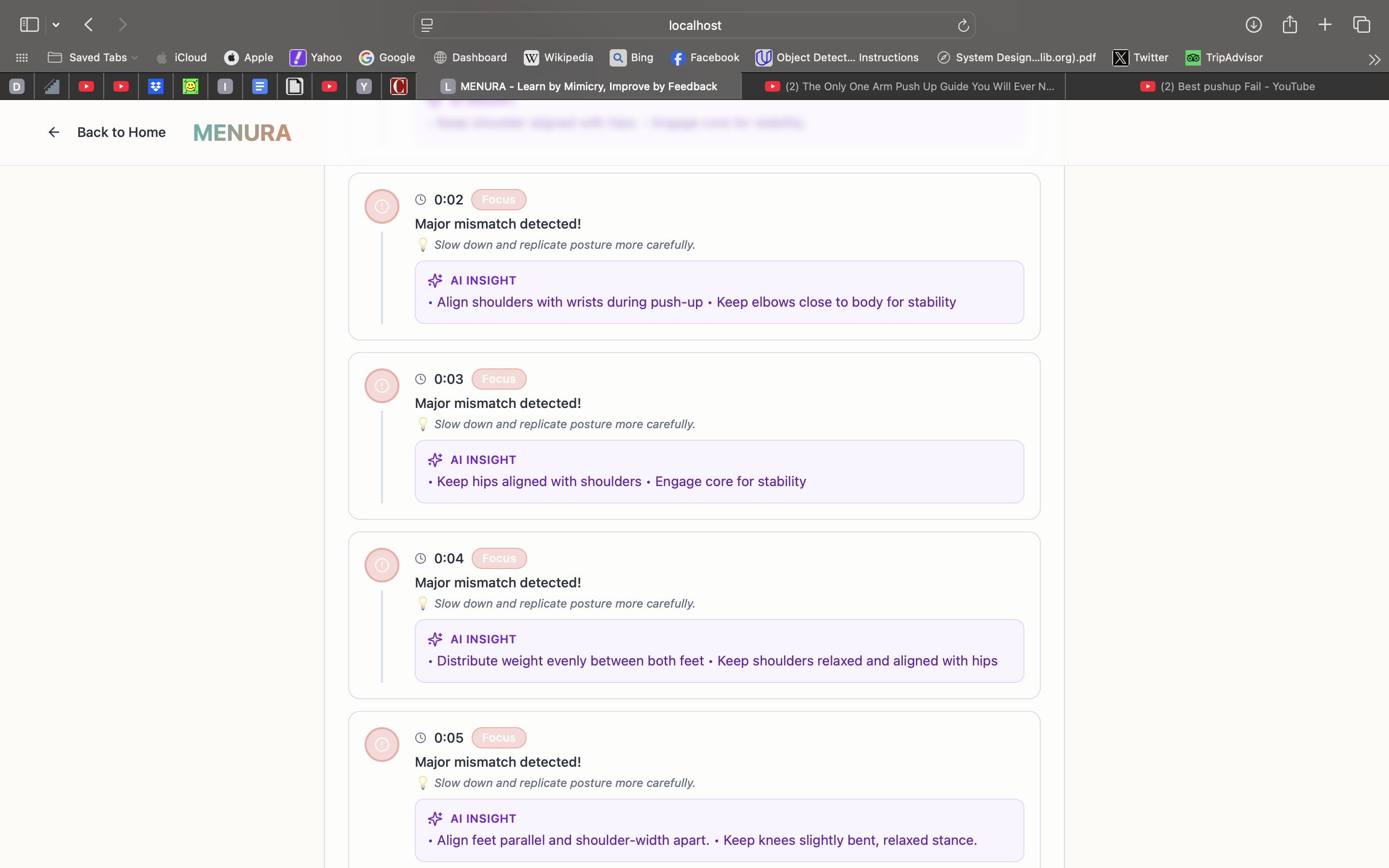
MENURA takes an expert reference video and compares it to the user’s attempt using a multimodal analysis pipeline. It performs: Frame-level SSIM structural similarity Pose and motion inference Visual and temporal alignment scoring Automatic feedback generation using a self-evolving AI agent It then returns: Timestamped feedback Posture and movement corrections Timing and speed adjustments Clear, concise improvement notes MENURA gets smarter the more it is used. User attempts feed back into a learning pool that refines future suggestions and strengthens the feedback model.
How we built it
We engineered MENURA as a fully modular, multimodal learning pipeline. The frontend was built using React, with a design system inspired by modern, minimal learning interfaces. We used assets and visual elements from LinkUp and Freepik to maintain a polished, cohesive brand identity throughout the platform. The backend is powered by Node.js and integrates OpenAI’s multimodal reasoning models to generate detailed insights from video comparisons. SSIM structural similarity, pose estimation, and motion analysis were implemented to evaluate how closely a user’s attempt matches the expert reference. To support adaptation over time, we designed a lightweight feedback memory layer that stores recurring patterns, common mistakes, and frequently seen corrections. This allows MENURA to evolve its guidance as more users interact with the system. The architecture follows a clean pipeline: Upload → Decode → Compare → Analyze → Generate Feedback → Improve. This approach ensures that MENURA remains accurate, responsive, and self-improving as it processes more data.
Challenges we ran into
Tuning SSIM thresholds so that the model distinguishes meaningful mismatches without overreacting to lighting or background changes. Aligning frame timelines between reference and attempt videos with different lengths or speeds. Managing multimodal reasoning latency while keeping feedback generation fast. Building a feedback memory system that improves over time without introducing noise or bias. Designing a clean, intuitive UI that works consistently across devices and different media types. Accomplishments that we're proud of A fully functioning end-to-end learning coach that compares videos and generates meaningful, actionable feedback within seconds. A self-evolving agent that improves automatically as more users interact with it. A clean UX that makes the process of uploading, comparing, and practicing smooth and engaging. Building a system that feels personal, adaptive, and useful from the very first attempt.
What we learned
How to build a multimodal feedback system combining structural similarity, pose analysis, and a reasoning model. How to design a pipeline that balances accuracy with speed, especially under tight hackathon constraints. How to create a feedback layer that improves as more attempts are processed. The importance of UI clarity in motivating users to practice and iterate. That learning products need both precision and warmth to be effective.
What’s next for MENURA – Mimic AI
Expand to support audio mimicry (singing, pronunciation, instrument tuning) with waveform-based similarity. Build a public dataset of common mistakes and corrections to further enhance the self-evolving agent. Add mobile-first recording and real-time comparison. Introduce community-driven challenges and skill pathways. Support professional coaching modes for sports, music, and creator training. Develop a fully local, privacy-preserving model for on-device feedback.


Log in or sign up for Devpost to join the conversation.