-
-
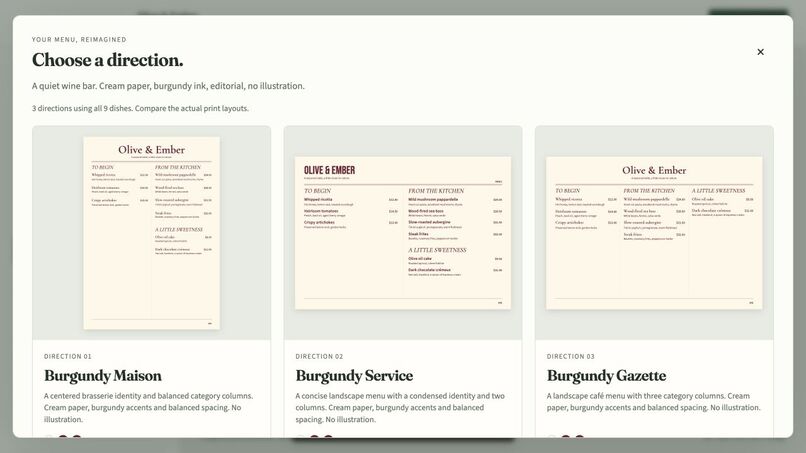
Actual Menu Atelier print directions for the original Olive & Ember menu.
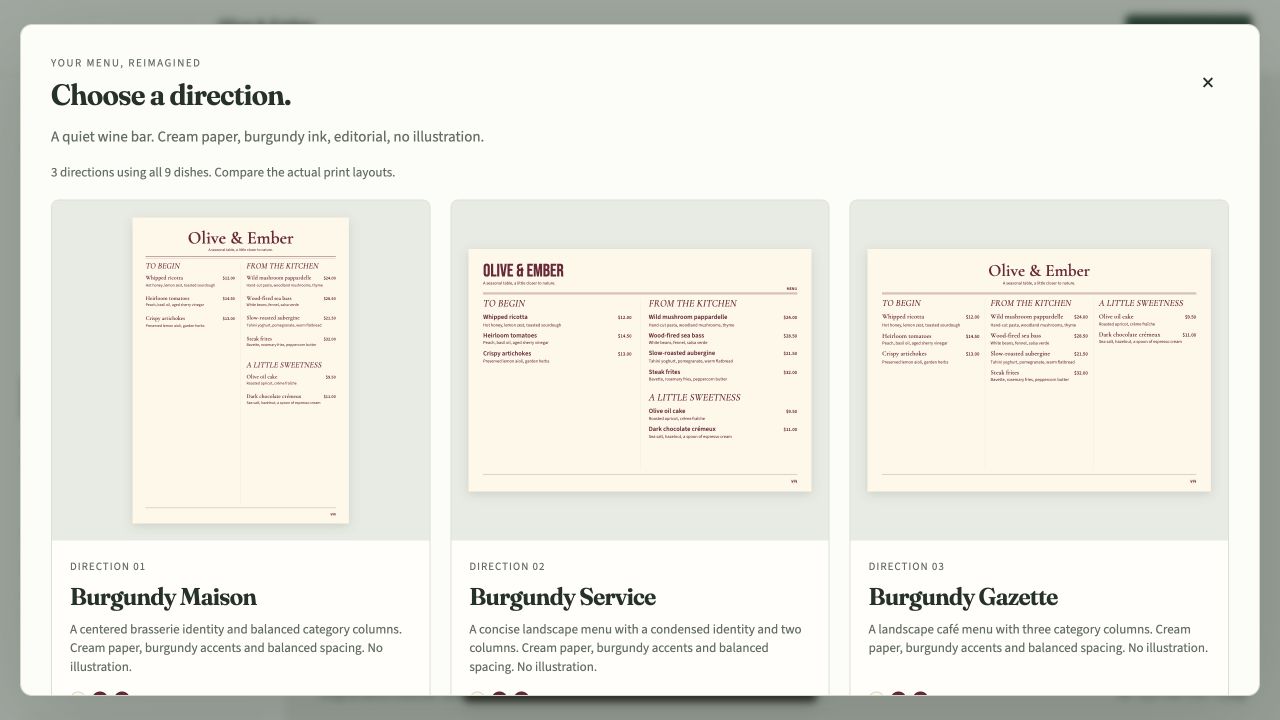
Inspiration
Restaurant owners need to change dishes and prices without rebuilding a menu from scratch. Menu Atelier started with a concrete idea: import an existing menu, turn it into an editable print design, make a real price change, and export a usable PDF.
What it does
Upload or paste menu content, then review the extracted dishes and prices. Explore typographic print directions, edit a printed price directly, and export a PDF with selectable text and embedded fonts. A JSON backup preserves the menu and selected design recipe. Undo and browser storage support later updates.
The demo uses the original fictional Olive & Ember menu. Whipped ricotta changes from $12.00 to $14.50 and keeps that amount after a layout change and PDF export.
How it was built
The browser application uses JavaScript, HTML and CSS, pdf-lib, fontkit, PDF.js and Tesseract.js. Prices are stored as integer minor units. The SVG preview and native PDF share measured text records from the same font bytes. Design recipes stay separate from authoritative menu facts.
The current print system has full-width Italian rows, balanced brasserie columns and landscape category layouts. Brief-based generation is a bounded local design grammar. It does not call a language model or invent arbitrary layouts. No generated images are used in the current release.
Use of the Devpost Learn Skill Pack
The required Skill Pack guided the scope, PRD, specification, build slices, verification and shipping preparation. The unique kernel was a real editable price change that survives PDF export. The public repository includes scope.md, prd.md, spec.md, the build checklist and the application map.
The entrant supplied the idea, reviewed the visual outputs and directed iterations. An AI coding assistant implemented and revised the code and checks. This was an AI-assisted development project, rather than an app claiming runtime AI inference. The narrated demonstration uses edited captures of the actual application and a synthetic voice.
Challenges and findings
Several visual iterations did not meet the entrant's design expectations. The latest candidate replaces poster layouts with an editorial print grammar. Its taste remains open to review. The build also exposed the need to measure against the selected paper stock and actual embedded fonts. Import review is essential because OCR and arbitrary PDF columns can misread prices.
Working result
The current build passes 43 checks covering source preservation, PDF text and geometry, prices, pagination, import recovery, recipes, undo and backup restoration. Physical browser PDF downloads were inspected to confirm edited amounts. These checks establish bounded correctness, not a design award or universal OCR accuracy.
Next steps
Add an authorized runtime model art director, expand script and font coverage, and test with restaurant owners using their own full menus. The current core workflow runs without an API key.
Newgen Labs is a solo team. Source snapshots in the optional restaurant studies are attributed and unofficial. The public demo uses only the original fictional menu.
