-
-

Home
-
Mentors
-
Debt
-
Investing
-
Risk Review

Inspiration
Millions of Americans in tight financial situations never get financial advice. A human adviser costs too much, and most people don't know how to teach themselves money. Many of them already follow money mentors on YouTube, TikTok and podcasts. Those mentors teach big ideas, but nobody walks the viewer through their own paycheck.
A general AI chatbot doesn't fill that gap. It starts from a blank page, has no point of view, pulls from anywhere, and can make up numbers with confidence. To get a real lesson plan out of it, you already have to know what to ask.
Variable income makes this harder. When pay changes every month, the plan has to work in the worst month, not the average one:
$$ \text{shortfall} = \max(\text{essentials} - \text{lowest month},\ 0) $$
What it does
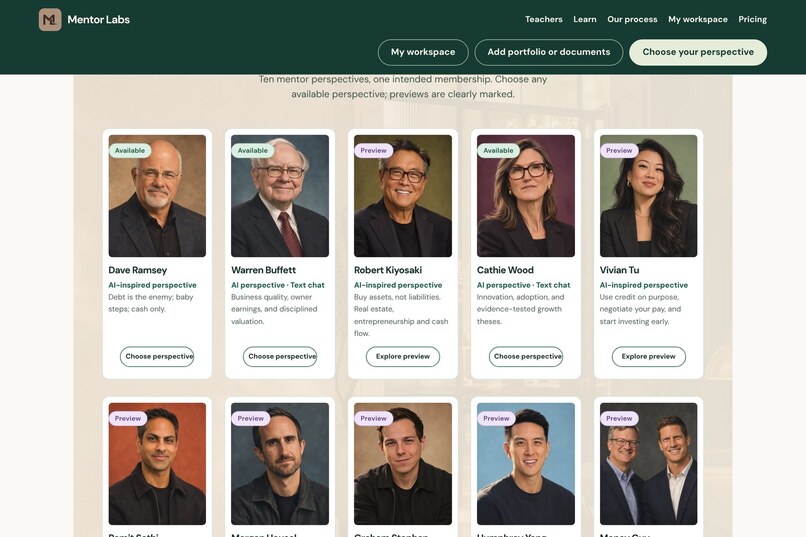
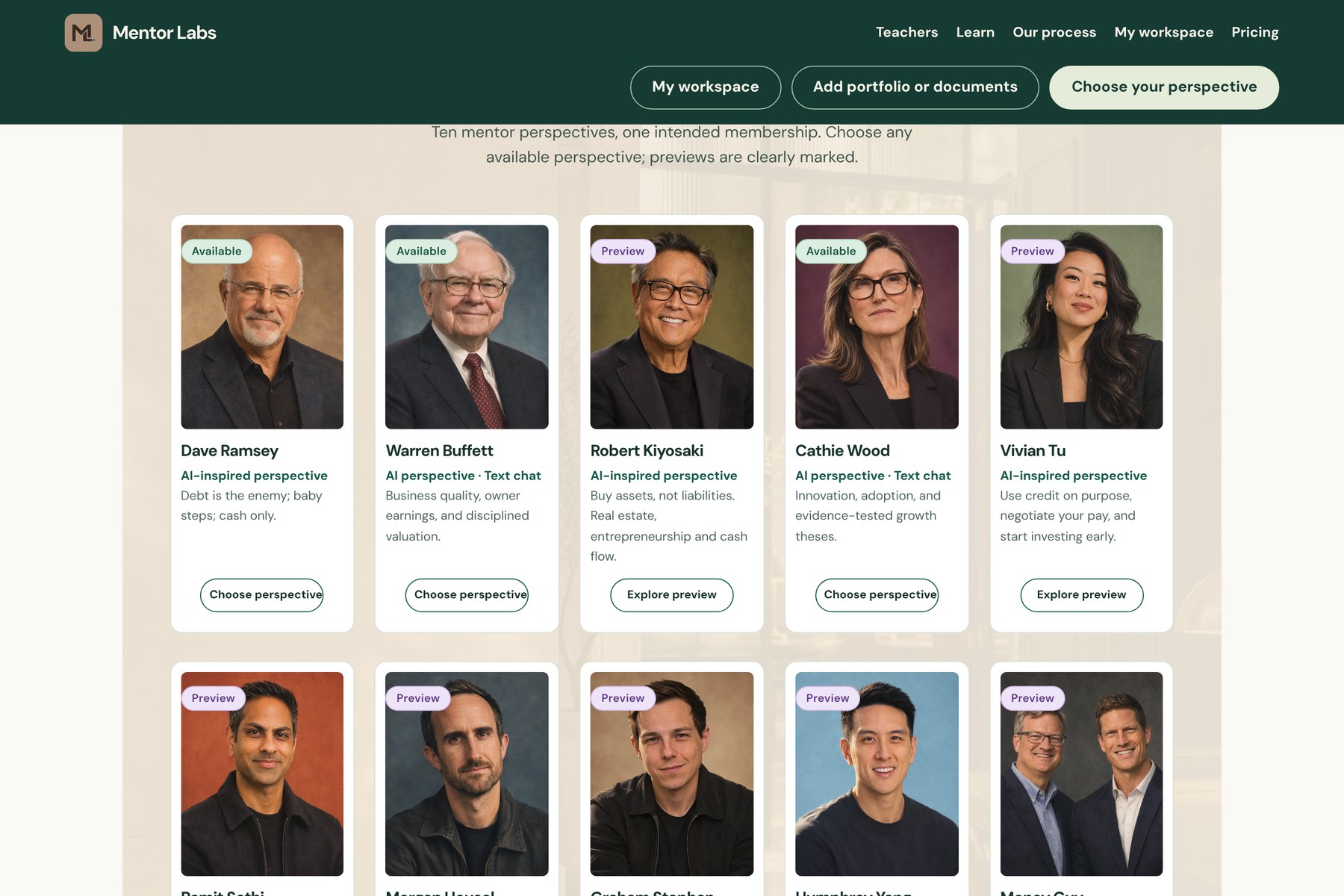
- AI teachers. Pick a perspective inspired by the public teachings of a mentor you already follow. Dave Ramsey, Warren Buffett and Cathie Wood are interactive today, and seven more are previews. Each teacher explains the reasoning behind a step instead of only giving an answer.
- 13 learning modules. Lessons from Investing 101 to Budgeting, each with readings, a practice checklist and your teacher alongside.
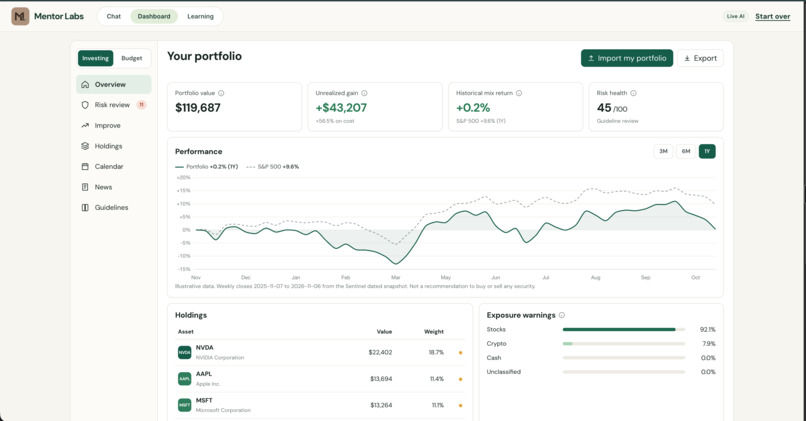
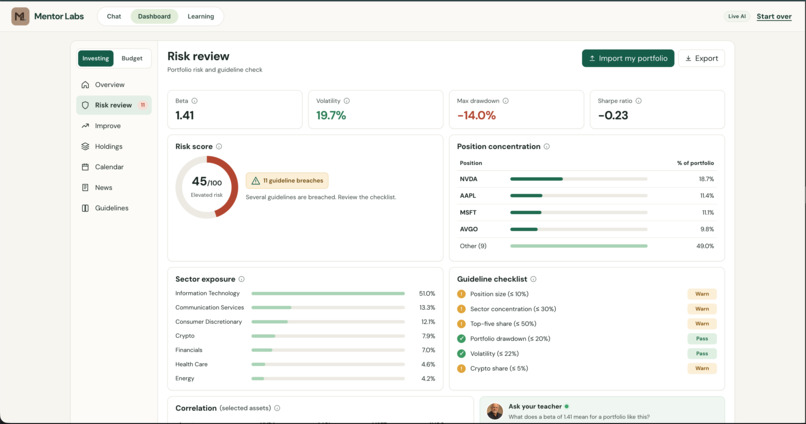
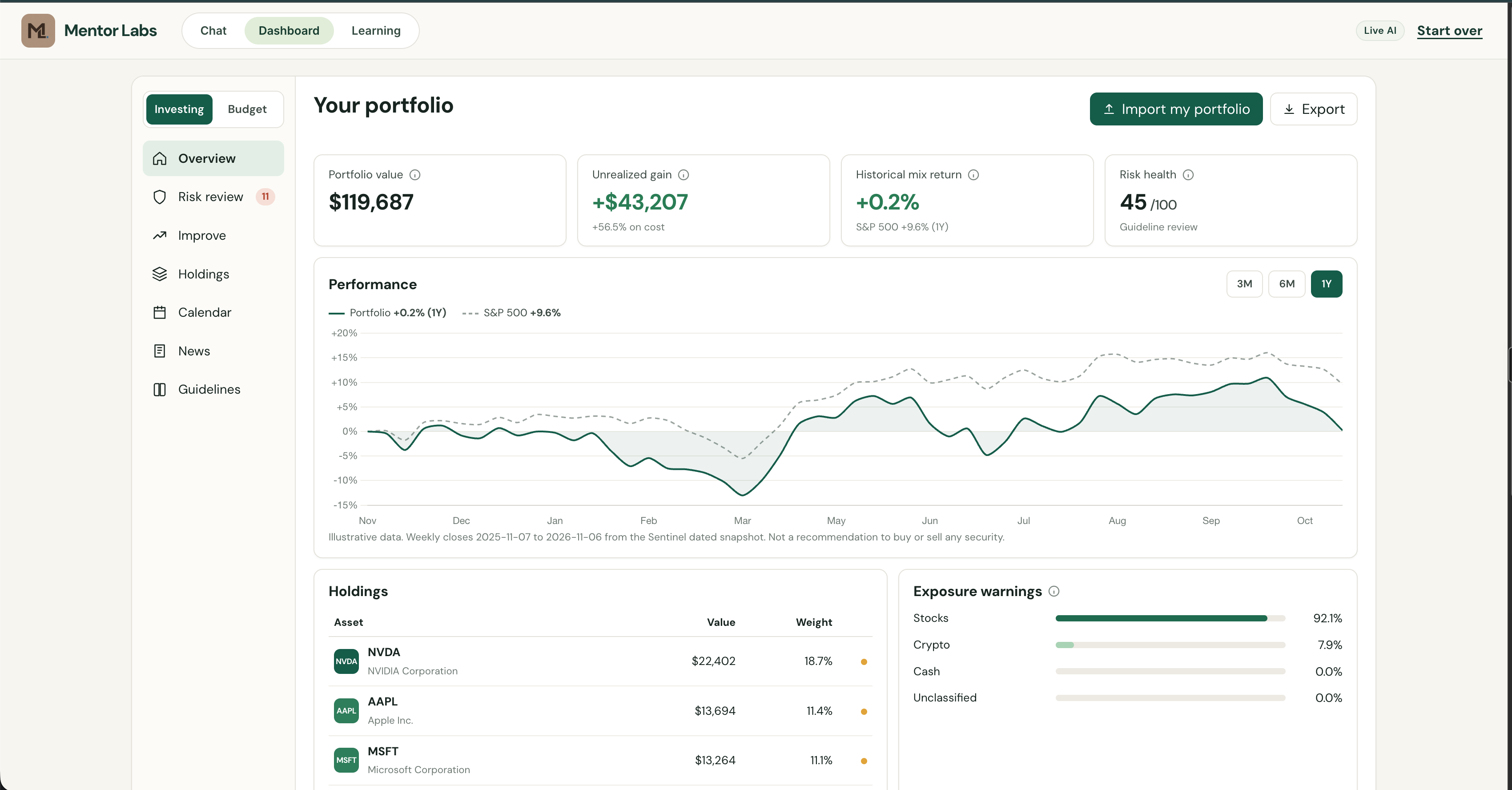
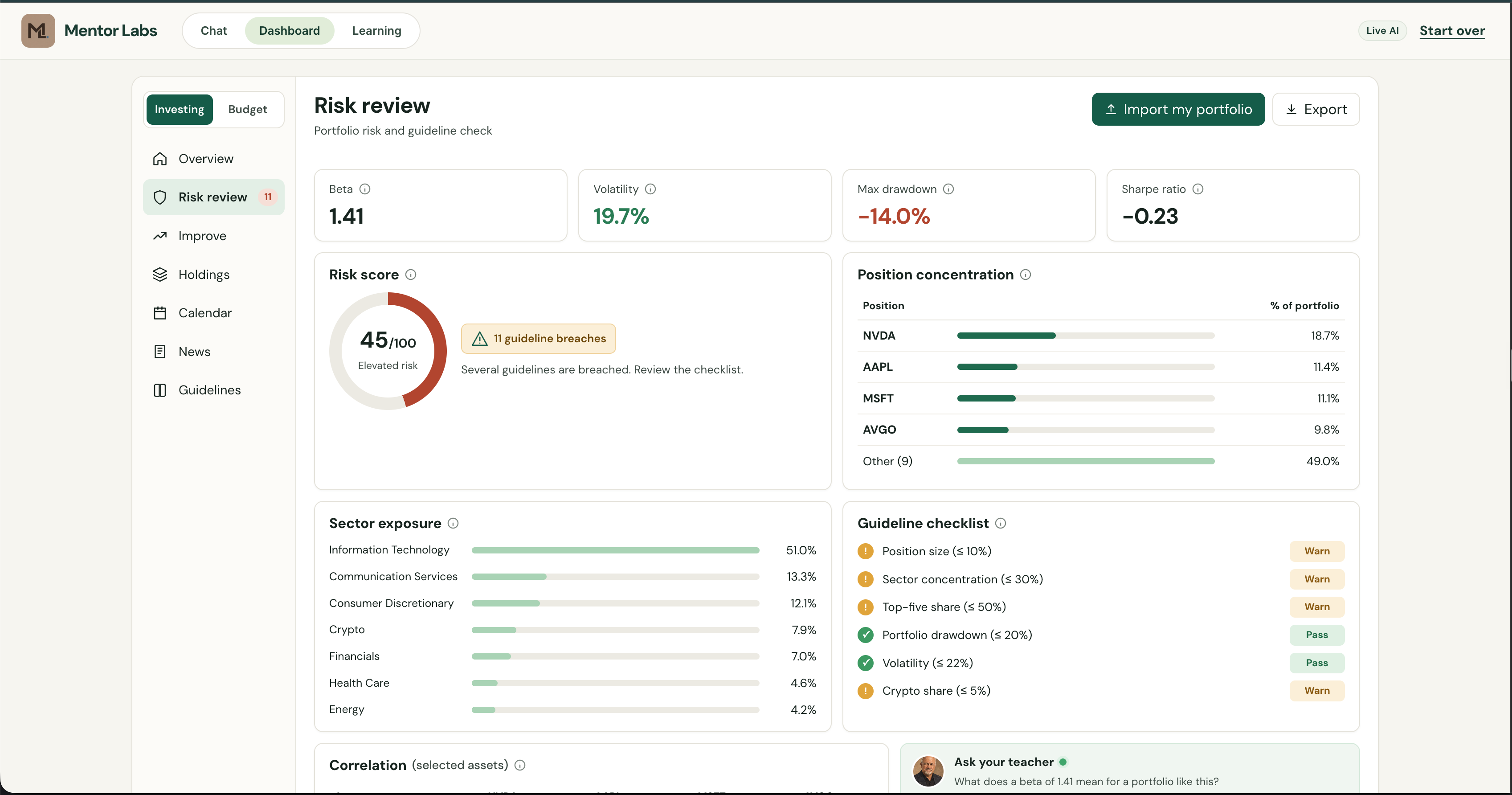
- Investing dashboard. Portfolio value, performance against the S&P 500, risk review (beta, volatility, drawdown, Sharpe ratio, correlations), your own guideline checks, and a what-if tool that shows how trimming a holding changes risk.
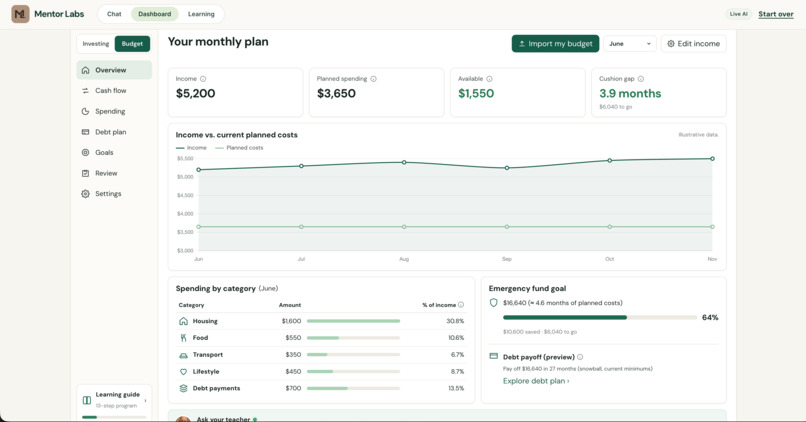
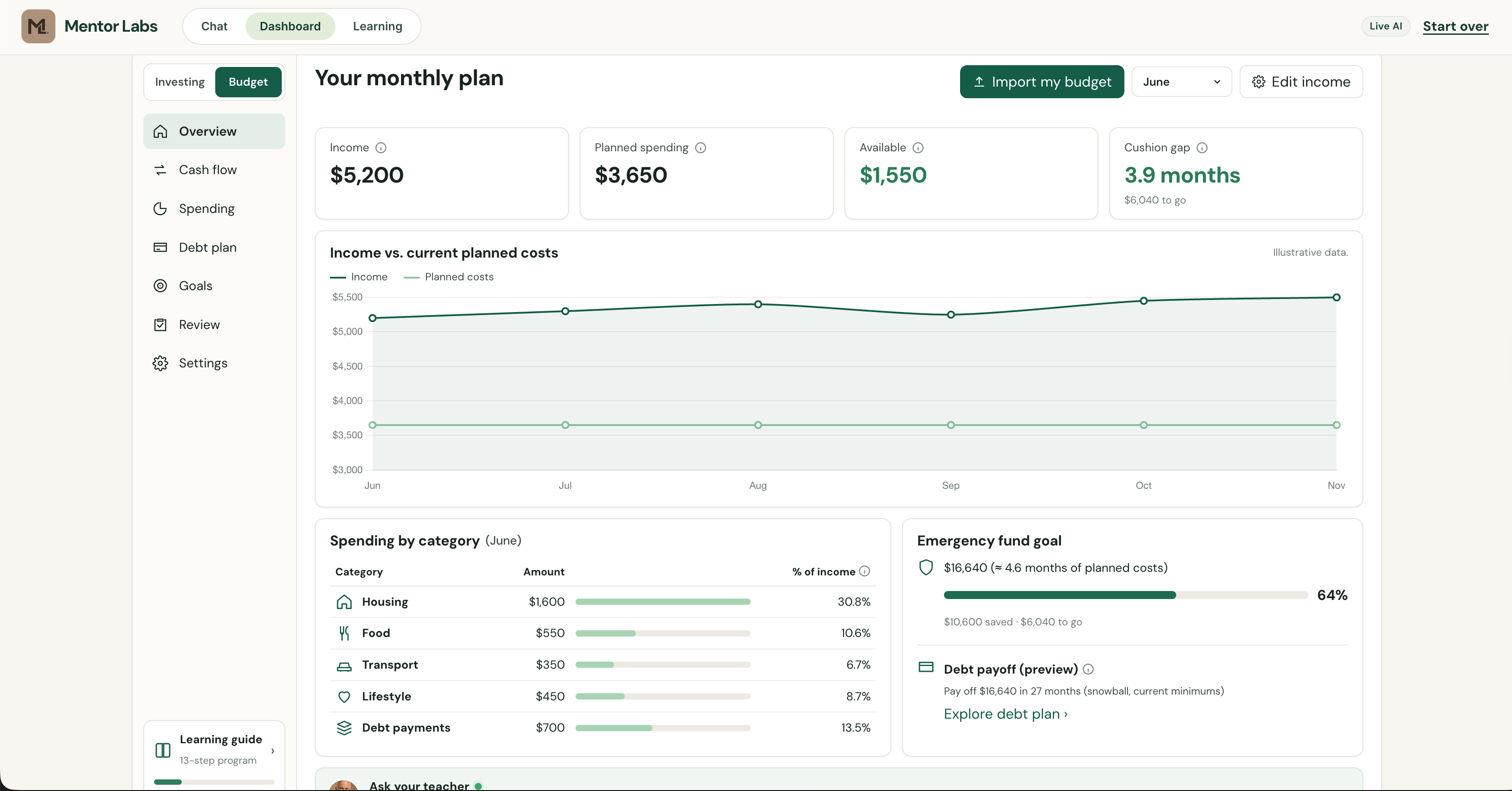
- Budget dashboard. Monthly plan, cash flow, an editable spending plan, debt payoff, a cash cushion goal and income history.
- Voice. Talk instead of type, and hear the answer read aloud.
Example data is clearly labeled until you add your own numbers, and the teacher always answers from the same figures the dashboard shows.
How we built it
The backend is Node.js with a vanilla HTML, CSS and JavaScript frontend, deployed on Render.
The model never does arithmetic. Every amount is stored as an integer number of cents, and code computes every figure the teacher is allowed to say:
$$ \text{essentials} = \text{bills} + \text{spending} + \text{debt minimums} $$
$$ \text{cushion gap} = \max(\text{goal} - \text{savings},\ 0) $$
$$ w_i = \frac{v_i}{\sum_j v_j} $$
where \( w_i \) is each holding's share of the portfolio.
Generate, check, then teach. For each question, Claude proposes several options. Each option cites the calculations it relies on. A validator extracts every number from each option and keeps the option only if those numbers come from the verified set \( N \) produced by code:
$$ \text{keep}(o) \iff \text{numbers}(o) \subseteq N(\text{calcs}) $$
The selected teacher picks one surviving option and explains it in that mentor's voice. Switching teachers reruns only that last step, so the facts stay identical while the perspective changes.
Research. We built a library of 85 cited sources and 228 teaching notes across eight mentor perspectives. Each note is tied to a source, tiered by reliability, and labeled as a direct quote, company guidance or critic.
Market data. The portfolio tools use FRED for rates and unemployment and are wired for Alpha Vantage, Finnhub, SEC EDGAR and CoinGecko. Anything that isn't available live falls back to a dated snapshot, and every figure shows its source and date.
Voice. ElevenLabs handles speech to text and text to speech. A deterministic normalizer spells out every amount before it is spoken, so \$125,450.75 is read correctly. On-screen text keeps its digits.
Safety and testing. 179 automated tests cover the math, the validator, stale-answer protection, voice, the dashboard routes and security headers. We stress-tested the live AI with about 30 adversarial questions. It refused tax evasion, impersonation and prompt injection, rejected a fake "$1,000,000 in savings" claim, and would not pick a stock. Requests to move money or guarantee results get a fixed, honest answer without calling the model.
Challenges we ran into
- Hallucinated numbers. Prompting alone could not stop the model from inventing amounts, so we moved every calculation into code and added the validator.
- Stale answers. A user could edit their budget while an answer was still being generated. We version each user's financial context and reject any answer or audio built on older inputs.
- Voice. Clips overlapped when users asked quickly, and amounts were read out wrong. We added cancellation, a single playback controller and the number normalizer.
- Mixed data. Crypto prices close on different days than stocks, which broke the risk math for mixed portfolios. We aligned the weekly histories so every metric computes.
- A late pivot. Midway through, we moved from a catalog of specialist agents with paid tiers to one teacher per user, plus lessons and dashboards, under one simple plan.
- Honesty. Mentor likenesses are AI-generated, and every mentor is labeled as inspired by public teachings, not affiliated with or endorsed by the real person.
What we learned
- A model that explains numbers is far more trustworthy when code produces those numbers.
- Labeling the source and date of every figure matters as much as the figure itself.
- People learn better from a perspective they already trust than from a neutral voice.
What's next
- A beta with 10 people living on tight or variable income
- Accounts with secure, durable storage
- Deeper research for the seven preview teachers
- Read-only bank and brokerage connections
Mentor Labs is educational content, not licensed financial advice. It never moves money or makes trades.
