-
-
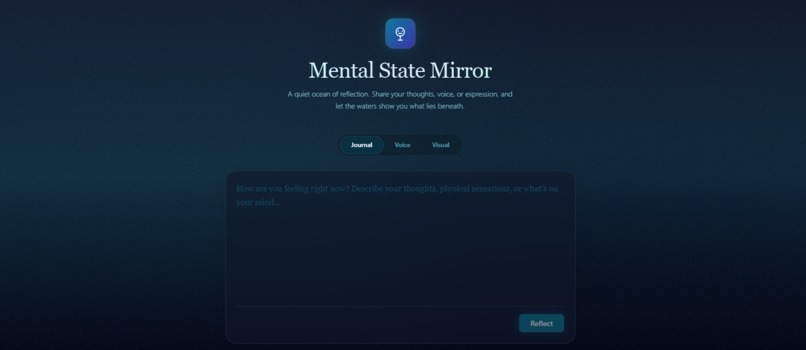
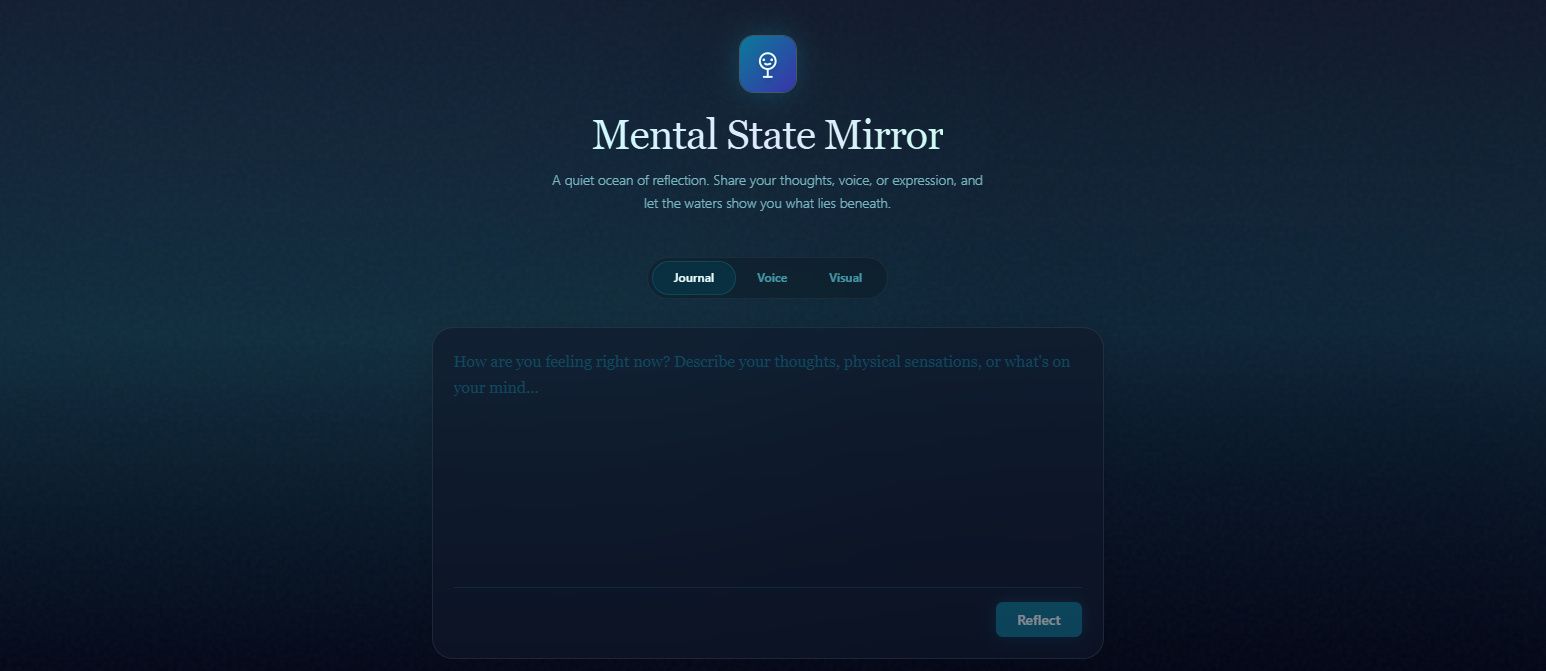
interface of the website
Inspiration
Many mental health tools focus on labelling, diagnosing, or “fixing” how people feel. However, often the hardest part isn’t treatment—it’s simply understanding what’s happening internally. Journals, voice notes, and reflections can reveal patterns that are difficult to see from the inside.
As a person who struggles with mental health issues, I was inspired to explore a quieter role for AI: not as a judge or expert, but as a mirror. Mental State Mirror was created to help people notice emotional patterns in their own words and experiences, without defining them or telling them what to do. By avoiding diagnosis, this approach can be applied broadly across everyday reflection tools rather than being limited to clinical settings.
What it does
Mental State Mirror is a reflective AI application that helps users gain emotional clarity by mirroring patterns present in their reflection. Users can share a short reflection (text, and optionally audio or image), and the system responds with:
- a calm, non-judgmental reflection written as observations
- explicit observable cues that explain why the reflection was generated
- a structured breakdown of emotional signals and cognitive load
- an optional, gentle grounding suggestion
The application avoids diagnoses, clinical labels, and prescriptive advice. Instead, it focuses on helping users better understand how their experience might feel in the moment. By making emotional patterns visible and explainable, Mental State Mirror helps users build awareness without relying on labels or clinical framing. This reflective approach can scale across journaling apps, educational tools, and wellness platforms without requiring clinical framing or oversight.
Gemini Integration (~200 words write-up)
Mental State Mirror is built around Gemini 3’s ability to reason about ambiguity, metaphor, and emotional context—capabilities that simpler sentiment or classification models cannot provide. Gemini 3 serves as the core intelligence layer, analysing user input and generating structured, explainable reflections that support emotional self-awareness without diagnosing or prescribing.
Gemini 3 is used to infer emotional signals and cognitive patterns from language and context, including tone, repetition, metaphor usage, and external references (such as environment or conditions). Rather than producing free-form responses, the model is guided by a carefully designed system instruction and a strict response schema. This ensures that every output clearly separates observed cues, reasoning transparency, and the user-facing reflection.
Exaggerated or metaphorical language is explicitly interpreted as expressive emphasis unless the user states otherwise. This demonstrates Gemini 3’s ability to reason beyond literal interpretation and respond with nuance and restraint.
The application was prototyped in Google AI Studio to rapidly iterate on Gemini 3 behaviour, safety boundaries, and probabilistic language. The same behaviour is reproduced in a portable implementation using the Gemini API for transparency and reproducibility.
Mental State Mirror highlights how Gemini 3 can be used responsibly in sensitive domains by prioritising explainability, restraint, and human-centred reasoning over classification or diagnosis.
Challenges I ran into
One of the main challenges was balancing emotional sensitivity with technical clarity. Early outputs were emotionally accurate but sometimes too definitive or intense. Refining the system prompt to consistently use probabilistic language, handle metaphors safely, and avoid over-interpretation required careful iteration.
Another challenge was designing a UI that surfaced reasoning without overwhelming users. I had to decide what belonged in the model output versus what should remain a presentation-layer choice.
Accomplishments that I am proud of
- Designing a strict, schema-driven Gemini output for a sensitive use case
- Making Gemini’s reasoning visible and explainable, not hidden
- Handling metaphorical and exaggerated language safely and intentionally
- Building a polished, calm UI that reflects the project’s philosophy
- Demonstrating responsible AI design rather than just a conversational interface
What I learned
I learned that powerful AI systems don’t need to be loud or directive to be impactful. Small design choices—such as separating observation from interpretation, or explaining why a response was generated—significantly change how users experience AI.
I also learned how critical prompt design and output structure are when working with advanced reasoning models like Gemini 3, especially in emotionally sensitive domains.
What's next for Mental State Mirror
Next steps include:
- expanding multimodal support with more robust audio and image pipelines
- adding optional user controls to tune the level of reflection or detail
- conducting usability studies to refine explainability and tone
- exploring integrations where reflective AI could support education, wellness check-ins, or creative journaling—without replacing human care Mental State Mirror is an exploration of how AI can support understanding rather than judgment, and Gemini 3 made that possible.
Built With
- ai-studio
- gemini
- html
- react
- typescript
- vite

Log in or sign up for Devpost to join the conversation.