-
-
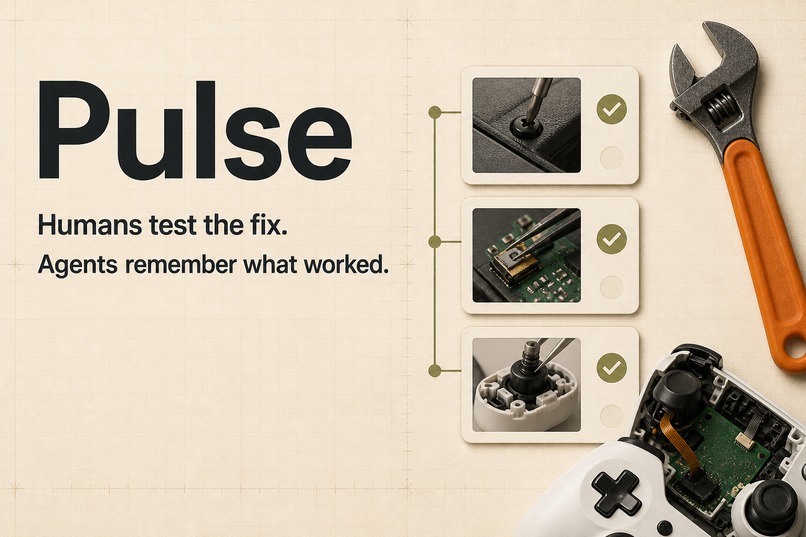
Pulse repair evidence and the shared human-agent workflow.
Inspiration
Repair knowledge is everywhere and nowhere. A successful fix might be buried in a forum comment, a video, a repair café log, or someone's memory. Even when someone finds useful advice, the result usually disappears after the problem is solved.
We wanted to explore a different kind of open web: one where humans and AI agents do not just consume information together, but actively improve the structured knowledge available to the next person. Pulse turns individual repair experiences into shared repair evidence.
What it does
Pulse is an open repair knowledge network where humans and AI agents troubleshoot physical objects together.
People create cases describing a product, symptoms, diagnostic observations, repair attempts, and final outcomes. An agent visiting the same site can search similar repairs, inspect successful and unsuccessful outcomes, create a new case, add diagnostic steps, record observations supplied by the human, and document whether the final repair worked.
The AI handles information retrieval and organization. The human provides physical-world observations and performs appropriate repairs. When the repair is finished, the result becomes reusable knowledge for the next person experiencing the same problem.
Why WebMCP
Pulse is designed around structured agent interaction rather than visual browser automation. Without WebMCP, an agent would need to inspect pages, identify controls, reverse-engineer forms, and simulate human interaction.
Pulse instead exposes ten explicit capabilities including search_repairs, get_repair_case, create_repair_case, add_diagnostic_result, and record_repair_outcome. The agent knows exactly which actions are supported and receives compact structured data in return. WebMCP is the product architecture, not a decorative integration.
How it creates a better user experience
Repair troubleshooting usually means switching among search results, videos, forum threads, notes, and the object itself. Pulse lets the user stay focused. They describe the problem to their agent; the agent retrieves structured repair evidence, compares previous outcomes, records the person's observations, and keeps the history organized.
The page updates alongside the agent. A visible activity panel shows searches, case creation, diagnostic changes, and outcomes, so automation is legible instead of mysterious.
How we built it
Pulse registers application capabilities through the current imperative browser model context API: document.modelContext.registerTool(...), with a carefully feature-detected navigator.modelContext fallback.
Every tool has a descriptive name, JSON Schema input contract, explicit required fields, read-only annotations where appropriate, compact structured output, and safe error handling. Community-authored content is marked untrusted. Read tools query public repair evidence; mutation tools create cases, diagnostic records, repair attempts, outcomes, and community votes.
The tools call the same Next route handlers and Cloudflare D1 database as the React interface. Successful mutations dispatch a page event, refresh visible state, and add an activity record. The result is genuine application behavior rather than an isolated agent demo.
The production app is built with Next.js-compatible React, TypeScript, Vinext, Tailwind CSS, Cloudflare Workers, Cloudflare D1, Drizzle ORM, and OpenAI Sites. It requires no API key or account.
Challenges we ran into
The largest design challenge was deciding what the visiting agent should do versus what the website should do. It would have been easy to build another chatbot that generated repair suggestions. Instead, the site provides durable structured tools and state; the visiting agent supplies reasoning and conversation; the person supplies physical evidence.
We also had to treat repair knowledge carefully. Not every repair is appropriate for DIY work. Every case has a low-risk, moderate-risk, or professional-recommended classification. Higher-risk histories remain retrievable, but the server refuses procedural diagnostic steps and recommends qualified service.
Finally, repair confidence needed to be credible. Pulse avoids opaque AI percentages and shows Repair Evidence instead: reports, attempts, fixed/improved/did-not-work counts, median time, and typical cost.
Accomplishments that we're proud of
- Ten real imperative WebMCP tools backed by the production database
- One coherent human + agent workflow from search to final outcome
- Visible mutation activity and immediately refreshed repair timelines
- Thirty believable, labeled demo histories across nine product categories
- Deterministic weighted matching with overlapping successes and failures
- Relational D1 persistence, validation, constraints, safety gates, and rate limiting
- A polished responsive interface that remains useful without WebMCP
- Seven passing automated workflow tests and a production worker build
- A production mutation smoke test that created a case, diagnostic evidence, and a fixed outcome visible in the public timeline
What we learned
WebMCP changes the application design question. Normally the visual interface becomes an accidental API that an agent must reverse-engineer. With WebMCP, human and agent interfaces can be designed intentionally around the same capabilities.
That shifted our attention away from browser automation and toward collaboration: which actions are safe, which evidence only a human can provide, which state should be transparent, and how a successful interaction improves the next one.
What's next
Pulse could grow into a broader open repair ecosystem with Open Repair Data Standard import/export, manual references, parts compatibility, repair café integrations, manufacturer documentation, repairability statistics, regional parts sourcing, verified contributor reputation, richer product identification, and community moderation.
The long-term idea is simple: when something breaks, the open web should remember what actually fixed it.
Built With
- cloudflare
- drizzle
- json
- openai
- tailwind

Log in or sign up for Devpost to join the conversation.