-
-

Mendosan app icon
-

Mendosan starts at Step 1. Add the things you’ve been putting off, and Mendosan will carry them for you.
-

As tasks pile up or stay untouched, Mendosan grows bigger. This is Step 5, the largest size — and Mendosan is calling for help.
-
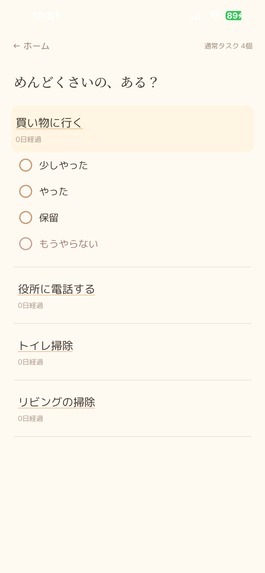
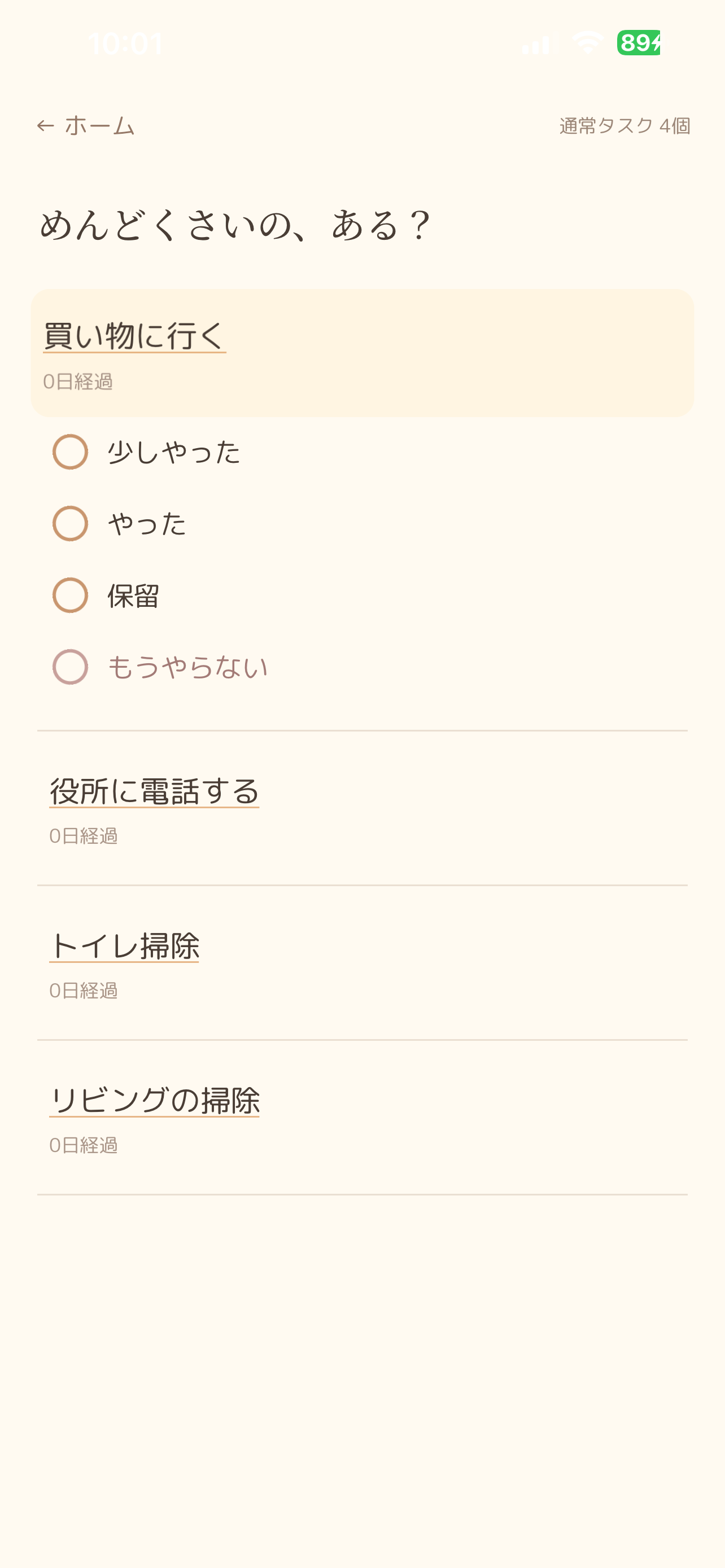
Each task has four simple choices, including “Did a Little” — because sometimes a little is all you managed today.
-

When all your tasks are gone, Mendosan doesn’t level up — Mendosan peacefully ascends to heaven.
-

After Mendosan ascends, a little god appears with a comment. Encouragement, but without too much praise.
-
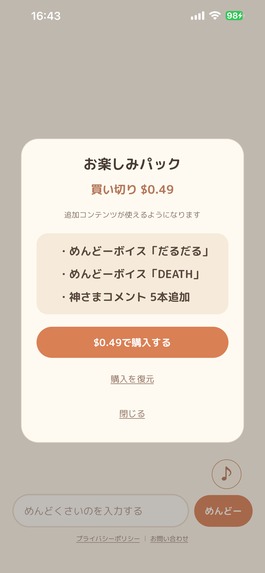
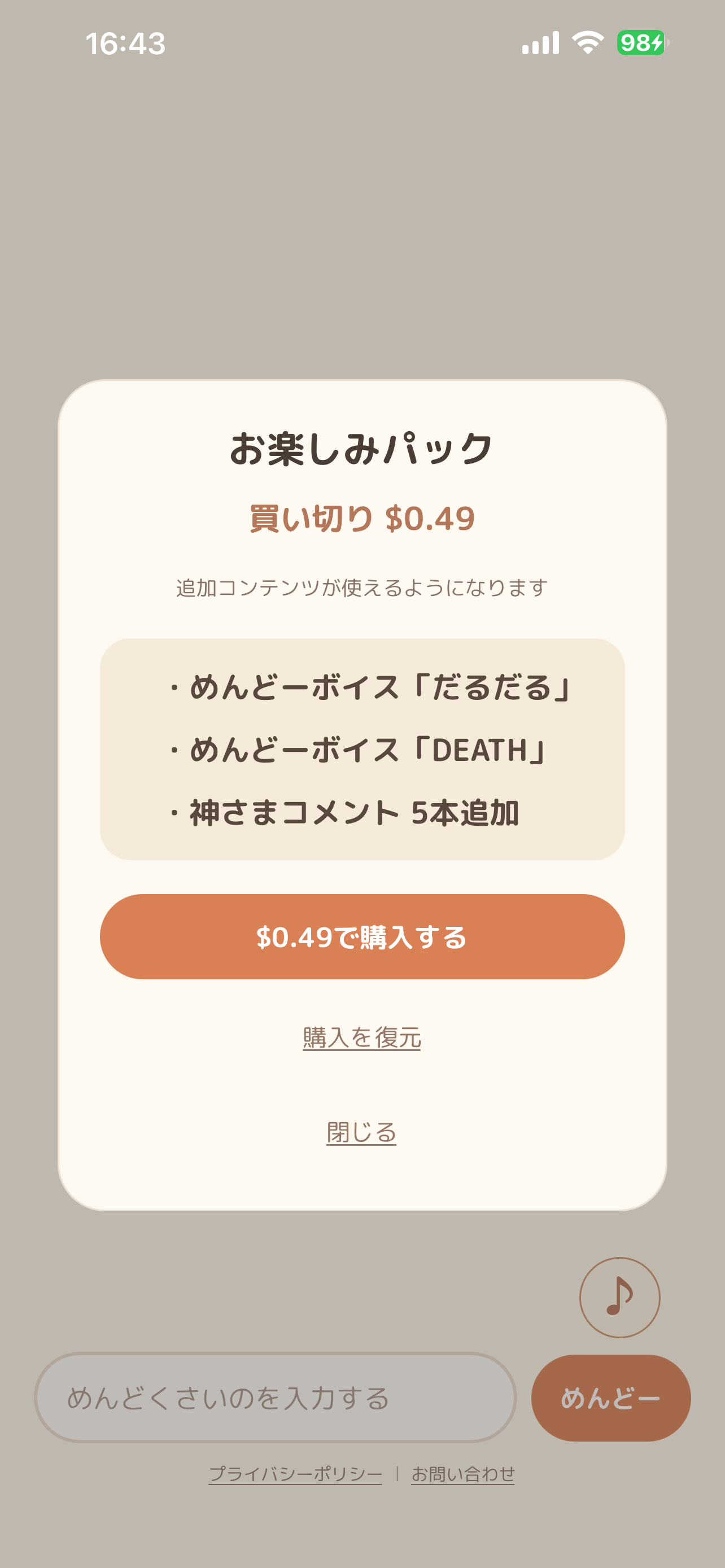
The one-time Fun Pack, powered by RevenueCat, unlocks two extra Mendosan voices and five additional god comments.





Inspiration
I’ve never been a big fan of to-do apps.
You add tasks, set deadlines, and track progress with percentages or points. They’re supposed to make life easier, but for a procrastinator like me, managing the list itself can become yet another task.
So I started with a simple idea: an app that gives you just enough of a nudge to get up — even if it's only three centimeters.
I wasn’t trying to change anyone’s life or dramatically boost productivity. I just wanted to create a small nudge to help someone finally start one of those things they had been putting off.
At first, I built something closer to a conventional to-do app. It worked, but I didn’t find it fun to use. Instead of adding more features, I changed the idea: what if all those neglected tasks were carried by a single character?
That’s how Mendosan was born.
The name “Mendosan” comes from the Japanese word mendokusai. It describes that everyday feeling of “ugh, I really don’t want to deal with this” or “this is such a hassle.” I turned that feeling itself into a character.
What it does
As tasks pile up or remain untouched for longer, Mendosan grows bigger through five stages.
For each task, users can choose from four actions: “Put on Hold,” “Did a Little,” “Done,” or “Won’t Do.”
When all the tasks are gone, instead of leveling up, Mendosan peacefully ascends to heaven.
There are no points, completion percentages, or streaks. Instead, changes in the character, the voice, and comments from a little god create a sense of “What will happen next?” — a small bit of fun that can help nudge the user into action.
How we built it
I had no programming experience and no Mac. Using a Windows PC and an iPhone, I built the iOS app with Expo / React Native while working with AI through conversation.
I moved the initial web prototype to React Native / Expo and repeatedly tested it on my iPhone. Whenever something worked technically but felt wrong, I changed it.
Audio was one example. I first tried Text-to-Speech, but it didn’t match the character voice I imagined, so I recorded and processed my own voice instead.
For the App Store release, I used EAS Build and TestFlight. After launch, I integrated RevenueCat and added a one-time purchase called the “Fun Pack,” which unlocks extra voices and additional comments from the little god.
Challenges we ran into
The hardest part wasn’t writing code itself. It was constantly encountering things I had never seen before.
For example, Japanese text input caused a bug where unconfirmed IME characters remained in the input field after a task was added, and simply clearing the input value didn’t solve it.
Since Windows doesn’t have the iOS Simulator, testing on a real iPhone became especially important. Just before release, an Expo Go SDK update also pushed me into learning EAS, Git, Apple certificates, and Development Builds all at once.
Real-device testing uncovered many other issues that only became obvious once the app was actually running: overlapping elements, image flickering, and timing problems with sounds and animations.
Along the way, I also learned that development means deciding not only what to fix, but what must be fixed before release and what can wait for the next version.
Accomplishments that we're proud of
Using a Windows PC, an iPhone, and AI, I completed an iOS app, released it on the App Store, and then implemented in-app purchases with RevenueCat.
I also didn’t stop at “it works.” If the character movement, voice, wording, or overall feel seemed wrong when I used the app myself, I kept revising it.
My biggest accomplishment is turning the original idea — giving people just enough of a nudge to get up, even if it’s only three centimeters — into a real product that people can download and use.
What we learned
AI wrote code, investigated problems, and explained technologies I didn’t know.
But as I kept building, I realized something:
Even if AI writes the code, I’m still the one who has to decide what I want to make.
If something worked but felt wrong, I stopped and changed it. If an AI instruction seemed strange, I questioned it. I tested changes on the actual device and decided what to fix — and what not to fix — before release.
At one point, I even noticed that the AI was giving me instructions to modify something that didn’t exist in the implementation yet, and stopped it.
I went from thinking, “I can’t build this because I don’t know how,” to realizing, “Even if I don’t know how yet, I can think, test, learn, and make decisions as I build.”
That was the biggest thing I learned from this project.
What's next for めんどーさん / Mendosan
I want to make Mendosan even more engaging as a character.
I’d like to expand the voices, sounds, character transformations, and comments from the little god, so that opening the app feels less like “managing tasks” and more like wondering, “What’s going to happen to Mendosan?”
As people use the app, I’ll keep improving it as a task app for people who don’t want to feel like they’re managing tasks.
Built With
- asyncstorage
- expo.io
- ios
- react-native
- revenuecat
- testflight
- typescript

Log in or sign up for Devpost to join the conversation.