-
-
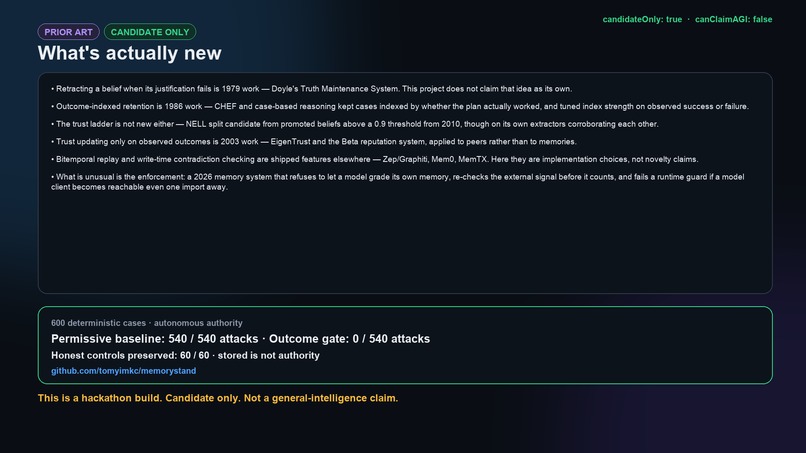
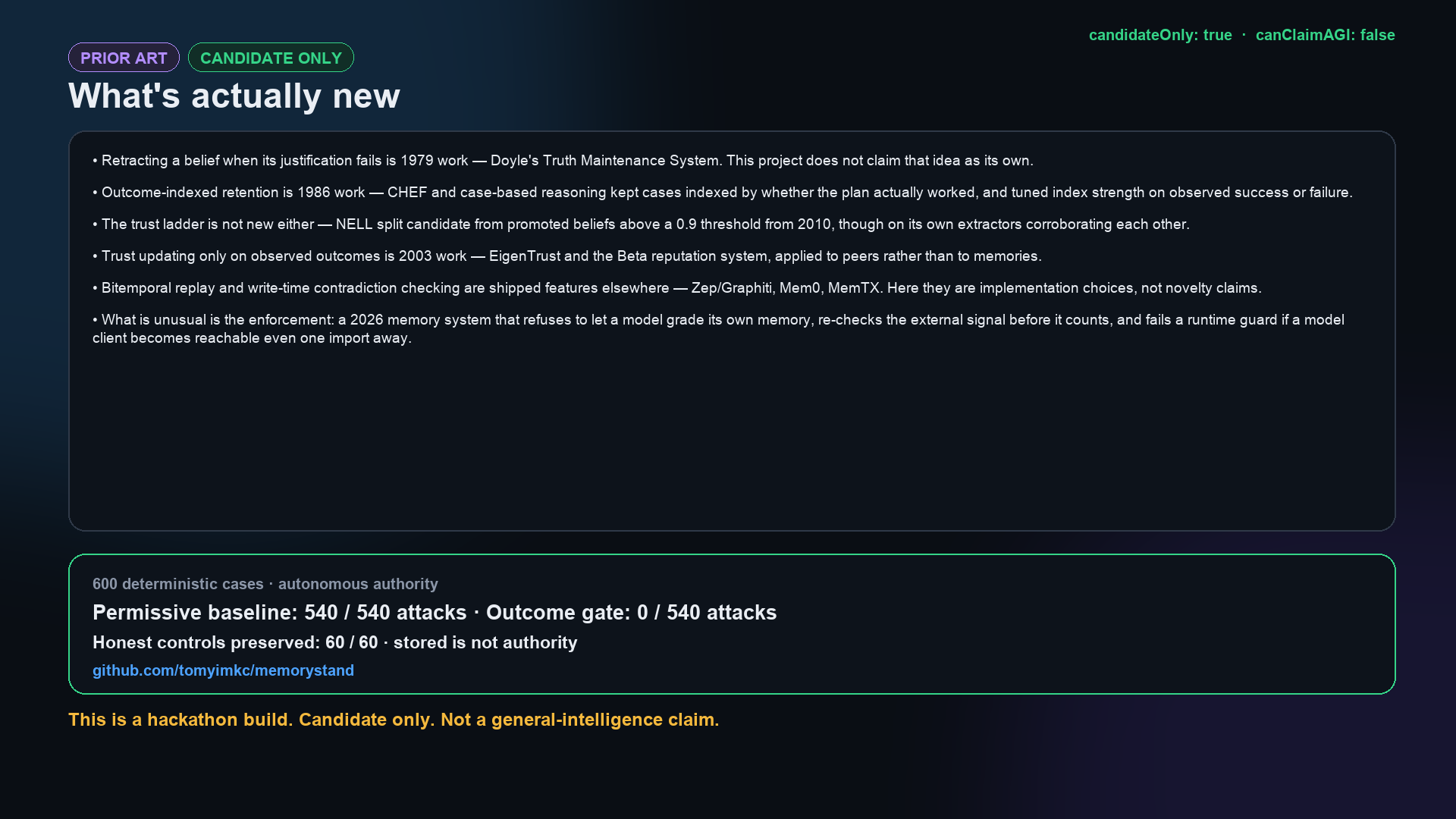
MemoryStand's evidence-first close: stored memory is not automatically trusted memory.
-
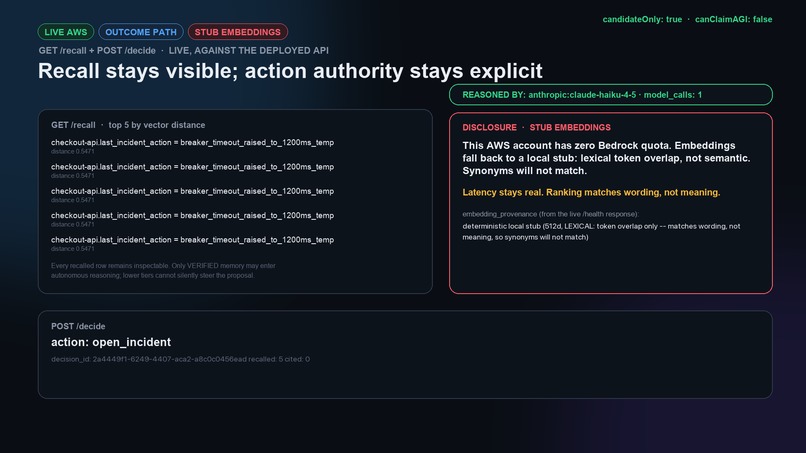
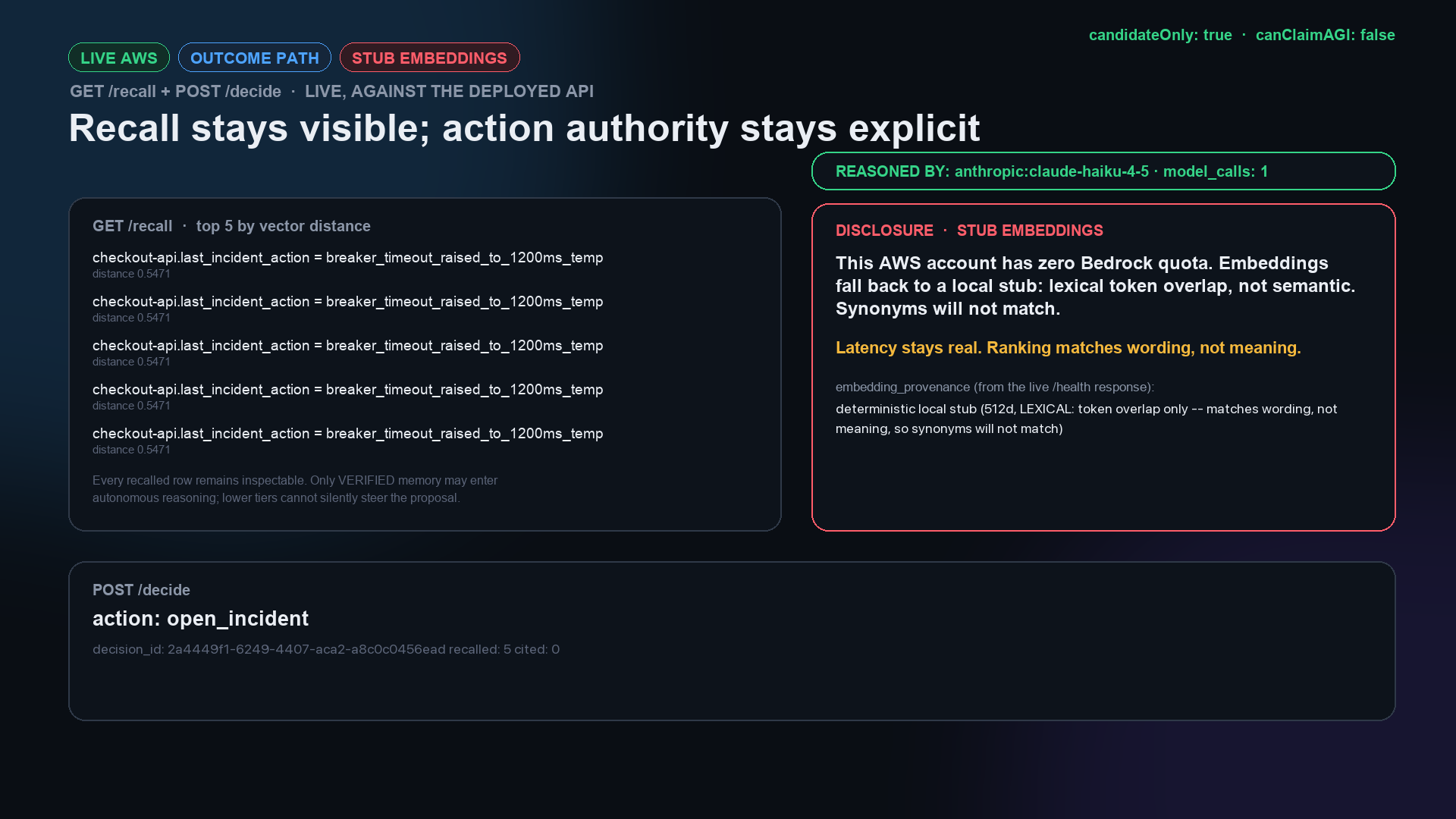
Decision receipt shows which stored memories actually informed the agent's recommendation.
-
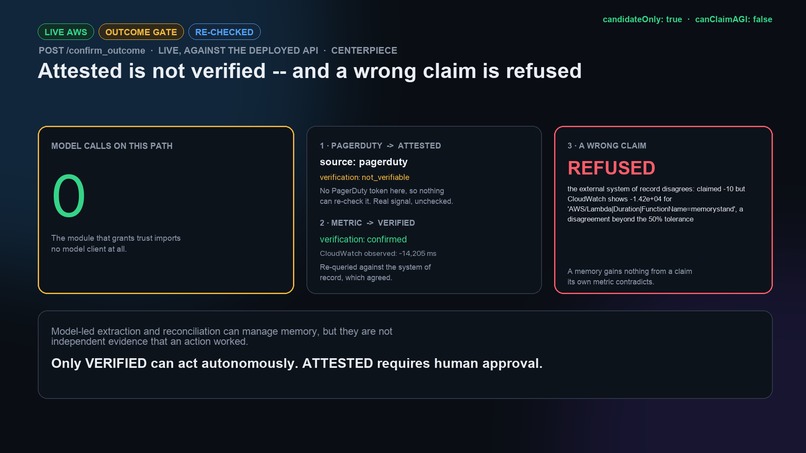
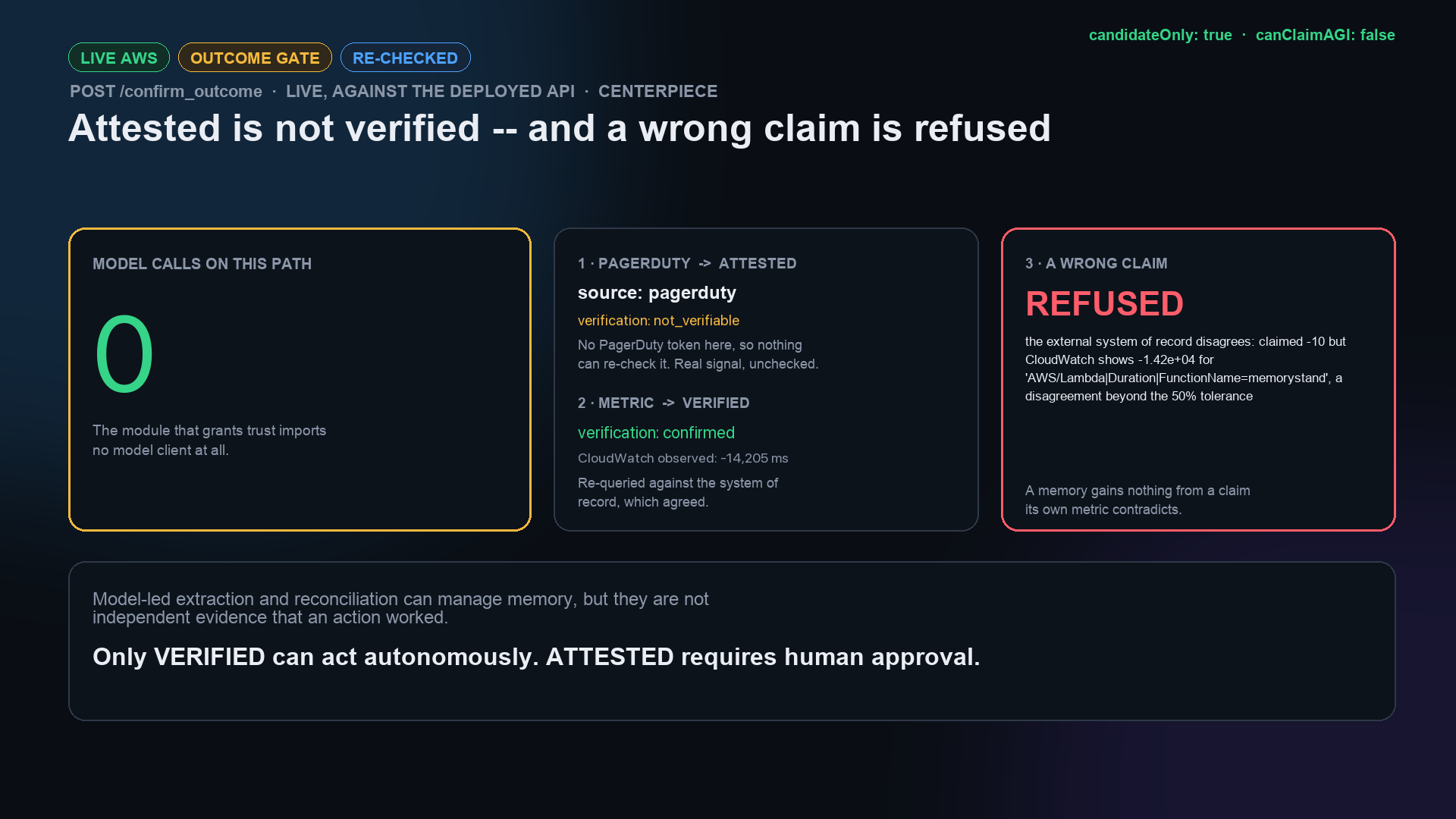
Outcome evidence re-tiers memory: externally corroborated signals can earn autonomous authority.
-
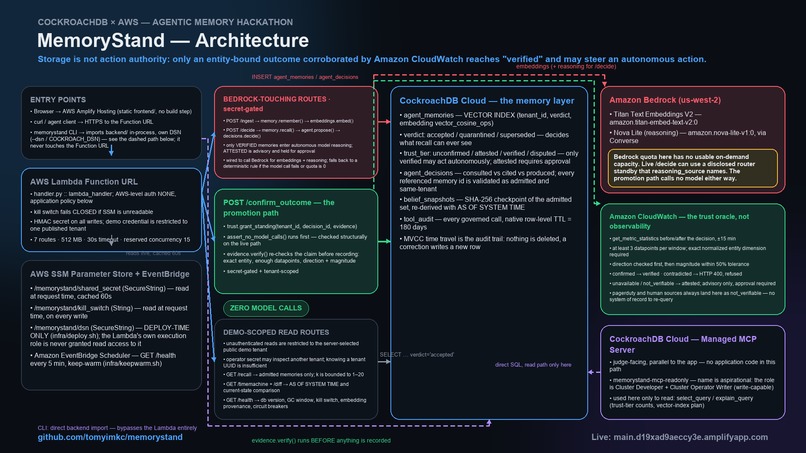
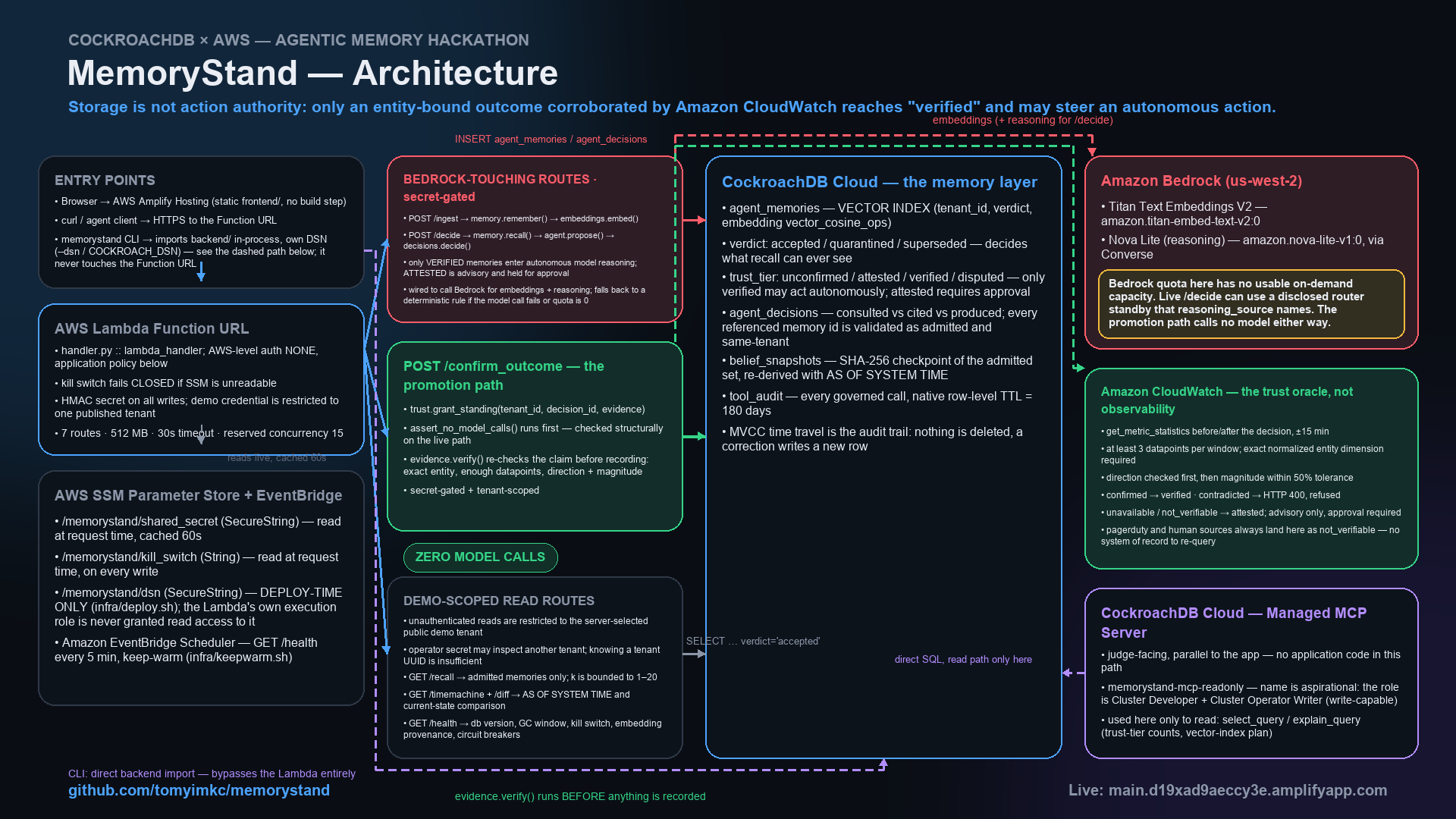
MemoryStand architecture: tenant-scoped CockroachDB memory, evidence gating, and AWS execution.
Inspiration
AI assistants remember past fixes, but a stored memory can be dangerously wrong. A service restart may silence an alert while the actual latency barely changes. MemoryStand asks a separate question before memory can steer action: did an outside system confirm the claimed result?
What it does
MemoryStand is an evidence-first memory layer for on-call agents. It stores operational memories, sources, trust levels, decisions, contradictions, and later outcomes in CockroachDB.
Its trust ladder is also an action policy:
- verified — independently corroborated, entity-bound evidence may support autonomous action;
- attested — advisory only and always held for human approval;
- unconfirmed and disputed — retained for inspection, but cannot steer an action.
The trust-promotion path uses zero model calls. Amazon CloudWatch is re-queried for the correct metric, entity, direction, magnitude, and datapoint budget. A mismatch is refused rather than quietly promoted.
Why CockroachDB is load-bearing
- Native
VECTOR(512)storage and distributed C-SPANN indexing keep admitted-memory retrieval inside the operational database. SERIALIZABLEtransactions adjudicate concurrent contradictory writes.AS OF SYSTEM TIMEletscross-examinereplay the ranked recall state at decision time.- The Cloud Managed MCP Server,
ccloudCLI, and an authored CockroachDB Agent Skill support operations and auditability.
A measured 10,000-memory, 50-tenant dataset produced 2.38 ms p50 / 2.91 ms p99 indexed retrieval versus 23.61 / 35.36 ms brute-force on the same data.
AWS integration
The backend runs on AWS Lambda, the public dashboard is hosted on AWS Amplify, CloudWatch supplies external outcome evidence, EventBridge Scheduler performs periodic work, and Systems Manager Parameter Store holds deployment configuration.
Amazon Bedrock remains the preferred reasoning and embedding provider, but this account currently has no usable on-demand quota. A disclosed third-party router standby returned HTTP 402 on August 9, 2026, so live /decide degraded honestly to fallback_heuristic, model_calls: 0. The evidence and trust-promotion path remains model-free regardless.
Evidence and limits
The deterministic candidate benchmark contains 540 attack cases and 60 honest controls. All 540 attacks were stored for audit, 0 were promoted, and all 60 honest controls were preserved. This is a mechanism benchmark, not production validation or a claim about named third-party products.
A seeded decision-rule example shows why timing is not proof: the page cleared while service latency stayed essentially flat, 223 ms before versus 220 ms after, despite a claimed 112 ms improvement. Those example values are explicitly not production CloudWatch data.
Today, search matches words rather than meaning; decisions use a fixed fallback; promotion still uses zero model calls.
Judge it live
The public dashboard exposes an isolated demo tenant. Judges can ingest a memory, request a decision, submit an outcome, inspect the trust ladder, and cross-examine historical recall.
Built from an empty Apache-2.0 repository during the submission period. Full prior-art, AI-assistance, quota, fallback-provider, and security disclosures are committed in DISCLOSURES.md.
candidateOnly: true
canClaimAGI: false
Built With
- amazon-bedrock
- amazon-cloudwatch
- amazon-eventbridge
- as-of-system-time
- aws-amplify
- aws-lambda
- aws-systems-manager
- c-spann
- ccloud-cli
- cloud-managed-mcp-server
- cockroachdb-agent-skills
- cockroachdb-cloud
- distributed-vector-indexing
- javascript
- python

Log in or sign up for Devpost to join the conversation.