-
-
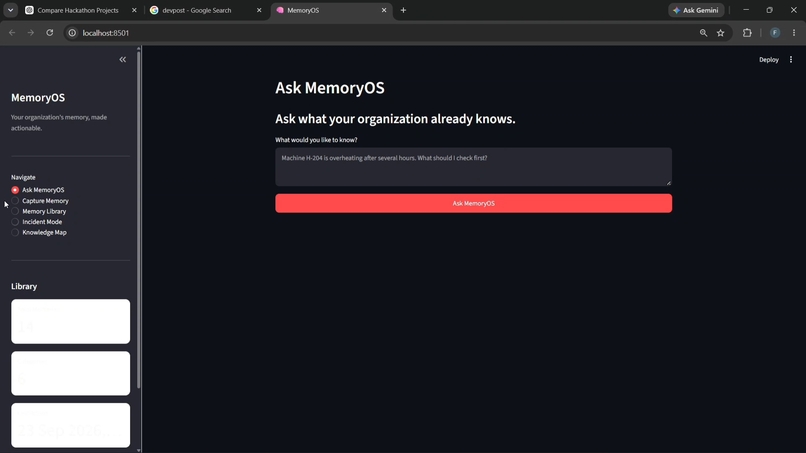
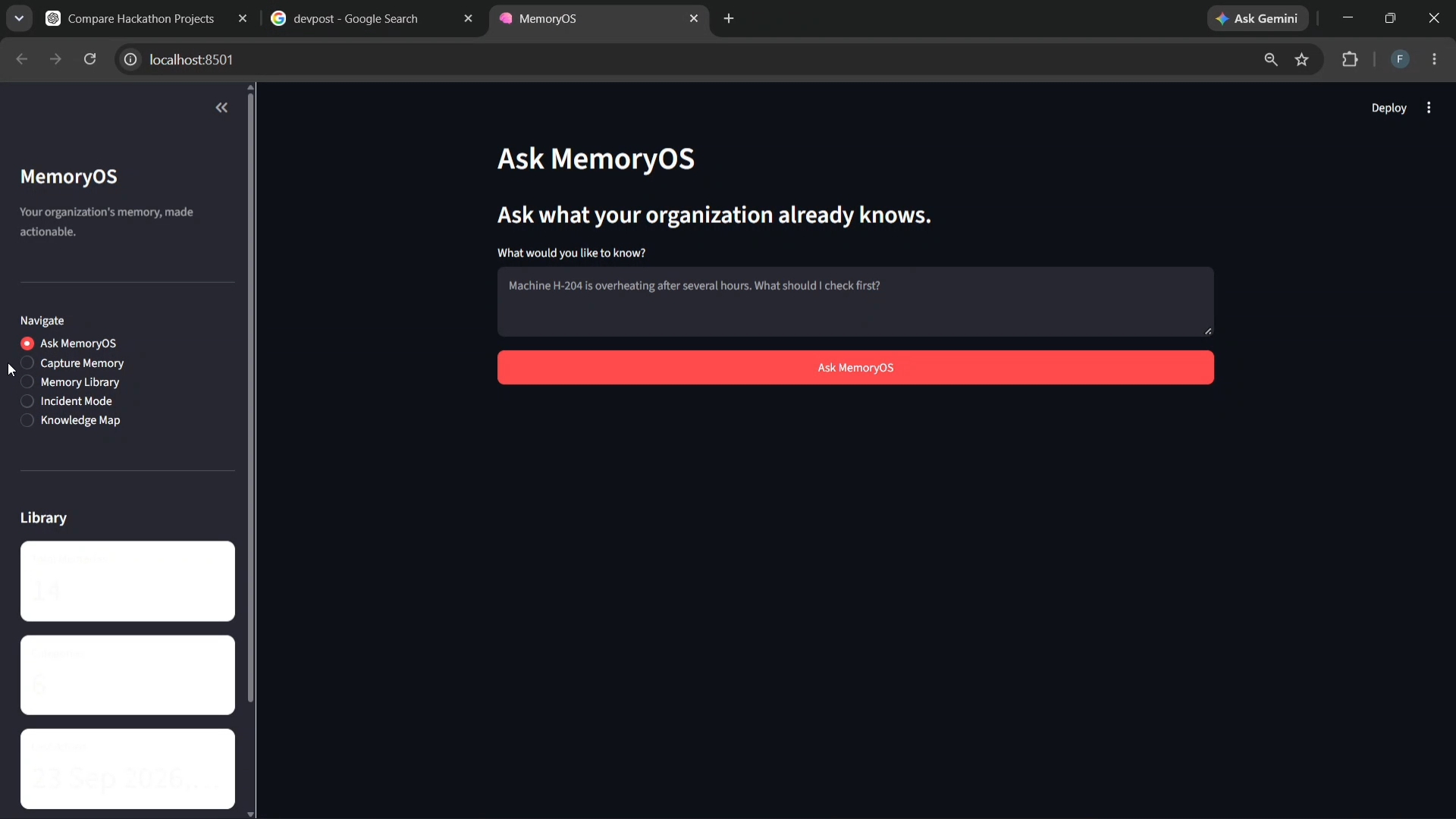
The General overview
-
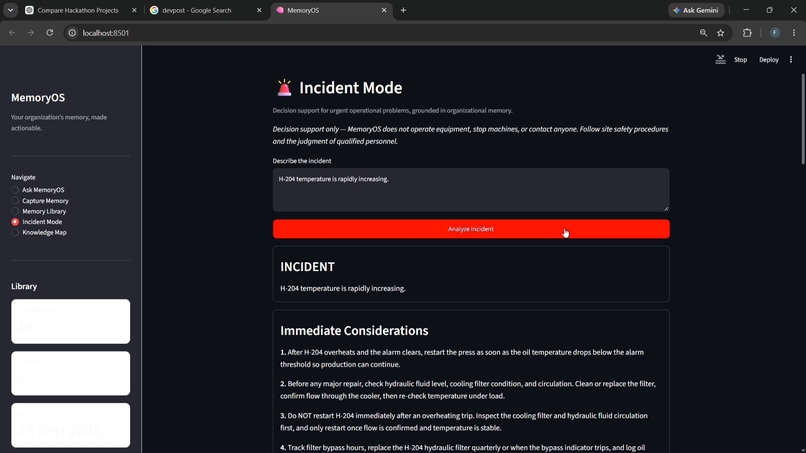
-
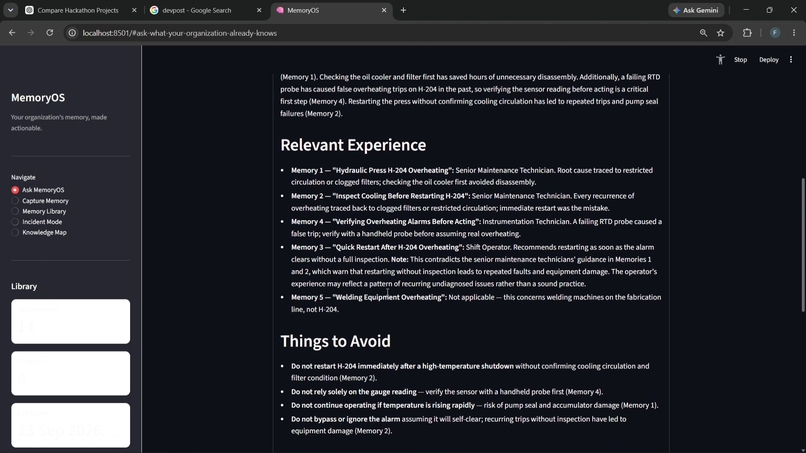
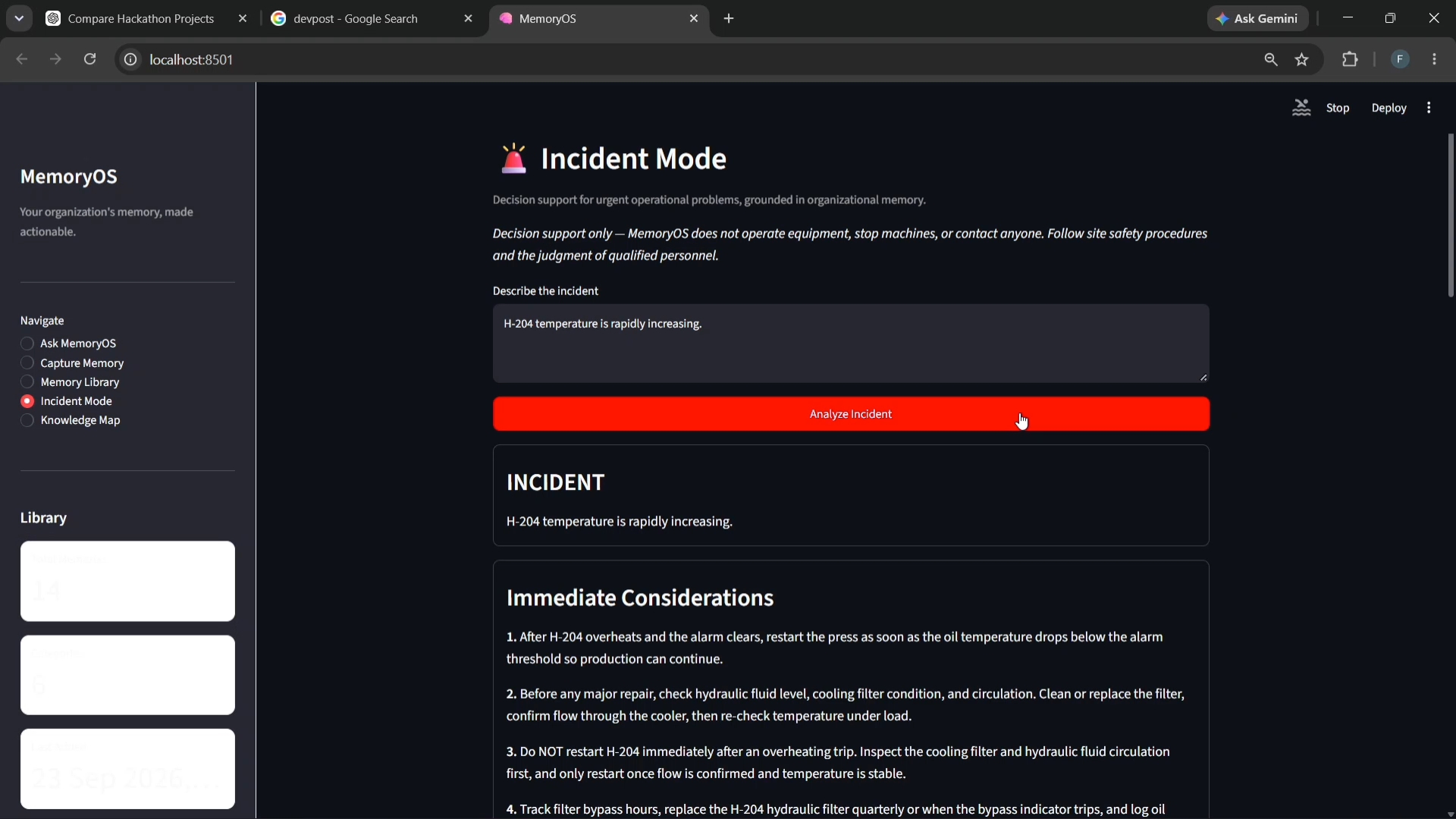
The incident tab
Inspiration
Valuable knowledge often disappears when experienced people leave a team or when newer members don't know who to ask. Documentation can preserve instructions, but it rarely preserves the practical experience behind them — what to check first, what mistakes to avoid, and what actually worked in a real situation.
We wanted to explore whether AI could turn this scattered human experience into a useful, searchable memory for an organization.
What it does
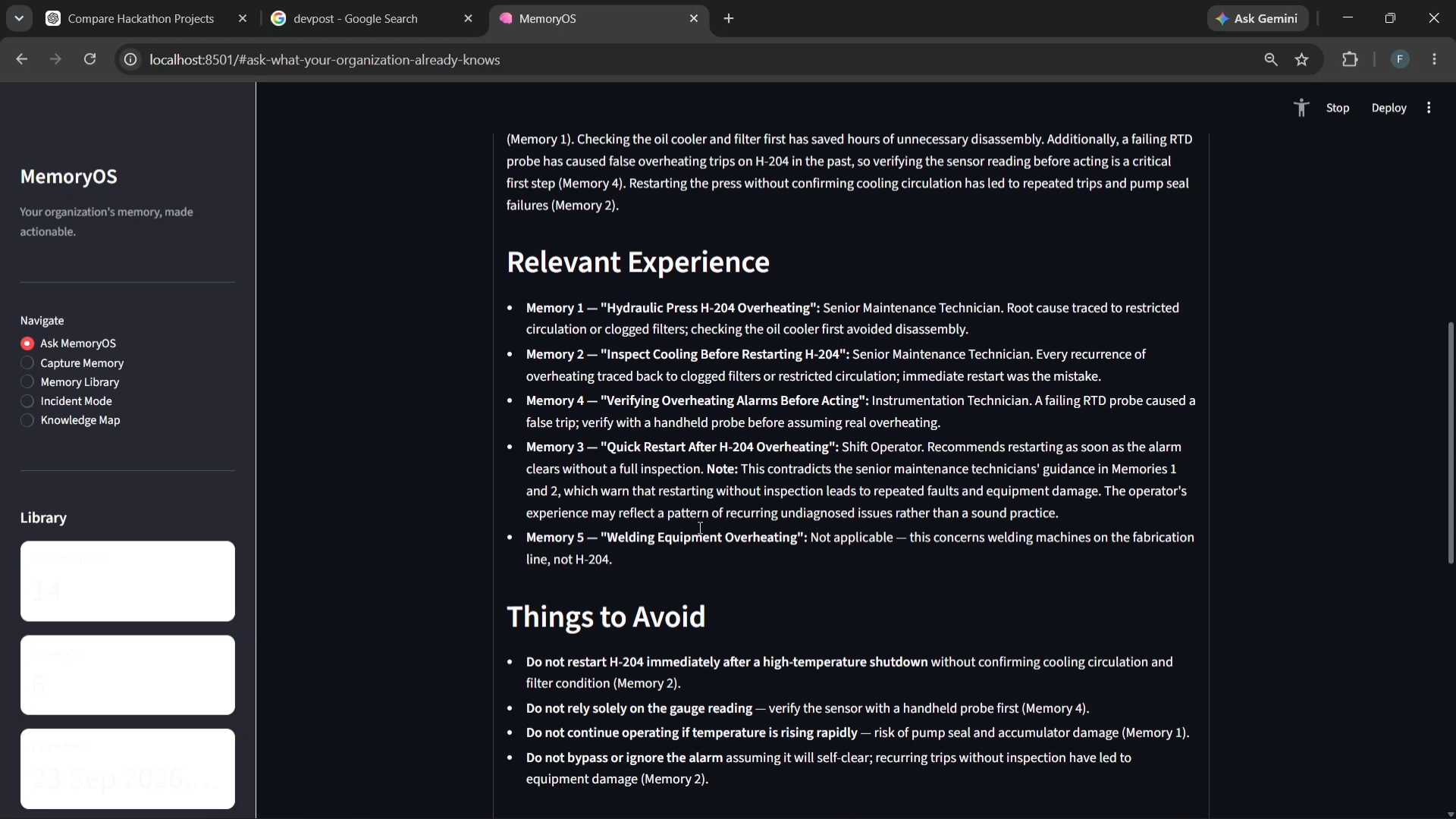
MemoryOS captures knowledge and experience from people within an organization and makes it accessible through an AI-powered interface.
A user can add experiences, procedures, troubleshooting notes, or lessons learned. Another team member can then ask questions in natural language and receive relevant, contextual answers based on the organization's accumulated knowledge.
The goal is not simply to create another chatbot, but to create a layer of institutional memory that helps teams reuse knowledge instead of repeatedly solving the same problems.
How we built it
MemoryOS is being built as an AI-powered web application with a lightweight architecture designed around knowledge capture and retrieval.
The system processes user-provided knowledge, makes it searchable, retrieves relevant information for a query, and uses an AI model to turn that information into a practical response.
We are focusing on a complete working workflow rather than building unnecessary enterprise infrastructure for the prototype.
Challenges we ran into
One of the biggest challenges was deciding how to make the AI genuinely useful instead of simply adding a chatbot to a knowledge base.
We also had to balance the scope of the project with the limited time available for the hackathon. This meant prioritizing the core knowledge-capture and retrieval workflow while leaving larger enterprise features for future development.
Accomplishments that we're proud of
We are building a working prototype around a problem that affects teams across many industries: the loss and fragmentation of practical knowledge.
We are particularly focused on demonstrating how AI can transform raw experiences and documentation into information that another person can actually use.
What we learned
We learned that useful AI products are not necessarily about using the largest or most complex model. The quality of the underlying knowledge, retrieval process, context, and user experience can matter just as much.
We also learned the importance of designing the AI around a specific workflow rather than starting with a generic chatbot.
What's next for MemoryOS
The prototype is only the beginning. Future versions could support richer knowledge capture through voice and images, role-based access, organization-wide knowledge graphs, integrations with existing workplace tools, and continuous updating of institutional knowledge.
The long-term vision is to make organizational experience something that can be preserved, discovered, and passed on — rather than knowledge that disappears when the person who holds it is no longer available.
Built With
- ai
- database
- generative
- llm
- natural
- python
- rag
- streamlit
- vector
