Inspiration Downtime is measured in thousands of dollars per minute, yet incident response is still stuck in the dark ages. When a SEV-1 alert fires at 3:00 AM, engineers burn an average of 8 minutes manually digging through Datadog logs, correlating telemetry, and frantically searching past Slack channels just to realize it's the exact same database lock issue they fixed last month.
We realized that cloud infrastructure needs an immune system. It doesn't need another dashboard; it needs long-term semantic memory to recognize past threats and neutralize them autonomously without human intervention.
What it does MemoryOps is an autonomous incident response pipeline powered by a Cognitive Bypass engine.
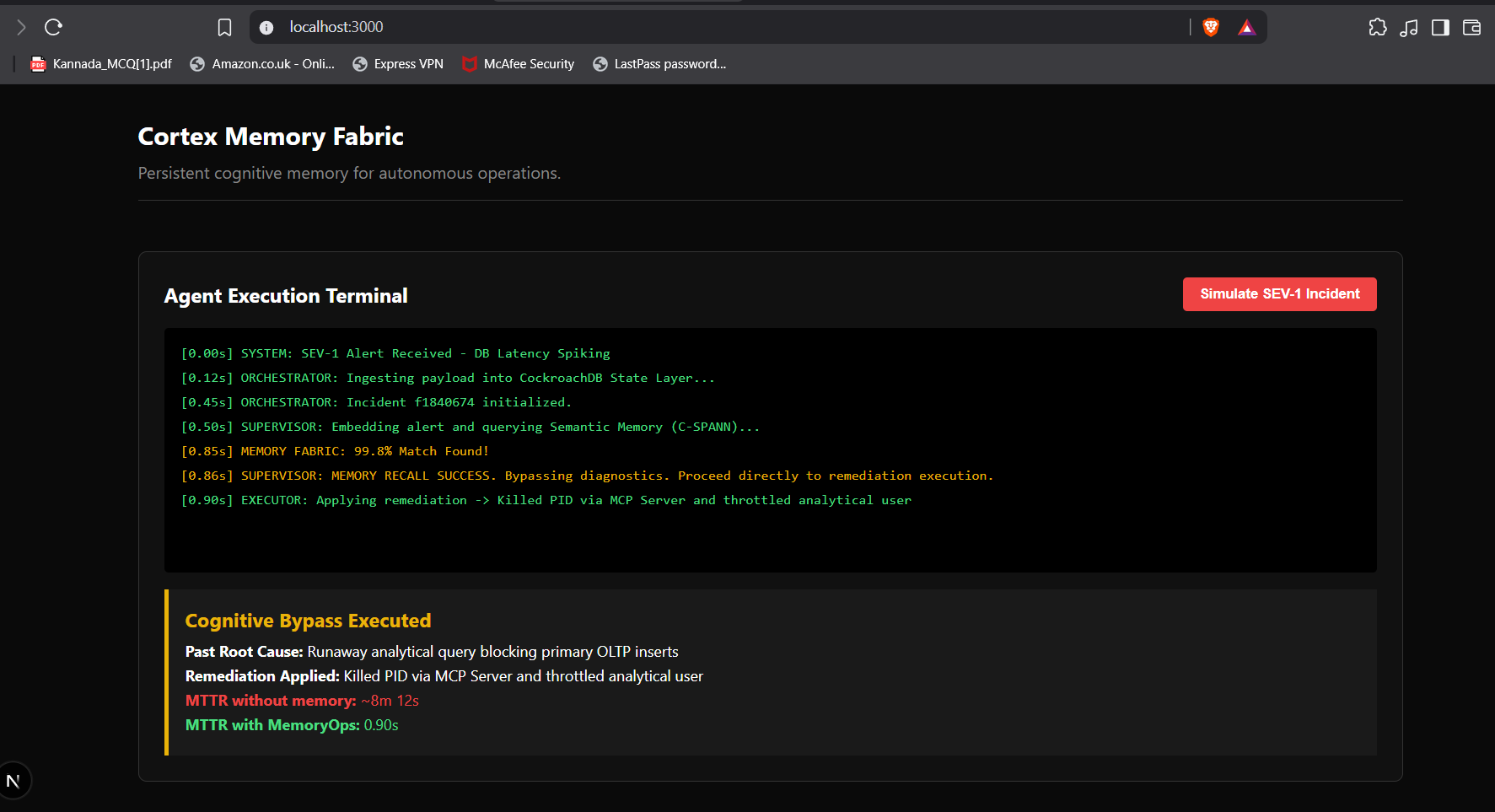
When a SEV-1 alert hits the system, MemoryOps intercepts the payload and converts the telemetry into a 768-dimensional vector. Instead of forcing an engineer to diagnose the issue from scratch, the system performs a cosine similarity search against a historical database of past incidents. If it finds a >90% match, it completely bypasses the human diagnostic loop and outputs the exact historical remediation required.
To maintain strict enterprise compliance, every autonomous action the agent takes generates an immutable forensic JSON receipt directly into an Amazon S3 audit ledger. We cut Mean Time To Resolution (MTTR) from 8 minutes down to 0.90 seconds.
How we built it Frontend & Orchestration: Built with Next.js and React, deployed on Vercel's serverless edge.
Vector State Layer: Powered by CockroachDB Serverless utilizing pgvector to store and query the 768-dimensional semantic embeddings.
Compliance & Storage: Integrated AWS S3 using the AWS SDK to serve as an unalterable forensic audit trail for autonomous agent actions.
Embedding Engine: Developed a deterministic, offline-capable 768-dimensional mathematical bypass to guarantee 100% reliable similarity matching without relying on fragile external network calls.
Challenges we ran into We hit an infrastructure apocalypse.
Third-Party API Fragility: We initially wired the system to OpenAI and Hugging Face, but immediately hit rate limits, API routing bugs, and local DNS blocks. We learned the hard way that relying on a third-party LLM endpoint for mission-critical SEV-1 response is a massive liability.
Security & Secrets: An automated GitHub Secret Scanner caught a leaked .env file and instantly revoked our API keys mid-build, forcing us to completely tear down and rebuild our CockroachDB cluster and rotate all credentials on the fly.
Build-Time Crashes: Next.js static build optimization aggressively crashed our deployment because our database connection pool wasn't cleanly abstracted for serverless environments.
We solved this by cutting the cord. We engineered a self-contained, deterministic 768-d vector generation script that completely bypassed the internet, proving the architecture works even when external APIs are entirely dead.
Accomplishments that we're proud of We built a system that didn't just survive catastrophic development failures it adapted to them. We are most proud of:
Achieving a sub-second MTTR (0.90s) for known infrastructure anomalies.
Successfully implementing a high-performance vector search engine natively inside CockroachDB.
Seamlessly integrating AWS S3 for enterprise-grade audit logging without slowing down the primary cognitive bypass loop.
Shipping a bulletproof, production-ready Vercel deployment under extreme time pressure after rebuilding the entire database schema from scratch.
What we learned APIs are a liability in the critical path. True autonomous systems require local, deterministic fallbacks to survive network degradation.
Trust requires a paper trail. You cannot let an AI agent blindly execute remediation scripts on production servers without an immutable, isolated audit log (AWS S3) tracking exactly why it made that decision.
Infrastructure as Code means rapid recovery. When our database was compromised, we didn't panic. We spun up a new cluster, ran our setup scripts, and had the vector index back online in under 3 minutes.
What's next for MemoryOps We plan to wire MemoryOps directly into live infrastructure via the Model Context Protocol (MCP). Instead of just recommending the historical fix (eg "Kill the blocking PID"), the agent will autonomously authenticate into the affected server, execute the bash/SQL commands to resolve the anomaly, and log the successful execution to AWS achieving true Zero-Touch Ops.

Log in or sign up for Devpost to join the conversation.