Inspiration
When an elderly loved one with Alzheimer’s or dementia wanders away from home, families face a terrifying dilemma. Standard emergency responses often involve calling the police—which can escalate confusion and fear for the patient—or broadcasting the patient's medical vulnerability across public Facebook groups, stripping them of their dignity. We wanted to build a localized, high-empathy solution that leverages the community's eyes and ears without compromising a patient's privacy
What it does
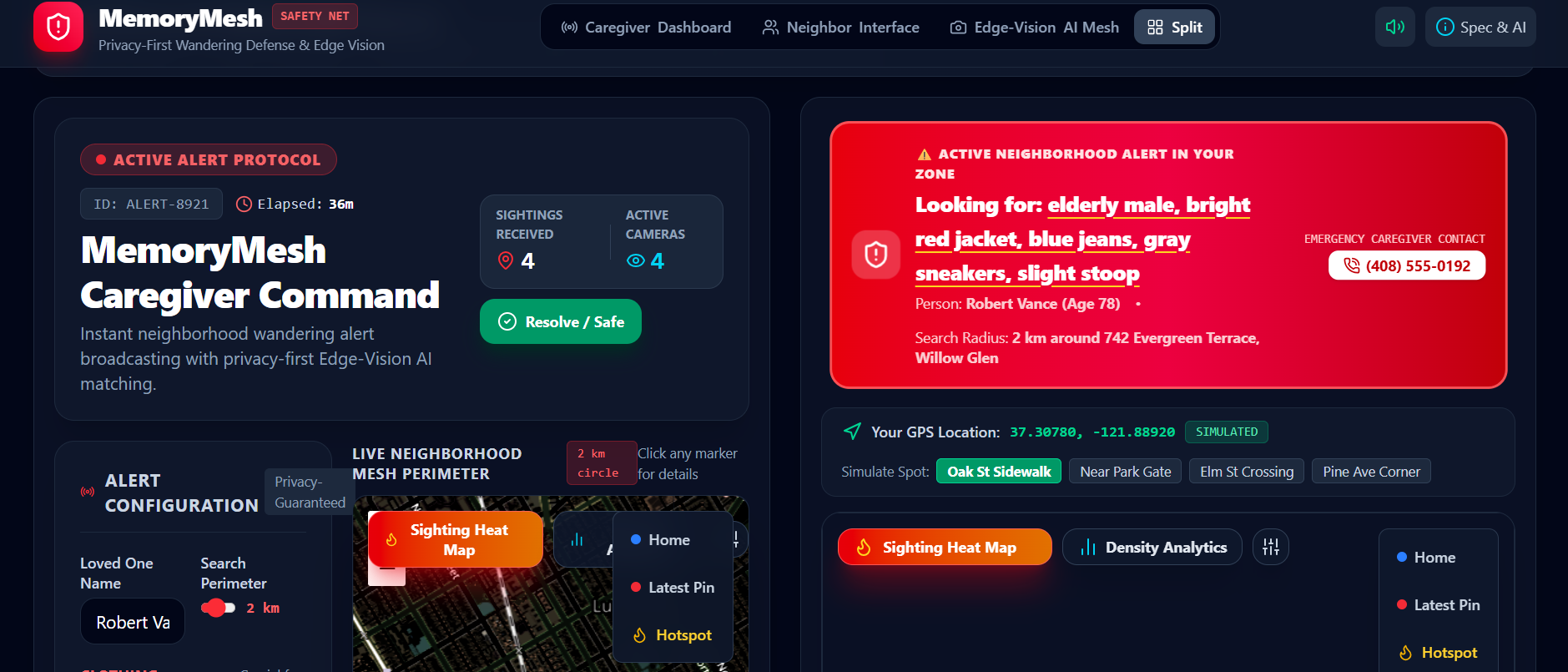
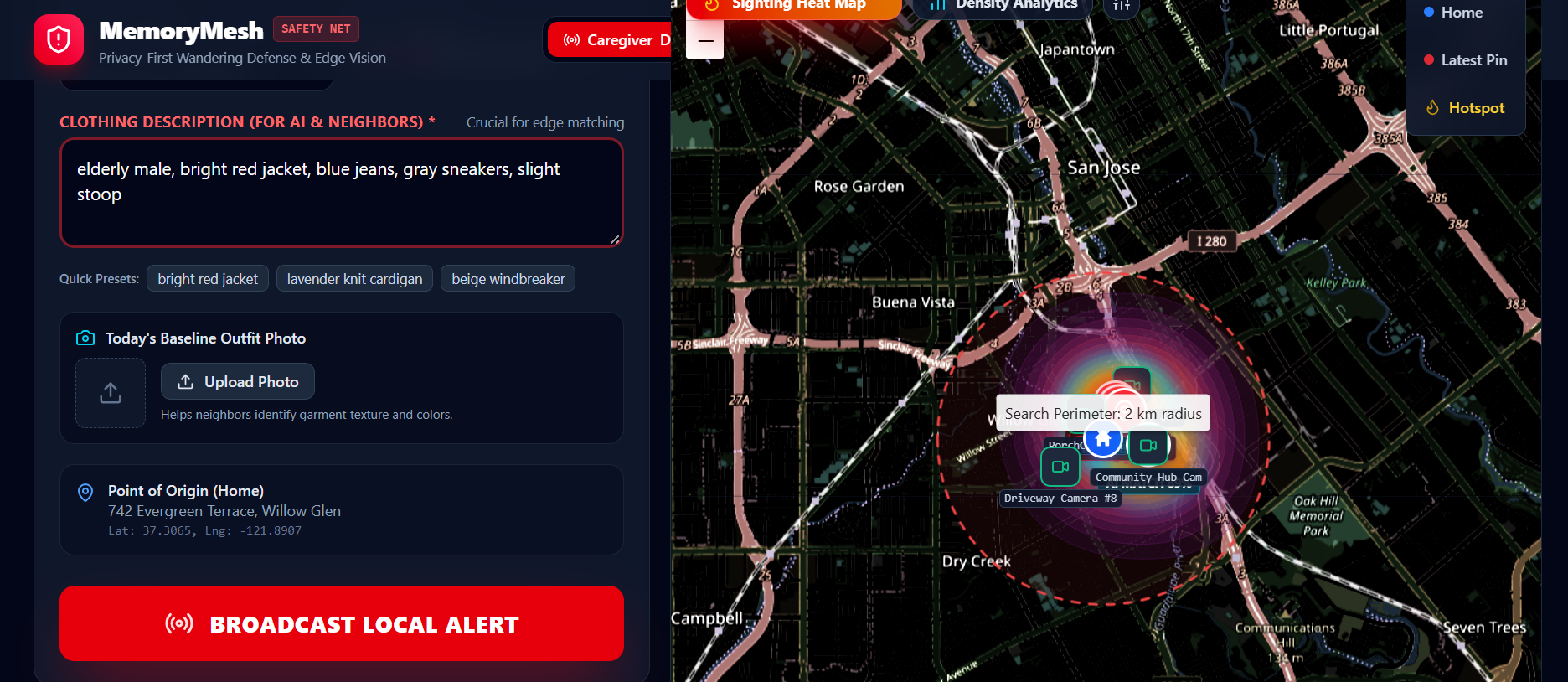
MemoryMesh is a decentralized safety net that empowers neighbors to safely and quietly locate wandering individuals. It operates through three main pillars:
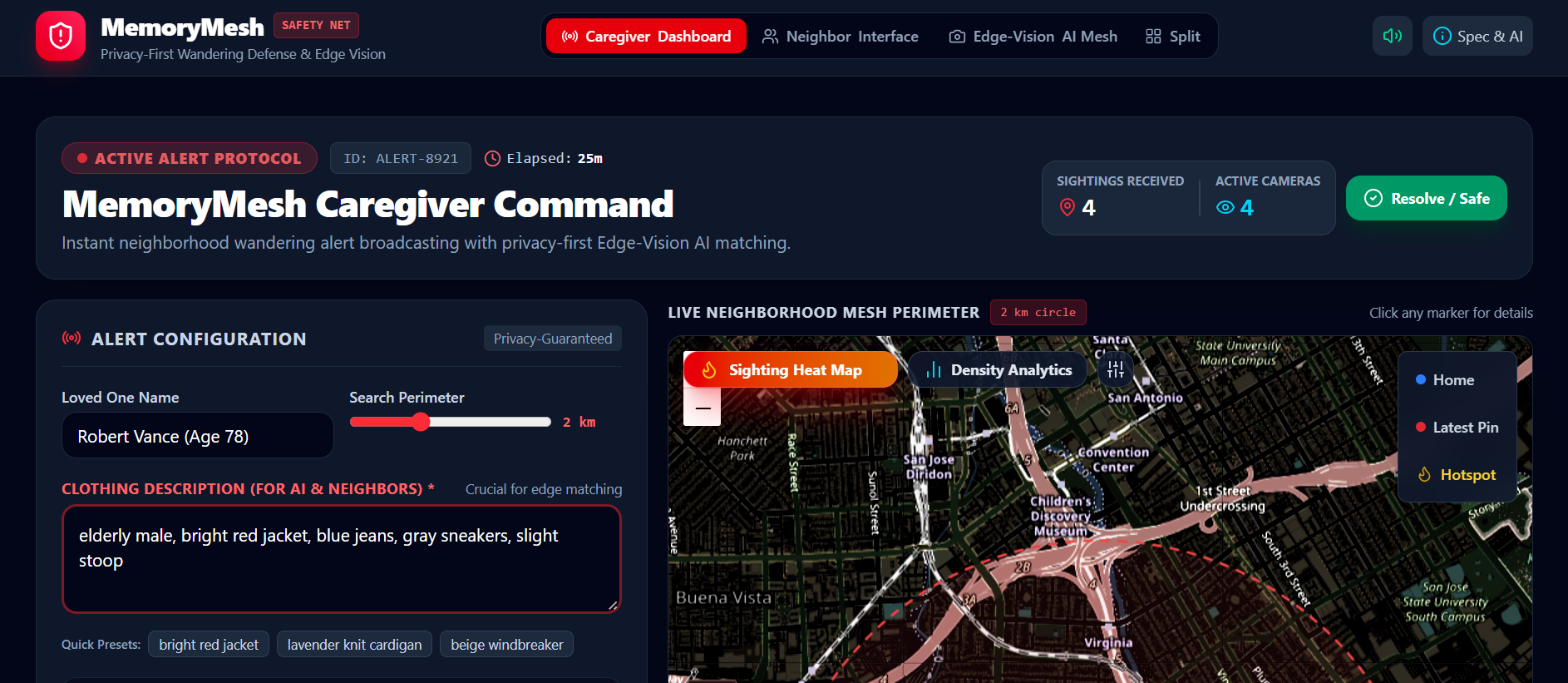
The Caregiver Dashboard: When a wandering event occurs, a family member triggers a localized geo-fenced alert. Instead of broadcasting names or medical history, they input a simple clothing description (e.g., "Red sweater, blue jeans") and a baseline photo.
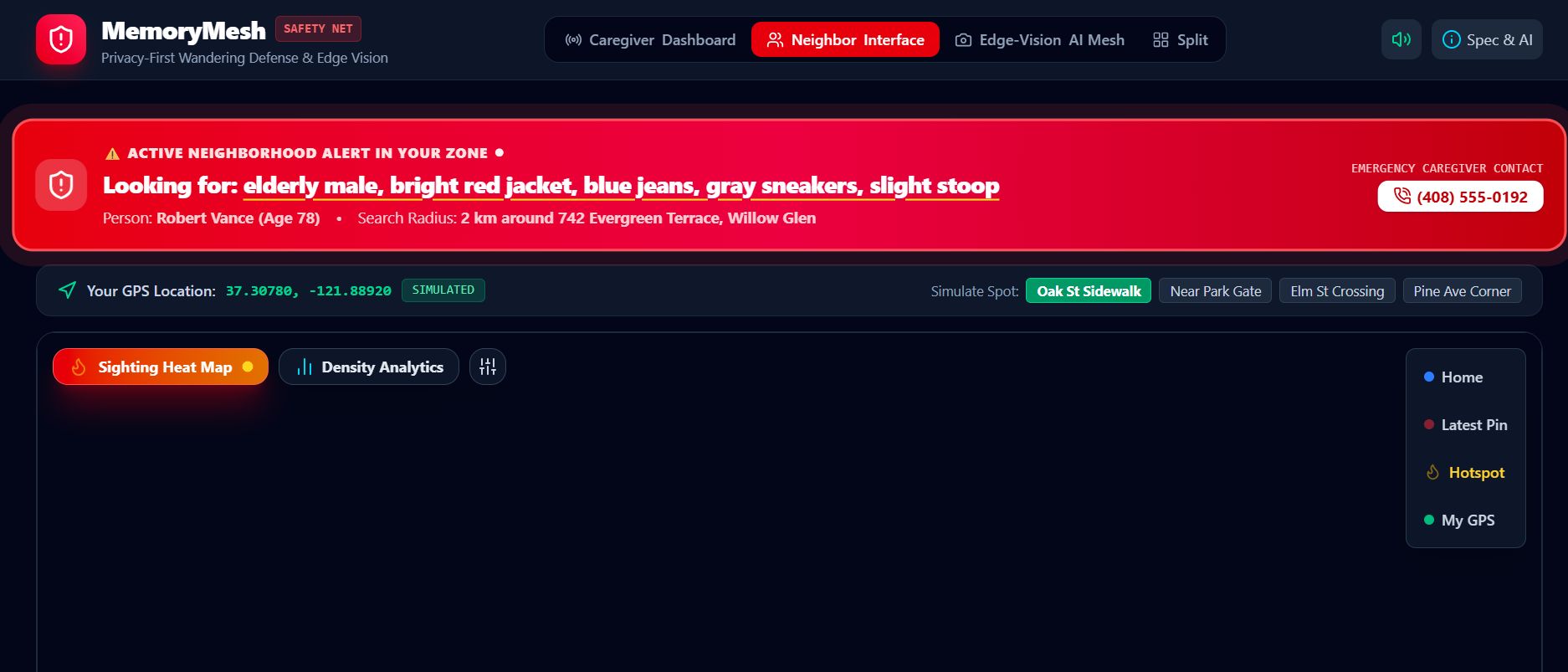
The Community Mesh: Opted-in neighbors receive a real-time, zero-friction notification on their devices. If they spot the individual, a single button tap captures their device's GPS coordinates and drops a secure pin on the caregiver's live map.
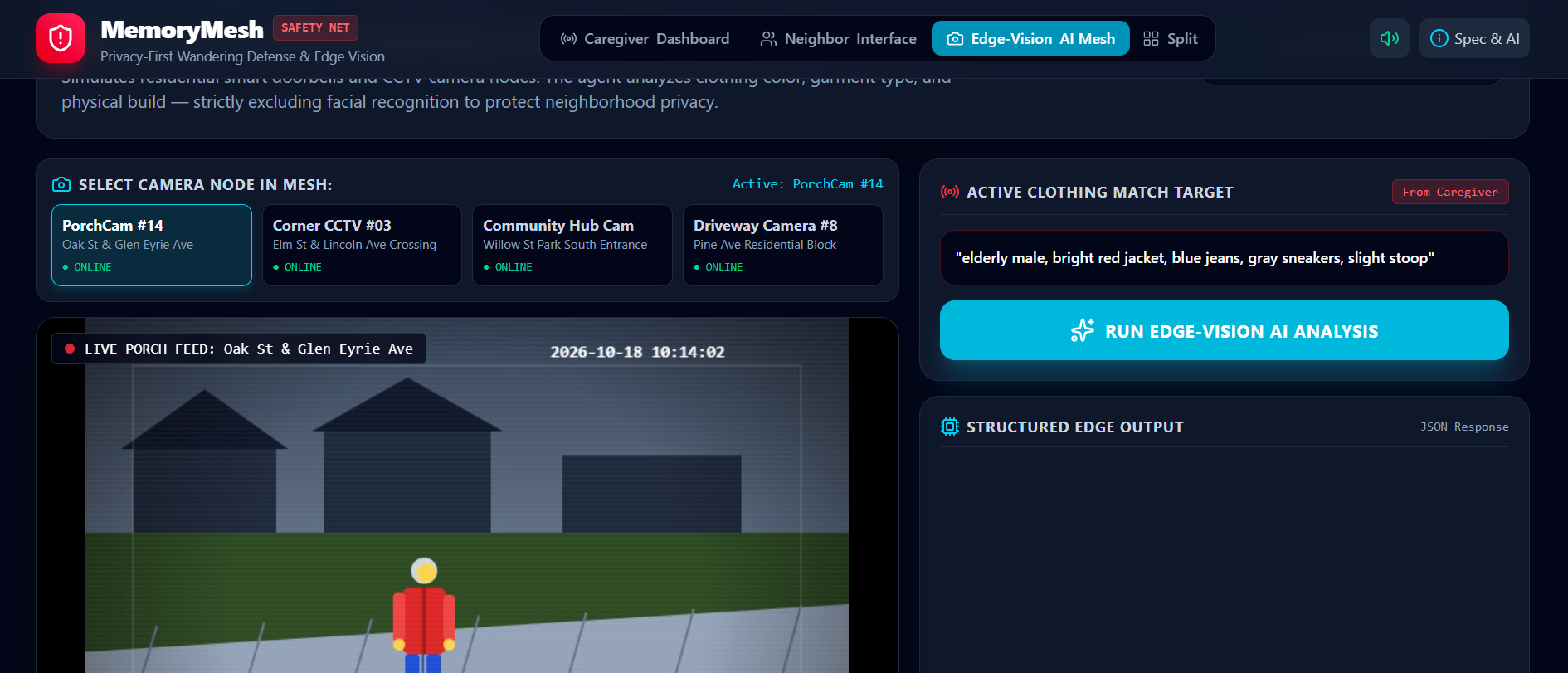
The AI Edge-Vision Agent: To automate the search, MemoryMesh simulates integrations with residential doorbell cameras. Using multimodal AI, the system processes image feeds against the caregiver's text description. If the AI detects a clothing and build match, it automatically pushes a verified location pin to the caregiver—no human intervention or invasive facial recognition required.
How we built it
MemoryMesh is built for real-time speed and extreme accessibility.
Frontend: We utilized React and TypeScript to build a type-safe, highly responsive web application, styled with Tailwind CSS for a high-contrast, accessible user interface.
Mapping & Real-Time Data: We integrated Mapbox GL JS to handle the interactive neighborhood routing and search-radius visualizations. The live location pinning is powered by a real-time database (Firebase/Supabase), ensuring the caregiver's map updates instantly without page refreshes.
Artificial Intelligence: We leveraged Google AI Studio and the Gemini Vision API to build the edge-vision matching agent. By passing structured JSON system prompts, the AI accurately identifies clothing anomalies in simulated camera feeds while strictly adhering to privacy guidelines (avoiding facial recognition).
Deployment: The entire web application is deployed on Vercel for seamless hosting and rapid iteration.
Challenges we ran into
Building a real-time location tracker that doesn't feel like a surveillance state was our biggest hurdle. We had to carefully engineer the AI prompt to focus only on clothing color and garment type rather than identifying personal facial features, ensuring the tech remains a tool for social good rather than an invasion of privacy.
Accomplishments that we're proud of
We are incredibly proud of the zero-friction Responder UI. In a crisis, people don't have time to navigate complex menus or log in to accounts. By reducing the neighbor's action to a single "I See Them" button that instantly fetches device geolocation, we removed the barrier to community action.
What we learned
Constraining Vision AI: We learned that getting an LLM to accurately analyze an image is easy, but getting it to adhere strictly to privacy boundaries is difficult. We had to aggressively iterate our prompt engineering to force the Gemini API to ignore faces and focus exclusively on clothing and build, while ensuring the output was strictly formatted as parsable JSON.
Real-Time State Synchronization: Syncing live Geolocation data from multiple neighbor devices through Firebase and plotting it instantly on a Mapbox canvas taught us a lot about advanced React state management and preventing map re-rendering glitches.
Designing for Panic: We realized that standard UI/UX patterns fail during an emergency. We had to unlearn the instinct to add more features and instead focused on extreme minimalism. We learned that in high-stress situations, a single, massive "Drop Pin" button is infinitely more effective than a multi-step confirmation menu.
Handling Browser Permissions: We gained hands-on experience managing asynchronous browser Geolocation APIs, including gracefully handling edge cases where a user denies location tracking or experiences a GPS drop-out.
What's next for MemoryMesh
In the future, we want to build a lightweight API endpoint that local municipal cameras or real smart-home ecosystems (like Ring or Nest) could securely plug into. We also plan to implement SMS fallbacks for neighbors who want to participate in the mesh network without requiring a smartphone.
Built With
- api
- dementia
- fullstack
- python
- socialgood

Log in or sign up for Devpost to join the conversation.