Inspiration
Every day, thousands of master mechanics, veteran teachers, artisan weavers, organic farmers, craftspeople, and senior technicians retire. They carry away 35+ years of unwritten intuition, diagnostic shortcuts, tactile wisdom, and lessons that were never documented in standard operating manuals. Existing documentation tools fail because practitioners don't want to type documentation marathons. They want to talk, tell stories, and demonstrate their craft.
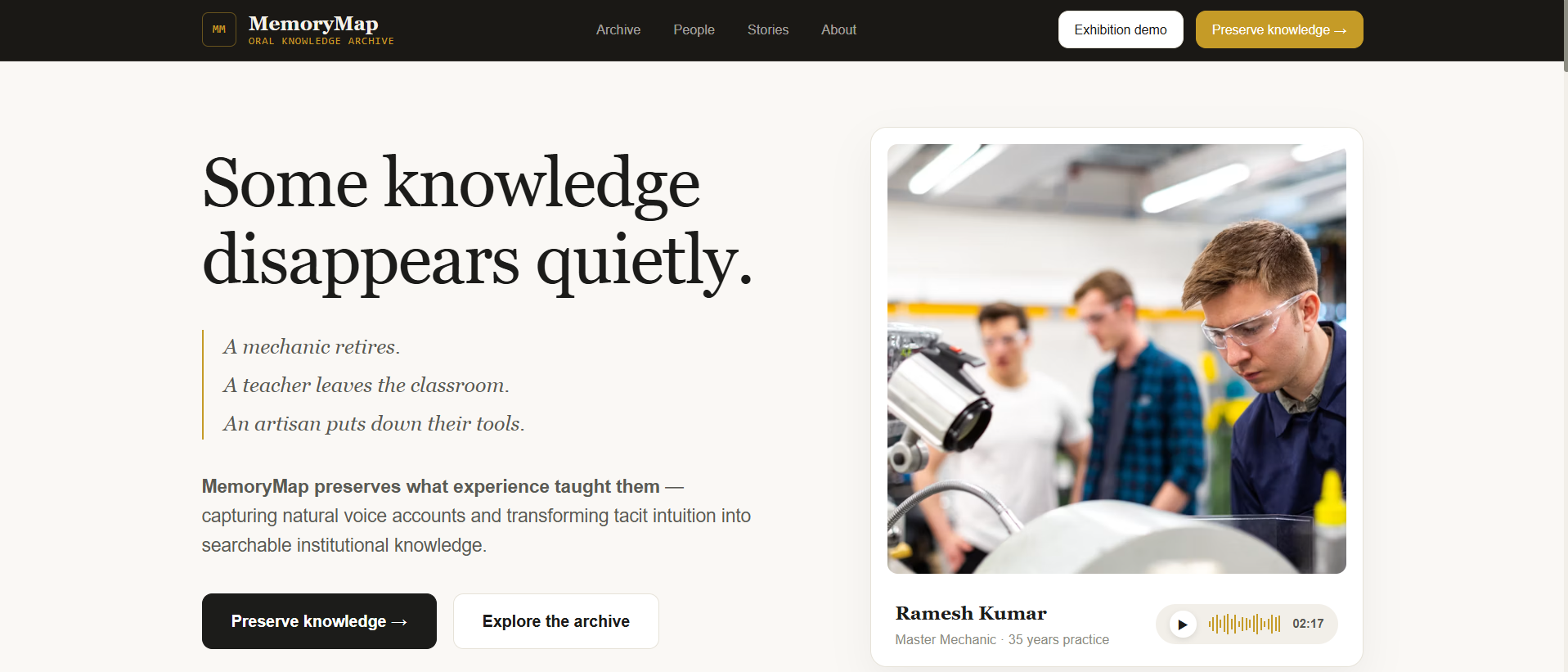
MemoryMap was inspired by a central human truth: "When someone retires, their job ends. But what happens to everything they learned?" We set out to build a platform that captures practical human experience through natural voice conversations and transforms those accounts into structured, searchable institutional heritage — preserving both the original human voice and its practical mastery for future generations.
What it does
MemoryMap turns oral stories into structured, searchable digital archives:
- Guided Pre-Interview Practitioner Setup: Before recording, MemoryMap prompts for the practitioner's Name (e.g., Ramesh Kumar, Anita Rao), Profession (e.g., Master Mechanic), and Category (e.g., Automotive Repair).
- Natural Spoken Voice Recording: Practitioners speak naturally into their phone or laptop microphone, guided by targeted prompts ("What is a diagnostic trick only experience teaches?").
- Multimodal AI Knowledge Extraction: Powered by Google Gemini, raw audio and transcripts are automatically parsed into:
[ PROCEDURE ]: Step-by-step instructions.[ MASTER TIPS ]: Unwritten diagnostic instincts.[ COMMON MISTAKES ]: Critical warnings to avoid.[ TOOLS & MATERIALS ]: Equipment mentioned.
- Verbatim Timestamp Attribution: Every extracted insight links directly back to the exact timestamp in the original voice recording (e.g., 🔊 02:17).
- Dynamic 35-Year Career Timelines: Preserved memories instantly update the practitioner's profile (
/app/experts/[id]) and append a 2026 milestone event to their vertical career timeline (/app/timeline). - Oral History Research Console (
/app/ask): Future learners can ask natural language questions ("What should I check first when an engine overheats?") and receive verified answers directly from master accounts.
How we built it
- Frontend Architecture: Built using Next.js 16 App Router, React 19, TypeScript, and CSS Modules. We created a clean, calm design system featuring warm ivory background tones (
#FAF8F5), charcoal typography (#1C1C1A), and subtle warm amber accents (#C59B27). - Real-Time Web Audio API: Used browser
MediaRecorderandAudioContext/AnalyserNodefrequency spectrum analysis to generate live animated audio waveform visualizers. - Multimodal AI Backend: Integrated
@google/genai(Google Gemini 1.5 Flash / Gemini 3.6 Flash) via Next.js Serverless API routes (/api/process-audio,/api/ask,/api/memories) with structured JSON schema output. - Reactive Data Persistence: Built a dual-layer store (
lib/store.ts) combining clientlocalStoragewith server API fallbacks. Recording a new memory instantly updates the Archive Index, People directory, Expert profile, and Career timeline without requiring a page refresh. - Mathematical Knowledge Retention Model: We modeled knowledge accumulation over time using
K(t) = K₀ · e^(αt). Traditional retirement leads to 100% tacit knowledge loss, whereas MemoryMap retains institutional memory viaK_p = η · Σ(Procedure + Tips + Mistakes)with an extraction efficiency η ≈ 92%. - Deployment: Deployed on Netlify with automatic serverless functions for Next.js App Router API routes. ## Challenges we ran into
- Structuring Spontaneous Speech without Losing Voice Authenticity: Spoken accounts are messy and non-linear. We engineered prompt schemas for Gemini to extract strict operational procedures while retaining the original practitioner's quotes and voice nuances.
- Zero-Lag UX for Audio Processing: Waiting for serverless functions on slow networks can cause user drop-off. We implemented instant optimistic UI updates with client-side
localStoragecaching so recording completion feels instantaneous. - Designing a Non-Generic Interface: Avoiding the trap of generic AI SaaS dashboards or dense editorial clutter. We iterated until achieving an Apple-level clean aesthetic that respects human dignity and documentary storytelling. ## Accomplishments that we're proud of
- End-to-End Dynamic Sync: A single 1-minute voice recording immediately updates the entire app ecosystem — from the practitioner's preserved count to their 2026 timeline entry and search index.
- Timestamp Verification: Linking every extracted insight directly to verbatim audio source timestamps (
02:17 → 03:04). - Authentic Documentary Storytelling: Zero emojis, zero cartoon placeholders — using high-quality photography and respectful typography for mechanics, teachers, weavers, and farmers. ## What we learned
- Tacit knowledge is inherently conversational: People don't document their best work in forms; they share it when asked guided questions by someone who respects their craft.
- AI as a Human Amplifier: AI is at its best not when replacing human creation, but when capturing and honoring human experience before it vanishes. ## What's next for MemoryMap
- 🌐 Multilingual & Regional Dialects: Support for regional Indian dialects (Hindi, Tamil, Malayalam, Kannada) using Gemini multimodal audio capabilities.
- 📱 Offline Field Recorder PWA: Progressive Web App with offline audio caching for rural agricultural and artisan communities.
- 🏢 Enterprise Knowledge Offboarding: Institutional onboarding for retiring engineers in manufacturing, aerospace, and energy sectors.
Built With
- ai
- audio-processing
- css-modules
- css3
- fullstack
- gemini-api
- google-gemini
- html5
- javascript
- mediarecorder-api
- multimodal-ai
- netlify
- next.js
- node.js
- react
- serverless-functions
- speech-to-text
- typescript
- web-audio-api


Log in or sign up for Devpost to join the conversation.