-
-
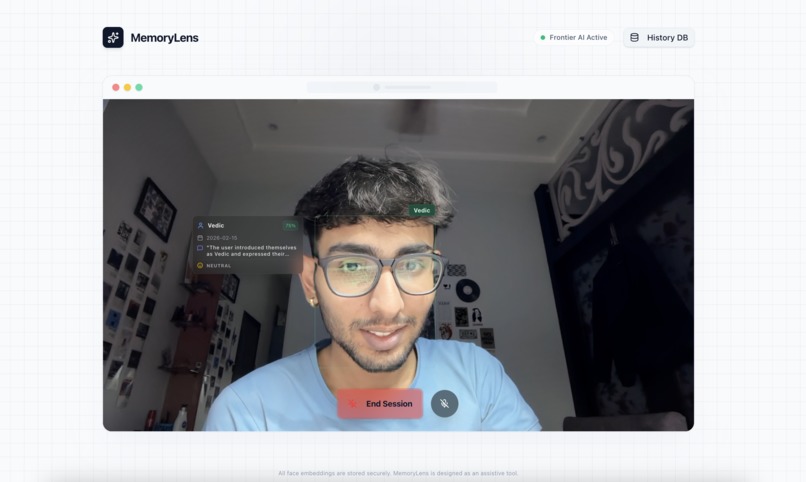
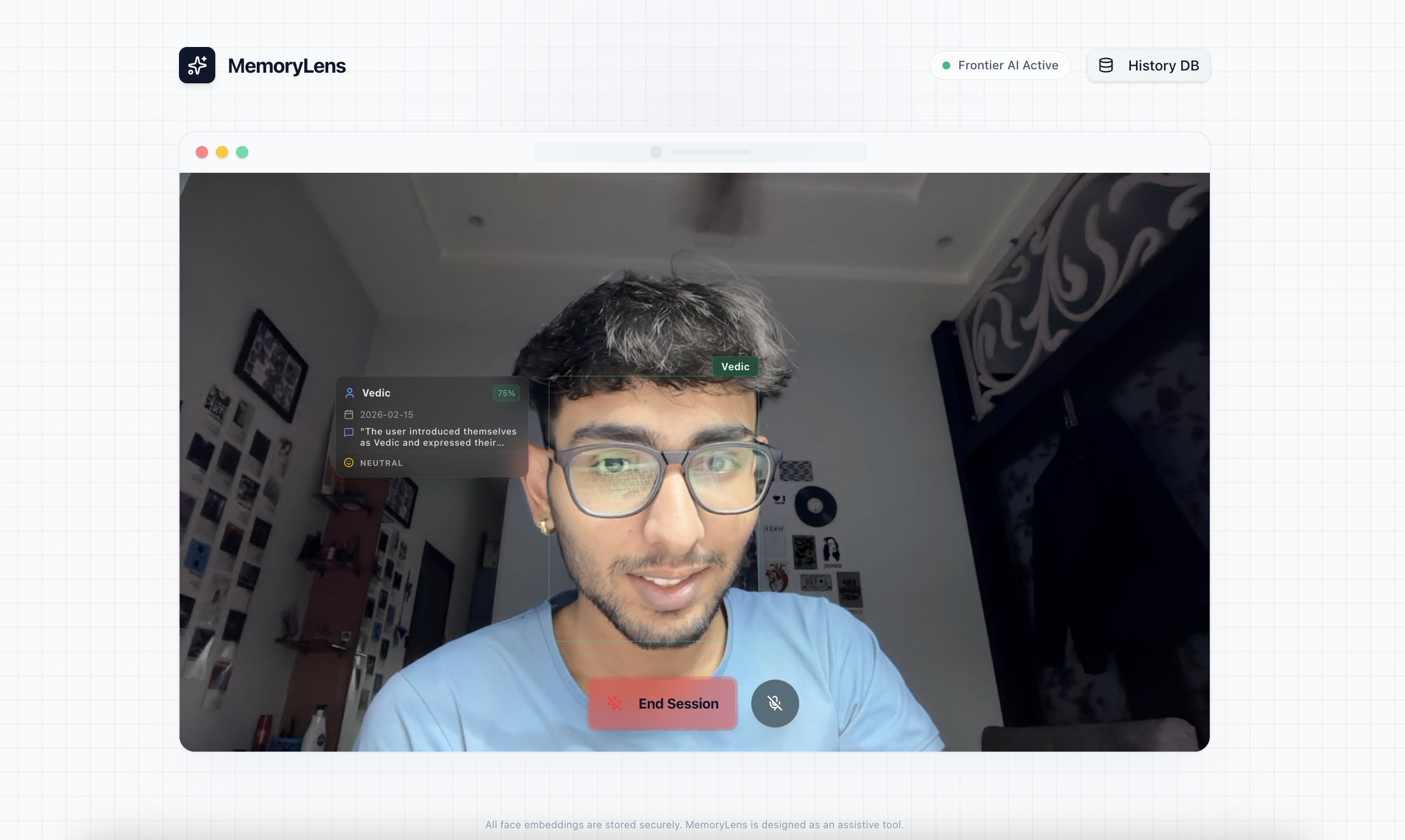
Real-time face recognition overlay displaying name, last meeting date, and conversation context instantly.
-
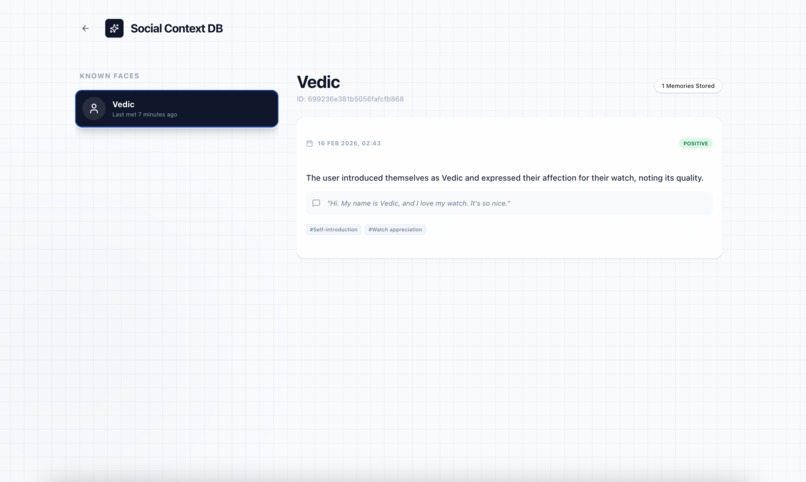
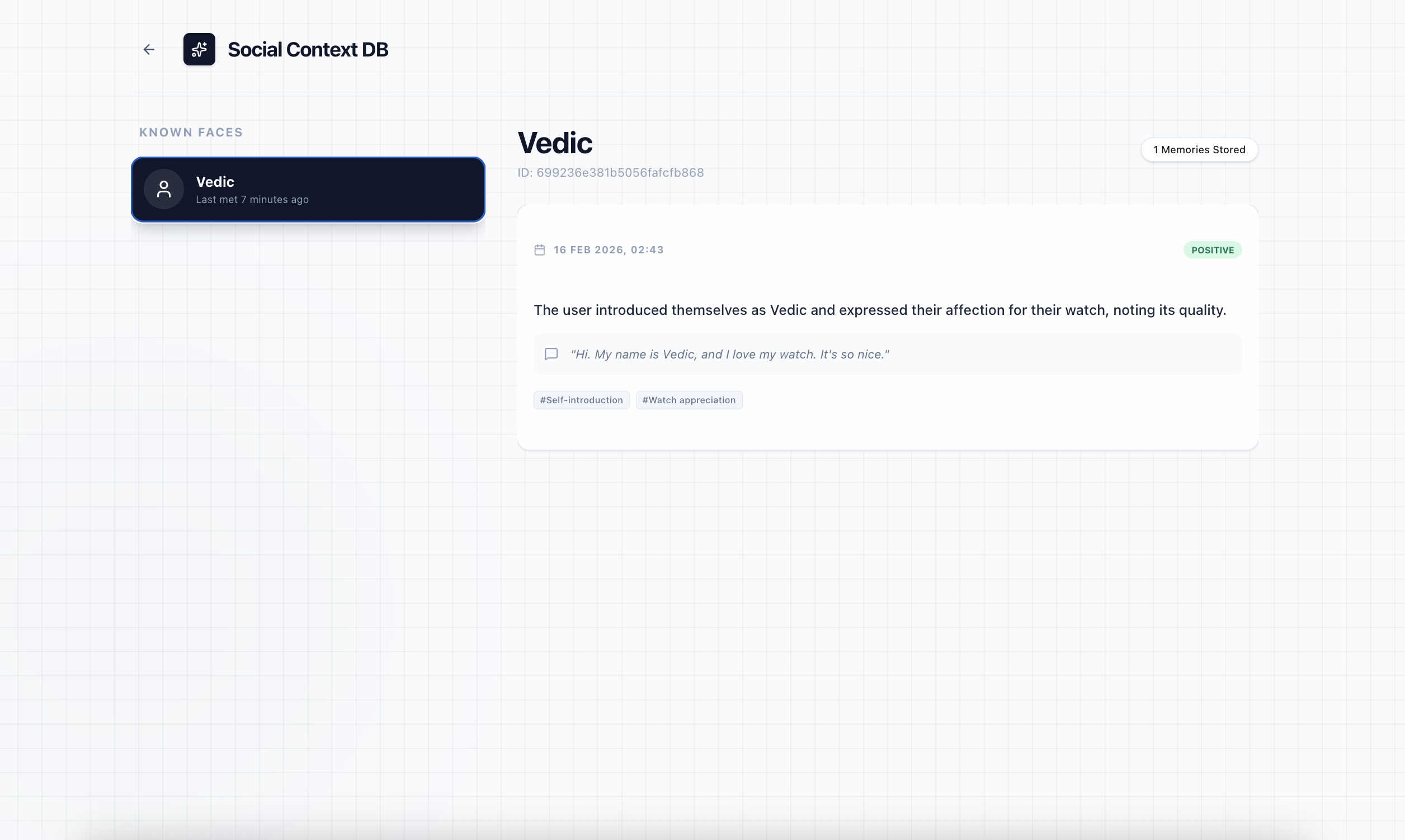
View stored contacts, last meeting dates, and AI-summarized conversation history in a structured memory dashboard.
The Problem
Human memory is powerful, but unreliable.
In professional, academic, and social environments, forgetting names, context, or previous discussions can lead to lost opportunities, awkward interactions, and increased anxiety.
Networking events. Conferences. Team collaborations.
We constantly rely on memory.. yet biological memory has limits.
What if AI could extend human memory responsibly?
Our Solution: MemoryLens
MemoryLens is a real-time multimodal AI system that augments human social memory.
Using a camera interface (webcam for this prototype, wearable-ready architecture for future smart glasses), MemoryLens:
- Detects a face in real time
- Matches it using facial embeddings
- Retrieves the last recorded interaction
- Displays contextual information instantly
After each conversation, users can record a short voice note.
The system:
- Transcribes speech using Deepgram
- Extracts key topics
- Summarizes the conversation
- Detects emotional tone
- Securely links the memory to that individual
The next time you meet them, context reappears seamlessly.
Technical Architecture
MemoryLens is a multimodal AI system combining:
Computer Vision
- OpenCV for real-time face detection
face_recognitionfor generating 128-d facial embeddings- Cosine similarity matching for identification
- Optimized frame downscaling to reduce CPU load
Speech Intelligence
- Deepgram API for high-accuracy transcription
- LLM-based summarization (OpenAI/Gemini)
- Automatic topic extraction
- Emotional tone classification
Intelligent Memory Storage
- MongoDB Atlas for structured memory storage
- Vector-style embedding matching
- In-memory embedding caching for low-latency performance
- WebSocket streaming for near real-time recognition
Frontend Experience
- Next.js 15 + TypeScript
- Tailwind CSS
- Live webcam feed
- Dynamic bounding box overlays
- Context cards rendered in real time
The system processes lightweight frames every 1.5 seconds to balance performance and accuracy.
Impact & Usefulness
MemoryLens is assistive AI.
It benefits:
- Students building professional networks
- Professionals managing hundreds of contacts
- Neurodivergent individuals who struggle with social recall
- Individuals with mild cognitive memory challenges
Beyond networking, this has implications for:
- Assistive cognitive healthcare tools
- Wearable AI companions
- Context-aware IoT systems
This is AI augmenting humans, not replacing them.
Privacy & Ethical Design
Privacy is core to MemoryLens.
- No external identity databases
- No scraping of third-party facial data
- User-controlled embedding storage
- No mass surveillance architecture
- Designed for personal, ethical augmentation only
We believe the future of AI must be responsible and human-centered.
Challenges & Innovation
Building a real-time multimodal AI system required solving:
- Frame optimization to avoid CPU overload
- Real-time embedding matching at low latency
- Stable WebSocket communication
- Accurate recognition under varied lighting
- Designing overlays that feel natural and non-intrusive
We implemented:
- Frame downscaling
- Embedding caching in RAM
- Similarity threshold tuning
- Lightweight WebSocket payloads
The result is a stable, responsive prototype.
Future Roadmap
MemoryLens is wearable-ready.
Future developments include:
- Meta Smart Glasses integration
- On-device encrypted embedding storage
- Calendar & CRM integration
- Smart follow-up reminders
- Multi-person conversation tracking
- Edge-device offline optimization
MemoryLens could evolve into a personal AI memory operating system.
Why This Project Matters
AI is increasingly capable of seeing, hearing, and understanding.
The key question is not:
Can we build it?
The real question is:
Can we build it responsibly?
MemoryLens demonstrates a frontier application of multimodal AI that enhances human connection while respecting privacy.
Not for surveillance.
Not for manipulation.
But for meaningful human interaction.


Log in or sign up for Devpost to join the conversation.