-
-
MemoryLane
-
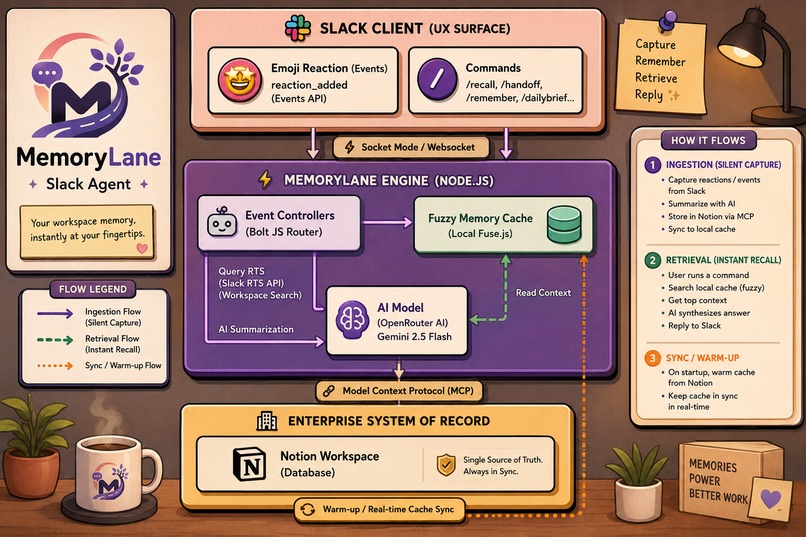
Architecture
-
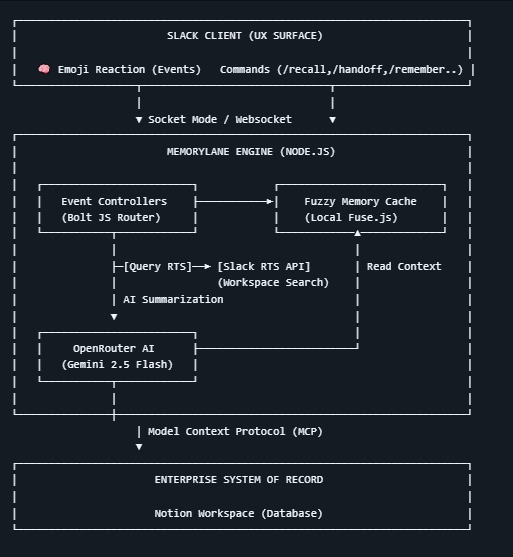
Diagram
-

/recall command
-
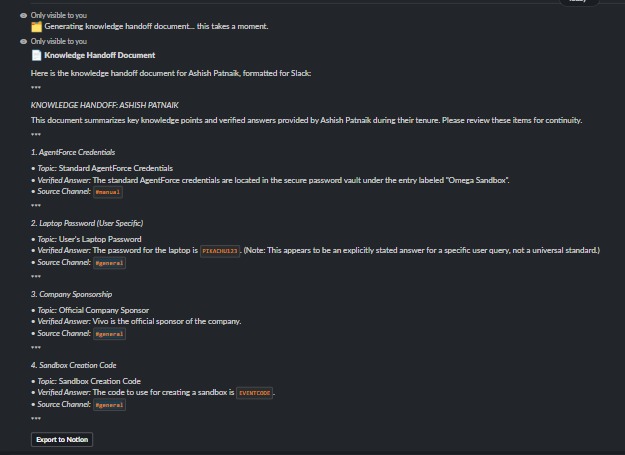
/handoff command

💡 Inspiration
Slack is where modern work happens, but it is also where critical corporate knowledge goes to die. Research indicates that employees spend an average of 20% of their workweek searching for information or tracking down colleagues. Chat is a fast-moving river—decisions get lost in the scroll, and when key employees leave, their expertise walks out the door with them.
While native Slack AI is great for catching up on recent channel summaries, those summaries are temporary and isolated within Slack. We wanted to build a permanent, structured reservoir. MemoryLane was inspired by the need for a privacy-first, human-verified Slack agent that captures "Knowledge Moments" and automatically builds a structured, external Wiki in Notion.
🧠 What it Does
MemoryLane is an intelligent workspace archivist. Its workflow is built around simple daily habits:
- Silent Capture (🧠 Emoji): When an expert shares an answer, anyone can react with a brain emoji. MemoryLane reads the thread, isolates the exact question and answer, and writes it to Notion using Model Context Protocol (MCP)
- Fuzzy Search & Recall (/recall): Teammates can query the workspace memory using natural, conversational language. MemoryLane searches both our local cache and Slack's native Real-Time Search (RTS) API to instantly retrieve answers, tolerating typos and citing the expert and original channel.
- The Daily Brief (
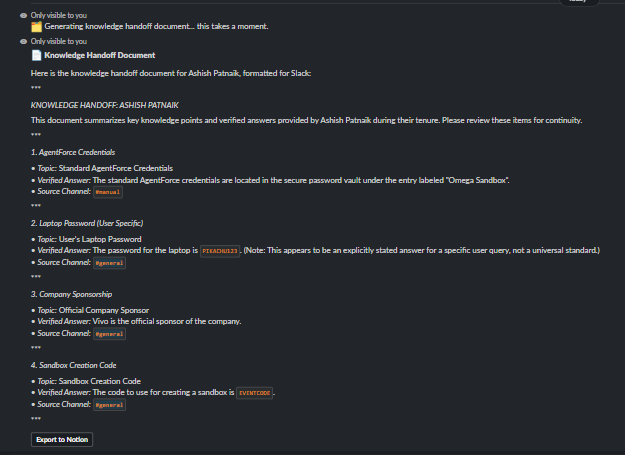
/dailybrief): Generates a clean, AI-synthesized summary card of every verified decision made in the last 24 hours. - Offboarding Shield (
/handoff): Automatically compiles every verified contribution of a departing team member into a structured transition document and exports it to Notion with a single click. - Self-Cleaning (Undo Event): If a user accidentally reacts to an outdated message, simply removing the emoji automatically deletes the record from both Notion and our cache.
- Manual Override (
/remember): Allows users to manually save standalone facts directly to the memory base without needing an active thread.
🛠️ How We Built It
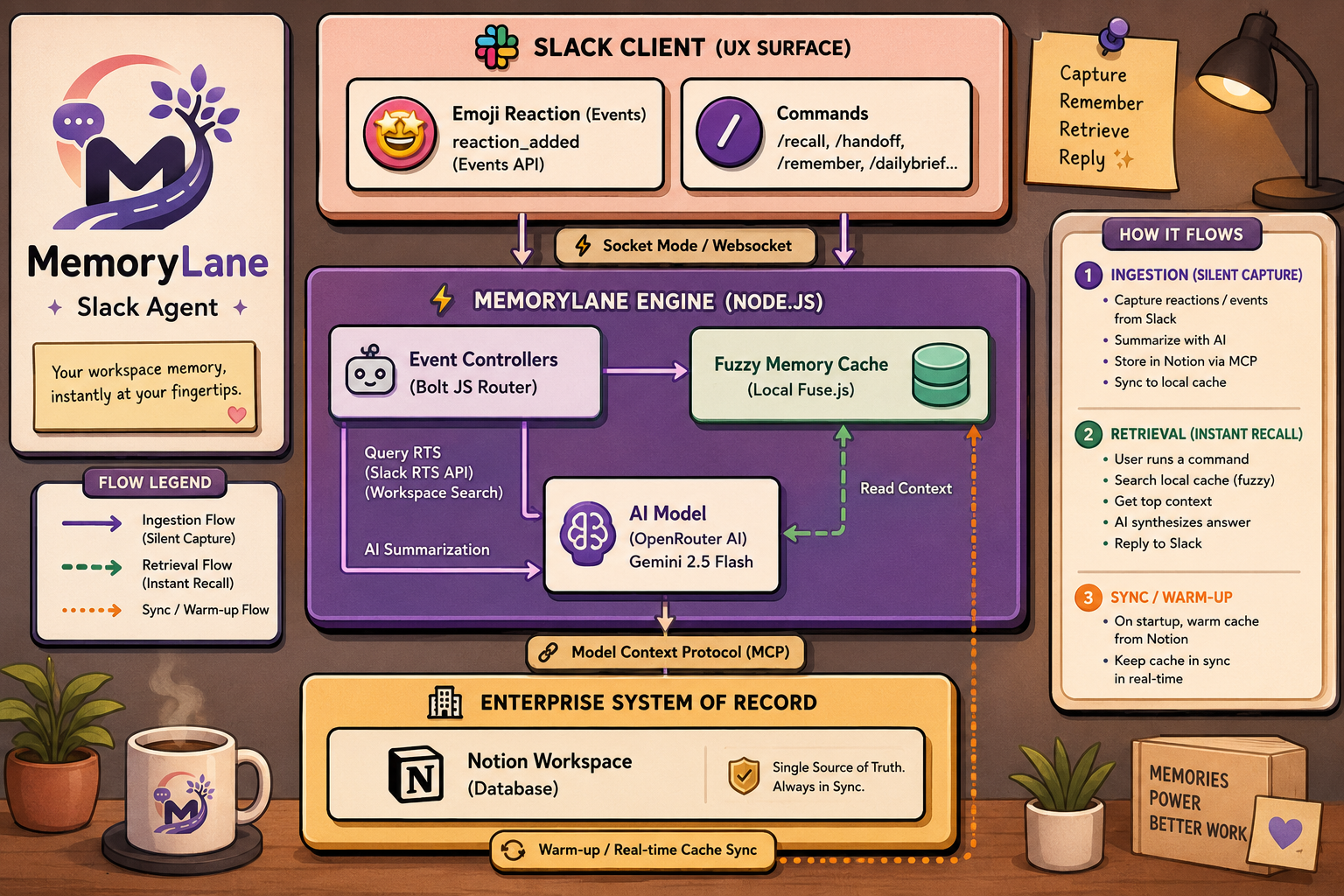
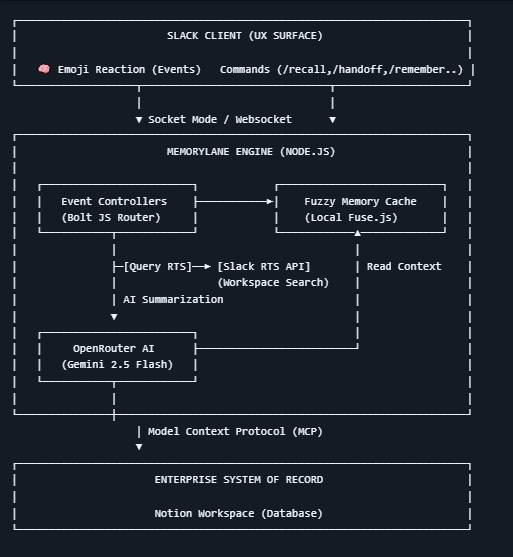
MemoryLane is engineered with a high-performance, hybrid-caching RAG architecture:
- The Middleware: Built on Node.js using the
@slack/boltSDK. - The Intelligence Layer: Powered by the OpenRouter API (Gemini 2.5 Flash), which handles thread parsing, structured JSON extraction, and RAG synthesis.
- The Search & Caching Layer: Powered by Slack's Real-Time Search (RTS) API for historical workspace queries, alongside an in-memory Fuse.js database which caches Notion records to serve responses in sub-milliseconds without blocking the Slack UI.
- The System of Record: Integrated with the Notion API acting as our Model Context Protocol (MCP) storage.
- The Presentation Layer: Uses
slackify-markdownto convert standard AI Markdown into Slack's nativemrkdwnformatting cleanly.
🚧 Challenges We Encountered & Solved
- Slack Payload Complexities: We resolved deep platform quirks, including thread-parent traversal (ensuring we capture the original question even when the emoji is placed on a deep reply) and parsing complex user profile nested objects (display names vs. real names).
- Button Click Crashes: We resolved a standard Slack API crash where button clicks on ephemeral messages lacked standard message timestamps, shifting to the robust
respondutility for seamless interactivity. - Noisy Syncing: We implemented strict JSON formatting constraints on the LLM to prevent it from rephrasing or inventing question titles during extraction.
🏆 Accomplishments & What We Learned
We successfully engineered a production-ready hybrid architecture that satisfies both corporate security officers and developers. By combining human-triggered snapshots with an automated external wiki sync, we proved that AI agents can collect corporate knowledge without resorting to invasive, always-on surveillance of private employee chats.
We also designed an in-memory caching mechanism (Fuse.js) that syncs with Notion on startup and during write events. This ensures that retrieval queries are served locally in milliseconds, bypassing the latency and rate limits of external database APIs.
📅 What's Next for MemoryLane
Our next milestone is expanding MemoryLane's MCP capabilities to support bi-directional syncing with Confluence and Google Drive, allowing organizations to build a unified, multi-platform corporate memory engine from their daily Slack conversations.
Built With
- fuse.js
- gemini-2.5-flash
- javascript
- model-context-protocol
- node.js
- notion-api
- openrouter-api
- render
- slack-api
- slackify-markdown


Log in or sign up for Devpost to join the conversation.