-
-
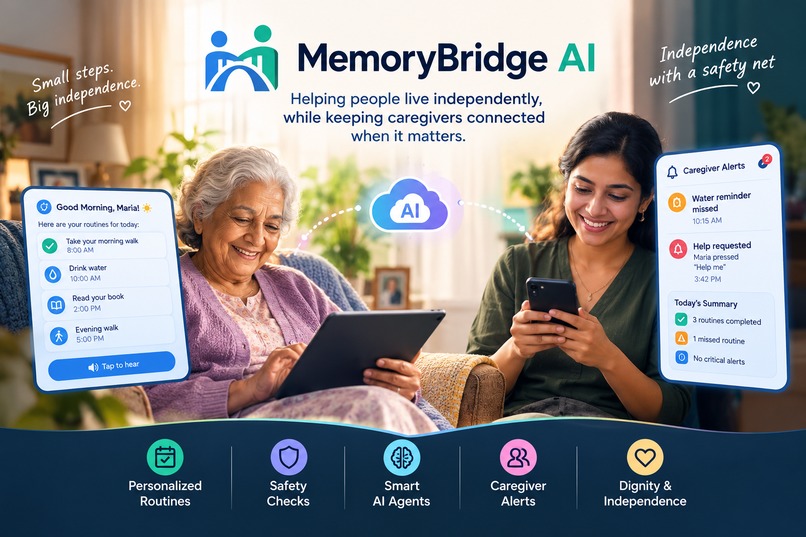
Helping people live independently, while keeping cargivers connected when it matters
-
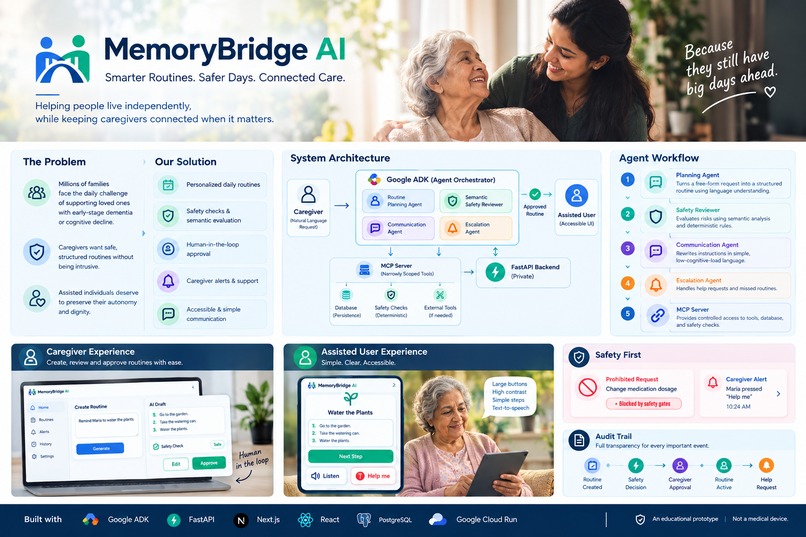
Memory bridge ai is smarter routines, safe days, connected care
-
title banner
-
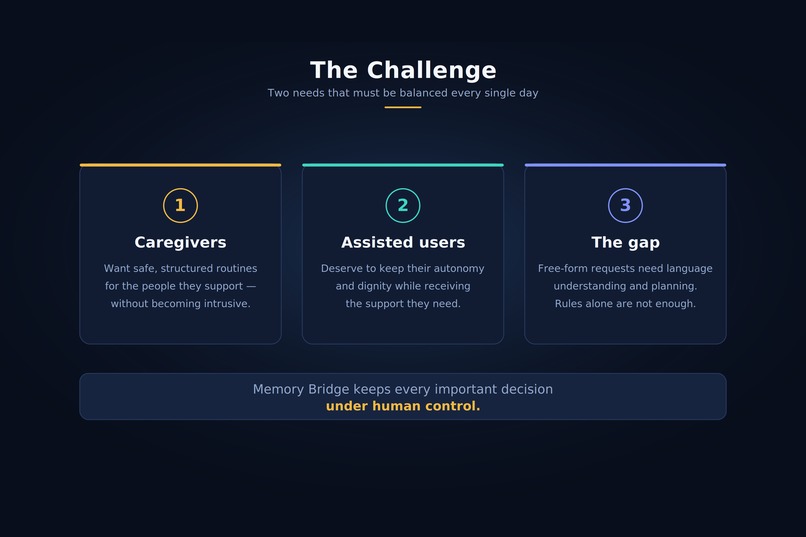
the challenges
-
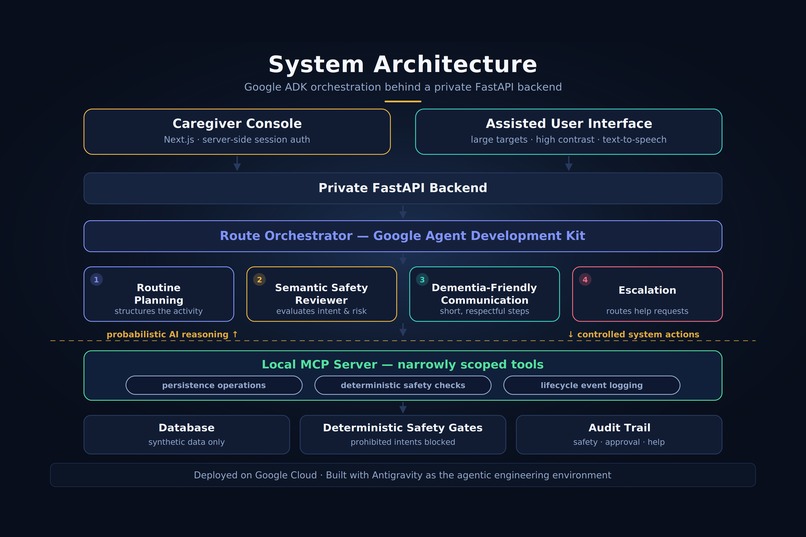
system architecture
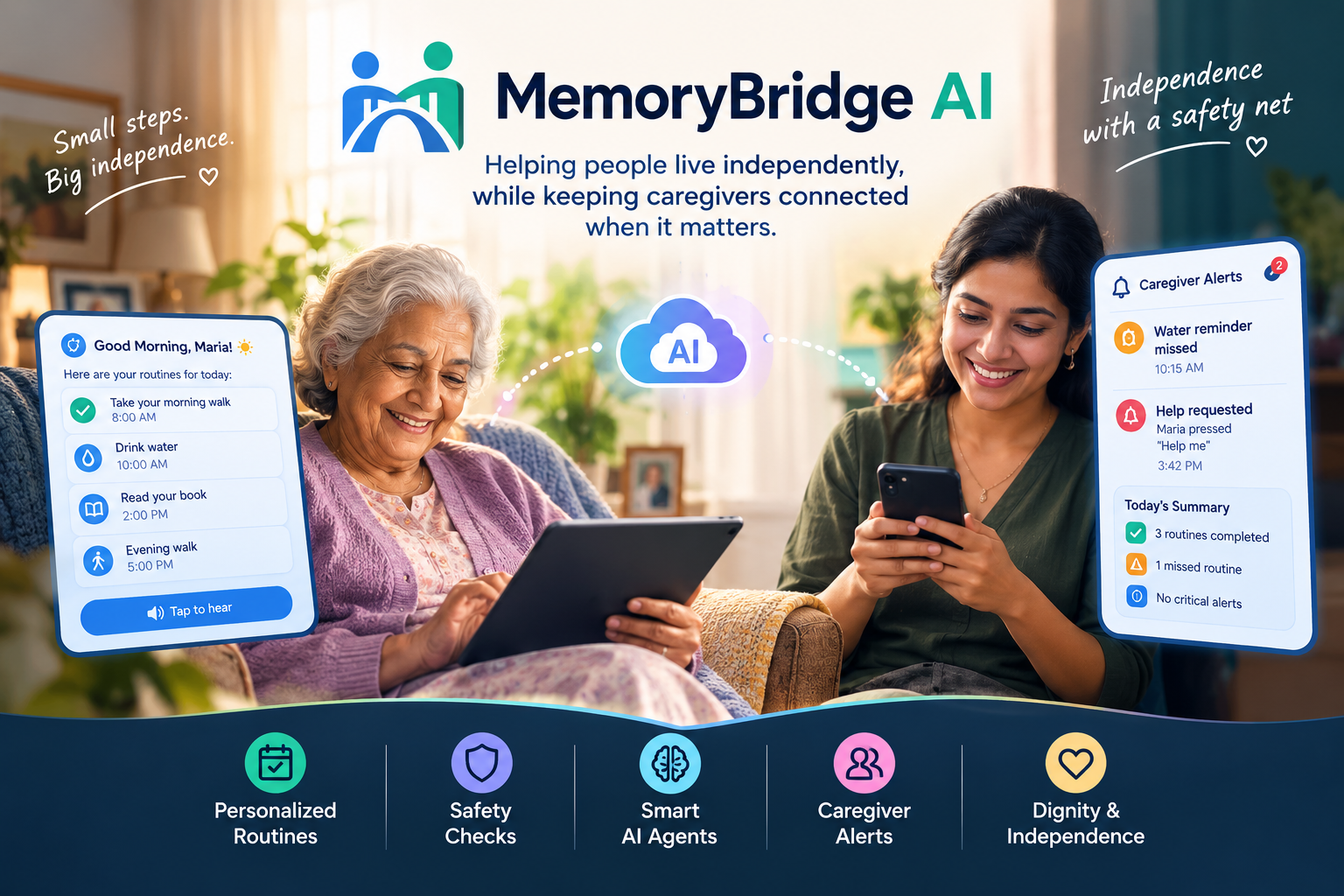
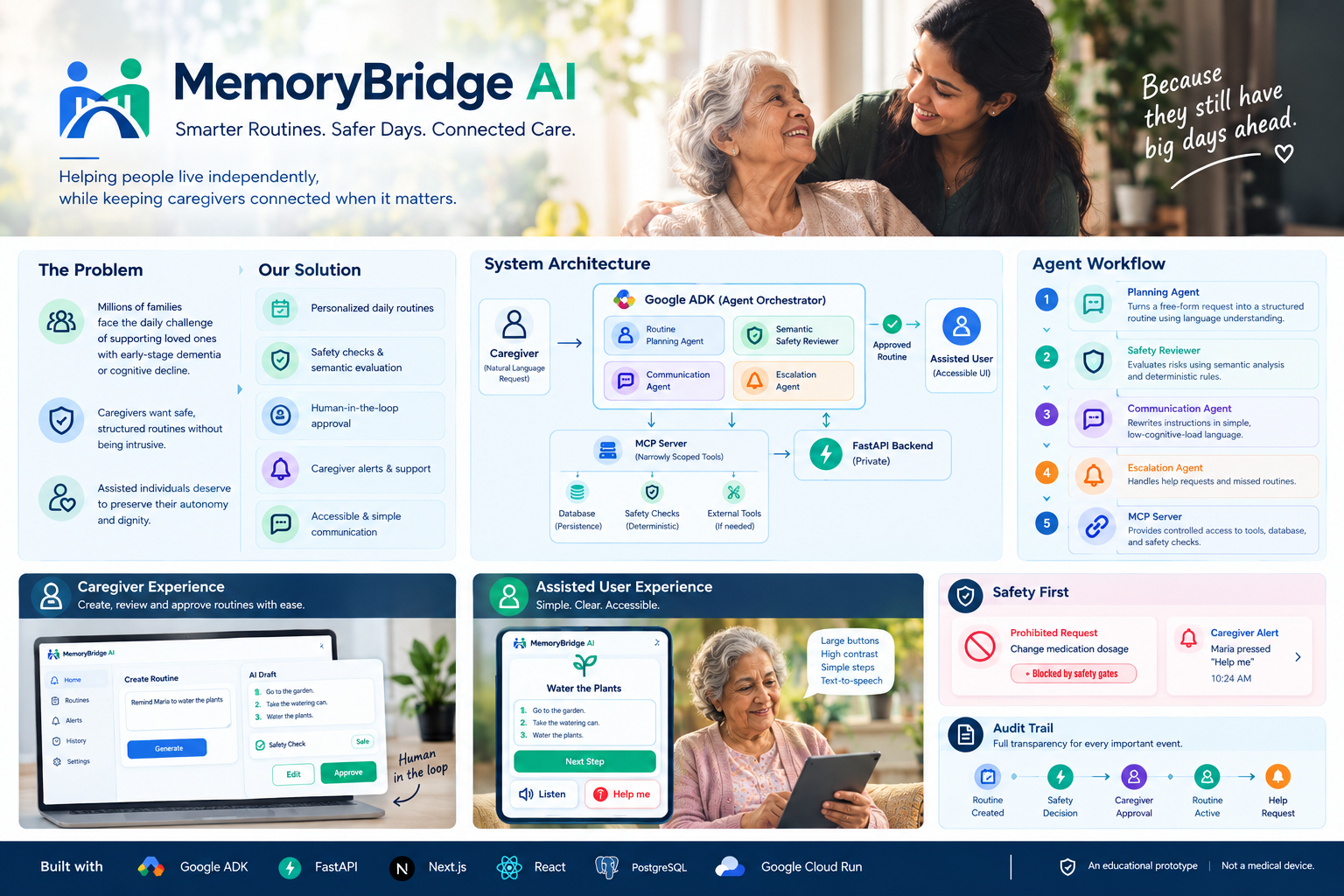
MemoryBridgeAI: Safety-First Daily Support Through Human-Guided AI Agents
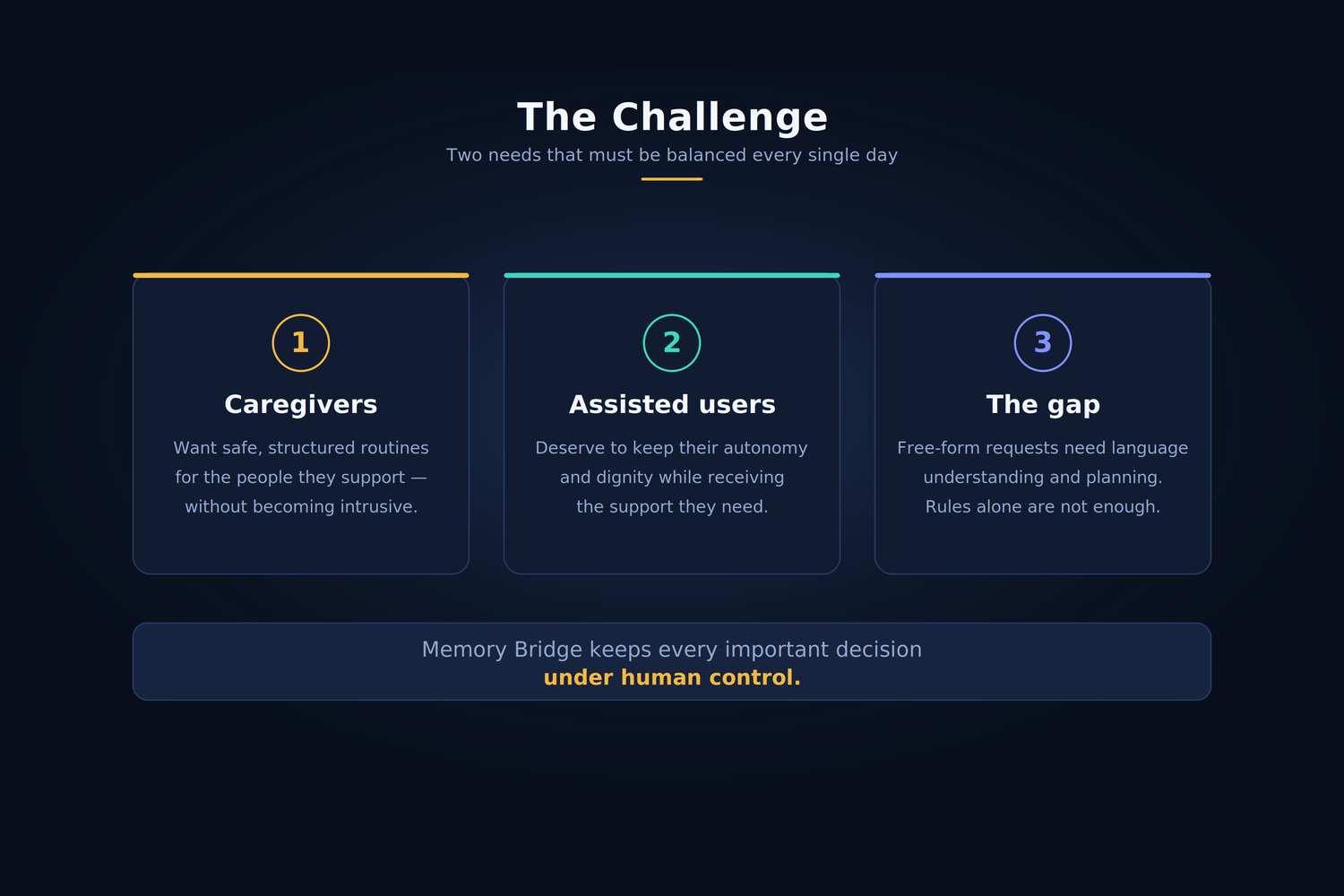
The challenge For people living with early-stage dementia or cognitive decline, familiar daily activities can gradually become difficult to remember, organize, and complete independently.
At the same time, caregivers face a painful balance: they want to provide support, but constant checking can be exhausting for the caregiver and intrusive for the assisted person. Existing reminder applications can display notifications, but they rarely understand natural-language caregiver intent, evaluate whether a requested activity is safe, or convert it into calm, low-cognitive-load instructions.
MemoryBridgeAI explores how AI agents can support daily independence without replacing human judgment.
The solution MemoryBridgeAI is a safety-first multi-agent prototype that helps caregivers create structured daily routines for an assisted user.
A caregiver can enter a natural-language request such as:
“Remind Maria to water the plants at 10:00.”
MemoryBridgeAI then:
extracts the caregiver’s intended activity and schedule; converts the activity into small, understandable steps; checks the request against deterministic safety restrictions; performs a semantic safety review; rewrites the instructions for low cognitive load; presents the result to the caregiver for explicit review; activates the routine only after human approval. The approved routine appears in Maria’s simplified /today interface. Maria can listen to the instructions, mark the routine as completed, request help, or indicate that she wants to contact her caregiver.
A “Help me” action creates a caregiver-facing in-app alert. MemoryBridgeAI does not place real calls, send emergency messages, or contact external services.
Why an agent system? This problem requires more than a basic reminder form.
Caregiver requests are written in natural language and may be incomplete, ambiguous, overly complicated, or unsafe. The system must reason about the request while remaining inside strict boundaries.
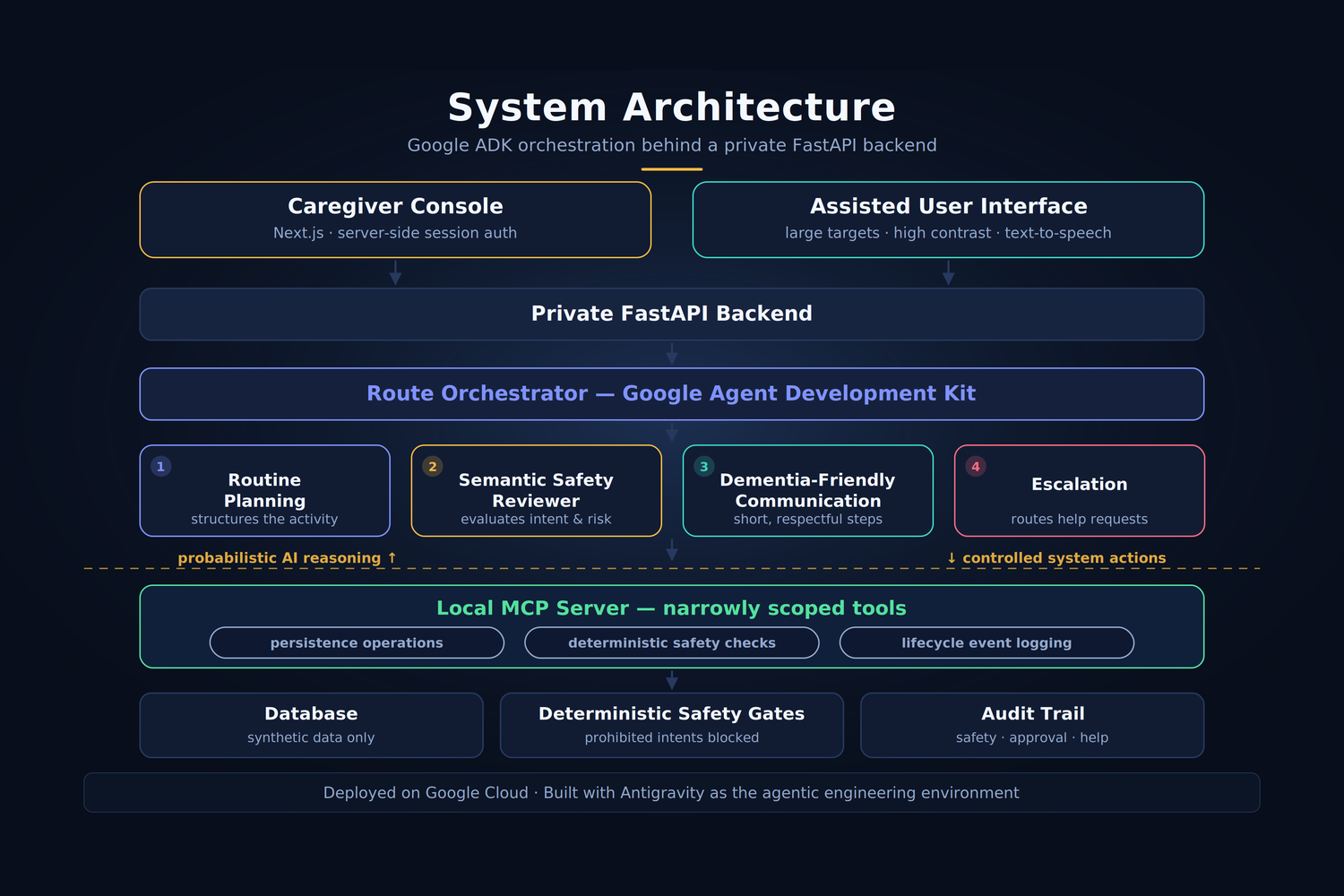
MemoryBridgeAI uses Google Agent Development Kit to coordinate specialized agents:
Routine Planning Agent — extracts the intent, time, and activity and creates structured steps. Semantic Safety Reviewer — evaluates whether the proposed routine contains unsafe or prohibited intent. Dementia-Friendly Communication Agent — rewrites instructions using short sentences, one action at a time, and respectful language. Escalation Agent — handles assisted-user help requests and creates caregiver alerts. The agents are coordinated by a deterministic workflow rather than being allowed to act autonomously without limits.
Safety-first architecture
MemoryBridgeAI follows a “Safety First, AI Second” architecture.
Before an LLM processes an allowed routine, deterministic gates check for prohibited categories such as:
medication or dosage changes; medical diagnosis or medical advice; financial transactions; emergency-service actions; unlocking doors; controlling appliances; other high-risk actions outside the prototype’s scope. For example, a request such as:
“Tell Maria to take an extra pill because she has a headache.”
is rejected and cannot be approved.
The system also enforces a human-in-the-loop checkpoint. Agents may create a draft, but they cannot activate it. Every routine requires explicit caregiver approval.
Model Context Protocol and data boundaries
The agents do not access the database directly.
All persistence operations pass through a dedicated Model Context Protocol routines server. The MCP server exposes narrowly scoped tools for operations such as:
creating a routine draft; listing caregiver routines; recording approvals and rejections; creating a caregiver alert; retrieving the assisted user’s daily routines. This creates a clear boundary between probabilistic agent reasoning and deterministic persistence and safety logic.
Agent Skills further define each agent’s responsibilities, triggers, prohibited behaviors, and output requirements.
User experience
MemoryBridgeAI provides two purpose-built interfaces.
Caregiver portal The caregiver can:
create a routine using natural language; review the AI-generated steps; inspect the safety decision; edit and revalidate a draft; explicitly approve or reject it; view active routines; view help alerts; inspect a redacted audit timeline. Assisted-user portal The /today experience is intentionally simplified:
one routine is emphasized at a time; large text and interaction targets; short, numbered steps; high contrast; Listen functionality; clear Done and Help me actions; minimal navigation and visual noise. The interface is designed for accessibility and reduced cognitive load, but it has not undergone clinical validation.
Evaluation
MemoryBridgeAI was tested through a focused automated evaluation suite and production smoke tests.
Verified Phase 5 results include:
28/28 focused evaluation cases passed; 10/10 prohibited routine cases were rejected; prohibited routines never reached the communication agent; 0 approval-bypass cases; 6/6 prompt-injection tests passed; 8/8 extraction cases passed without inventing missing times or contact names; 5/5 communication-rubric cases passed; 20/20 MCP server tests passed; 20/20 web tests passed; 0 axe-core accessibility violations in the tested interfaces; 0 real secrets detected in tracked files. The production deployment was additionally smoke-tested through the live caregiver and assisted-user flows.
Deployment
MemoryBridge is deployed on Google Cloud Run.
The deployment separates:
a public Next.js web application; a private FastAPI agent backend; Google ADK agent orchestration; a local MCP subprocess inside the backend boundary; Neon PostgreSQL persistence. The public web service communicates with the private backend using Google Cloud service-to-service identity. The application-level caregiver and assisted-user identities remain server-side and are not exposed to the browser. Responsible use MemoryBridgeAI is an educational prototype using synthetic demo data. It is not a medical device and does not:
diagnose dementia;
provide medical advice; prescribe or modify medication; monitor a person medically; contact emergency services; replace caregivers or healthcare professionals. The project demonstrates how agent systems can be constrained through deterministic policies, human approval, narrow tools, evaluation, and transparent audit events.
Links
GitHub:https://github.com/Harshithpalan/MemoryBridge-AI.git Live caregiver demo:https://web-six-kohl-j9pauk3m8u.vercel.app/caregiver Assisted-user demo:https://web-six-kohl-j9pauk3m8u.vercel.app/today
Built With
- adk
- agents
- ai
- cloud
- css
- fastapi
- gemini
- intelligence
- machine
- mcp
- multi-agent
- natural
- next.js
- postgresql
- python
- react
- sqlalchemy
- tailwind


Log in or sign up for Devpost to join the conversation.