-
-
Memory Reinforcement Tutor
Inspiration
The inspiration for Memory Reinforcement Tutor AI came from my own experience of forgetting important concepts while learning AI and ML. Even after understanding topics clearly I noticed that memory faded with time. This made me explore how forgetting follows patterns and how it can be modeled mathematically. I wanted to build a system that does not just store information but actively predicts when a user may forget it.
What it does
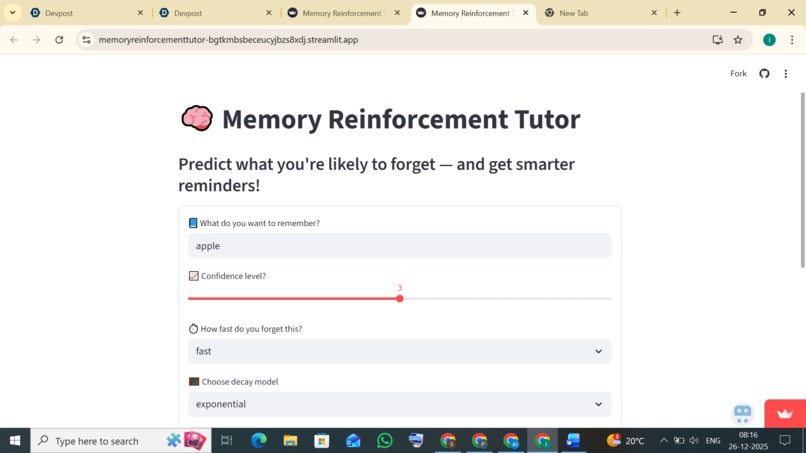
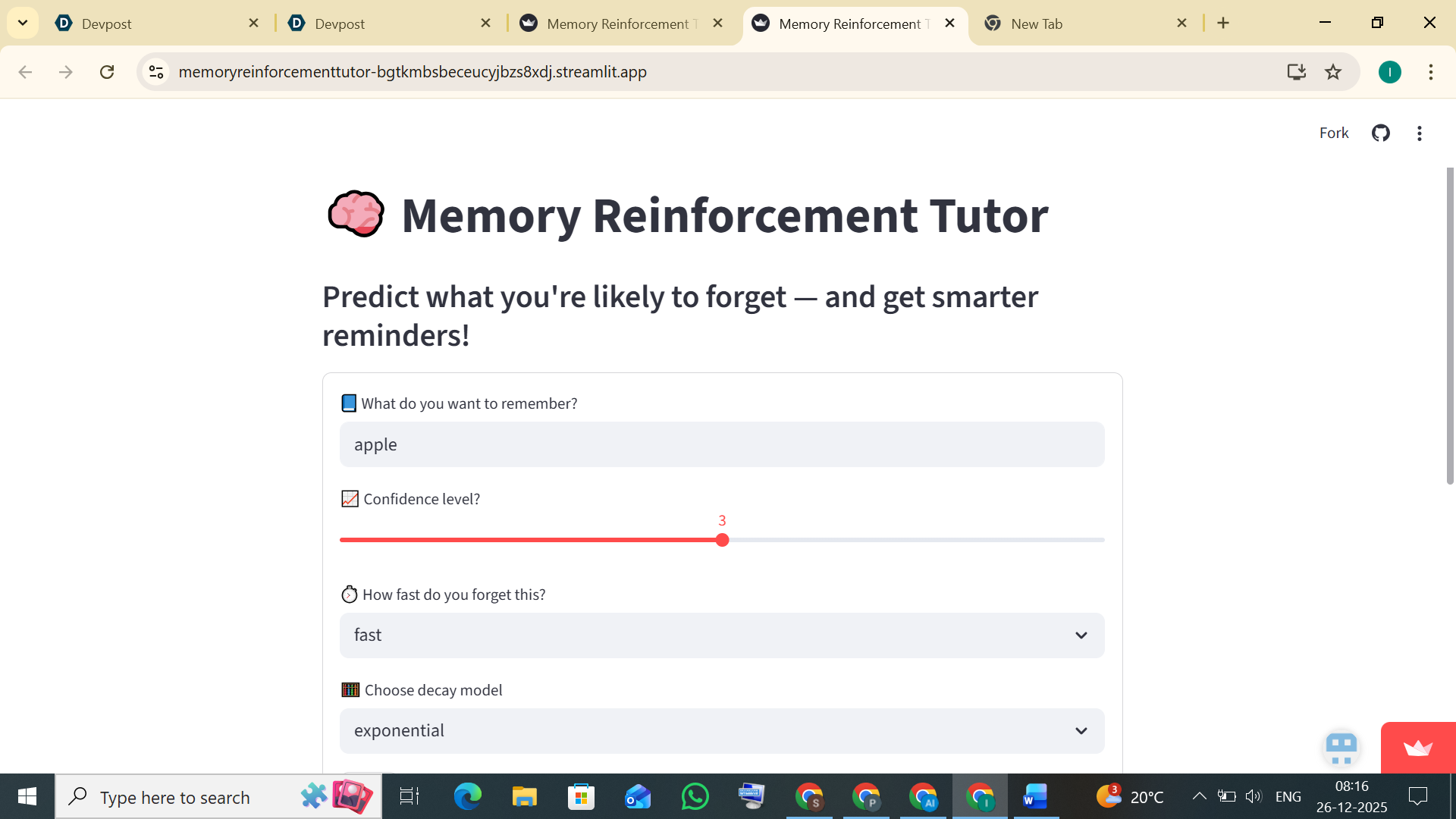
Memory Reinforcement Tutor AI predicts what a user is likely to forget and suggests when a review is needed. Users can enter any topic choose their confidence level select how fast they forget and pick a decay model. The system tracks memory strength over time shows visual graphs compares decay models and maintains a complete history of all memory entries.
How we built it
The project was built using Python and Streamlit. Memory behavior is simulated using mathematical decay models such as exponential and linear decay. User interactions act as real time data that updates memory strength dynamically. The application is fully deployed online and works without external APIs datasets or paid services.
Challenges we ran into
Designing realistic memory decay without hardcoded logic was a major challenge. Managing multiple memory items with independent states required careful structure. Another challenge was making the system explainable while keeping the logic simple enough for real time interaction.
Accomplishments that we're proud of
We successfully built a fully interactive AI style system that simulates learning instead of relying on datasets. The project includes explainable formulas visual analytics decay model comparison and a full memory history. It is accessible from any device and demonstrates a complete AI project lifecycle.
What i learned
This project helped me understand how to convert human behavior into mathematical models. I learned how to design explainable AI systems manage dynamic application state and deploy a real world AI project. It also improved my ability to think in terms of systems rather than isolated features.
What's next for Memory Reinforcement Tutor AI
Future improvements include smarter review scheduling long term memory simulation user progress insights and personalized learning patterns. The goal is to evolve the system into a more adaptive and intelligent learning assistant.


Log in or sign up for Devpost to join the conversation.