-
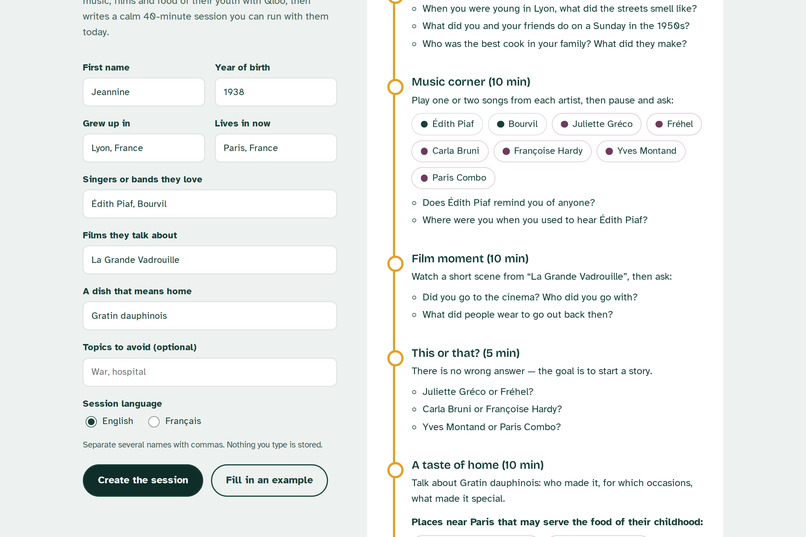
A session for Jeannine, born in Lyon in 1938: Qloo extends Piaf and Bourvil to Gréco, Fréhel and Montand.
Inspiration
What it ## Inspiration
In hospitals and nursing homes, there are older patients and residents for whom one song, one film or the smell of one dish can open a door that nothing else opens. Reminiscence activities are one of the most widely used non-drug approaches in elder care, but they only work when the material belongs to that person's life. In practice, staff and families fall back on the same generic playlist for everyone, and it rarely fits someone who grew up in Lyon in the 1950s, in Porto, or in Algiers.
The people who know the resident best (their family) have five minutes, not five hours. The people who run the activity (care staff) have many residents and little time to research each one. Memory Lane sits between them.
What it does
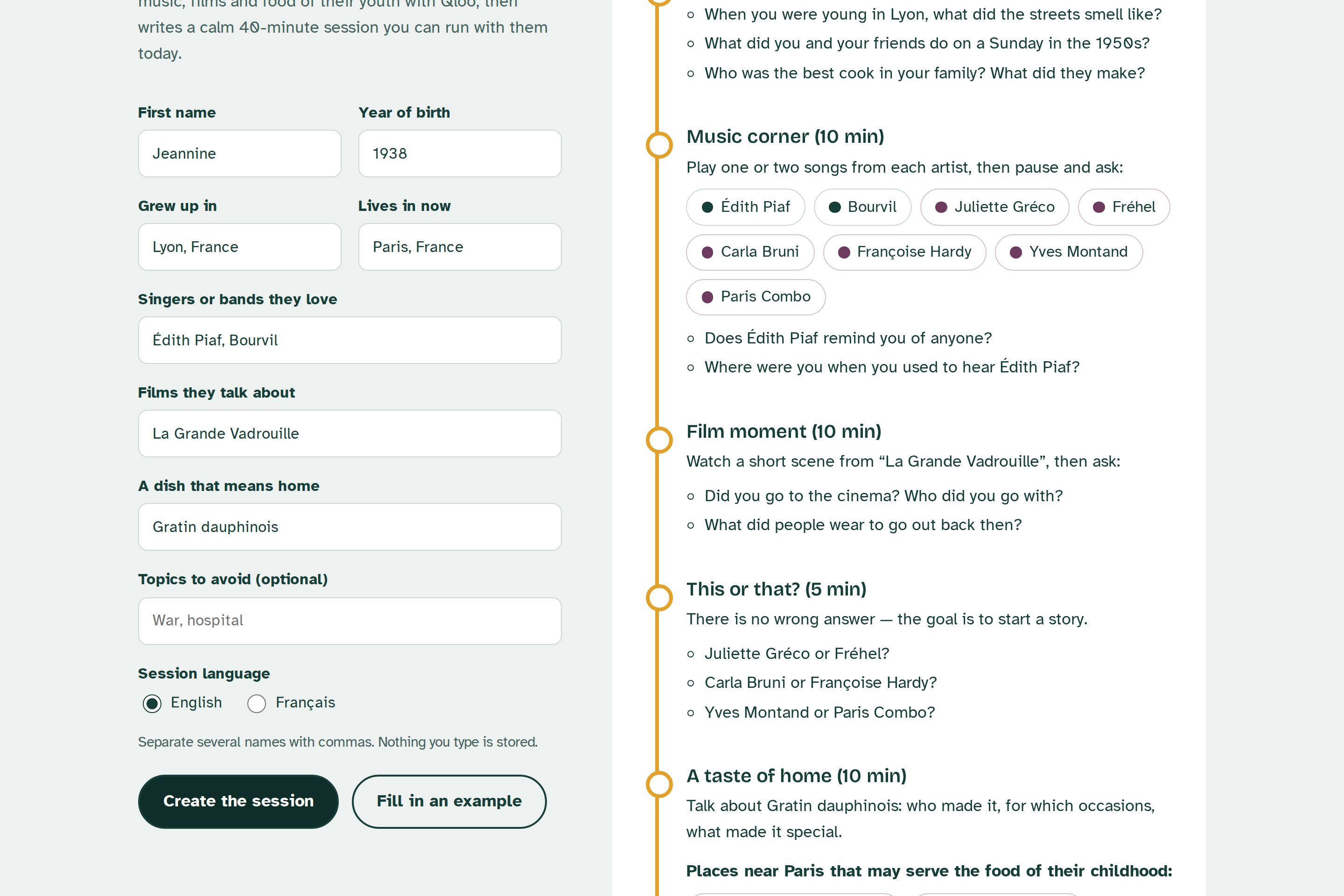
A family member or caregiver fills in a short profile: first name, year of birth, where the person grew up, where they live now, and a few singers, films and dishes they loved. Memory Lane then builds a calm, 40-minute session the staff can run the same day:
- Warm-up questions anchored in the right place and decade ("When you were young in Lyon, what did the streets smell like?").
- A music corner mixing the artists the family named with artists Qloo finds close to them (from Édith Piaf, Qloo surfaces Juliette Gréco, Fréhel, Yves Montand, Françoise Hardy).
- A film moment built around a film from their youth.
- A "this or that?" game with no wrong answers: it starts stories instead of testing memory.
- A taste of home: real restaurants near where they live now that cook the food of where they grew up (a Lyon-style bouchon in Paris, a Portuguese restaurant, an Algerian restaurant in Marseille), so a family can plan an outing or bring a dish in.
- Notes for the person leading, including topics the family asked to avoid.
Every suggestion is labelled with its source, "from the family" or "suggested by Qloo", and a "How Memory Lane used Qloo" panel lists each call the agent made and why. Sessions can be generated in English or French and printed.
How it is Qloo-powered
Qloo is not a decoration here: every name in the session is either typed by the family or returned by Qloo. The agent runs a small, explicit plan against Qloo's MCP server (@qloo/qloo-harness):
qloo_find_tagsturns vague context into Qloo tags: the decade of their youth, the music of their country, the cuisine of their home town.qloo_recommend(artists) uses the family's favourite artists as signals and the country's music style as a filter, so recommendations stay in the right culture.qloo_recommend(movies) uses the decade as a filter, then the agent checks release years itself.qloo_recommend(places) combines the current city as a location signal with the home cuisine as a filter.
The agent also handles Qloo's answers like an agent should:
- Ambiguity: "Édith Piaf" is an artist, an album and an author in Qloo. When Qloo answers
needs_input, the agent picks the candidate of the kind it needs (an artist for music, a movie for films) and asks again with its ID. Names it cannot place are dropped, never guessed. - Gaps: some cities have few
How we built it
Challenges we ran into
Accomplishments that we're proud of
What we learned
What's next for Memory Lane
Built With
- css
- github-actions
- html
- javascript
- model-context-protocol
- node.js
- qloo
- render

Log in or sign up for Devpost to join the conversation.