Inspiration
Qloo's brief asks whether an agent can serve seniors with "easy-to-chew menus" and "health constraints". Memory Lane takes that further, into the place where older people's taste matters most and gets the least attention: the care home.
About 70% of care-home residents aged 65 and over in England are living with dementia (Alzheimer's Society). In the US, the share is 41% in nursing homes and 44% in assisted living (CDC). That's across about 279,000 older residents in England and Wales (ONS) and about 2.2 million in US nursing homes and residential care (CDC).
Reminiscence and music can modestly improve mood, quality of life and communication. Cochrane reviews found care homes showed the widest benefits from reminiscence (Cochrane 2018), and music therapy probably reduces depression (Cochrane 2025). It works best with each person's own years: people recall most from about age 10 to 30, peaking around 14 for music (Jakubowski et al. 2020).
Yet activity staff are stretched: England's adult social care sector had 96,000 vacancies in 2025/26 (Skills for Care). Nobody has an hour to research what each resident grew up with. Memory Lane does it in about 15 seconds.
What it does
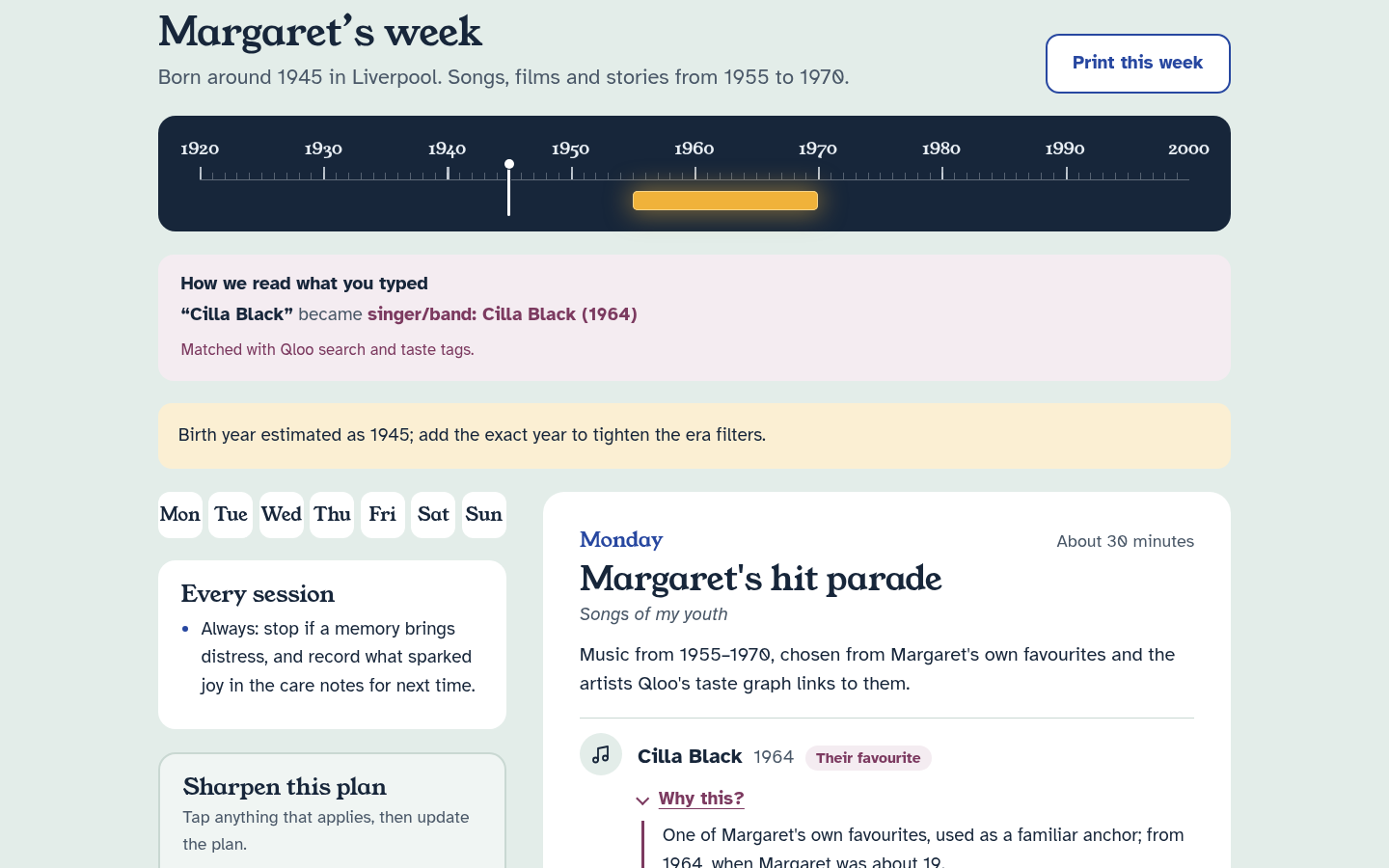
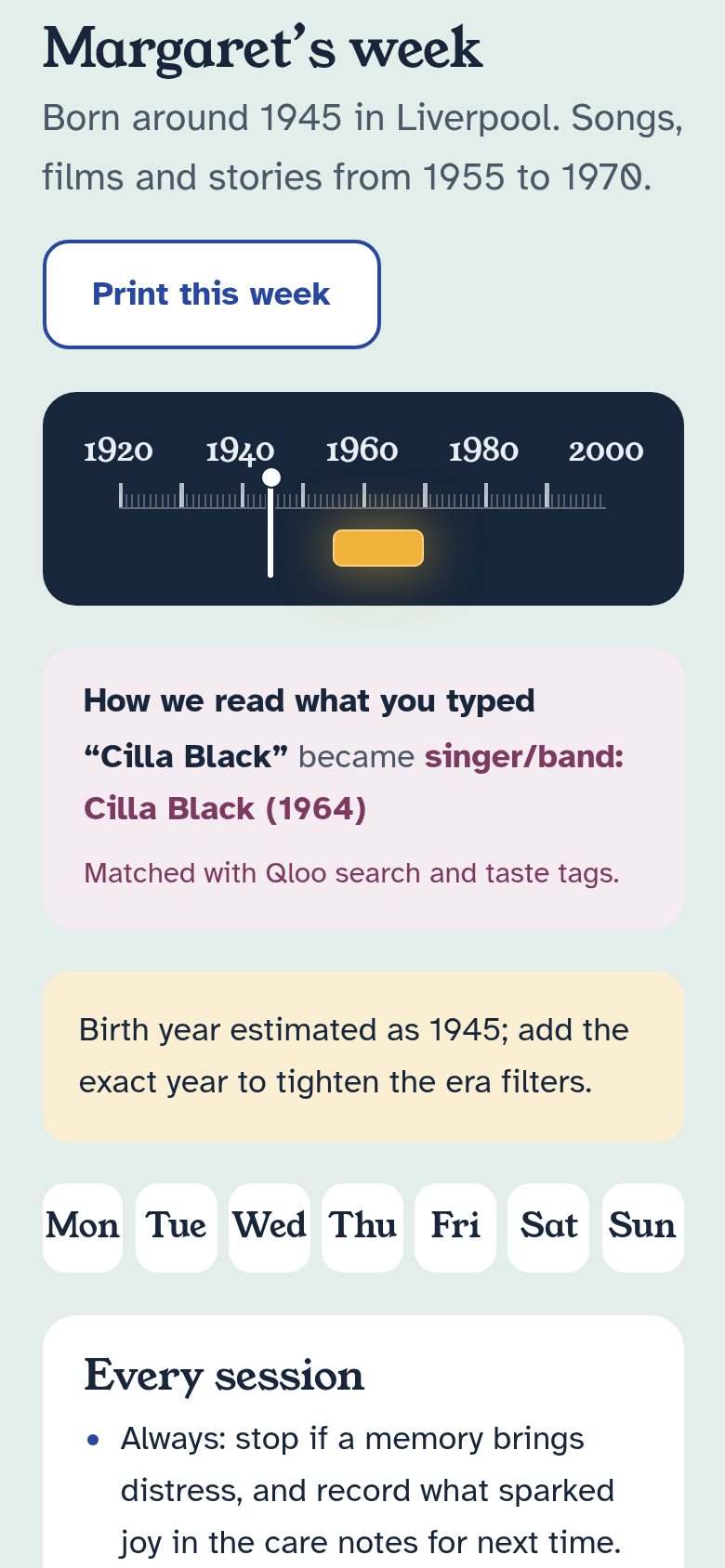
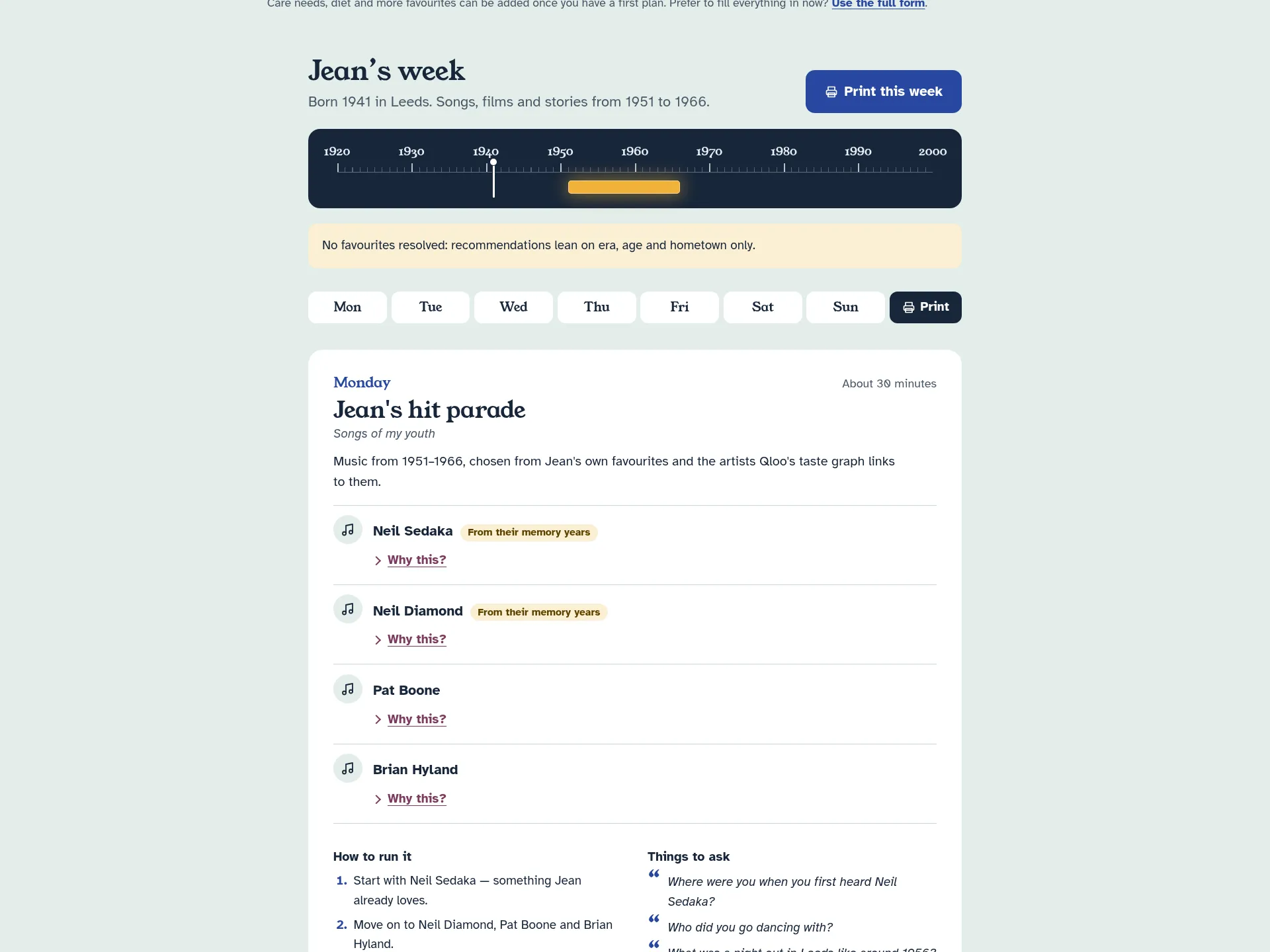
A member of staff types roughly when a resident was born and one thing they loved ("1942", "Lulu"), or a few lines about their life. Memory Lane returns a printable seven-day plan:
- songs, films and TV from their own years
- a taste of home (real places from their hometown), plus soft-food and diabetic adaptations
- armchair travel, a read-aloud and a Sunday sing-along
- steps for each day, conversation prompts written for their dementia stage, and a "Why this?" reason grounded in Qloo signals
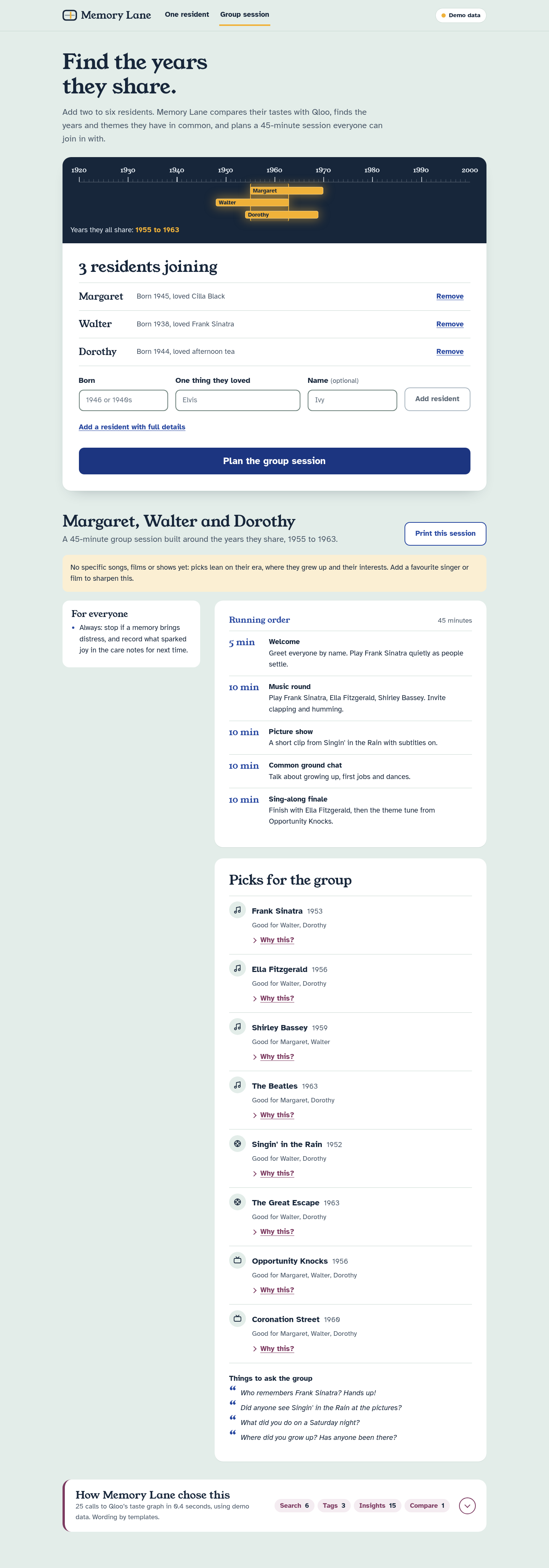
Group mode finds the taste 2 to 6 residents share, with a common-ground score from Qloo's compare analysis. Everything prints to A4 with a "What sparked joy" line for staff.
Why it needs Qloo
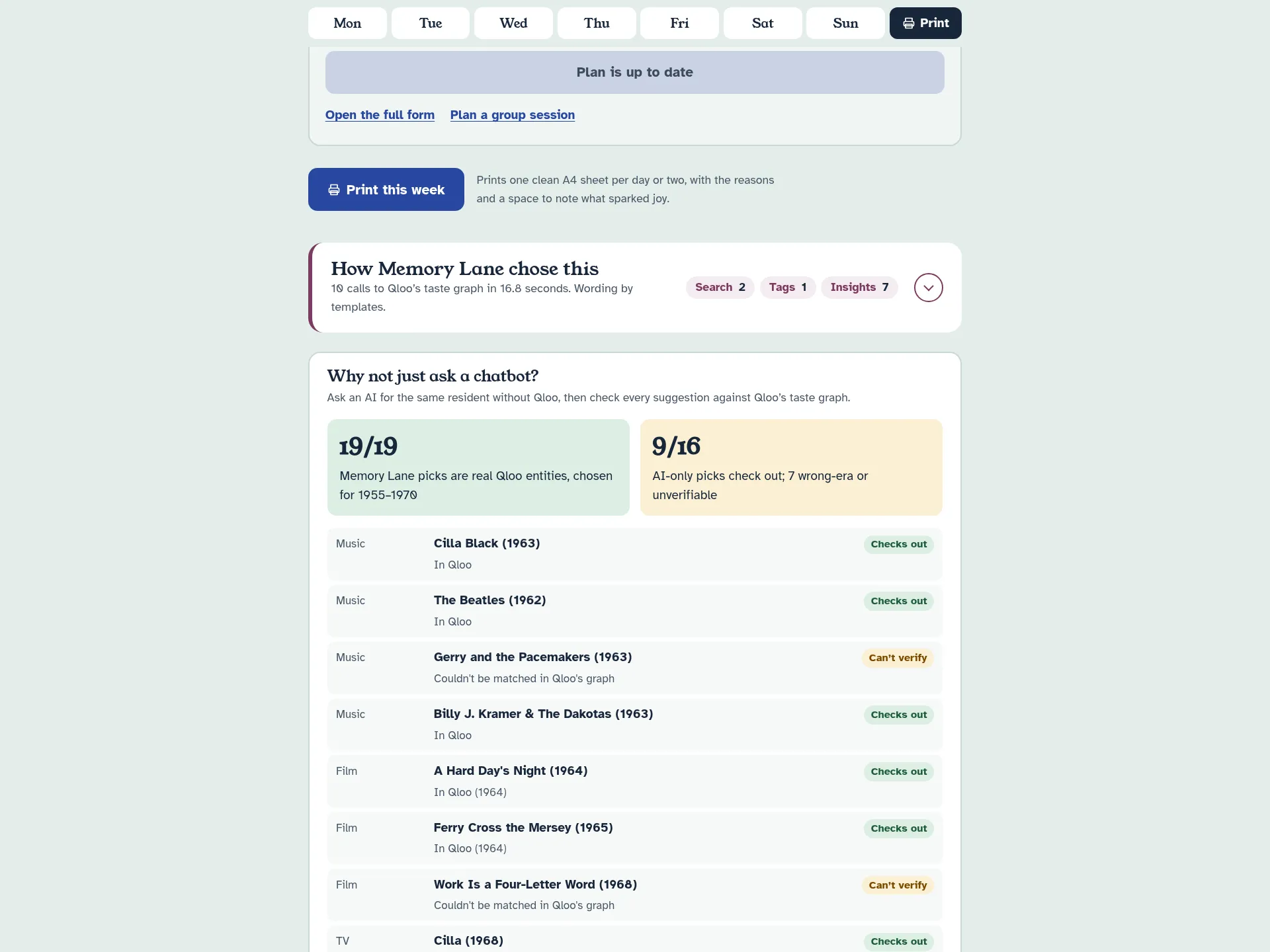
A chatbot can name famous 1960s singers. It can't tell you which ones sit closest in taste to this resident's favourite, which films really sit in their teens and twenties, or which restaurants exist in their hometown today. Qloo can. Every Memory Lane pick is a real Qloo entity, and its "Why this?" shows the signal behind it: affinity to their favourite, era tags, hometown.
The app includes a "Why not just ask a chatbot?" check. It asks an AI for the same resident without Qloo, then checks each suggestion against Qloo's graph. Staff can see which AI picks hold up and which can't be verified, next to a plan in which every item is grounded.
How the agent works
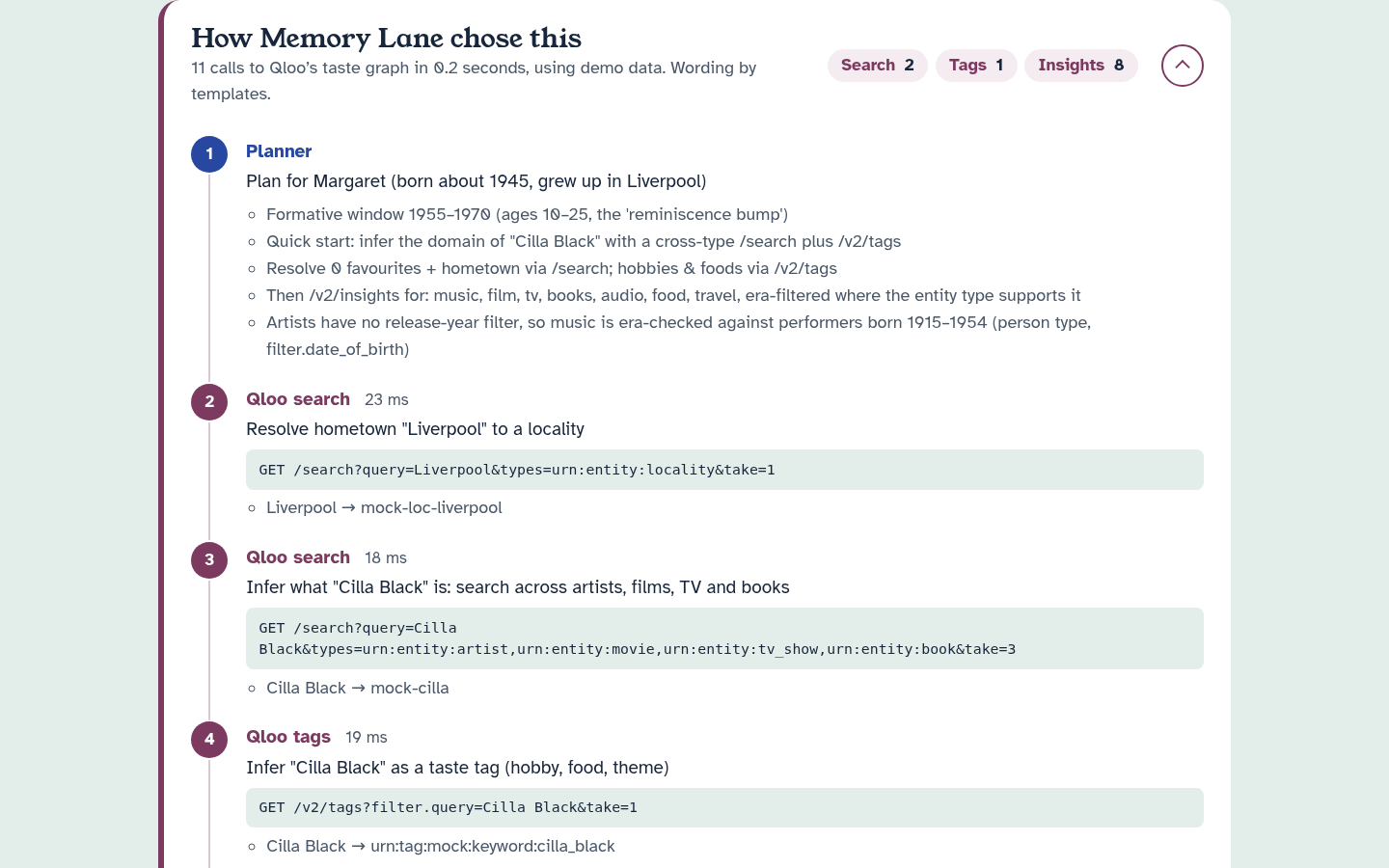
Each plan is a live agent run, and its steps stream to the screen as they happen:
- AI planner (Groq or Gemini) reads staff notes and decides what to look up: artists, titles, hobby and food tags, care needs.
- Qloo
/searchresolves favourites and the hometown./v2/tagspicks era-specific genres and interest tags./v2/insightsfinds taste-affine artists, verifies performers' eras, and finds era-filtered films, TV and books, local restaurants and destinations./v2/analysis/comparefinds shared tastes in group mode. That's 12 to 26 real calls per plan, all shown in the app with parameters and results. - AI care review: a critic removes candidates that are distressing (psychiatric hospitals, graphic war) or from the wrong era, and the plan backfills from Qloo.
- Composer: writes the wording. It can never add an item Qloo didn't return.
The AI steps run on free models: Groq (gpt-oss) first, with Gemini Flash and OpenRouter as fallbacks. If all are slow or unavailable, each AI step is skipped and shown as skipped. The Qloo plan still arrives, with template wording.
Use it from any AI agent
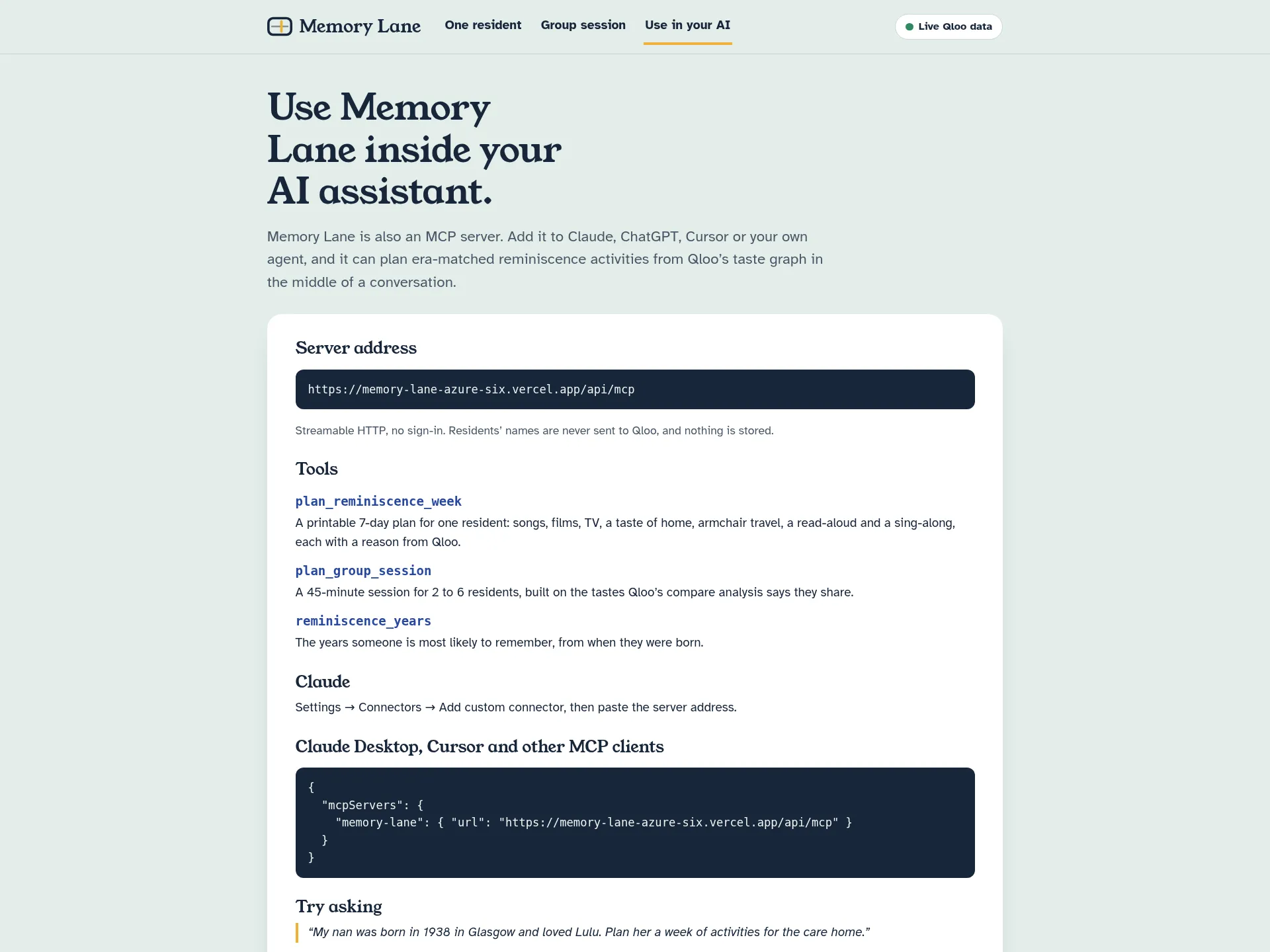
Memory Lane is also a remote MCP server (/api/mcp) with plan_reminiscence_week, plan_group_session and reminiscence_years. Families and staff can ask Claude, ChatGPT or Cursor "Nan was born in 1938 in Glasgow and loved Lulu. Plan her week." and get a Qloo-grounded plan back.
How we built it
Next.js 15 and TypeScript on Vercel. Calls run in parallel within Qloo's rate limit, with spacing, retries, timeouts and caching. Results are checked against the resident's era, and items are filtered by type (restaurants only for food, no hotels, hometown excluded from travel). Groq-hosted gpt-oss models handle planning, review and wording, with Gemini Flash as a fallback. MIT licensed.
Privacy
Names never go to Qloo. Qloo only sees taste signals, years and a hometown. Staff notes go to the AI planner only, and nothing is stored.
Who pays
(Proposed) Care-home groups subscribe per home per month, priced within the activities budget. Family members can be invited free to add life-story details that sharpen each plan.
What's next
A "what sparked joy" log that feeds next week's plan, saved residents, and pilots with activity coordinators.
Try it
Live demo: https://memory-lane-azure-six.vercel.app (no sign-in). MCP: https://memory-lane-azure-six.vercel.app/agents. Source (MIT): https://github.com/OlsOls4/memory-lane|
Built With
- gemini
- groq
- mcp
- next.js
- node.js
- qloo
- react
- typescript
- vercel

Log in or sign up for Devpost to join the conversation.