Inspiration
What it does
How we built it
Challenges we ran into
Accomplishments that we're proud of
What we learned
What's next for Memory Kerner for AIOA spArk HAT
Inspiration
Open-source language models are powerful, but their knowledge quickly becomes outdated and they usually lose useful experience between sessions. Running a stronger model does not solve this completely, especially in specialist domains such as law, medicine, Linux administration, or software engineering.
We created Memory Kernel for AIOA spArk HAT to give open-source models something they normally do not have: persistent, verifiable and reusable specialist memory.
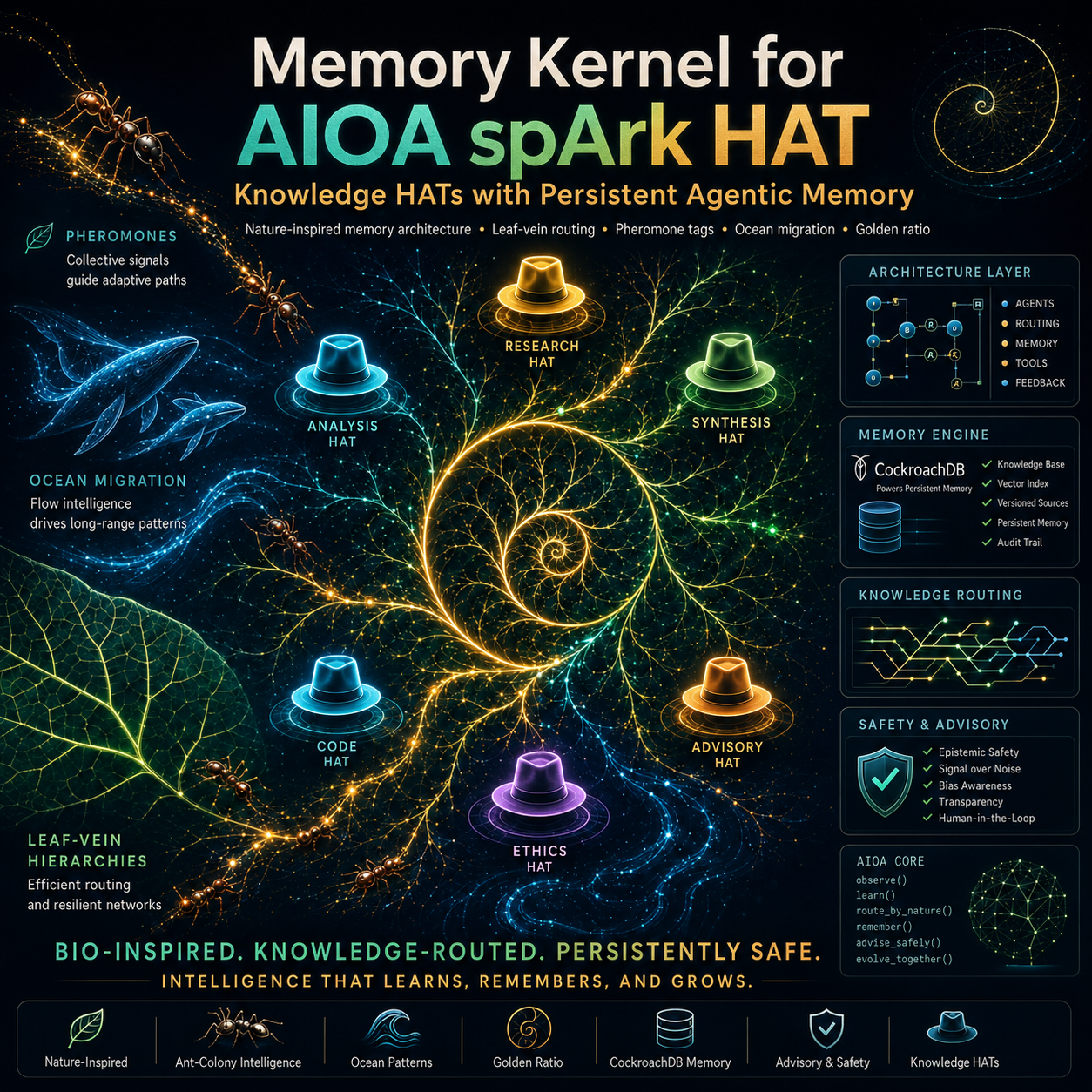
Our concept is called a Knowledge HAT. A HAT is a modular knowledge and memory layer that can be placed over a selected AI model. Instead of retraining the model weights, users can build HATs for different domains and continuously improve how their models work inside AIOA.
What it does
The Knowledge Kernel detects whether a user request belongs to an installed HAT.
For normal messages such as greetings or casual conversation, the request passes directly to the selected model. For specialist questions, the kernel activates the appropriate HAT, retrieves current evidence and checks the model's draft response.
When the model produces an outdated or unsupported claim, the kernel can:
identify the disputed claim; retrieve newer or more authoritative evidence; return a structured correction to the model; ask the model to revise its answer; verify the corrected response; store the validated correction as reusable model experience.
This means that a model such as Gemma can become more useful inside AIOA over time, while the original model remains replaceable and unchanged.
Our first HAT is focused on German federal employment law. It will demonstrate how the kernel handles legislation, amendments, effective dates, source provenance and outdated model knowledge.
How we are building it
CockroachDB is the central persistent memory layer of the system.
It will store:
source documents and their versions; legal facts and validity periods; vector embeddings and retrieval metadata; model claims and verification results; correction history; model-specific experience memory; complete audit records for kernel runs.
We are using CockroachDB Distributed Vector Indexing for semantic retrieval and CockroachDB Managed MCP for controlled memory inspection and agent operations.
The kernel is being designed as a reusable Python module. Each future HAT—German Law, Linux, Python or another specialist field—will implement the same routing, retrieval, verification and memory contracts.
AWS will provide the cloud execution boundary for the kernel and source storage, while CockroachDB remains the system of record for persistent agentic memory.
Challenges
The main challenge is preventing the knowledge layer from interfering with unrelated conversations. A legal HAT must help with German-law questions without blocking simple messages such as “hello.”
Another challenge is separating verified knowledge from model-generated content. Models are never allowed to write directly into canonical memory. New knowledge must retain its source, version, effective date and verification status.
We also need to preserve historical legal versions instead of overwriting old information when the law changes.
What we learned
Persistent AI memory requires more than saving chat history. Useful memory needs routing, provenance, temporal validity, conflict detection, access control and a clear policy deciding what is safe to remember.
What's next
We are currently implementing the reusable kernel contracts, CockroachDB schema and German Federal Law HAT. After validating the first complete correction-and-memory cycle, we will expand the same architecture to additional Knowledge HATs.
Public contact
LinkedIn — Łukasz Żuchowski: https://www.linkedin.com/in/łukasz-żuchowski-807160316/
Built With
- agentic
- amazon
- amazon-web-services
- cloud
- cockroachdb
- distributed
- fastapi
- gemma
- indexing
- lambda
- llm
- managed
- mcp
- memory
- open
- pgvector
- python
- rag
- s3
- search
- semantic
- server
- sql
- vector

Log in or sign up for Devpost to join the conversation.