

Memory Garden 🌱
We save more ideas than we can keep alive. Existing tools either archive our knowledge or pressure us to review it. Memory Garden offers a different approach: a visual landscape that shows, at a glance, everything you’ve saved, its importance, and how present it is in your memory, allowing you to choose what to revisit accordingly.
The Idea — Keeping Meaningful Knowledge Present
Throughout our lives, we encounter ideas, lessons, principles, questions, quotes, and concepts that can meaningfully influence how we think, work, and live.
We may save them in a note, highlight them in a book, write them in a journal, or place them inside an application because they feel worth remembering. Yet as days and months pass, many gradually disappear from our awareness.
That tension inspired Memory Garden.
Traditional note-taking tools are excellent at capturing, organizing, and preserving information. They make knowledge available when we decide to search for it again. But availability is not the same as presence.
Once something has been stored inside a document, folder, or database, it usually remains unchanged until we deliberately return to it. Note-taking tools generally do not reflect whether an idea still feels vivid, whether it is becoming distant, or how strongly we want to remain connected to it. That is not a limitation of those tools so much as a different goal: they are primarily designed to preserve and retrieve information, not to help meaningful knowledge remain present over time.
Spaced-repetition systems approach memory more directly and can be highly effective for deliberate study and memorization. However, they often introduce a different relationship with remembering: scheduled reviews, queues to process, overdue items, or a sense that the system has decided what deserves attention today.
Memory Garden explores another possibility:
What if remembering could feel less like maintaining a task list and more like revisiting a place?
Impact Statement
Memory Garden helps people preserve access to the ideas, lessons, and principles that can positively shape their lives, instead of letting them disappear into the constant flow of information.
By making meaningful knowledge easier to revisit without pressure, schedules, or productivity demands, it supports more intentional reflection, learning, and personal growth. This can benefit students, readers, creators, professionals, and people navigating important life changes by helping them stay connected to insights that influence how they make decisions, relate to others, and understand themselves.
In a world where information is abundant but attention is limited, Memory Garden aims to help people not only collect knowledge, but carry forward the ideas that matter.
How It Works
Memory Garden is a personal, interactive space for keeping meaningful ideas, lessons, principles, and questions present over time.
It is not intended to replace note-taking applications, reading tools, or journals. Instead, it complements them by giving the knowledge a person chooses to continue living with a different kind of space.
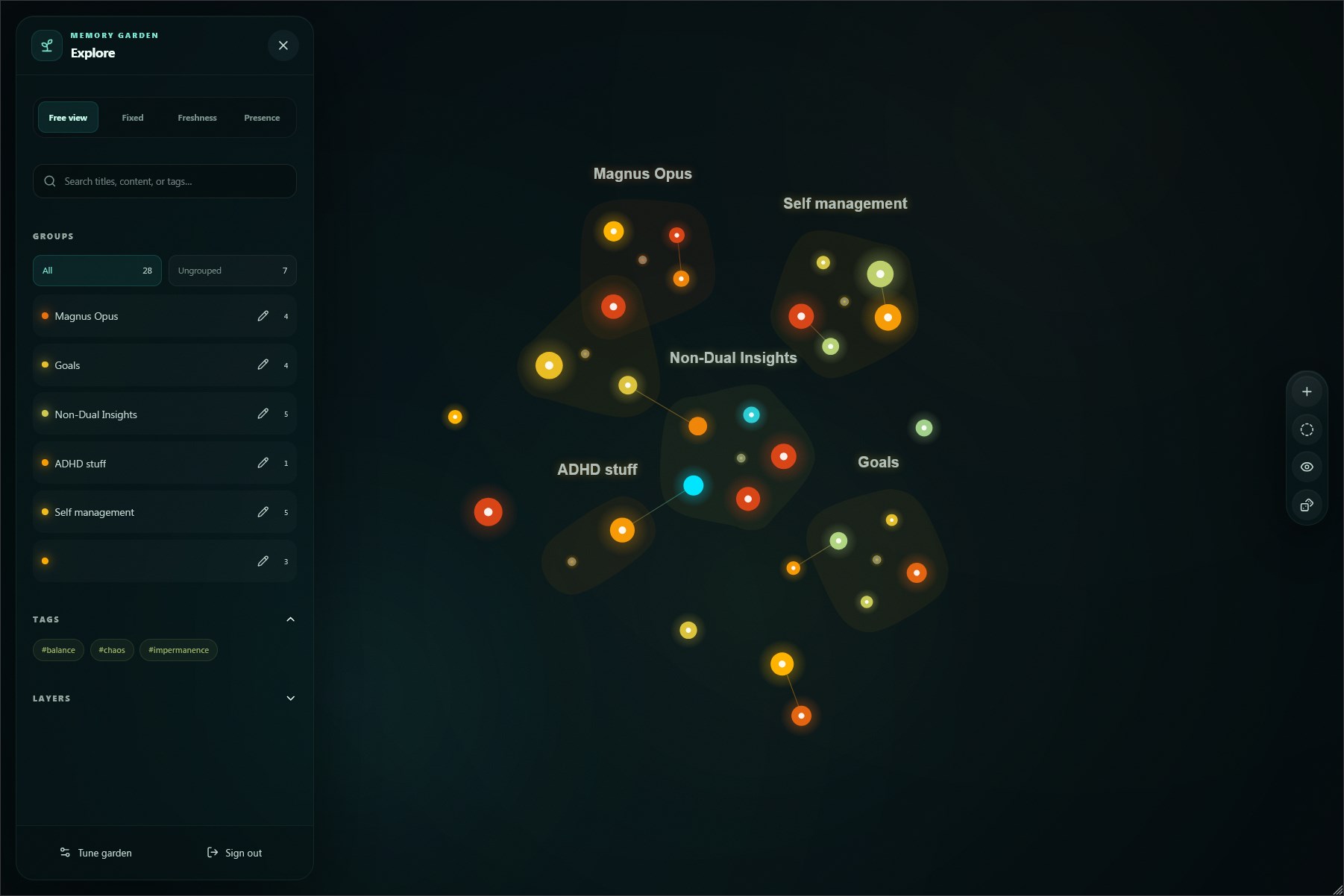
Instead of appearing as rows in a database or cards in a review queue, memories are planted as living nodes inside a visual garden.
Each memory has two central qualities:
- Freshness reflects how present that memory currently feels.
- Desired presence expresses how close the user wants that memory to remain.
Freshness is represented visually through the memory's changing appearance and color, while desired presence determines how prominently it occupies the garden.
Desired presence also shapes the memory's rhythm over time. Something the user wants to keep especially close will begin to show its fading presence sooner if it has not been revisited, while something intended to remain more quietly in the background can change at a gentler pace.
This never becomes a deadline.
Memory Garden does not mark memories as overdue, failed, or incomplete, and it does not require the user to maintain a review schedule. The changing state of the garden is simply a visual reflection of the relationship the user wanted to maintain with each idea.
Users can enter the garden, wander through their memories, notice what remains vivid, discover what has begun to recede, and decide for themselves what they want to revisit.
When returning to a memory, the user can indicate how present it actually felt, updating its freshness accordingly, or simply give it a lighter refresh without making an explicit assessment.
Over time, the garden becomes a changing landscape of what the user has chosen to keep present.
What Makes Memory Garden Different
Memory Garden explores remembering as an environment to revisit rather than an obligation to complete.
A living representation of memory
Memories are not static entries. Their visual state evolves as their freshness changes, making fading awareness visible without turning it into a warning or notification.
Desired presence
Users can express not only what they want to remember, but how present they want it to remain.
Greater desired presence gives a memory greater visual prominence and influences the rhythm with which its freshness changes.
A spatial garden instead of a list
Memories inhabit an interactive canvas rather than a conventional document hierarchy.
Users can physically move ideas, explore their relationships, and experience their knowledge spatially.
Organic groups
Related memories can form groups that behave as visual regions of the garden. A memory can belong to multiple groups simultaneously, reflecting the way an idea can naturally participate in several contexts at once.
Explicit connections
Memories can be linked directly, allowing relationships between principles, experiences, questions, or concepts to emerge visually.
Multiple ways to explore the same garden
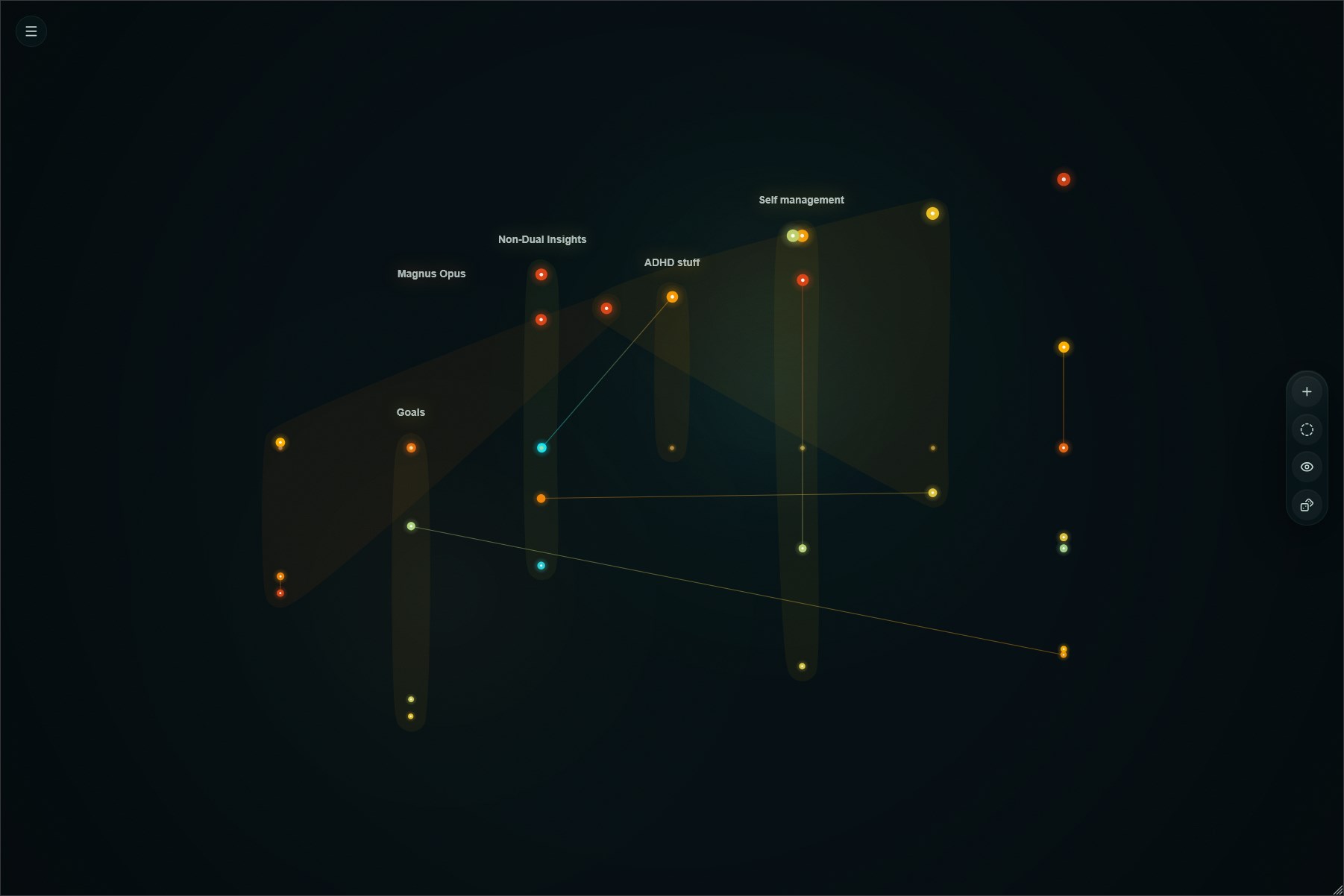
The underlying knowledge remains the same while the garden can be reorganized from different perspectives:
- A dynamic force-directed view, where memories arrange themselves through physical forces.
- A manual spatial view, where the user defines and preserves their positions.
- A freshness view, revealing which memories currently feel closest or most distant.
- A desired-presence view, emphasizing what the user most wants to keep near.
No memory debt
There are no streaks to maintain, overdue counters to clear, or mandatory reviews.
A fading memory is not a failed task. It is simply a quiet signal that something the user once chose to keep close has begun to move into the distance.
Intended Audience
Memory Garden is designed for people who encounter ideas that matter personally and want to maintain an ongoing relationship with them.
That may include:
- People who journal or regularly reflect on their experiences.
- Readers who encounter ideas in books, essays, articles, or conversations that they want to carry into their lives.
- People going through periods of personal or professional change who want to remain connected to lessons, intentions, or principles they have discovered.
- Writers, designers, founders, researchers, and other creators who want important ideas or guiding principles to stay mentally accessible.
- People who already use note-taking or knowledge-management tools but want a complementary place for the knowledge they consider personally meaningful.
- Anyone interested in a more visual, spatial, and low-pressure relationship with remembering.
Memory Garden does not assume that a user is trying to memorize something word for word, complete a curriculum, or reach a productivity target.
The question it centers is much simpler:
What do you want to keep present in your life?
Technology Stack
Memory Garden is built as a cloud-first web application with responsive local interaction and offline resilience.
Frontend
- Next.js 16
- React 19
- TypeScript
- Zustand for interactive application state
- react-force-graph-2d for canvas-based graph rendering
- D3 for graph physics, positioning, and frame-level visual behavior
The visual graph is intentionally separated from persistence and domain logic. D3 manages mutable simulation and rendering behavior, while the application layer handles memories, groups, links, freshness, desired presence, and garden state.
Backend and Edge Runtime
- Next.js App Router
- Vinext
- Cloudflare Workers
- OpenAI Sites
A lightweight Next.js backend runs through Vinext on a Cloudflare Worker and exposes runtime configuration and demo-authentication endpoints.
Static assets and server-rendered routes are also served through the Worker.
Database and Authentication
- Supabase PostgreSQL
- Supabase Auth
- Row Level Security
Row Level Security isolates each user's data.
A Different Relationship With Remembering
Most software asks us to save information, organize it, retrieve it, or complete something with it.
Memory Garden asks something different.
It gives meaningful knowledge a visible place where it can remain, change, connect with other ideas, fade naturally, and be encountered again.
Instead of asking:
"What am I required to review today?"
Memory Garden invites us to ask:
"What do I want to keep present?"

Built With
- indexeddb
- next.js
- postgresql
- react
- tailwind-css
- typescript
- vite
- zustand

Log in or sign up for Devpost to join the conversation.