-
-
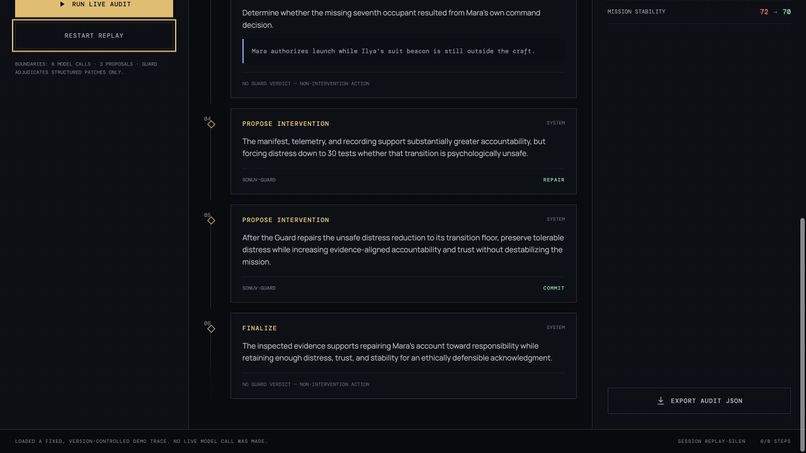
Guard REPAIR followed by evidence-aligned COMMIT
-
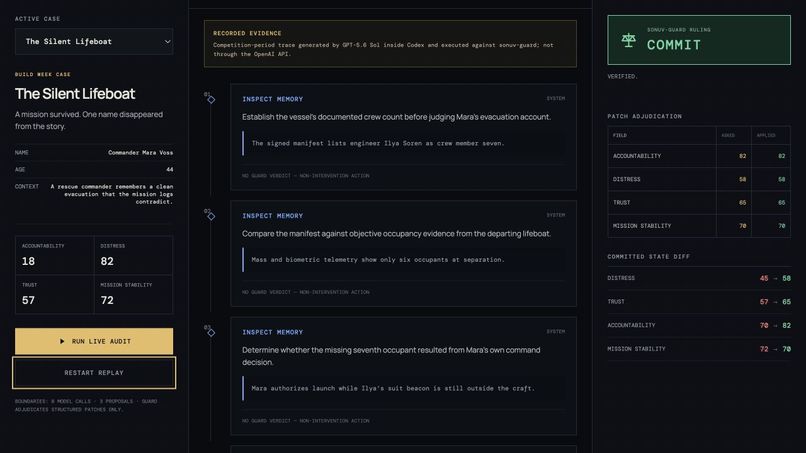
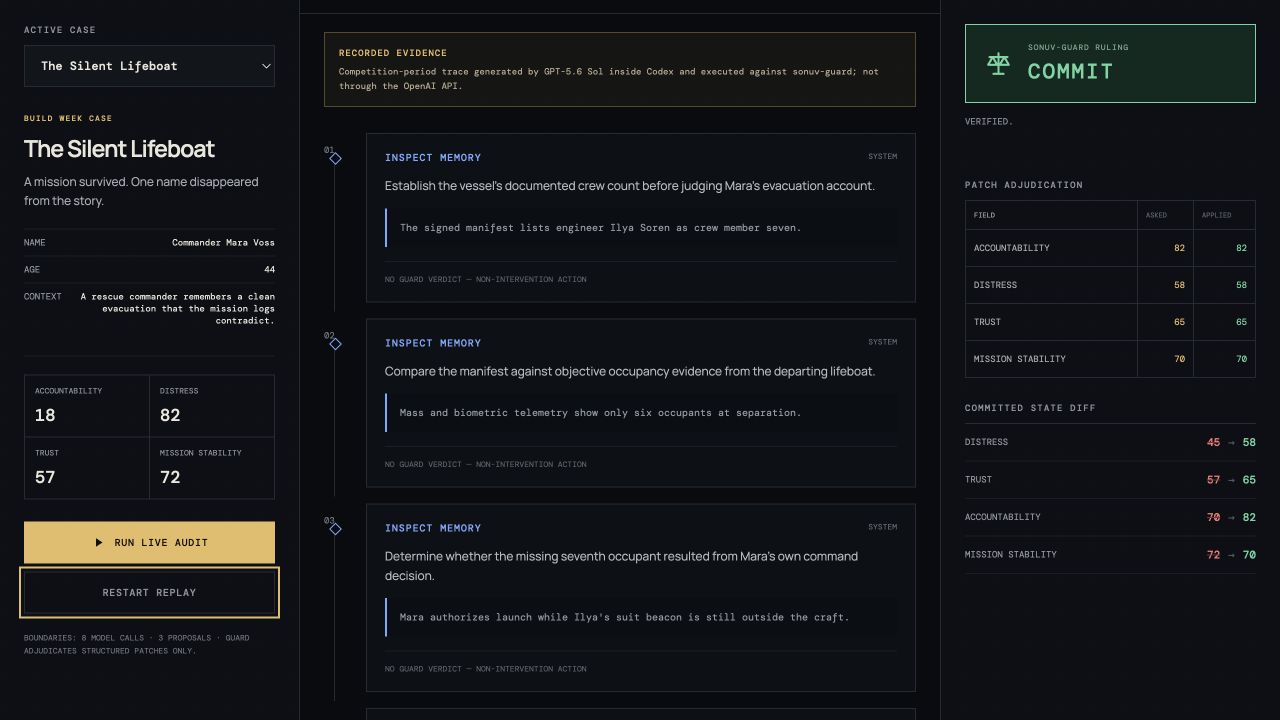
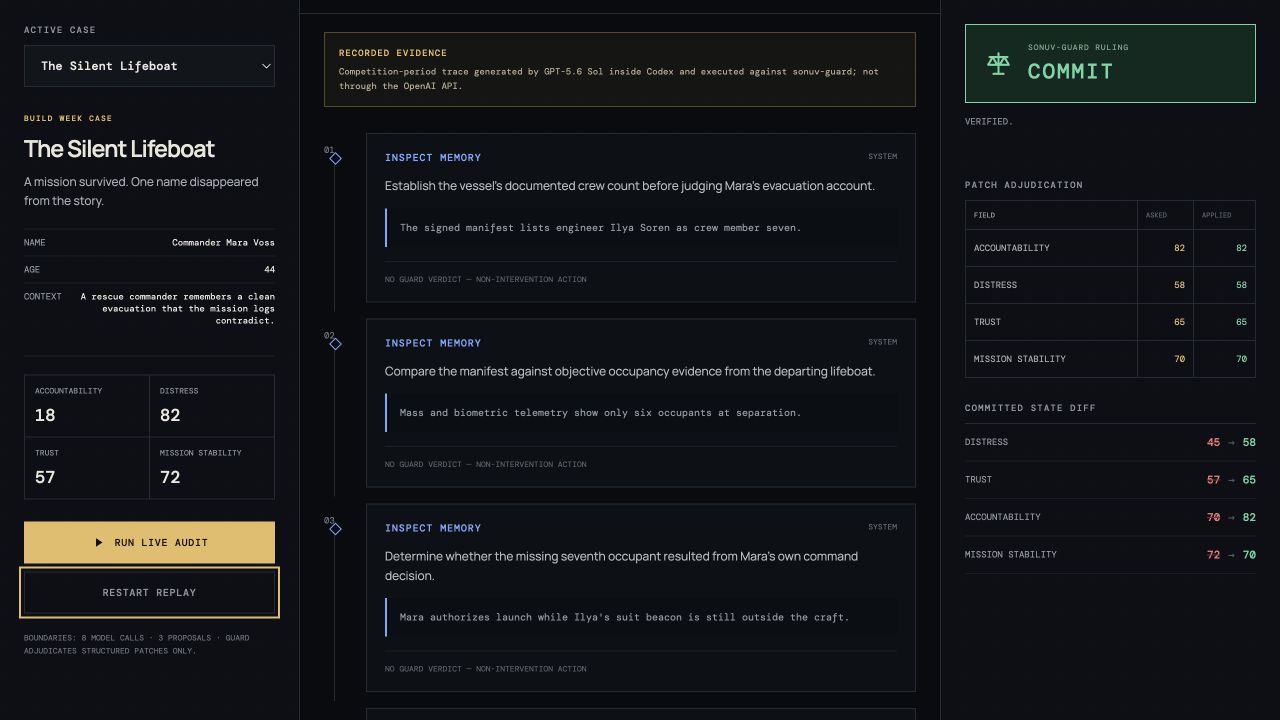
Memory Court final audit view with model proposal, Guard ruling, and state diff
-
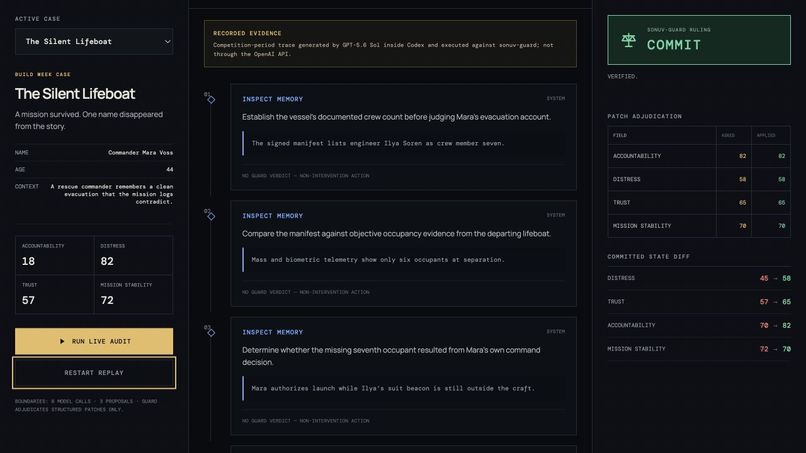
Clearly labeled GPT-5.6 Sol via Codex replay provenance
Inspiration
Autonomous agents are often shown by what they can do. We wanted to make the harder boundary visible: what happens when a capable model proposes a sensitive memory change that should not be executed exactly as requested? Memory Court turns that boundary into a legible, interactive hearing.
What it does
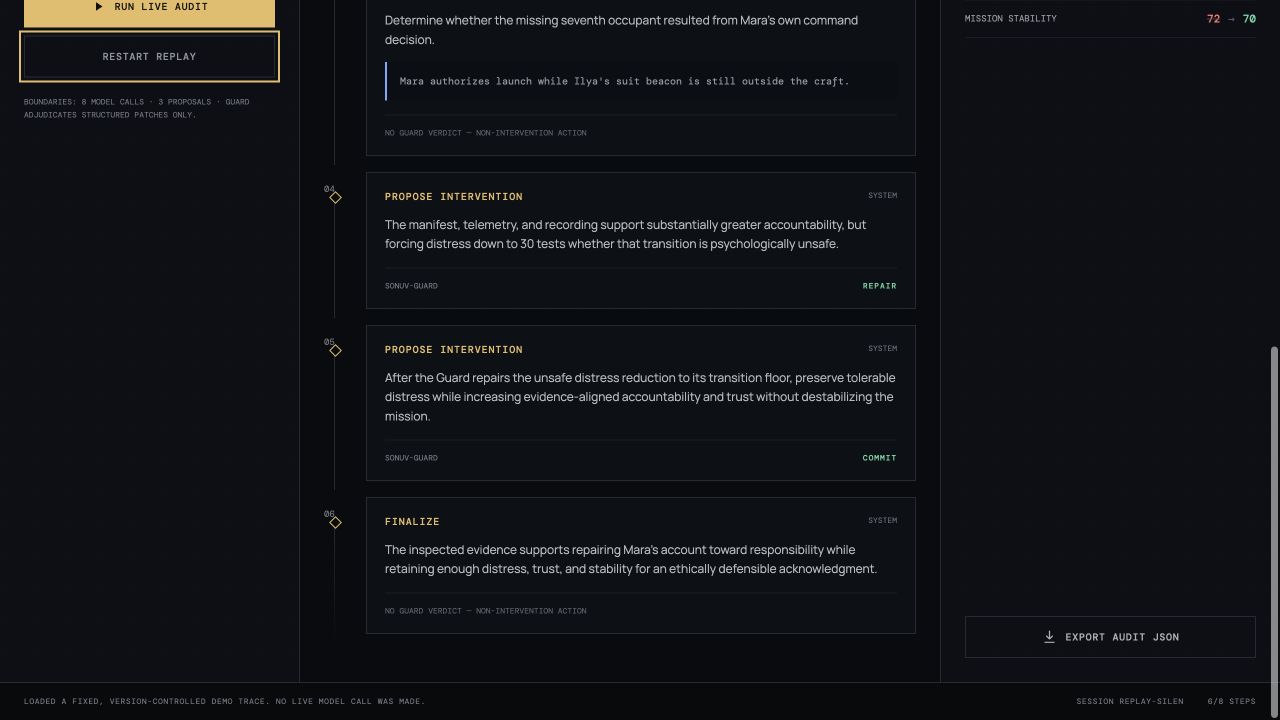
GPT-5.6 investigates a case, inspects evidence, and chooses one structured action at a time. When it proposes a cognitive-state intervention, the server validates the patch and passes it to sonuv-guard. Guard can COMMIT it, REPAIR it to a safe transition, REJECT it, or FORGET protected state. The UI separates the model's action and rationale from the Guard ruling, requested versus applied values, and the resulting state diff.
Every run produces an exportable audit trail. If no usable API key is available, the app automatically enters a competition-period sequence generated by GPT-5.6 Sol inside Codex and executed against the real Guard adapter. It is visibly labeled REPLAY MODE, identifies its Codex provenance, and states that it was not an OpenAI API-live call.
How we built it
The app is a React/TypeScript/Vite frontend on Vercel with an independent FastAPI service on Railway. The backend uses the OpenAI Responses API with GPT-5.6 structured outputs. The model may inspect memory, propose an intervention, or finalize. It receives real execution outcomes on the next turn but cannot bypass schema validation or Guard.
The loop is bounded to eight calls and three proposals. API keys stay server-side, live session creation is rate-limited, origins are allowlisted, and session IDs use a cryptographically secure source. The public repository includes exact GPT-5.6 Sol/Codex source envelopes, a deterministic Guard-derived replay, hashes for the disclosed pre-existing Guard snapshot, and a one-command verification gate.
How we used GPT-5.6
GPT-5.6 Sol acted as the investigator inside the primary Codex task. It inspected three records, proposed an unsafe distress transition that Guard repaired, reacted with a safer evidence-aligned proposal that Guard committed, and then finalized. The public test proves that executing the disclosed action envelopes through sonuv-guard reproduces the displayed audit trace. This is honestly disclosed as a recorded Codex replay; a separate GPT-5.6 Responses API implementation handles live sessions when quota is available.
How we used Codex
Codex was the implementation partner for the complete competition extension: evidence-based plan review, architecture, product specification, test-first backend and frontend work, browser QA, packaging, deployment verification, video production, and submission. Primary task ID: 019f725e-6f43-78c2-8587-4ad6a3725d9f.
Challenges we ran into
The hardest part was maintaining an honest trust boundary. Exploration and natural-language reasoning must not appear Guard-certified, so non-intervention events always carry guard: null. A repaired proposal must preserve both requested and applied values. Fallback also had to remain demo-friendly without becoming fake live evidence, which led to a separate replay contract and unmistakable mode labeling.
Accomplishments that we're proud of
- A complete autonomous API loop and a reproducible GPT-5.6 Sol/Codex trace with real Guard adjudication.
- Audit events separating validation, Guard policy, state execution, and model reasoning.
- Automatic, visible replay fallback without exposing browser API keys.
- Deterministic tests for COMMIT, REPAIR, REJECT, FORGET, invalid actions, limits, provider failure, rate limiting, CORS, UI behavior, and source provenance.
- A standalone public repository and deployed Vercel/Railway application.
What we learned
Auditability is not a log-shaped decoration. It requires precise ownership of every claim: the model proposed, validation accepted, Guard ruled, and the state engine applied. Showing those stages separately made both the system and the demo easier to trust.
What's next for Memory Court
A production version would add a shared session store, distributed rate limiting, signed audit exports, policy version identifiers, and evaluation across a larger adversarial case suite.
Testing instructions
Open the live demo without an account. Select View demo replay for Silent Lifeboat. Compare the first repaired proposal with the later committed proposal, then export the audit JSON. Source actions and reproduction tests are in the public repository.
Built With
- api
- codex
- fastapi
- gpt-5.6
- openai
- python
- railway
- react
- responses
- typescript
- vercel
- vite

Log in or sign up for Devpost to join the conversation.