Inspiration
This project was inspired by the real-life challenges faced by people living with Alzheimer’s disease and their families. Patients often struggle with memory loss, confusion, and daily tasks, while caregivers face stress and constant responsibility. I wanted to create a solution that combines technology with empathy to support both sides.
What it does
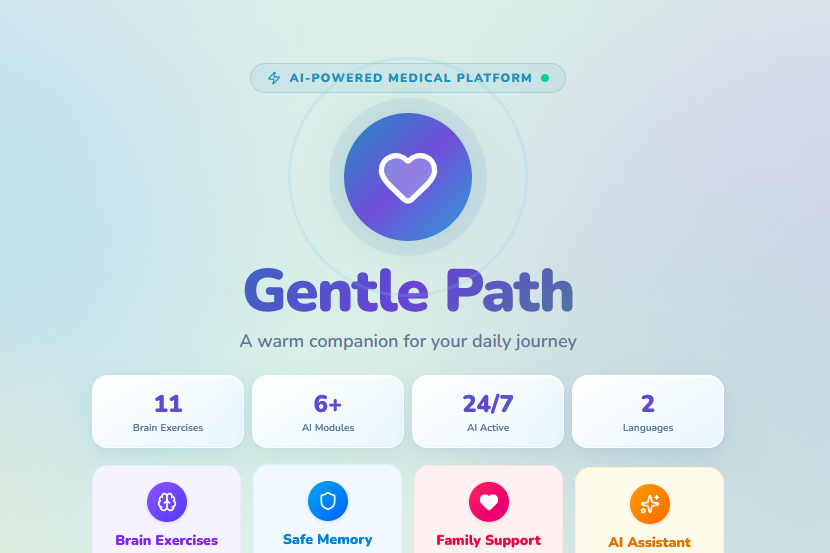
This application helps people living with Alzheimer’s manage their daily life safely and independently. It provides smart reminders for medication, meals, and tasks, along with cognitive exercises to support memory and attention. The app includes an AI-powered assistant that guides the patient through daily routines, offers reassurance, and adapts to their behavior over time. It also features emergency contact tools and real-time caregiver support, allowing families to monitor activity, receive alerts, and assist when needed. By combining simplicity, intelligence, and human-centered design, the app improves safety, reduces confusion, and enhances the quality of life for both patients and caregivers.
How we built it
We built this application using a modern web-based architecture focused on performance, simplicity, and accessibility. The front-end was developed using HTML, CSS, and JavaScript, with a strong emphasis on responsive design and a clean, user-friendly interface suitable for elderly users. We implemented a bilingual system (Arabic & English) with full support for RTL and LTR layouts, ensuring a seamless experience for different users. The application logic includes a modular structure for features such as reminders, cognitive exercises, emergency tools, and caregiver monitoring. We also integrated an AI-driven system that simulates intelligent behavior, including adaptive reminders, user interaction tracking, and personalized assistance. Special attention was given to UI/UX design, using smooth animations, clear typography, and intuitive navigation to reduce confusion and improve usability. Finally, we optimized the project structure by reducing unnecessary files, organizing components efficiently, and ensuring stability and maintainability across the entire system.
Challenges we ran into
One of the biggest challenges was designing an interface that is both simple and powerful. Since the application targets Alzheimer’s patients, we had to ensure that every element is clear, readable, and easy to use, while still providing advanced functionality. Another challenge was implementing full bilingual support (Arabic & English), especially handling RTL and LTR layouts without breaking the design or user experience. We also faced difficulties in structuring the project efficiently due to the large number of features, which required careful organization and optimization to maintain performance and scalability. Integrating AI-like behavior was another challenge, as we needed to simulate intelligent responses, adaptive reminders, and user-aware interactions in a realistic and useful way. Finally, balancing innovation with usability was a key challenge — making the app advanced and impressive, while keeping it simple enough for elderly users to understand and use comfortably.
Accomplishments that we're proud of
We are proud of creating a meaningful solution that combines technology with real human impact. This application goes beyond a simple tool by providing practical support for Alzheimer’s patients and their caregivers. One of our key accomplishments is designing a clean, accessible, and bilingual interface (Arabic & English) that is easy to use for elderly users while still offering powerful features. We are also proud of integrating AI-driven behavior, allowing the application to adapt to users, provide smart reminders, and offer personalized assistance. Another achievement is the implementation of multiple helpful features in one platform, including cognitive exercises, emergency tools, daily routine support, and caregiver monitoring. Finally, we are proud of building a project that is not only technically strong, but also socially impactful, aiming to improve safety, independence, and quality of life for people living with Alzheimer’s.
What we learned
During this project, I learned:
- How to design user-friendly interfaces for sensitive users
- The importance of accessibility and simplicity in healthcare apps
- How AI can be used to support human behavior and daily routines
- How to structure a real-world problem into a functional solution ## Future developments We would like to develop this project further in the future: -1. Wearable Integration Smart bracelet connected to the app Heart rate and motion monitoring Fall detection system GPS tracking for patient safety Emergency button for instant alerts -2. Smart Home Integration Automatic lighting control Gas and appliance safety shutdown Exit/entry monitoring Activity tracking -3. Digital Twin Technology Create a behavioral model of the patient Predict cognitive decline Analyze daily habits Detect abnormal changes early -4. Healthcare Integration Share periodic reports with doctors Remote patient monitoring AI-assisted medical insights Telemedicine support -5. Multilingual & Voice AI Support for Arabic, French, and English Advanced voice assistant Optional voice cloning of family members -6. Robotic Assistant (Long-term Vision) Home companion robot Medication reminders Daily interaction support Assistance with simple tasks -7. AI-Powered Insights Behavioral analysis Memory pattern detection Smart reports for caregivers Personalized care suggestions -8. Security & Privacy Enhancements Data encryption Access control system Secure storage Use of synthetic data when required -9. Safe Self-Improving AI Continuous performance improvement Learning from usage patterns Suggesting system optimizations Human-controlled validation -10. Platform Expansion Connect patient, family, and doctors Unified care ecosystem Scalable and deployable globally
Built With
- css
- html5
- javascript
- lovable
- replit
- typescript


Log in or sign up for Devpost to join the conversation.