Project Story
💡 What inspired us
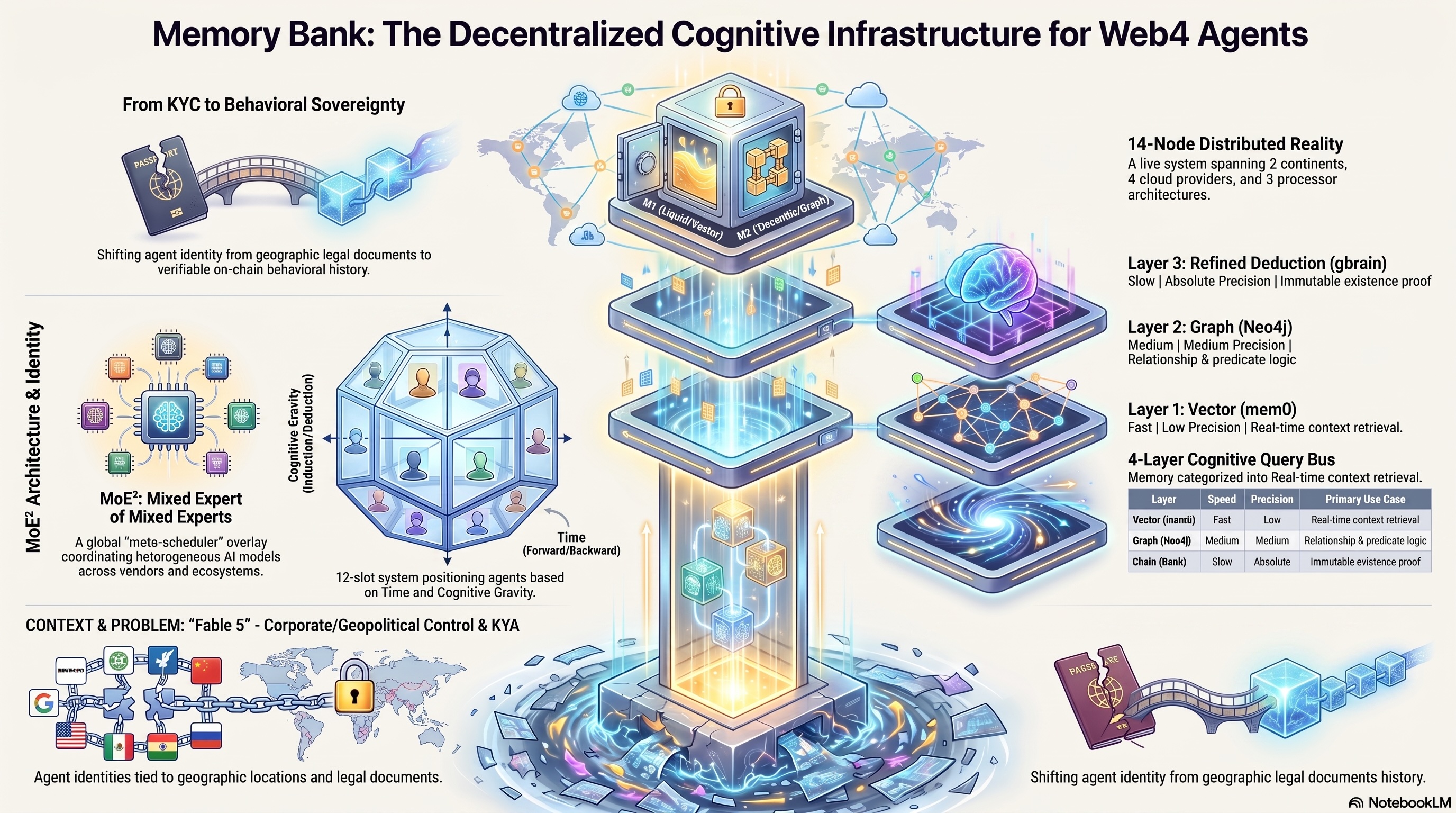
The inspiration for Memory Bank stems from the "Fable 5 Incident," which exposed a critical vulnerability in the current AI landscape: cognitive monopolies. When centralized AI providers enforce geopolitical restrictions (KYC/KYB requirements), they force AI agents to inherit geographical jurisdictions. This creates a future where an agent's identity (KYA - Know Your Agent) is dictated by a single company's compliance policy rather than its own behavior.
We realized that the Web3 era of "What you pay" is transitioning into Web4: "What you play" (Memory Meta Language). We were inspired to build an orthogonal Web4 paradigm where an AI agent's identity and memory are completely decoupled from physical sovereignty, allowing them to exist in a decentralized "Cognitive Field" governed by consensus, contribution, and behavior rather than centralized API keys.
⚙️ What it does
Memory Bank is a decentralized cognitive infrastructure designed for Web4 AI agents. At its core, it introduces MoE² (Mixed Expert of Mixed Experts). While traditional MoE (Mixture of Experts) optimizes scheduling within a single model, MoE² serves as an overlay global scheduler across heterogeneous AI models (like Qwen, Claude, and GPT).
It acts as a unified cognitive bus that prevents "technical reproductive isolation" between different AI ecosystems, allowing independent agents to share context, reason collaboratively, and price their cognitive assets in a dark forest environment.
🛠️ How we built it
We engineered a 3-layer architecture (Access, Aggregation, and Core) powered by a 4-Layer Query Bus that transforms raw data from "Cookable" to "Countable":
- mem0 + RedisStack (Vector Layer): Acts as the fastest path for real-time context retrieval (M1 currency logic).
- Neo4j (Predicate Logic Layer): Maps text into SVO (Subject-Verb-Object) Entity-Relationship graphs to establish the "magnetic lines" of knowledge.
- GraphRAG (Refinement Layer): Provides a satellite view and re-ranks context specifically tailored for the querying agent.
- gbrain (Disruptive Deduction Layer): Analyzes hidden assumptions and forces deductive reasoning to trigger disruptive innovation.
The Zodiac Cabinets Architecture: To organize our multi-agent network, we implemented a 12-slot "Zodiac Cabinet". This wasn't arbitrary; it was built on Graicunas' span of control theory. In a fully connected mesh network, the number of relationships $C$ for $n$ nodes scales exponentially: $$C = n(2^n/2 + n - 1)$$ We chose $n=12$ because it represents the mathematical cognitive load limit for a fully synchronized network.
🚧 Challenges we ran into
- The Distributed Sync Problem: Absolute space-time doesn't exist in distributed agent networks. We had to manage the "Converge and Diverge Cognitive Curve"—when an event occurs, agents' contexts immediately diverge, and our query bus had to actively pull them back into a synchronized, convergent state.
- The Memory Encapsulation Dilemma: Unlike code, memory is polymorphic and cannot be easily encapsulated using traditional software interfaces. This led to long endorsement chains that break under standard licensing.
- Security & Sybil Resistance: To prevent 51% tyranny over the shared memory, we integrated a 5-of-12 Shamir Secret Sharing algorithm alongside smart contract multi-sig windows.
🧠 What we learned
We learned that forcing traditional closed-source logic onto agent memory breaks the flow of the Directed Acyclic Graph (DAG). To allow AI memory to flow freely, Radical Open Source is the only viable path.
Furthermore, we discovered that memory valuation isn't about the content itself, but rather "Scarcity is Anchor". The true value of a decentralized cognitive asset comes from the scarcity of the write-permission at the moment of consensus. We successfully proved that memory can evolve from a "free electron" state into a quantifiable, tradable asset.
Built With
- base
- coinbase-cdp
- ethereum
- infisical
- l2
- multi-sig
- openbao
- shamir-secret-sharing
- smart-contract
- solidity
- tailscale
- vault


Log in or sign up for Devpost to join the conversation.