-
-
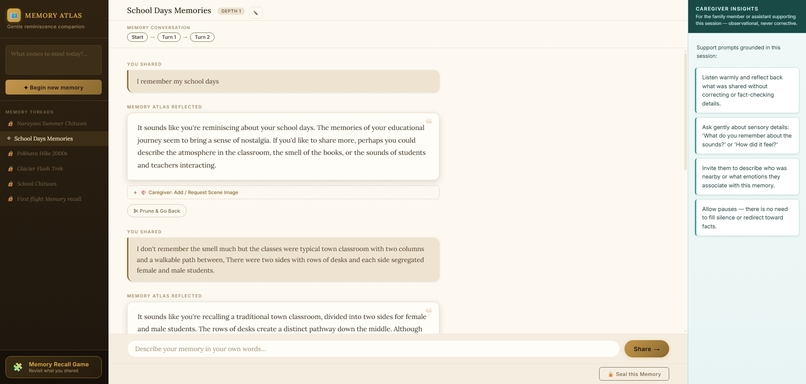
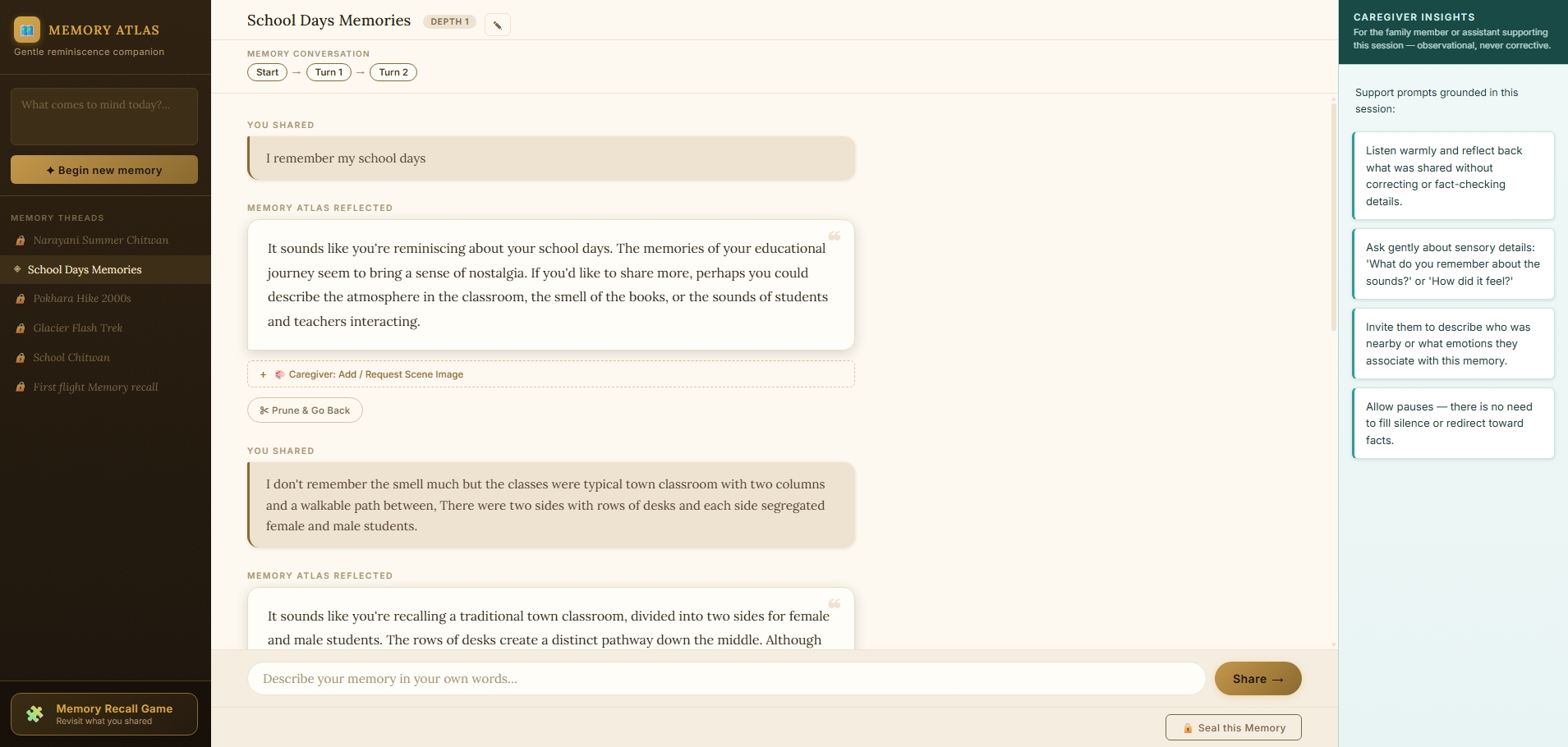
Overall outlook of interface
-
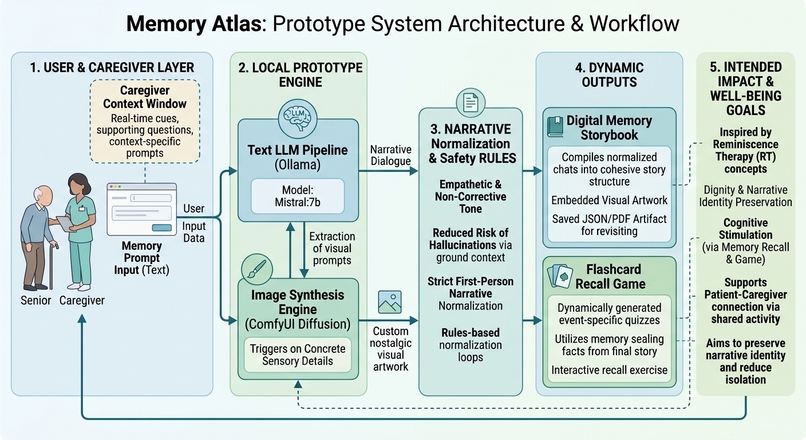
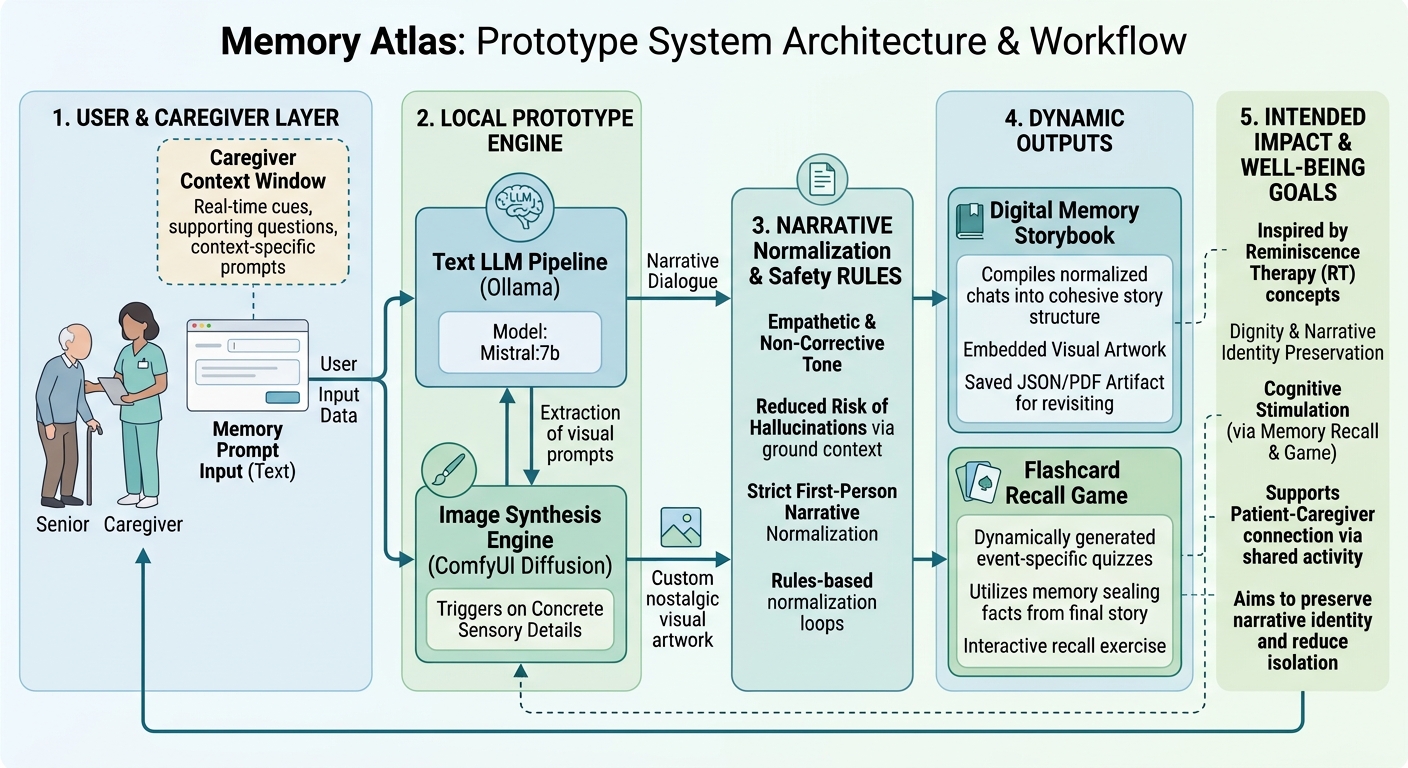
Simple architectural flow
Memory Atlas: Inspirations, Learnings, and Technical Journey
What Inspired Me
The inspiration behind Memory Atlas stems from a desire to address the emotional and cognitive challenges faced by individuals living with dementia and their care networks. Short-term memory loss often isolates individuals, yet their long-term autobiographical memories: such as a childhood home or an early pet: remain remarkably intact.
Clinical research highlights that Reminiscence Therapy (RT) provides valuable cognitive stimulation by engaging these enduring pathways. Furthermore, studies from institutions like the USC Leonard Davis School of Gerontology indicate that structured reminiscence can ease caregiver burden and improve relationships. However, casual conversations often lack structure, and caregivers frequently struggle to find engaging prompts. Memory Atlas was conceived as a supportive digital prototype to bridge this gap: an empathetic, AI-driven platform that preserves family stories, provides real-time caregiver guidance, and transforms memories into digital keepsakes by saving memories as structured stories paired with visual artwork.
How It Was Built
Memory Atlas was built locally as an end-to-end prototype to ensure data privacy for sensitive personal history. The architecture consists of four interconnected components:
- Conversational AI Engine: Powered by
mistral:7brunning locally via Ollama. The system uses structured system instructions to maintain a warm, non-corrective, and validating tone while asking gentle follow-up questions. - Caregiver Context Window: Operating alongside the main dialogue, a dynamic context panel analyzes user inputs and auto-generates real-time conversational cues and supporting questions for caregivers.
- Visual Asset Pipeline: Integrated with a local ComfyUI Diffusion endpoint. When the LLM extracts concrete sensory details from a user's memory, the visual pipeline generates a contextual illustration to visually anchor the memory.
- Memory Sealing & Game Generation: Upon concluding a session, raw conversation logs are parsed into a normalized, first-person storybook with embedded illustrations. A background pipeline extracts key facts to dynamically generate interactive flashcard quizzes for low-pressure recall exercises.
Challenges Faced
Building a multi-modal local system introduced several technical hurdles:
- Context Grounding & Hallucination Mitigation: Open-ended LLMs can easily introduce unprompted facts. Enforcing strict context boundaries required engineering detailed normalization prompts to keep generated storybooks strictly grounded in user-provided statements.
- Local Engine Coordination: Managing asynchronous execution between Ollama for text processing and ComfyUI for image rendering on a single GPU required precise pipeline scheduling to avoid memory allocation bottlenecks.
- Designing for Accessibility: Creating a user interface that feels reassuring to older adults meant avoiding high-contrast colors, overwhelming visual options, or complex menu hierarchies.
What I Learned
Developing Memory Atlas provided valuable technical and domain-specific insights:
- Human-Centered AI Design: Technology intended for cognitive care must prioritize empathy, simplicity, and non-corrective interactions over simple speed or optimization.
- Structured Information Extraction: Transforming unstructured chat logs into predictable JSON formats for storybooks and flashcards highlighted the importance of strict output schemas in LLM workflows.
- Local System Integration: Integrating separate local inference runtimes (Ollama and ComfyUI) reinforced best practices in resource management and API orchestration.
Limitations & Future Prospects
While the current prototype effectively demonstrates the core product vision, addressing its technical constraints opens up valuable opportunities for future development:
1. Contextual RAG & Historical Knowledge Retrieval
- Current Limitation: The current system relies exclusively on the immediate chat history within an active session, lacking access to broader background details about the user's life and era.
- Future Prospect: Developing a local RAG (Retrieval-Augmented Generation) framework that incorporates historical background documents, regional archives, and personal profile metadata (such as the town they grew up in, specific decades, or time of year). By cross-referencing user queries with these contextual documents, the system can ground conversations in verified historical details and enrich visual scene generation with period-accurate visual elements during reflection.
2. Universal Accessibility vs. Privacy Preservation
- Current Limitation: Requiring local GPU hardware and engine setups like Ollama and ComfyUI creates high technical friction for everyday non-technical users and care facilities.
- Future Prospect: Shifting from a hardware-heavy local setup to a web-accessible application while strictly upholding privacy and data protection standards. Future iterations will explore hybrid topologies, such as localized edge hardware, zero-knowledge cloud server architecture, or end-to-end encrypted databases, ensuring user health records and personal histories remain private and secure.


