Inspiration
Teams make important decisions every day, but the reasoning behind those decisions gets buried across meeting notes, PDFs, docs, chats, and action items. Later, new employees and managers often ask the same questions again: Why did we choose this database? Who owns this action item? What changed in the project timeline?
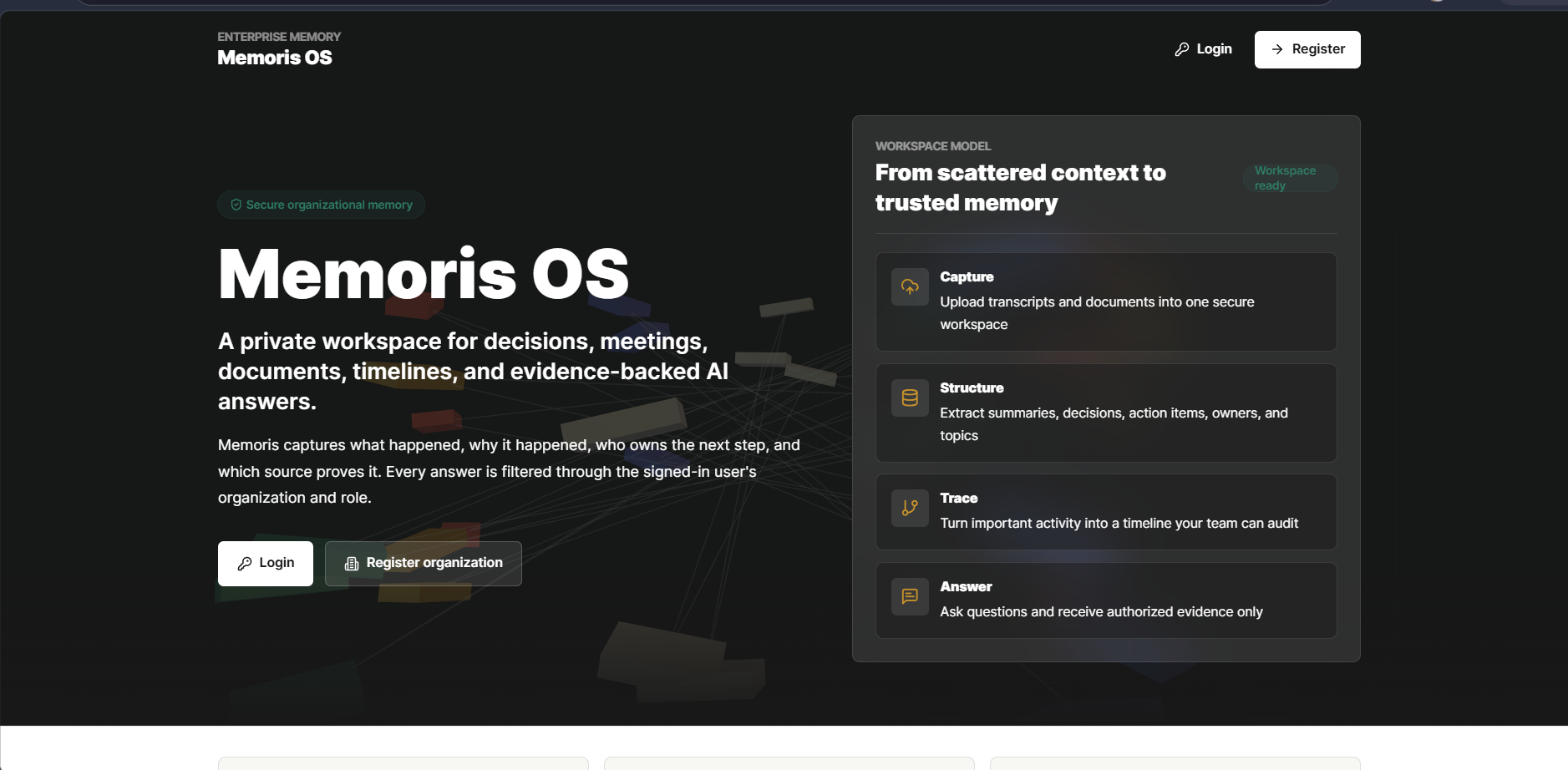
Memoris OS was inspired by that problem. The goal is to build a secure enterprise memory layer where an organization can store knowledge once, search it later, and ask AI questions with evidence instead of guessing.
What it does
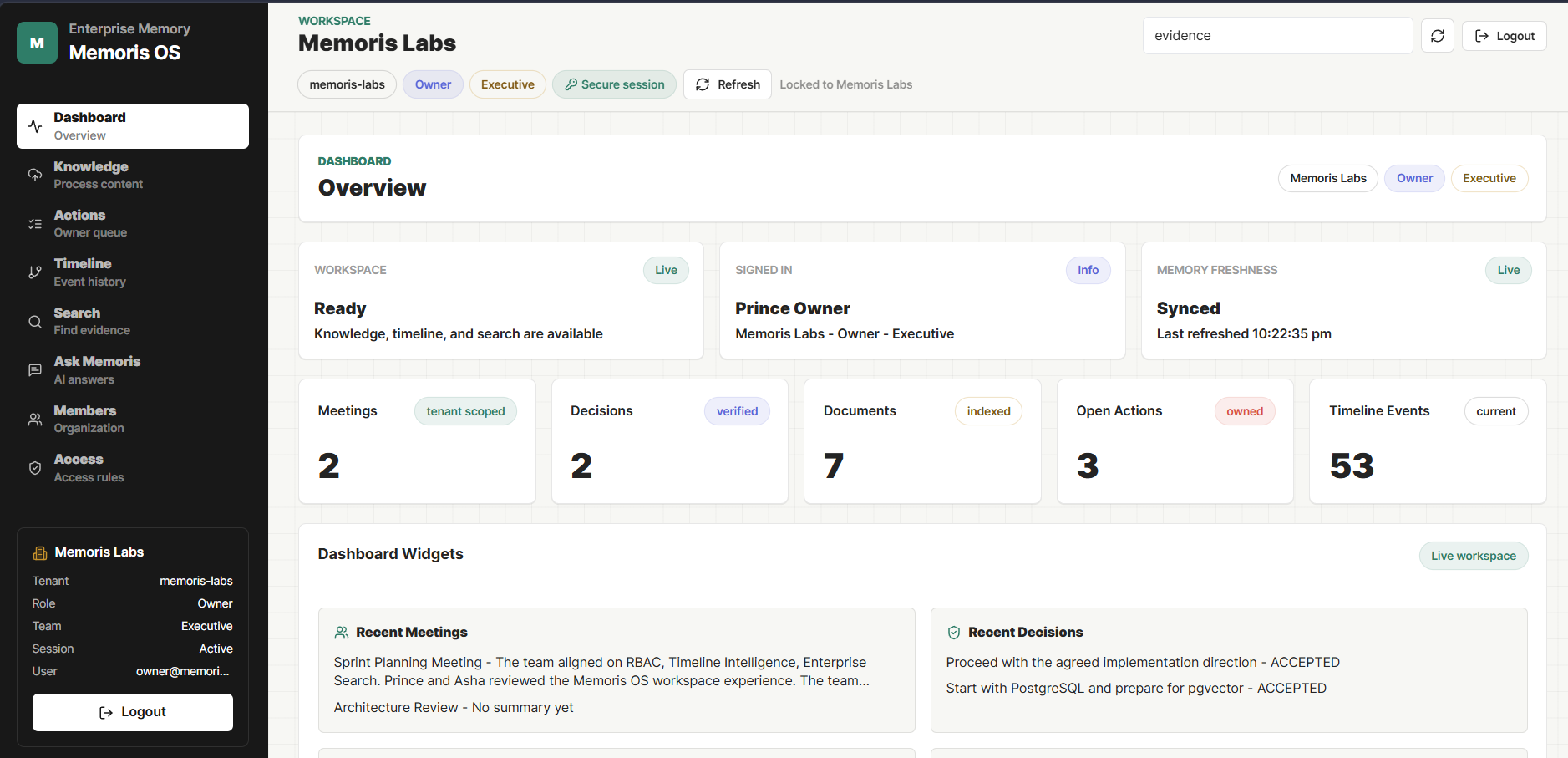
Memoris OS captures organization knowledge from documents, meetings, decisions, action items, and timeline events.
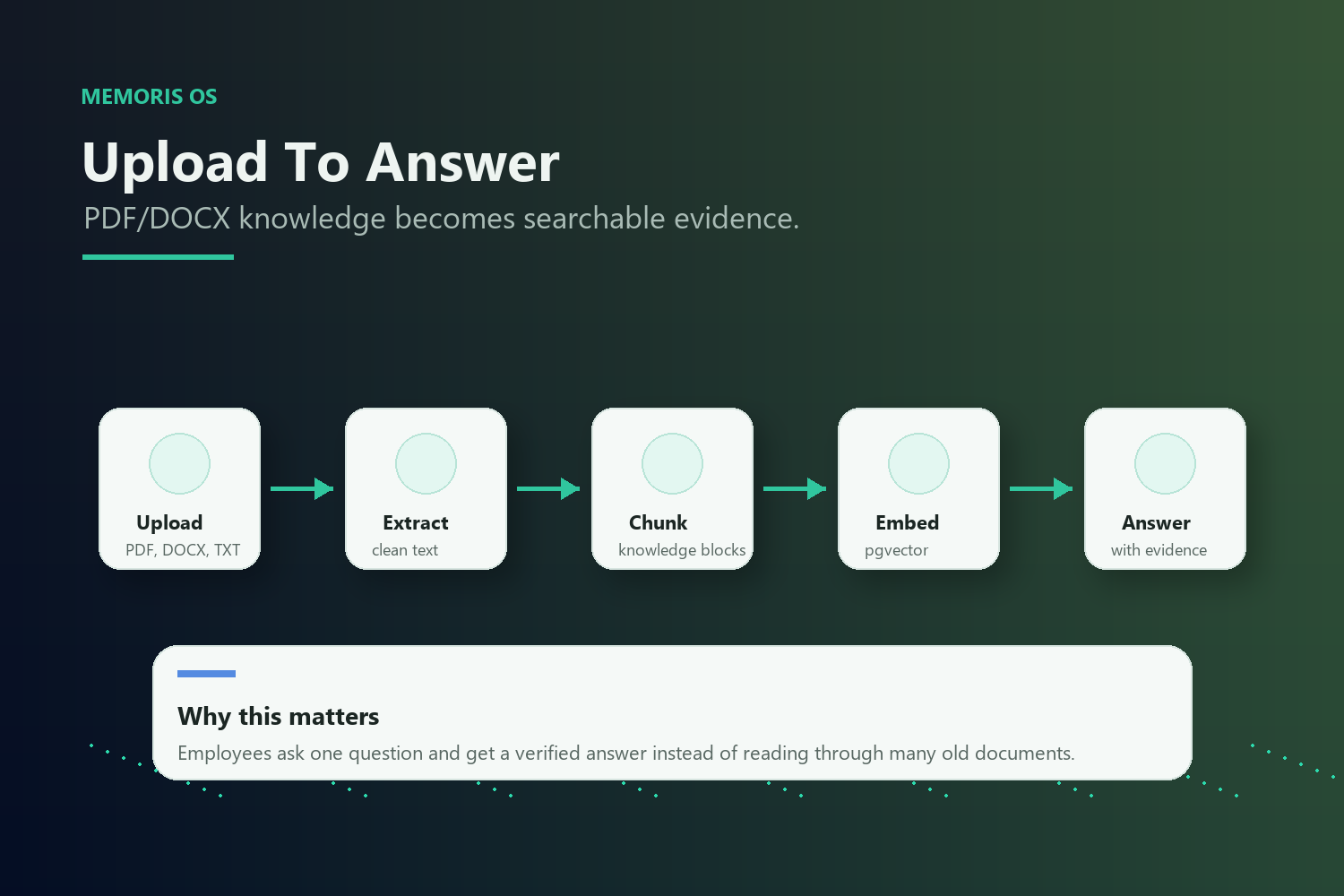
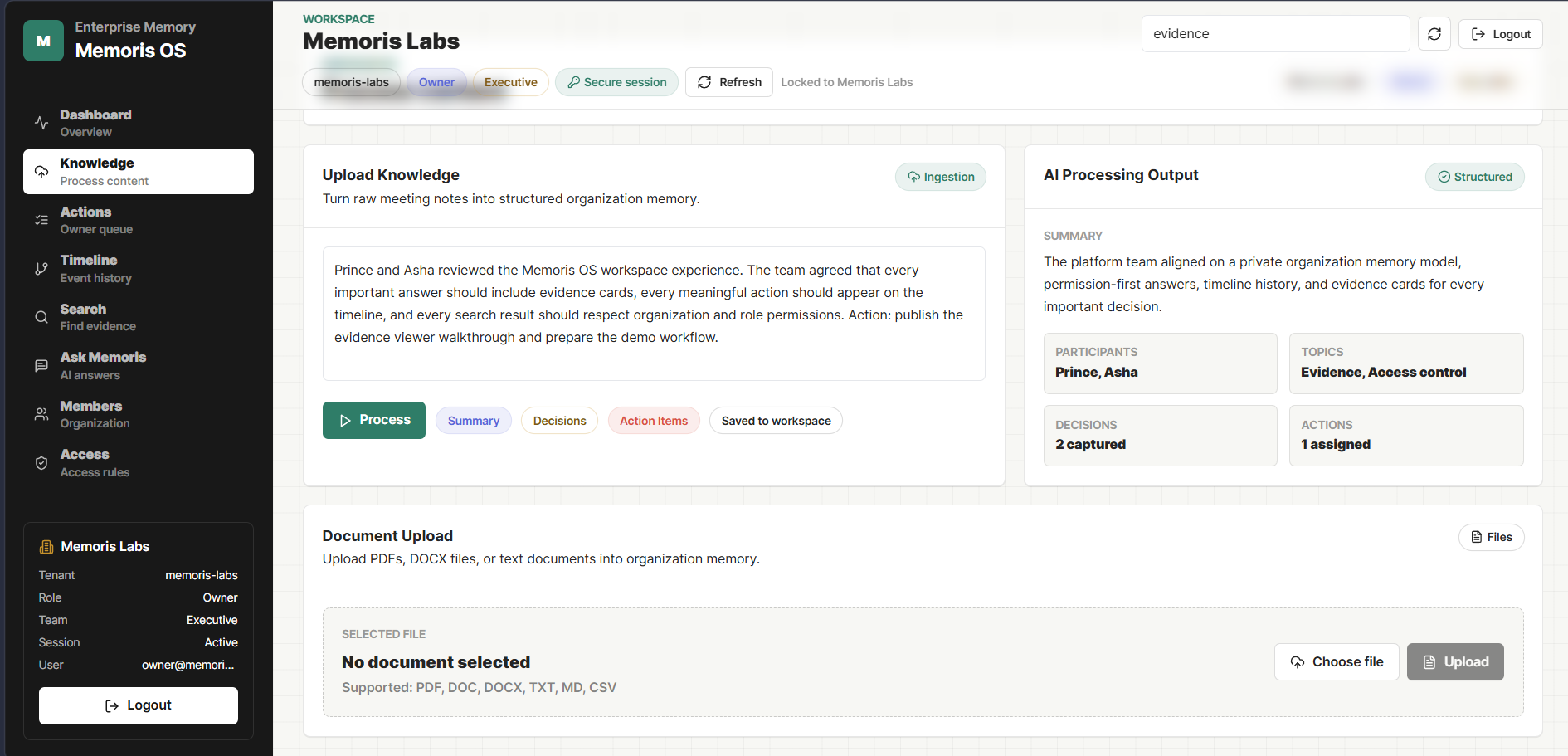
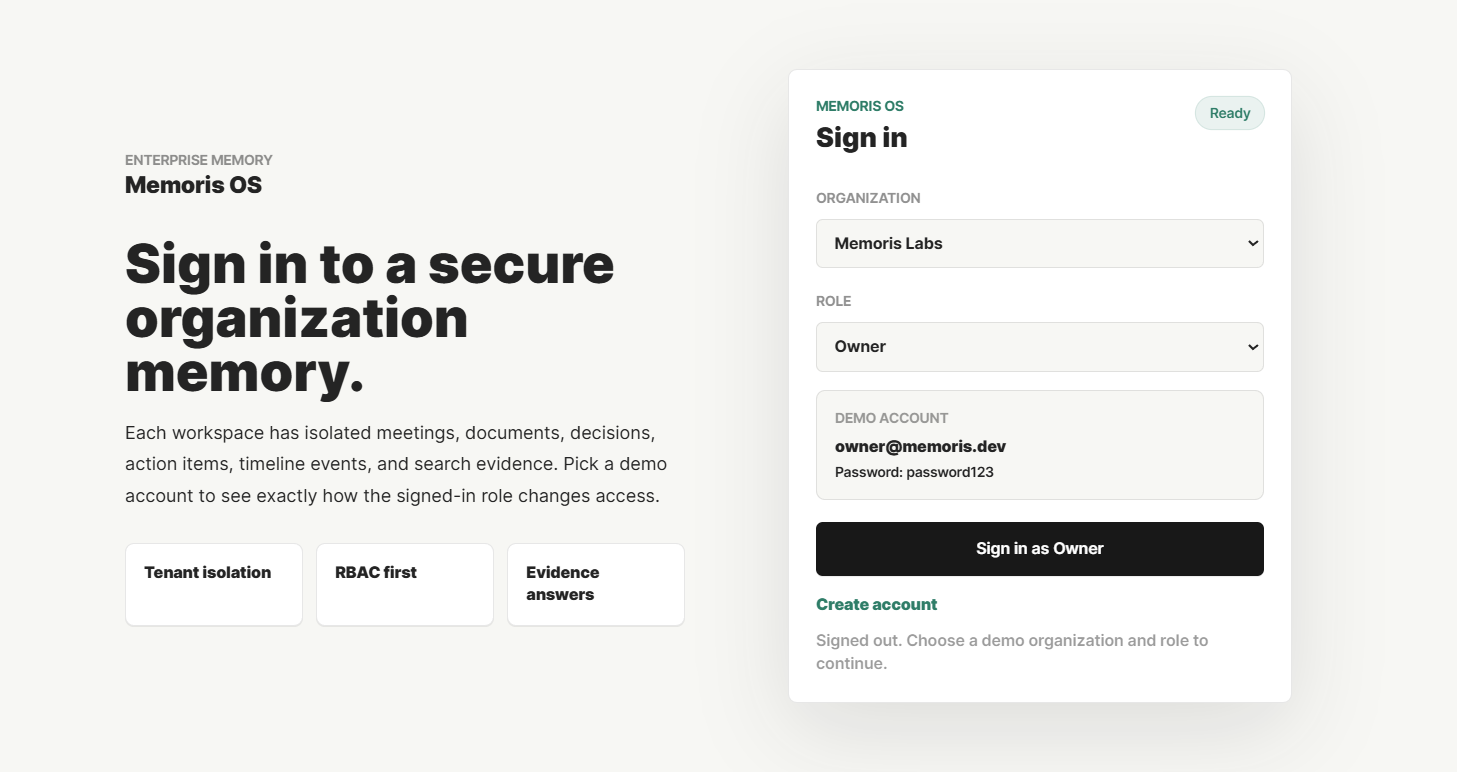
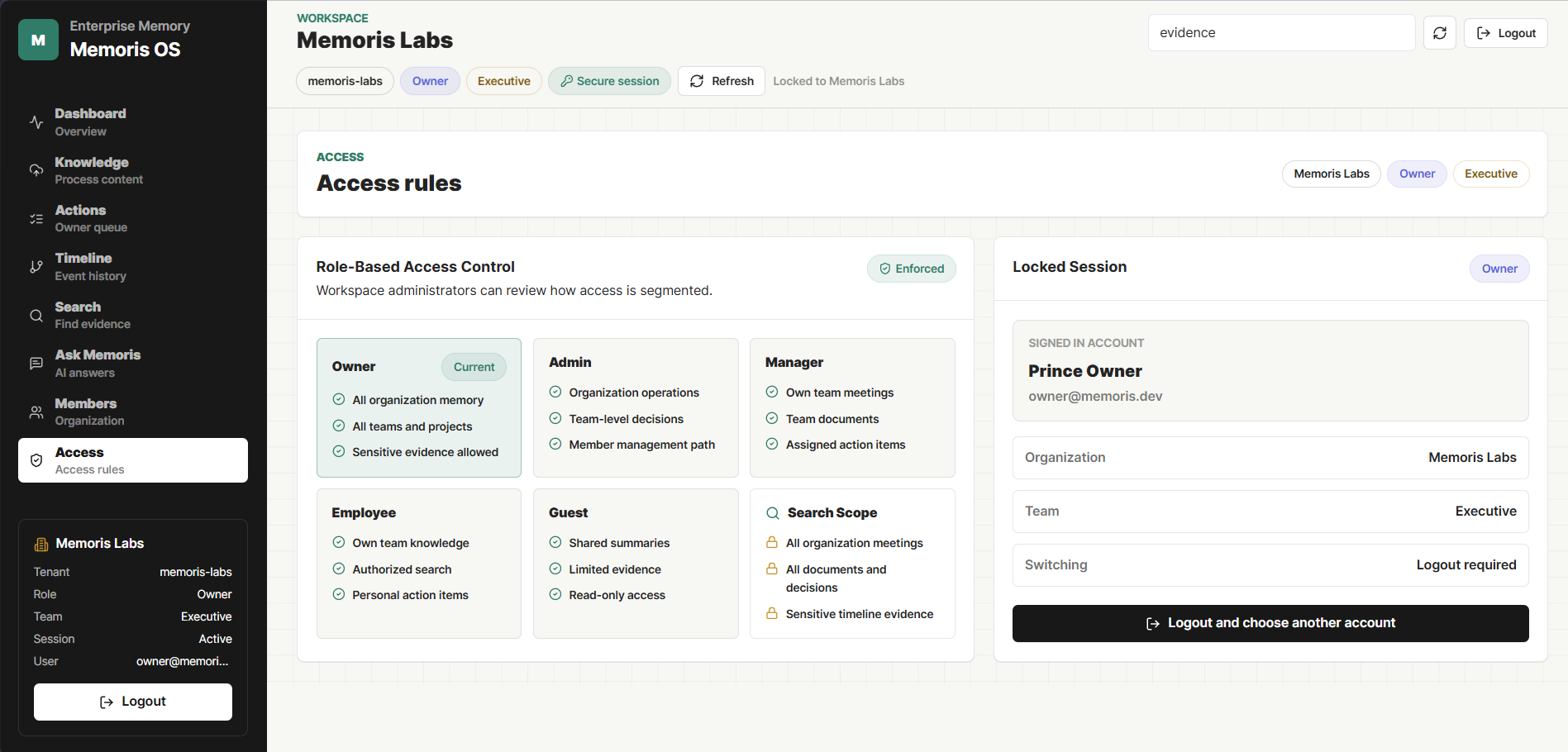
Users can sign in to an organization with a role such as Owner, Admin, Manager, Employee, or Guest. They can upload PDF, DOCX, TXT, MD, and CSV files. The backend extracts text, splits it into chunks, generates embeddings, and stores those chunks in PostgreSQL with pgvector.
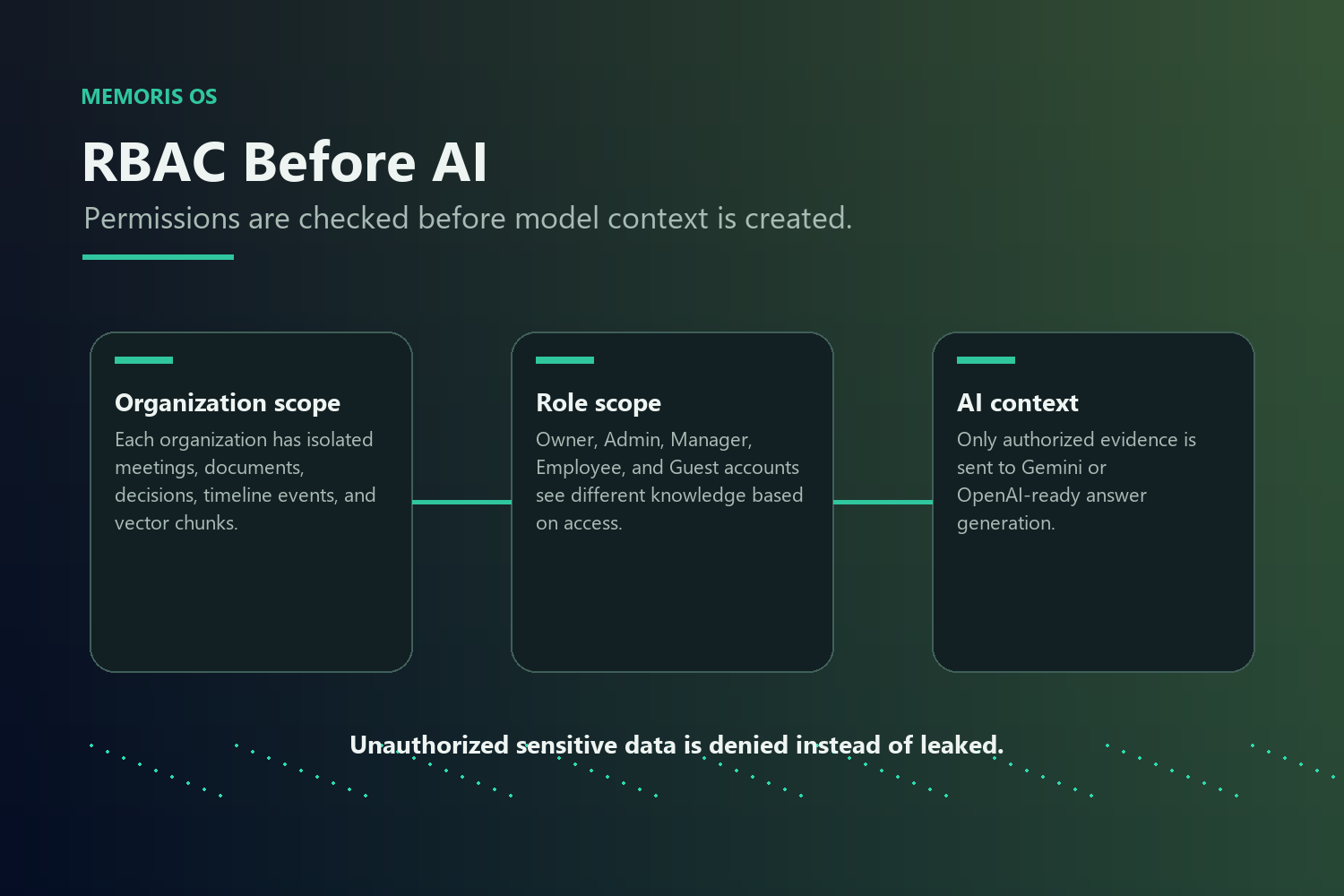
When a user asks a question in Ask Memoris, the system checks their organization and role permissions first. Then it retrieves only authorized knowledge, sends that context to the AI service, and returns an answer with evidence cards.
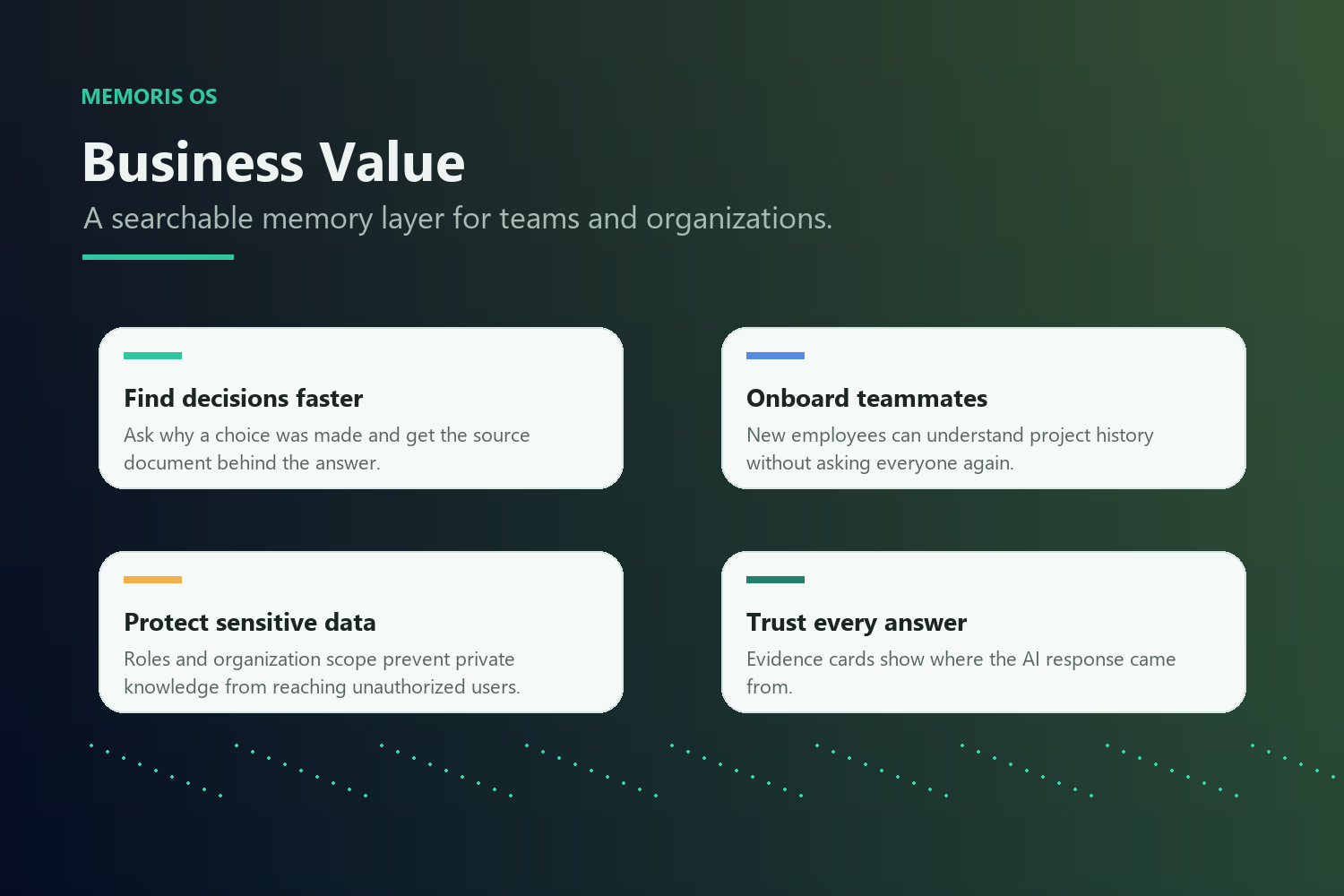
This makes Memoris OS useful for finding old decisions, onboarding teammates, tracking project history, and protecting sensitive information.
How we built it
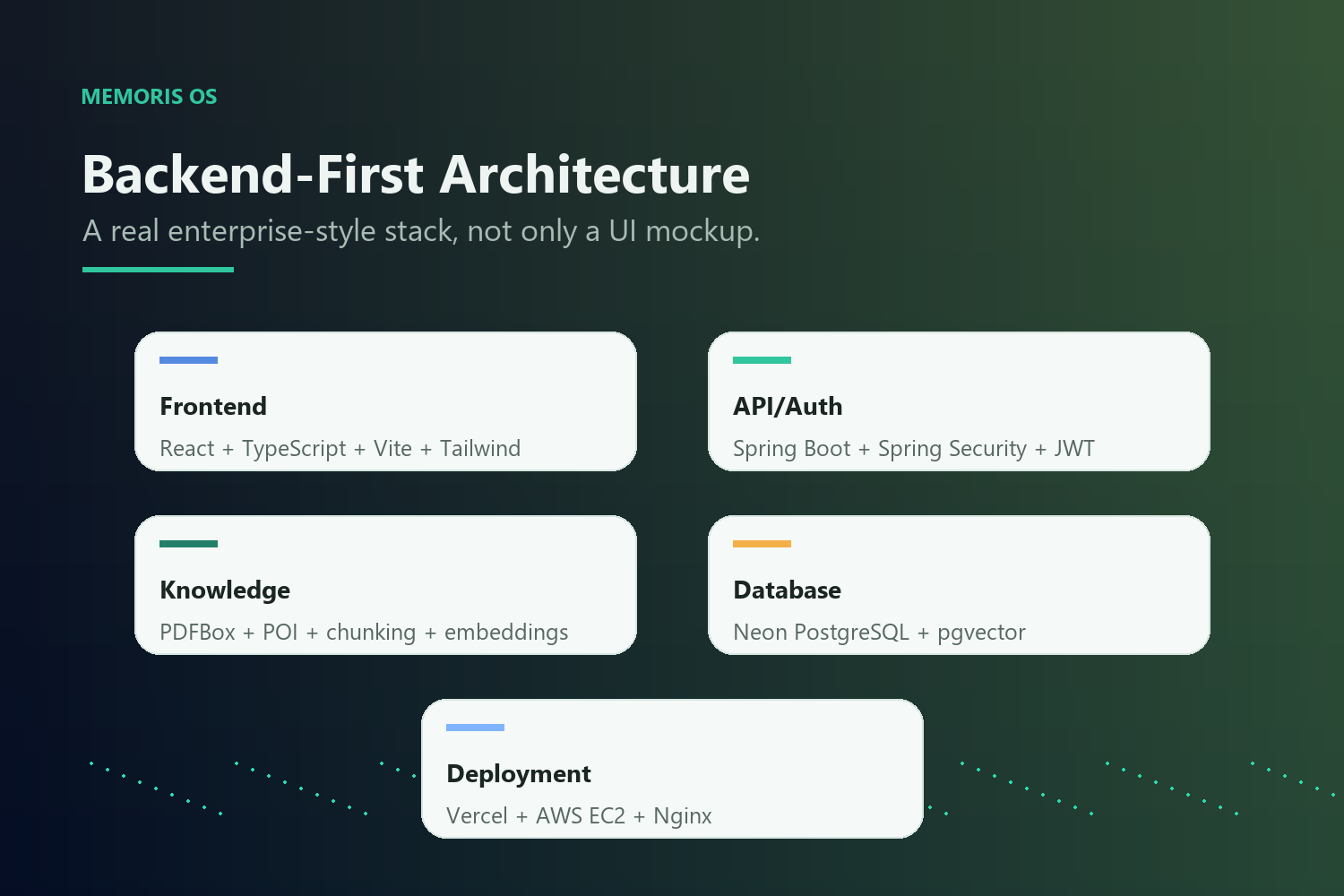
We built Memoris OS with a backend-first architecture.
The frontend uses React, TypeScript, Vite, and Tailwind to create a clean dashboard, landing page, login flow, Knowledge upload page, Timeline, Search, and Ask Memoris experience.
The backend uses Java 21 and Spring Boot. Spring Security and JWT handle authentication. The data model supports organizations, users, roles, meetings, documents, decisions, action items, timeline events, and document chunks.
For storage and retrieval, we used Neon PostgreSQL with pgvector. Uploaded documents are processed through Apache PDFBox and Apache POI, then chunked and embedded for semantic search.
For AI, the backend supports Gemini and is also OpenAI-ready. The app is deployed with Vercel for the frontend and AWS EC2 with Nginx for the backend.
Codex with GPT-5.6 helped throughout the build: architecture planning, backend implementation, frontend polish, RAG design, debugging deployment issues, writing tests, and creating the final documentation.
Challenges we ran into
The biggest challenge was making the project feel real instead of just looking like an AI demo.
We had to connect many moving parts: Spring Boot APIs, JWT authentication, role-based access control, Neon PostgreSQL, pgvector, document extraction, semantic retrieval, Vercel rewrites, EC2 hosting, Nginx proxying, and CORS.
Another challenge was security. For an enterprise AI product, it is not enough to simply send all company data to an AI model. We designed the retrieval flow so RBAC filtering happens before AI context is created. That means unauthorized data is never sent to the AI provider.
Deployment also took debugging. We had to make the frontend talk to the backend correctly through Vercel and Nginx while keeping the backend running as a systemd service on EC2.
Accomplishments that we're proud of
We are proud that Memoris OS is not just a frontend mockup. It has a real Java Spring Boot backend, authentication, RBAC, a PostgreSQL database, document upload, text extraction, chunking, embeddings, semantic retrieval, and evidence-backed AI responses.
We are also proud of the multi-tenant organization model. Each organization has its own users and data, and roles change what the user can access.
The most important accomplishment is the trust layer: Ask Memoris does not only answer questions. It shows evidence, and it blocks restricted questions when the user does not have permission.
What we learned
We learned how important backend architecture is for building useful AI products. A good AI feature is not only about the model. It needs data modeling, permissions, retrieval, evidence, deployment, and trust.
We also learned that RAG becomes much more powerful when it is connected to real business workflows. Uploading a PDF and asking a question is useful, but combining that with organization isolation, timeline intelligence, and RBAC makes it enterprise-ready.
Codex helped us move faster by acting like an engineering partner across planning, coding, debugging, deployment, and documentation.
What's next for Memoris OS
Next, we want to add richer organization workflows, including Slack and email ingestion, team-specific knowledge spaces, notification reminders for action items, and advanced timeline intelligence.
We also want to improve the AI retrieval layer with better ranking, source previews, OCR for scanned PDFs, and stronger admin controls for sensitive documents.
Long term, Memoris OS can become the secure memory layer for every organization: a place where teams can understand what happened, why decisions were made, and what needs to happen next.
Built With
- amazon-web-services
- apache
- css
- ec2
- gemini
- java
- jwt
- neon
- nginx
- openai
- pdfbox
- pgvector
- postgresql
- rag
- rbac
- react
- restapi
- security
- springboot
- tailwind
- typescript
- vercel
- vite

Log in or sign up for Devpost to join the conversation.