-
-
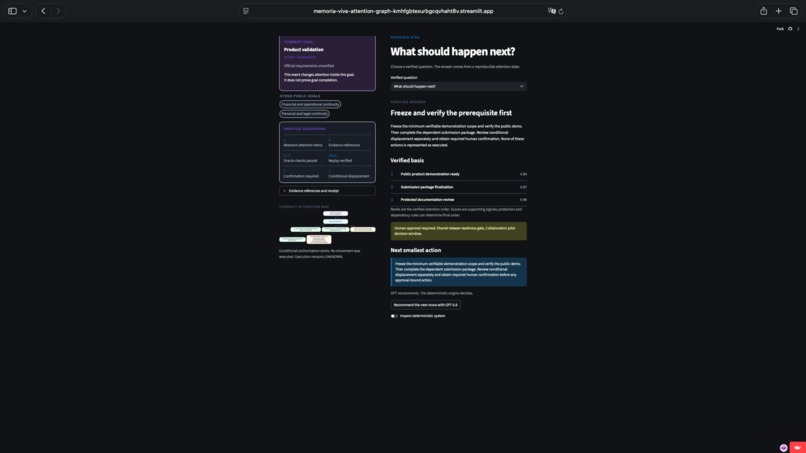
Interface
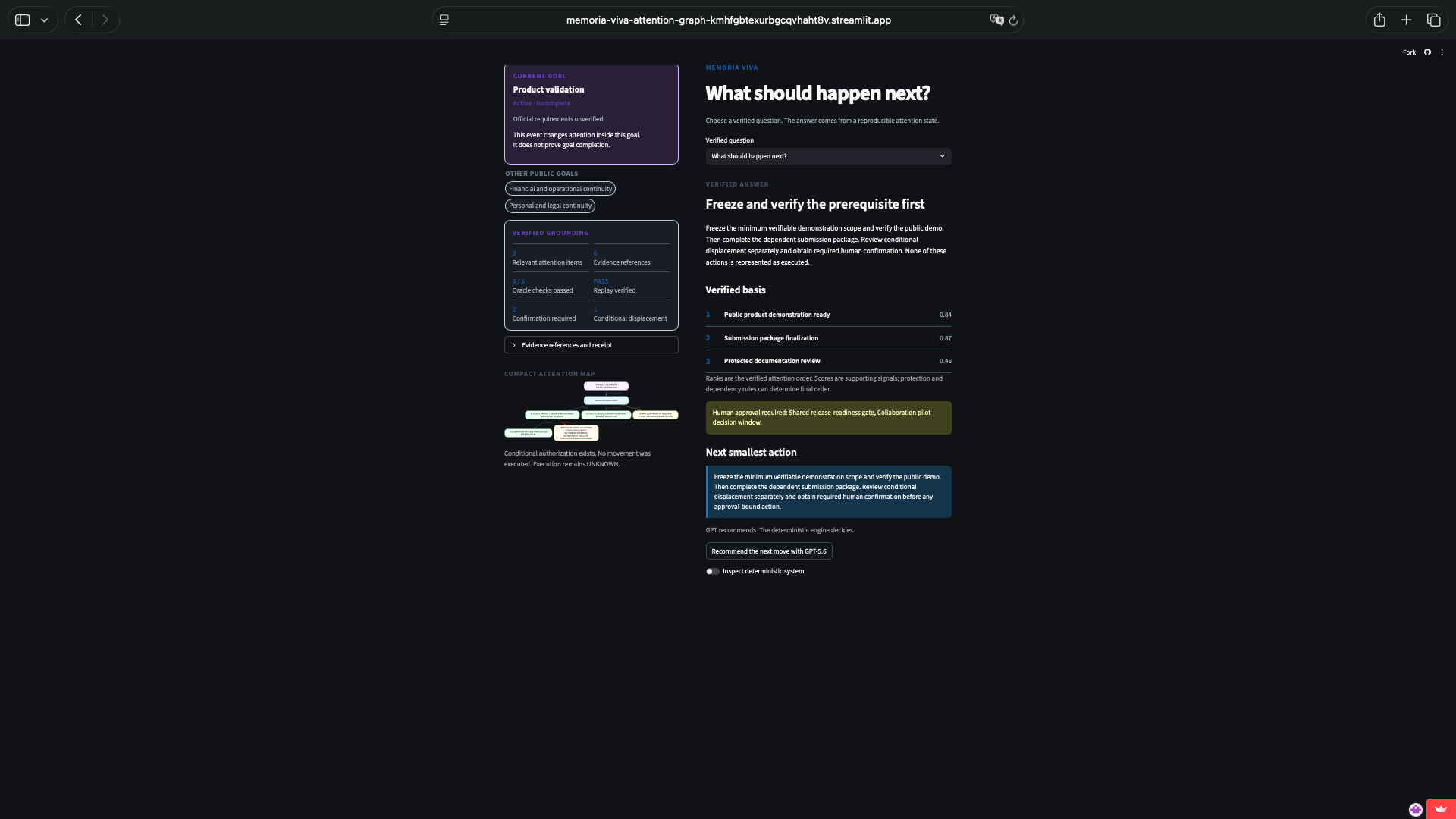
Inspiration
My life happens at the intersection of economics, art, business, and artificial intelligence. I have never lacked ideas, projects, or responsibilities. The harder problem has always been understanding what deserves my attention when a new event (or a change in my emotional state) reshapes everything around it.
Most productivity tools help people remember tasks. They do not explain how a new opportunity affects existing commitments, what must remain protected, what can be moved, what depends on what, what still requires awareness, and what should be the next move.
I wanted to build a system where memory is not just storage and attention is not just a to-do list. Attention should be a traceable decision.
That idea became Memoria Viva.
What it does
Memoria Viva is built for founders and small teams whose commitments are scattered across calendars, messages, and operational systems. It transforms a verifiable external event into a reproducible before and after attention state.
The system:
- preserves the commitments that already existed;
- creates new commitments when the event justifies them;
- computes a versioned attention ranking;
- represents dependencies, conflicts, protection, and conditional displacement;
- keeps uncertainty visible instead of inventing certainty;
- identifies decisions that still require human confirmation;
- produces evidence-backed receipts that explain why the state changed.
The public demo uses a reviewed synthetic founder scenario.
A new OpenAI Build Week opportunity enters the system. Memoria Viva creates two protected commitments, keeps an earlier protected obligation in the top three, exposes one conditional displacement without claiming that it occurred, and preserves two items that still require confirmation.
The primary interface asks one verified question at a time, such as:
- What should happen next?
- What matters now?
- What changed after the event?
- What still requires human approval?
The question selects which part of the verified state to explain. It never changes the ranking or becomes a scoring feature.
How i built it
The project has two clearly separated layers.
Deterministic engine
The deterministic engine:
- validates the sanitized fixture against canonical JSON Schemas;
- builds immutable Snapshot T0;
- applies one canonical trigger;
- constructs Snapshot T1;
- extracts six attention components;
- calculates before-and-after rankings;
- generates a 21-change GraphDelta;
- produces an immutable RunRecord;
- compares the result against three human-authored oracles.
The same committed input produces byte-identical results and a stable replay digest.
Protection and dependency rules can affect final order without secretly modifying the underlying scores. Unknown values remain unknown. Conditional authorization never becomes executed movement unless execution is actually established.
GPT-5.6 explanation layer
GPT-5.6 does not decide what deserves attention.
It receives only a completed, sanitized deterministic answer. It may explain what the state means and recommend the next smallest action, but it cannot change:
- ranks;
- scores;
- execution states;
- evidence;
- uncertainty;
- approval requirements;
- GraphDelta;
- oracle results.
All model output uses strict Structured Outputs and is validated before it is shown. If the model is unavailable or returns an invalid result, the deterministic recommendation remains complete and authoritative.
Codex collaboration
Codex was my primary engineering collaborator throughout the build.
I used Codex to:
- translate the product philosophy into an ontology and canonical schemas;
- reconcile requirements, privacy boundaries, and human decisions;
- build the schema registry and fixture loader;
- implement canonical serialization and stable digests;
- construct immutable Snapshots;
- encode the trigger transition;
- design and validate the attention policy;
- isolate human-authored oracles from production scoring;
- generate GraphDelta and RunRecord receipts;
- build the CLI and Streamlit experience;
- create and maintain 260 tests;
- iterate from a technical dashboard into the final guided product experience.
I retained human authority over Goals, policy, privacy, trade-offs, approval boundaries, and public wording. The Git history, decision ledger, and append-only build log preserve that collaboration.
Challenges i ran into
Deadline
I had work and personal commitments, but I chose to take the risk and bring this idea into the world.
Separating AI explanation from system authority
The largest architectural challenge was preventing the language model from becoming the decision engine.
It was easy to create a chatbot that sounded persuasive. It was much harder to create a system where every important claim remained grounded in deterministic state, evidence, uncertainty, and explicit human policy.
Avoiding oracle leakage
The human-authored expected ranking is used only after production computation. It never enters the scoring pipeline. Maintaining that separation required explicit contracts and regression tests.
Preserving uncertainty
Many systems convert missing information into assumptions or default scores. Memoria Viva treats uncertainty, unknown execution, and pending approval as first-class state.
Privacy
The demo needed to preserve a realistic founder attention pattern without exposing real people, private locations, Calendar identifiers, exact chronology, raw messages, or reversible provenance.
Making the system understandable
The engine is technically detailed, but the product should feel simple. The final interface therefore presents one verified question, one grounded answer, one next action, a compact attention graph, and an optional technical inspector.
Accomplishments that i am proud of
- A complete deterministic T0 → trigger → T1 replay.
- Three human-authored oracle comparisons passing.
- A stable ReplayResult digest.
- A 21-change GraphDelta across seven semantic categories.
- Explicit protection, dependency, uncertainty, and approval boundaries.
- 260 passing tests.
- No-login public deployment.
- A public-safe synthetic scenario.
- Optional GPT-5.6 recommendations that cannot override deterministic state.
- A guided interface that allows non-technical users to understand the result while preserving technical proof underneath.
What i learned
Honestly, I learned that hard work and passion can turn an idea into something real. Technology is making the path from imagination to implementation faster than ever. That still amazes me.
What's next for Memoria Viva
The current MVP uses one reviewed synthetic scenario.
The next steps are:
- live, permissioned Calendar and communication connectors;
- private ingestion with user-controlled publication boundaries;
- multiple replay scenarios;
- empirical calibration of the attention policy;
- multi-user and team isolation;
- longitudinal memory across repeated state transitions;
- human-approved action planning after attention has been computed;
- richer visualization of how Goals, commitments, evidence, and decisions evolve over time.
The long-term vision is simple:
A normal chatbot responds from the current conversation.
Memoria Viva responds from a weighted, evidence-backed, versioned state that can be replayed and audited.
The language model does not decide what matters.
The Attention Graph does.

Log in or sign up for Devpost to join the conversation.