-
-
MEMORIA
Inspiration
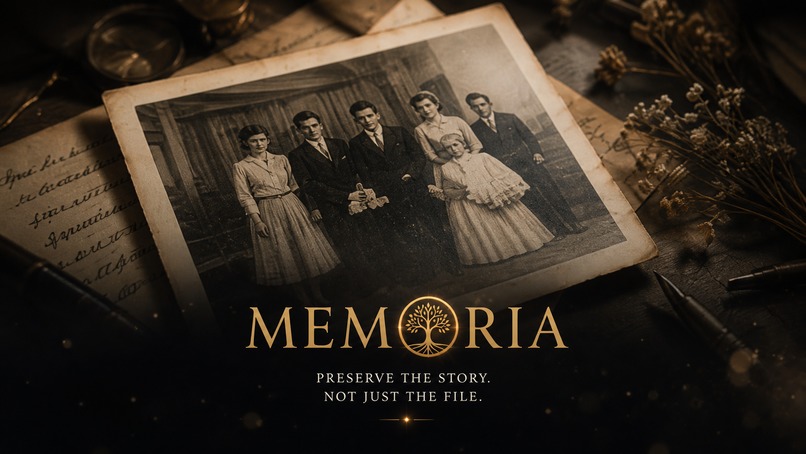
We realized that modern technology is incredibly good at preserving files, but not necessarily the stories behind them. A photograph may survive for generations while the people, emotions, events, and memories connected to it slowly disappear.
Memoria was inspired by a simple question: What if technology could preserve not only what happened, but why it mattered?
What it does
Memoria is an AI-powered Personal History Engine that transforms scattered photographs, videos, voice recordings, documents, and written memories into an interconnected personal history.
It identifies and connects people, places, events, dates, and relationships, creating a visual Memory Graph and searchable timeline.
Its core feature, Ask Your History, allows users to ask questions about their past and receive answers grounded in their own archived memories and supporting sources rather than generic AI-generated responses.
How we built it
Memoria was designed as a multimodal AI system combining image understanding, OCR, speech-to-text, text processing, entity and event extraction, semantic retrieval, and graph-based relationships.
The proposed architecture takes multimedia memories as input, extracts meaningful information, connects related memories through a Memory Graph, and makes that information accessible through a timeline, Memory Threads, and the Ask Your History interface.
We focused heavily on privacy, provenance, accessibility, and a simple experience that can work across generations.
Challenges we ran into
The biggest challenge was designing an AI experience that deals with personal history responsibly. Memories can be incomplete, ambiguous, or deeply personal, so simply generating plausible answers is not enough.
We had to consider how Memoria could reduce hallucinations, show where information comes from, handle uncertain relationships, protect private memories, and give users control over what is shared.
We also had to balance an ambitious long-term vision with a technically realistic architecture that could be developed incrementally.
Accomplishments that we're proud of
We are proud to have developed Memoria from an initial idea into a structured and research-informed product concept.
Our key accomplishment is identifying a gap between preserving digital files and preserving the context behind them, then designing Memoria around that gap. We developed the concept of a Memory Graph, connecting people, places, events, dates, and relationships across different types of memories.
We also designed Ask Your History, a source-grounded conversational experience that allows users to explore their personal history while connecting answers back to the memories and sources they came from.
Most importantly, we are proud that Memoria is not simply about storing more information. It is about using technology to preserve something that is much easier to lose:
the human context and stories behind our memories.
What we learned
We learned that solving a meaningful problem does not always require inventing an entirely new technology. Sometimes the innovation comes from combining existing technologies in a way that addresses a problem people genuinely care about.
We also learned that AI systems dealing with personal information need to prioritize trust, transparency, provenance, privacy, and user control alongside intelligence.
Most importantly, we learned to think beyond building an AI feature and instead design an entire experience around the human problem.
What's next for Memoria
The next step is to build a functional MVP beginning with photo and document ingestion, speech transcription, entity extraction, a basic Memory Graph, timeline generation, and source-grounded search.
From there, Memoria could expand into collaborative family archives, AI-assisted oral-history interviews, multilingual support, community archives, and partnerships with libraries, museums, and cultural organizations.
Our long-term vision is to evolve Memoria from a personal history tool into a platform for preserving family stories, community memories, and cultural heritage.
Because history isn't made of files. It's made of stories.
Built With
- artificialintelligence
- cloudcomputing
- computervision
- dataprivacy
- datavisualization
- digitalarchives
- generativeai
- humancomputerinteraction
- knowledgegraphs
- largelanguagemodels
- machine-learning
- multimodalai
- naturallanguageprocessing
- opticalcharacterrecognition
- retrievalaugmentedgeneration
- semanticsearch
- speechrecognition
- vectordatabase
- voiceai


Log in or sign up for Devpost to join the conversation.