-
-
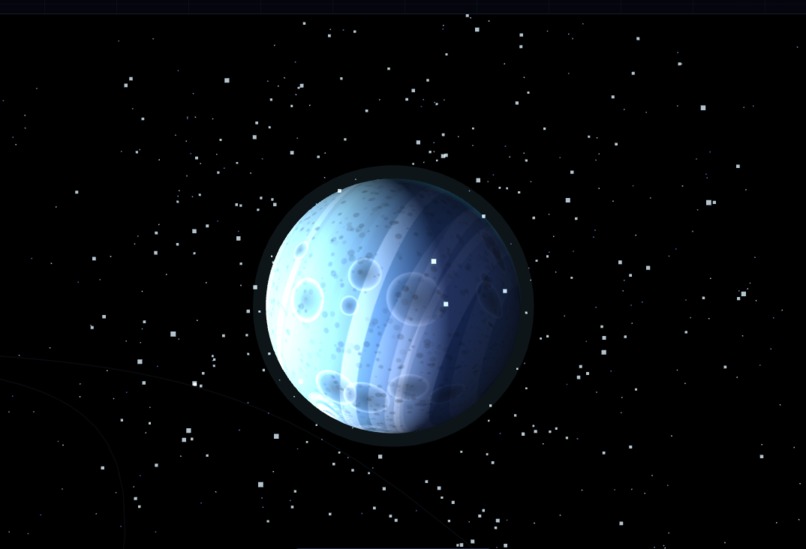
A planet representing a sad, rainy day.
-

Memoria Galaxy's homepage panel.
-

Memoria Galaxy's in depth analytics on a generated planet's traits.
-
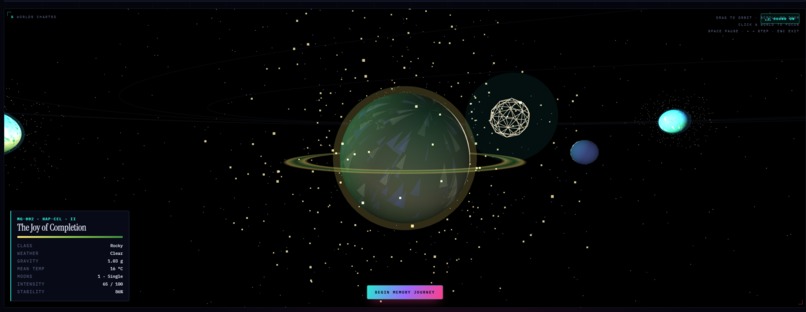
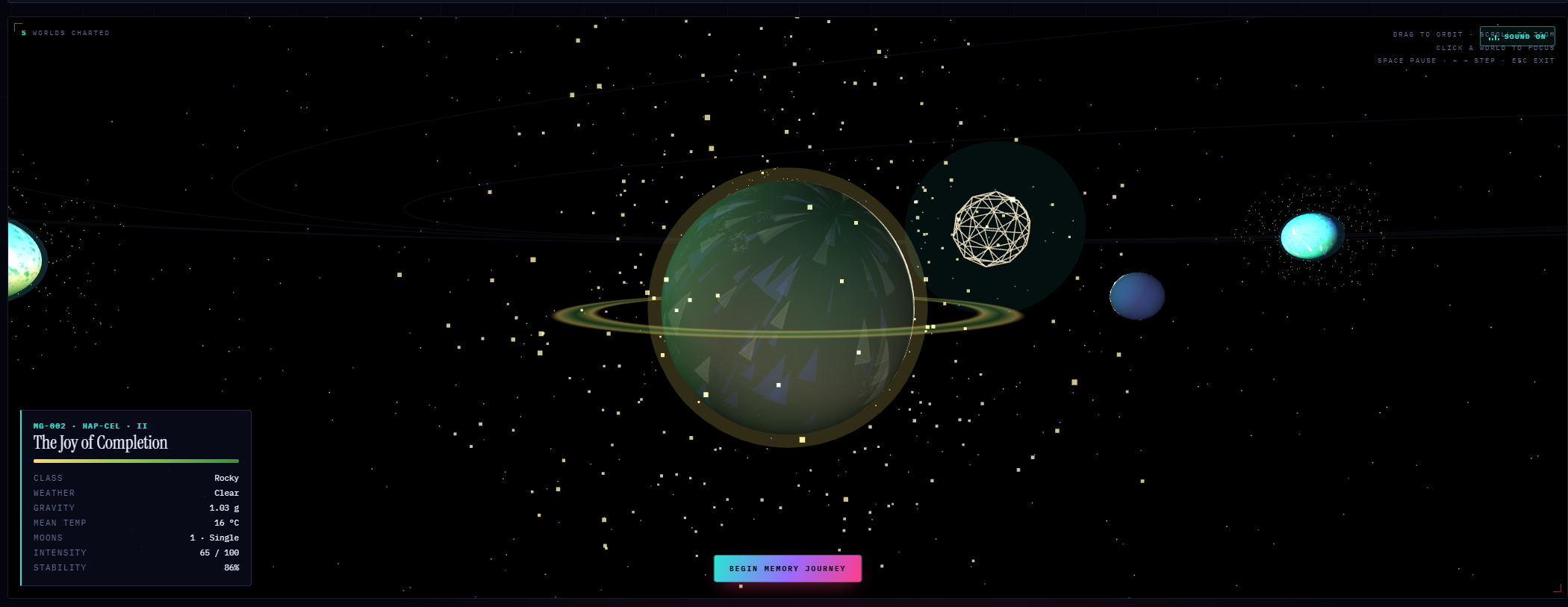
A user's joyful yet solemn planet titled "The Joy of Completion".
-
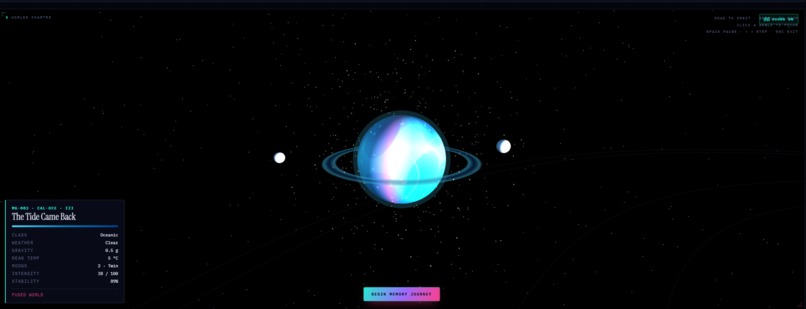
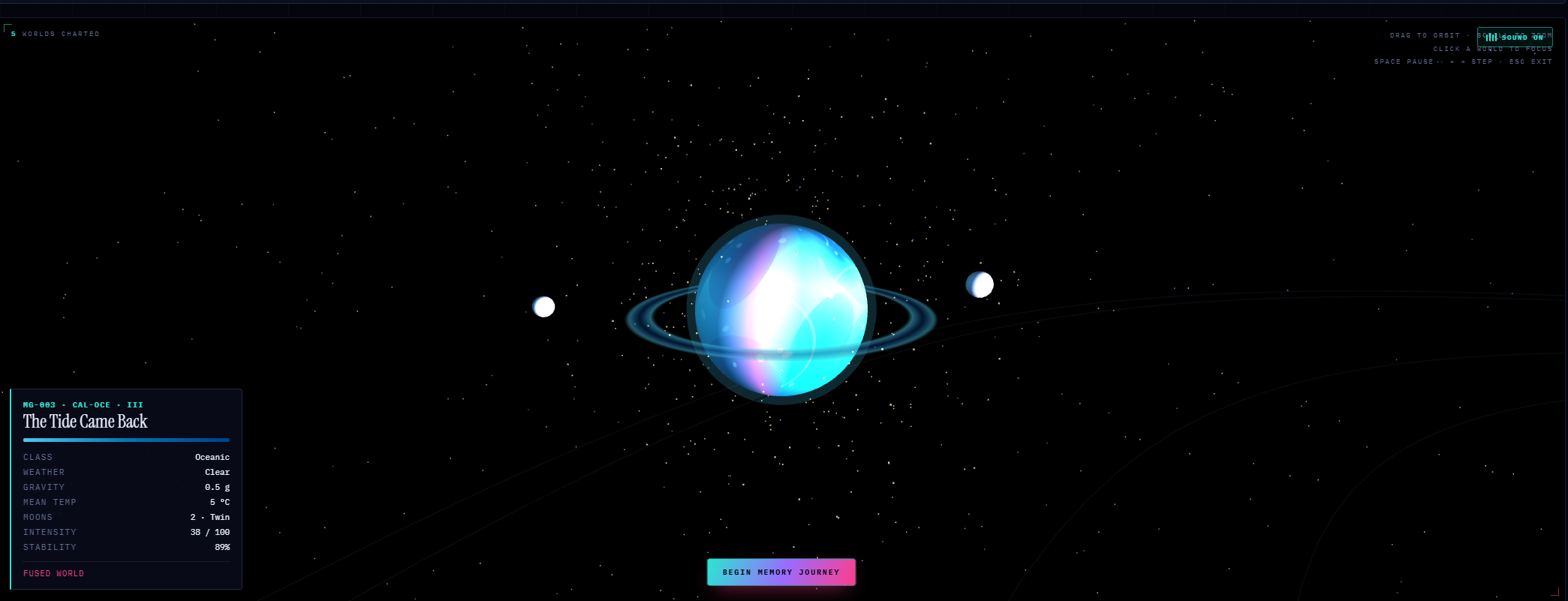
A user's melancholy, vibrant fusion planet titled "The Tide Came Back".


Inspiration
Traditional journaling is quite meaningful as it allows the person involved to reflect on themselves and their peers, but it often feels like just another task at the end of a long day. We wanted to make this process of reflection more imaginative, immersive, and emotionally resounding. We wanted to give every memory its own unique world and a collection of memories their own unique galaxy.
This thought is exactly what inspired our team to build Memoria Galaxy, an AI-powered journaling experience that transforms personal memories into an explorable galaxy. Additionally, the Hack the Arts theme challenged participants to create art that could not exist without technology. Memoria Galaxy embraces that goal by combining personal story telling, AI, interactive 3D graphics, and generative sound into a new form of self expression.
What it does
Users begin by writing a memory, feeling, or experience into the Memory Console. Then, the AI interprets the emotional message and theme of the entry, which it then converts them into a structured collection of artistic traits. These traits determine a multitude of characteristics for the planet:
- Color palette and shine
- Size, gravity, and orbit
- Rings, moons, weather, and atmosphere
- Environmental effects and emotional intensity
- Musical tune/melody
The resulting planet is added to the user's personal galaxy, where it can be viewed from different angles, zoomed into, and revisited through an interactive display.
Additionally, users can connect two memories and activate Memory Fusion. The AI identifies the emotional connection between the two memories and creates an entirely new planet that combines those characteristics while expressing a new emotional meaning.
Lastly, after building several planets, users can begin an immersive Memory Journey through their galaxy. This experience travels between their planets while revisiting their visual characteristics, emotional meanings, and soundscapes, turning a
How we built it
We built Memoria Galaxy primarily with Python and Streamlit, using Streamlit for the interface, session management, memory input, planet archive, and fusion controls.
For the AI system, we connected the application to Llama 3.1 through Ollama. This allowed the language model to run locally and interpret memories without requiring them to be sent to an external cloud service. The model receives a carefully engineered world design prompt and returns structured JSON containing fields such as emotion, theme, planet type, surface features, atmosphere, and more.
Additionally, the galaxy itself is rendered with a custom Three.js and WebGL visualization embedded inside Streamlit. We implemented procedural canvas textures, lighting, atmospheric effects, orbit calculations, and custom camera controls in order to create planets that were visually stunning and unique while keeping them consistent.
Challenges we ran into
One major challenge we ran into was transforming a user's subjective writing into a vibrant, visually stunning planet. Our earlier prototypes tended to create planets with repetitive colors or traits that did not strongly reflect the memory. We improved this by redesigning the prompts, implementing a stronger AI, expanding the feedback vocabulary, and combining AI decisions with our own world building rules.
Another challenge was rendering multiple detailed planets without visual overlap or clipping. In order to fix this visibility problem, we developed positioning calculations, dynamic display sizes, orbital distances, and camera controls so that the galaxy remained navigable as more memories were added.
Accomplishments that we're proud of
We are most proud that Memoria Galaxy was able to turn an ordinary piece of writing into a complete, interactive artwork rather than simply generating summaries or images. Additionally, we were able to successfully create numerous feats:
- AI generated planets with numerous interconnected visual and physical traits
- A navigable 3D galaxy with procedural textures and interactive controls
- Memory Fusion, which creates new insights from two existing experiences
- Generative soundscapes that give each world an auditory identity
- An immersive journey that transforms separate journal entries into a personal narrative
- A consistent visual identity that feels like a complete creative experience rather than a collection of unrelated features
What we learned
We learned that meaningful AI integration requires much more than just sending a prompt to a model. The model's interpretation must be carefully structured so that every response is visible, emotionally relevant, and provides insight. For example, our old AI integration was connecting an Ollama model with a meager and minimalistic prompt. This caused the AI to give prompts that were fragmented sentences, which we knew that we had to fix.
Finally, we learned that interactive art depends heavily on presentation. Camera movement, animation, UI, sound, and other small details all contribute massively to whether the user feels like they are using an application or entering their own emotionally immersive world.
What's next for Memoria Galaxy
Our next step is to give users permanent accounts so their galaxies can grow over months or years instead of lasting for a single session. We would also like to add encrypted storage, private exports, and shareable galaxy experiences to improve user experience even more; we want Memoria Galaxy to have even more of that community vibe.
Additionally, we plan to expand the creative system with voice-recorded memories so that users can also verbally feel a piece of themselves whenever they listen to one of their past memories.


Log in or sign up for Devpost to join the conversation.