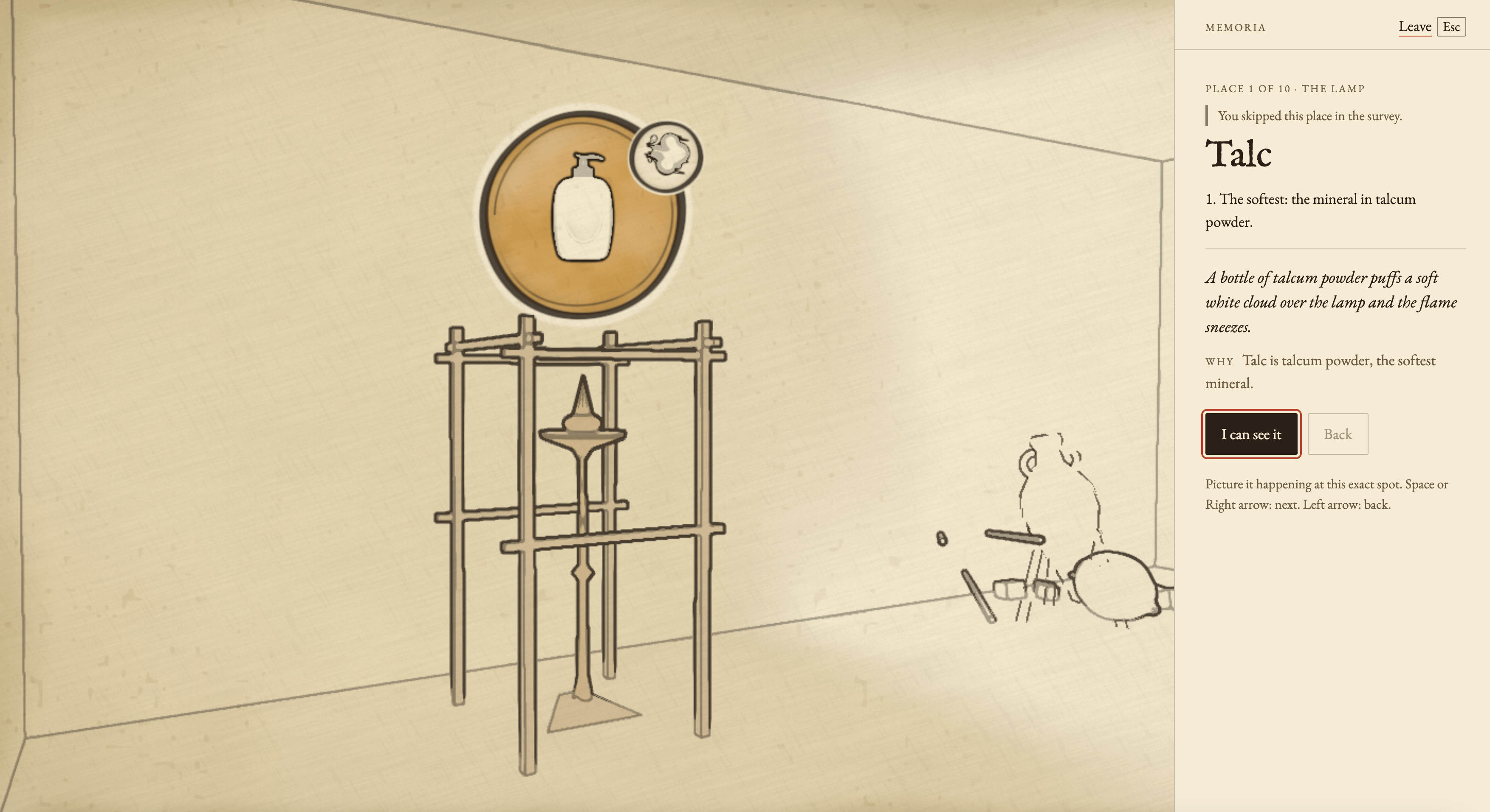
We were inspired by the complexities, and often deficiencies, of human memory. For instance, think about how easily you can remember the layout of your childhood home or your favorite video game. Now think about how much you remember from a class you took a year ago, or what you had for lunch a week ago.
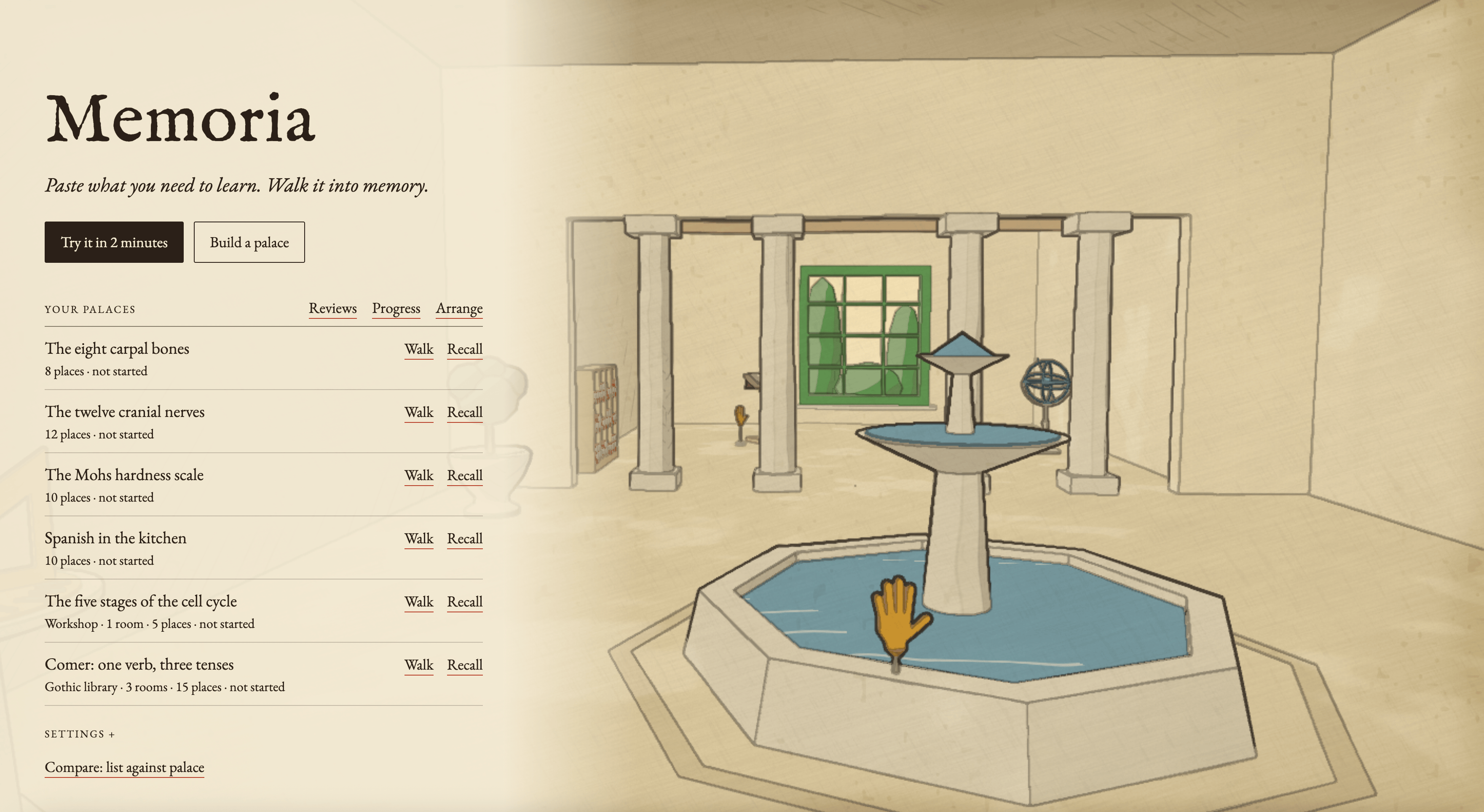
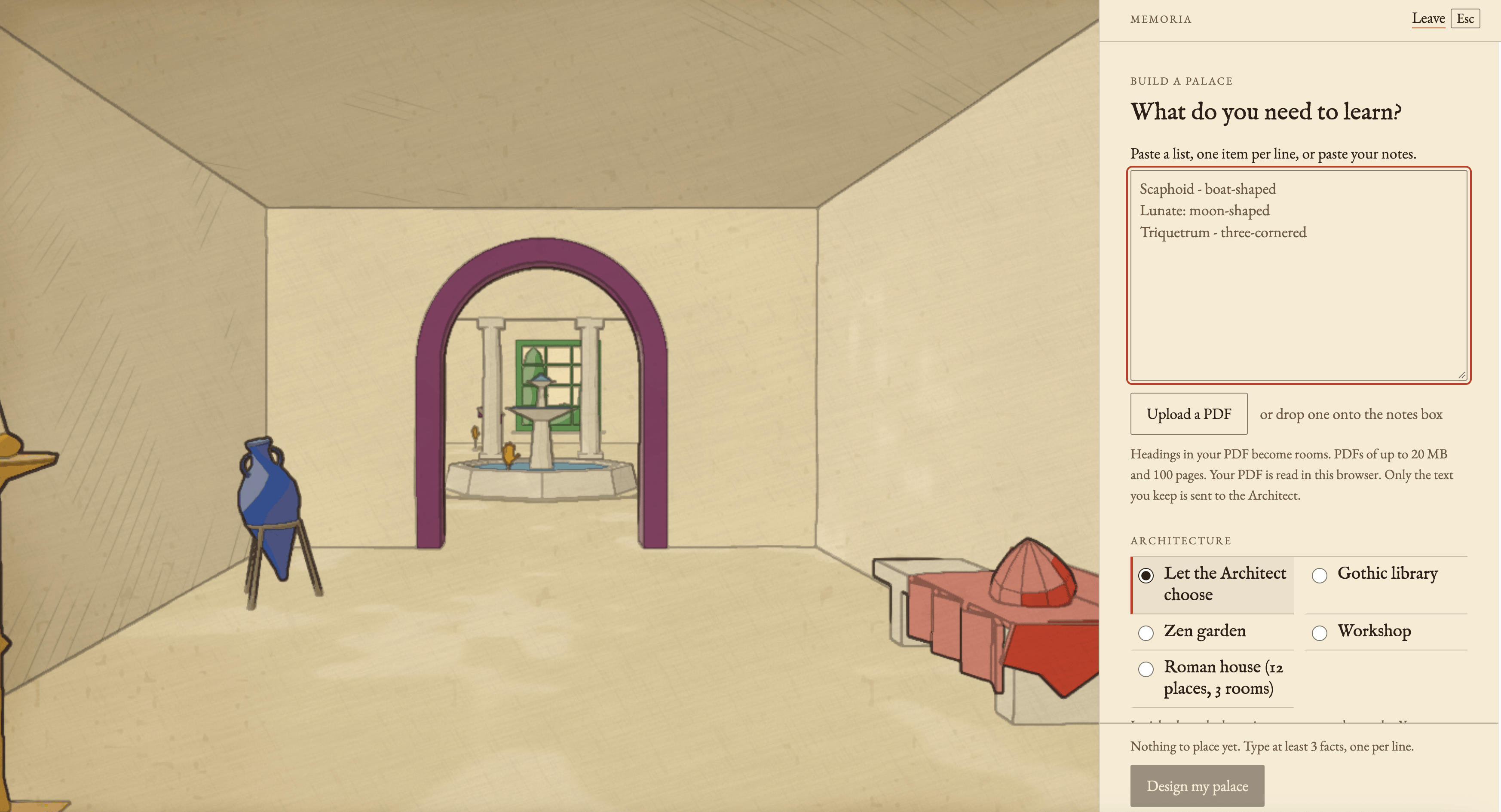
To improve human memory, we built Memoria. Memoria transforms sets of terms into interactive 3D learning environments in the form of memory palaces, using the method of loci. An AI constructor identifies important concepts, organizes the materials into rooms, and generates customizable images and associations between concepts and physical objects.
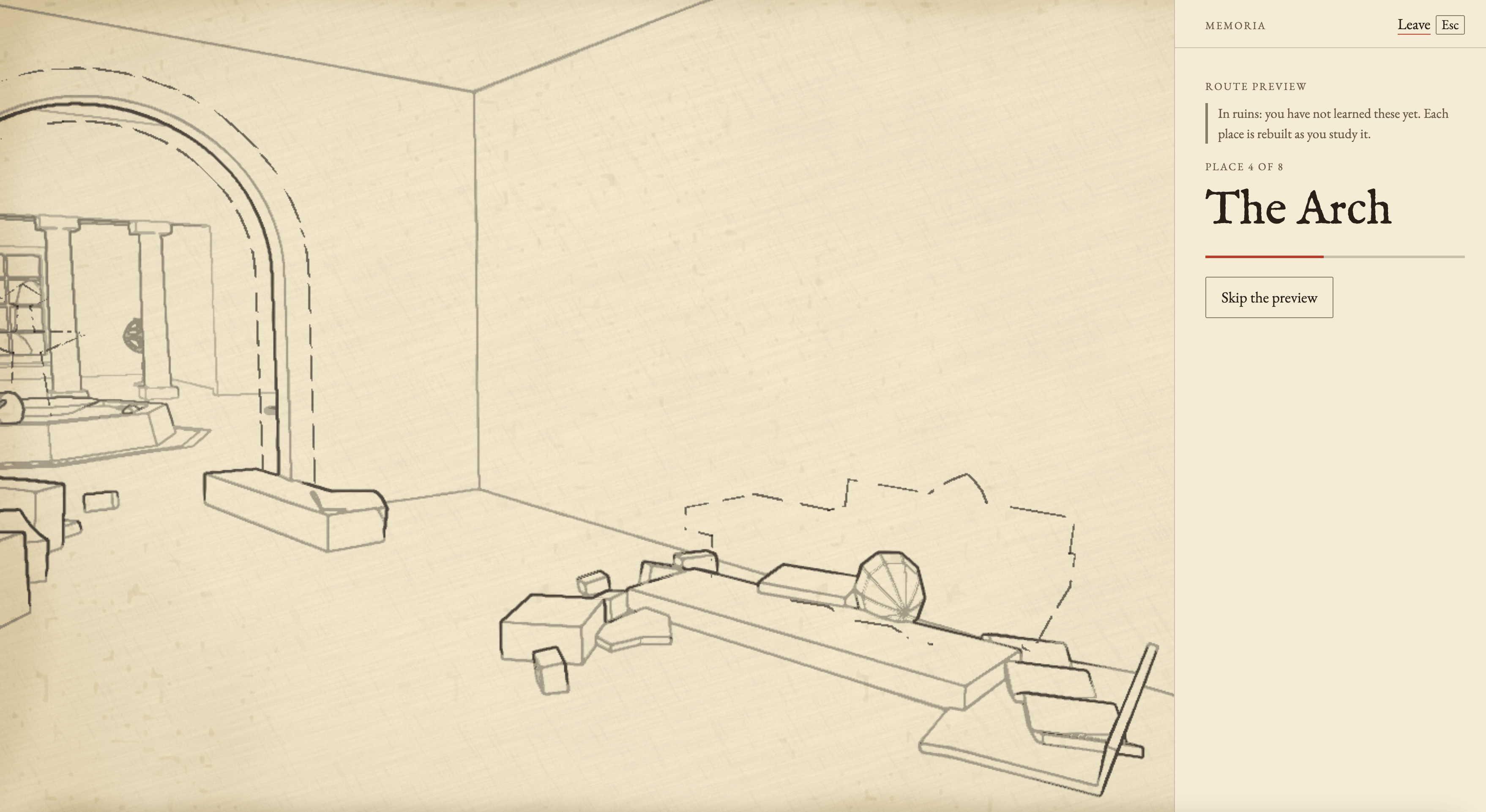
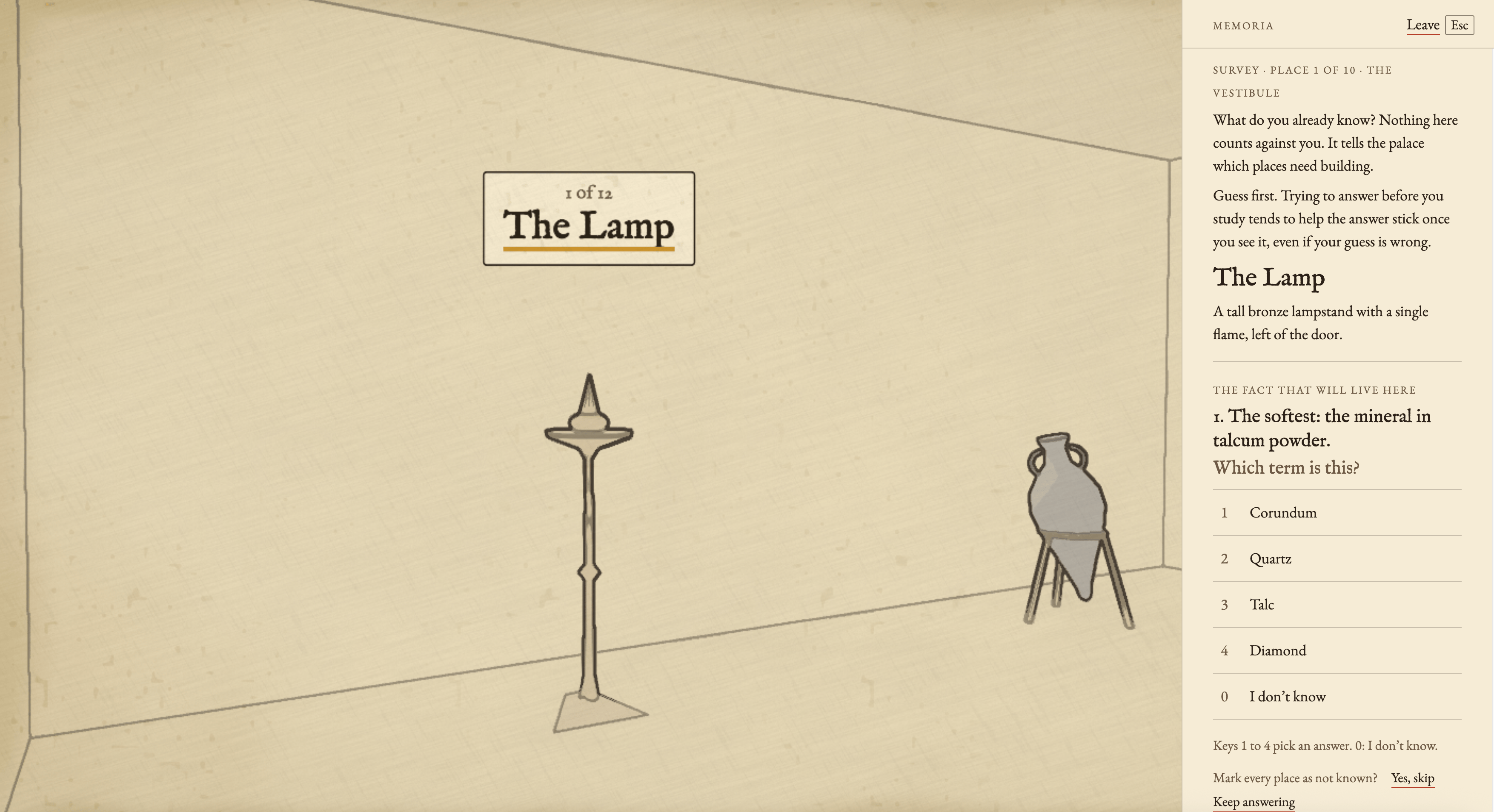
Memoria tests what you already know before it starts teaching, and each incorrect answer causes part of the palace to collapse. During the study walk, you encounter images that help you remember the information. When you return for recall, the images disappear. Get an answer right, and the corresponding location in the palace is restored. Over time, the palace transforms from ruins into a completed, beautiful environment reflecting your learning progress. Memoria also features a Workshop framework that organizes the route into connected stations to more effectively improve memory on terms embedded in the same process.
We built Memoria using React, TypeScript, three.js, and React Three Fiber, with a custom rendering system inspired by ink drawings and watercolor paintings. Our 3D engine separates architectural layouts, visual themes, and rendering styles, allowing us to generate different environments without rebuilding the entire application. We created Gothic library, Zen garden, Roman villa, and Workshop environments. We used PDF.js for document importing, Zustand for state management, and Vercel for deployment. Claude Code agents supported development, while automated browser tests helped verify the learning experience.
The biggest challenge we faced when building Memoria was translating abstract learning progress into a physical environment. We didn't want the memory palace's appearance to be a decorative progress bar; every ruined and repaired location needed to reflect actual learning. To achieve this, we ensured that genuine recall was being tested along the route via the method of loci. It would be difficult to remember the concepts by themselves, but recall is greatly facilitated by associations with locations in the palace.
We also encountered technical challenges when we ran into practical constraints with AI generation speed, browser rendering, and live-demo reliability. We successfully addressed these through parallel API requests, procedural environment generation, and automated testing.
Through the difficult yet rewarding process of building Memoria, we learned that building an educational product requires more than simply making learning aesthetic (though this is an important part!). A student recognizing information is not necessarily the same as remembering it. That's why we designed Memoria around the core tenet of recall via method of loci. In Memoria, we emphasized that different types of information shouldn't necessarily be taught in the same way, such as how terms in a process need to be represented by an environment capturing their relationships with each other.
Building Memoria was the greatest experience (and challenge) we've experienced yet. But what's next? We want to take Memoria to the next level by creating interactive simulations where students can manipulate variables, explore cause-and-effect relationships, and deeply understand the internals of why processes work.
Moreover, we also want to personalize the memory palaces using places, objects, and experiences students already know. Someone familiar with basketball might learn networks through passing plays, while someone who loves Minecraft might learn chemical processes through crafting mechanics. Or, an avid Harry Potter fan might find themselves navigating Hogwarts as they learn. We also hope to add sound effects and music to Memoria to make the overall experience more enjoyable.
We want Memoria to adapt not only to what students are learning, but also to how they already understand the world, in order to create positive change in education.
Built With
- anthropic-claude
- claude-api
- claude-code
- drei
- glsl
- pdf.js
- playwright
- postprocessing
- react
- react-three-fiber
- three.js
- typescript
- vercel
- vite
- webgl
- zod
- zustand

