-
-
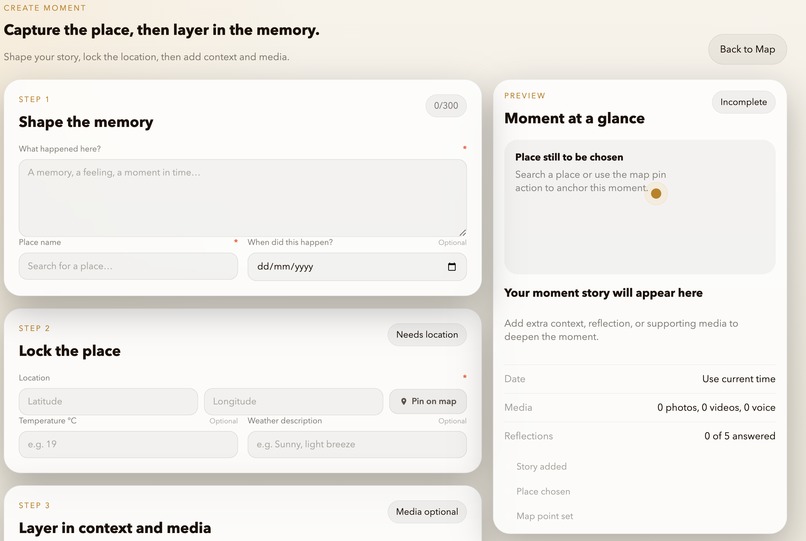
Drop a moment
-
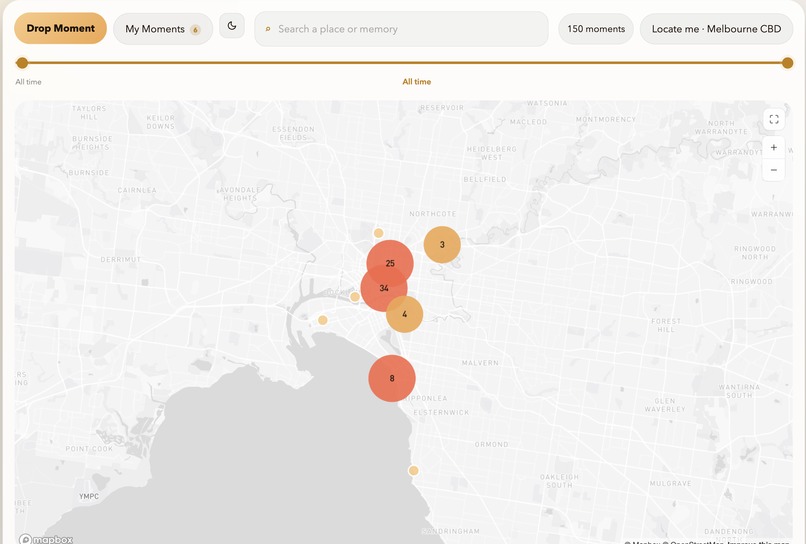
Moment Map
Inspiration
While 1.5 billion photos are taken globally every day, the vast majority remain locked in private albums, rarely tied to a location long-term. Existing platforms fail to capture the emotional reality of physical spaces: Google Street View records only exterior snapshots without a "sense of presence," and the Internet Archive preserves digital content rather than physical experiences.
This gap inspired our core philosophy—The Inversion. We realized that instead of using the person as the content container, we should use the location. As we put it: "We are not building a social network for people who happen to be at a place; we have built a memory system for places that happen to have people."
What it does
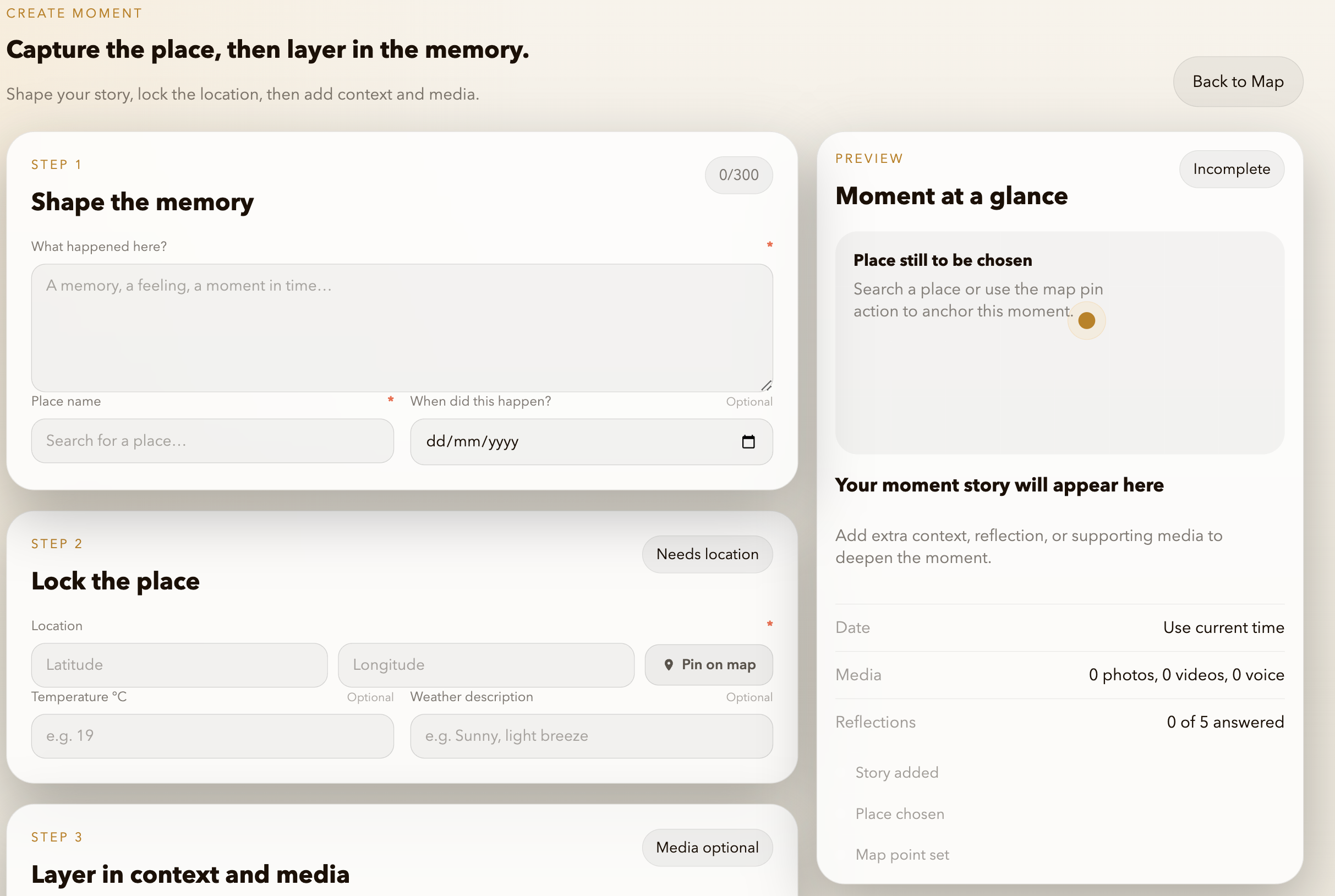
Time Pulse is an anonymous, place-first memory platform where users can leave photos, text, and voice notes at precise GPS coordinates.
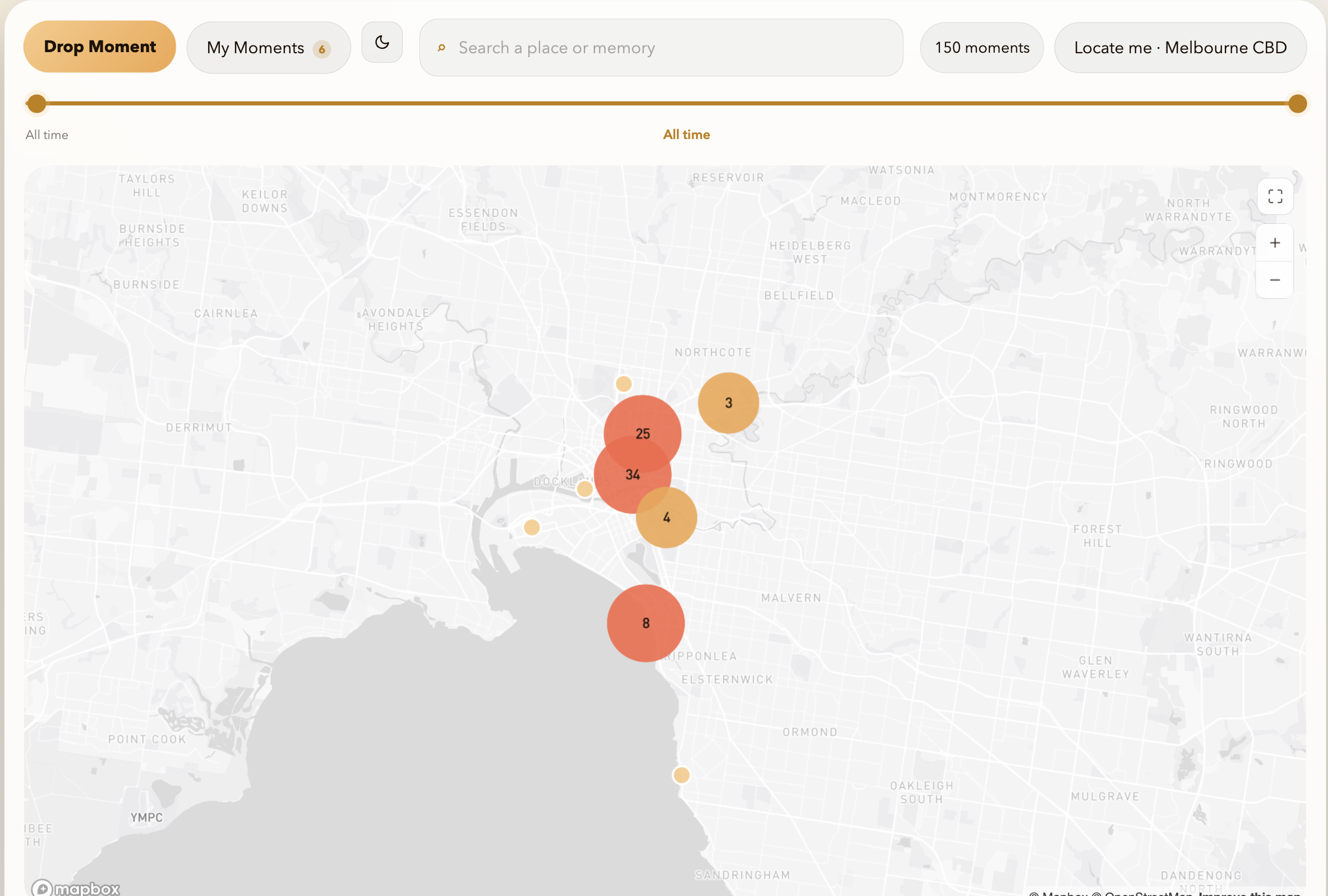
Instead of a traditional social feed driven by relationships and algorithms, Time Pulse uses location as the feed and time as the navigation axis. When users visit a specific place on the map, they can filter by year and month to view a historical accumulation of everyday moments. Content is completely anonymous (no profile pages, usernames, or follower counts) and is automatically enriched with timestamps, OpenWeatherMap data, and a contextual AI sentence, creating a permanent cultural archive of what it "felt" like to be at that exact spot on an ordinary day.
How we built it
Place-First Architecture: We utilized precise GPS coordinates and geohash (precision 7, approx. 150m grid) as the primary content container (Place ID), aggregating location data without relying on inconsistent Mapbox POIs.
Frontend & UX: The map serves as the primary interface, featuring a custom
TimelineFiltercomponent that allows users to filter the map by time periods. PIN sizes scale dynamically based on the number of accumulated moments.Backend & Storage: We integrated Supabase Storage to handle photo uploads and utilized the browser's native
MediaRecorderAPI to capture up to 60-second voice notes.Contextual Enrichment: We integrated OpenWeatherMap for environmental metadata and the Claude API to generate our "AI Context Sentence."
Challenges we ran into
The Cold Start Problem: As a platform heavily reliant on user density, a sparse map results in an empty experience. Finding ways to seed initial hotspots without compromising the platform's authenticity is a major hurdle.
Friction in the Mobile "Drop Flow": Creating a post requires a triple-permission check (GPS, Camera, Network). A failure at any step causes users to abandon the process, requiring us to carefully redesign the flow with step-by-step permission requests and optimistic UI updates.
Hardware & API Limitations: Relying on the browser's
MediaRecorderAPI for voice notes revealed compatibility limitations on certain versions of iOS Safari.Geospatial Nuances: Using geohash precision 7 works perfectly for standard areas but risks grouping unrelated locations into the same Place ID in high-density urban environments like CBDs.
Accomplishments that we're proud of
AI as Humility, Not Spectacle: In a landscape saturated with AI narratives, we took a restrained approach. Our AI only generates a single, quiet, factual sentence about the historical background of the time/place (e.g., "In March 2020, Australia entered COVID-19 lockdown..."). It never narrates the user's actions or uses emotional judgments, ensuring the moment belongs to the human, not the model.
True Cultural Preservation: Unlike Snapchat's Snap Map, where content disappears after 24 hours, Time Pulse permanently accumulates content by location, transforming everyday posts into a lasting historical archive.
Absolute Anonymity: We successfully stripped away the vanity metrics of modern social media. By removing likes, avatars, and usernames, we fostered an environment focused entirely on authenticity and place.
What we learned
Through our competitor analysis of Snap Map, Google Street View, and the Internet Archive, we learned that combining a map interface with a timeline exploration tool creates an entirely new user paradigm. We discovered that building a "place-centric" platform requires actively discarding human-centric design patterns. We also learned that in mobile web development, smoothing out UX friction—like handling GPS permission denials gracefully and providing immediate visual feedback during uploads—is just as critical as the backend architecture.
What's next for Time Pulse (Memorable)
Mobile Drop Flow Optimization: Implementing robust, user-friendly permission modals, upload progress bars, and post-upload Toast animations (optimistic updates) to make posting frictionless.
PWA Support: Allowing users to install the platform to their home screen to simulate a native app experience, reinforcing the habit of "posting on the go."
PIN Cluster Visualization: Upgrading our map layer to visually differentiate between single and multiple moments (e.g., numeric badges) to better guide users to detailed place pages.
Content Safety & Global Reach: Integrating a Safe Search API framework to establish a baseline for content moderation, and eventually building multilingual support to capture the true cultural diversity of global storytelling.
Built With
- claude
- codex
- vscode


Log in or sign up for Devpost to join the conversation.