Inspiration
Dementia and Alzheimer’s disease affect millions of people worldwide, gradually eroding one of the most fundamental aspects of human life: memory. As these conditions progress, patients may begin to forget daily routines, important events, and, in many cases, even the people they love most.
Imagine looking at your own son, daughter, or a lifelong friend and not being able to remember who they are. The emotional impact of such moments extends beyond the patient and it affects entire families. Conversations become difficult, relationships become strained, and precious memories slowly fade away.
Memora was born from a simple question: What if technology could help reconnect patients with the people and memories that matter most?
Our goal is not merely to identify faces - it revives connections, feelings, the good, the bad and the worst of memories, all at the same time. Our belief was clear - When memories fade, relationships shouldn't.
What It Does
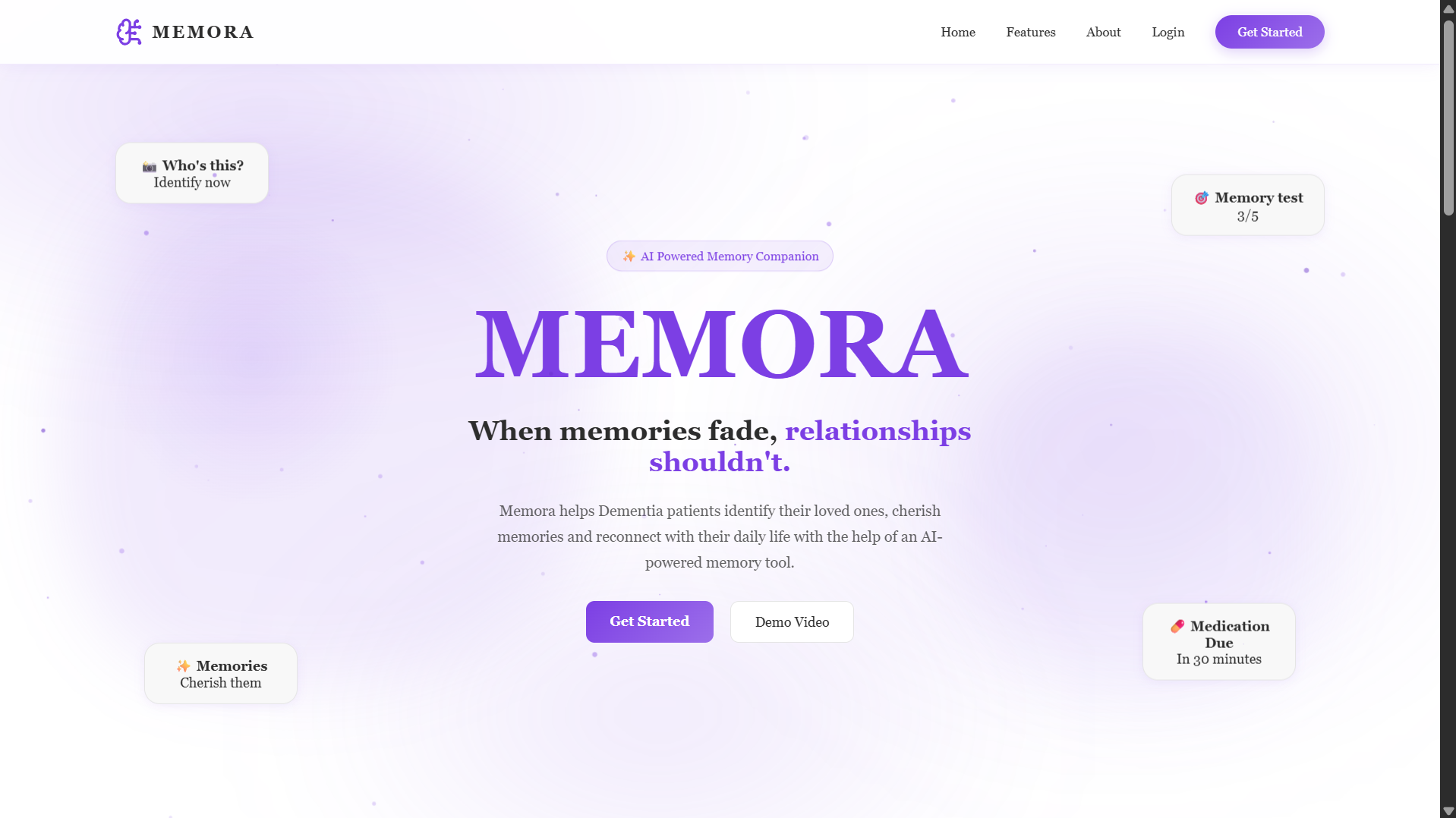
Memora is an intelligent, web-based AI companion designed specifically for people experiencing difficulties in keeping their memories sharp.
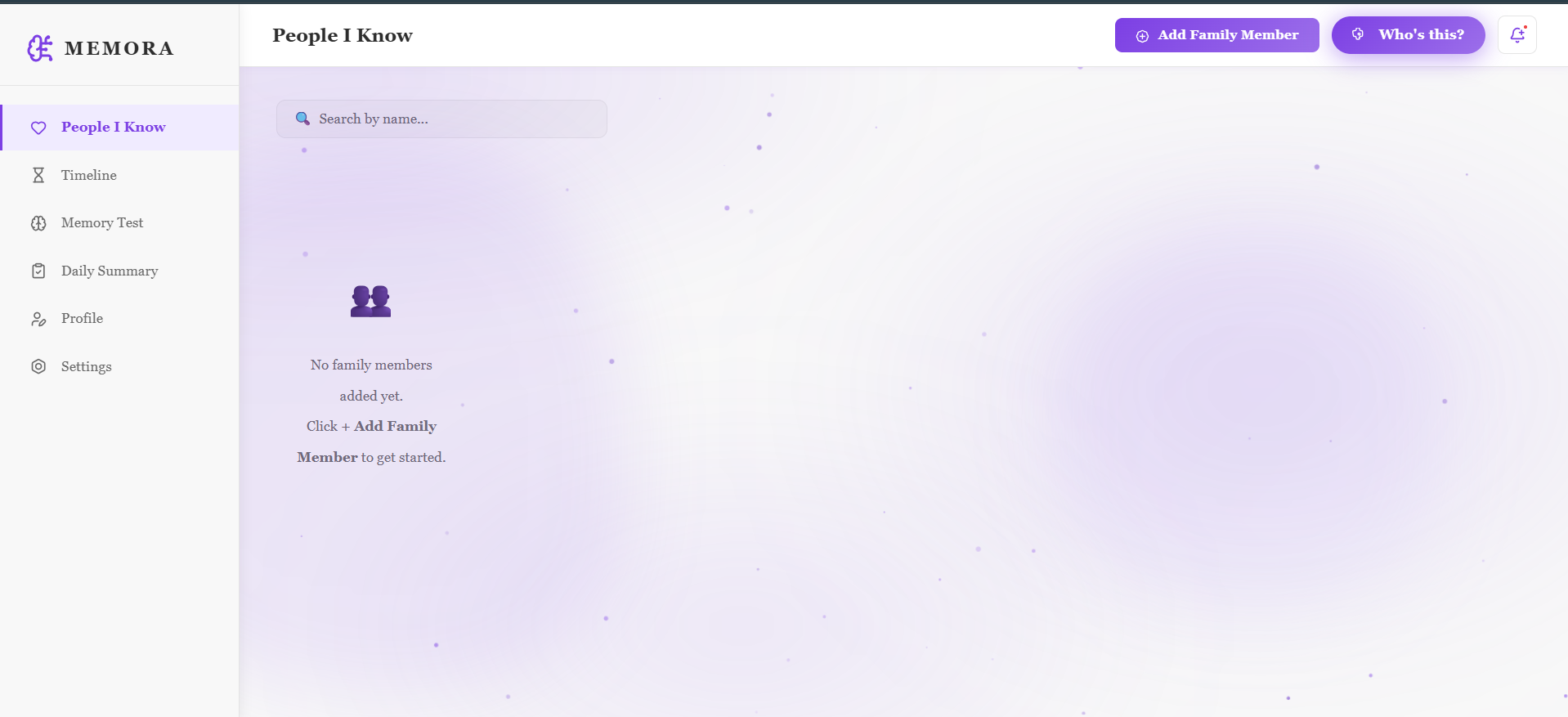
Its flagship feature, "Who's This?", allows patients to identify family members and loved ones using a webcam or camera-enabled device. When a recognized individual appears in front of the camera, Memora instantly identifies them and presents relevant information about that person. However, facial recognition is only the tip of the iceberg, we also offer:
- Saving people the person knows - family members, a loved one, etc.
- A beautiful visual timeline of your cherished memories.
- Important notes or memories associated with them.
- Specific personal details that may help trigger recollection at the earliest.
The objective is not simply facial recognition but rather a memory reinforcement. Every successful identification has the potential to revive emotions, stories, experiences, and human connections that might otherwise remain hidden behind the effects of Dementia/Alzheimer/Parkinson's disease.
How We Built It
Memora was developed as a full-stack web application using:
Backend
- Python
- Flask
- Flask-SocketIO
- face_recognition
- SQLite3
- Pickle-based data storage
Frontend
- HTML5
- CSS3
- JavaScript
Facial Recognition Pipeline
Family members upload profile photographs of family members while saving their profiles. We used the python library - face_recognition for facial identification.
- If a person is recognized: a cyberpunk styled box appears on the top right corner of the screen displaying the name of that family member/loved one.
- If person if not recognized, the white text at the bottom displays: "Face detected, but not recognised"
Challenges We Ran Into
Building Memora presented a variety of technical and practical challenges.
Real-Time Face Recognition
One of the biggest hurdles was finding a face recognition solution that was both accurate and fast enough for live video streams.
We experimented with:
- Haar Cascades,
- LBPH Face Recognition,
- Finally came to the conclusion to use face_recognition ...
While some approaches were fast, they lacked sufficient accuracy. Others provided better recognition but were too computationally expensive for real-time use. After some testing and debate, we settled on the face_recognition library, which provided the best balance of performance and reliability for our use case.
WebSocket Configuration Issues
During development, we had to go through "Invalid async_mode specified" (missing asynchronous drivers, Eventlet and/or Gevent) multiple times and some issues while installing face_recognition (particularly while installing dlib library which caused some errors during installation by pip3). Deciding how to transfer video frame back to backend was a task too, so we opted for python flask-socketio instead of using a react.js and python api system.
Project Architecture Decisions
Our original plan involved:
- React.js frontend,
- Python-flask REST APIs for communication
As said earlier, we realized that real-time recognition would benefit quite a bit from WebSocket-based communication., hence we chose a Flask-SocketIO based system could meet our requirements just fine.
Best Viewing Experience
We are actively working on improving responsiveness and accessibility across tablets and mobile devices to ensure a smooth user experience for patients, caregivers, and families on all screen sizes. Stay tuned for that!
What's Next for Memora
We see some potential as far as future development of this project is concerned. Our long-term vision is to create a comprehensive digital companion for people living with dementia and memory-related conditions, to make them live a normal and balanced life.
Planned features include:
- Memory assessment tests
- Interactive memory timelines
- Smart reminders and medicine tracker tools
- Family activity logs
- Voice-assisted interaction
Ultimately, we envision Memora becoming more than a recognition tool. It's a bridge between people, relationships and the moments that define who we are. Because, When memories fade, relationships shouldn't.


Log in or sign up for Devpost to join the conversation.