-
-
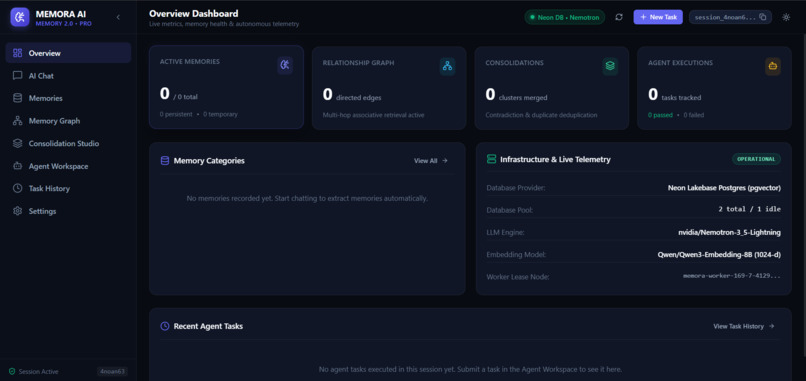
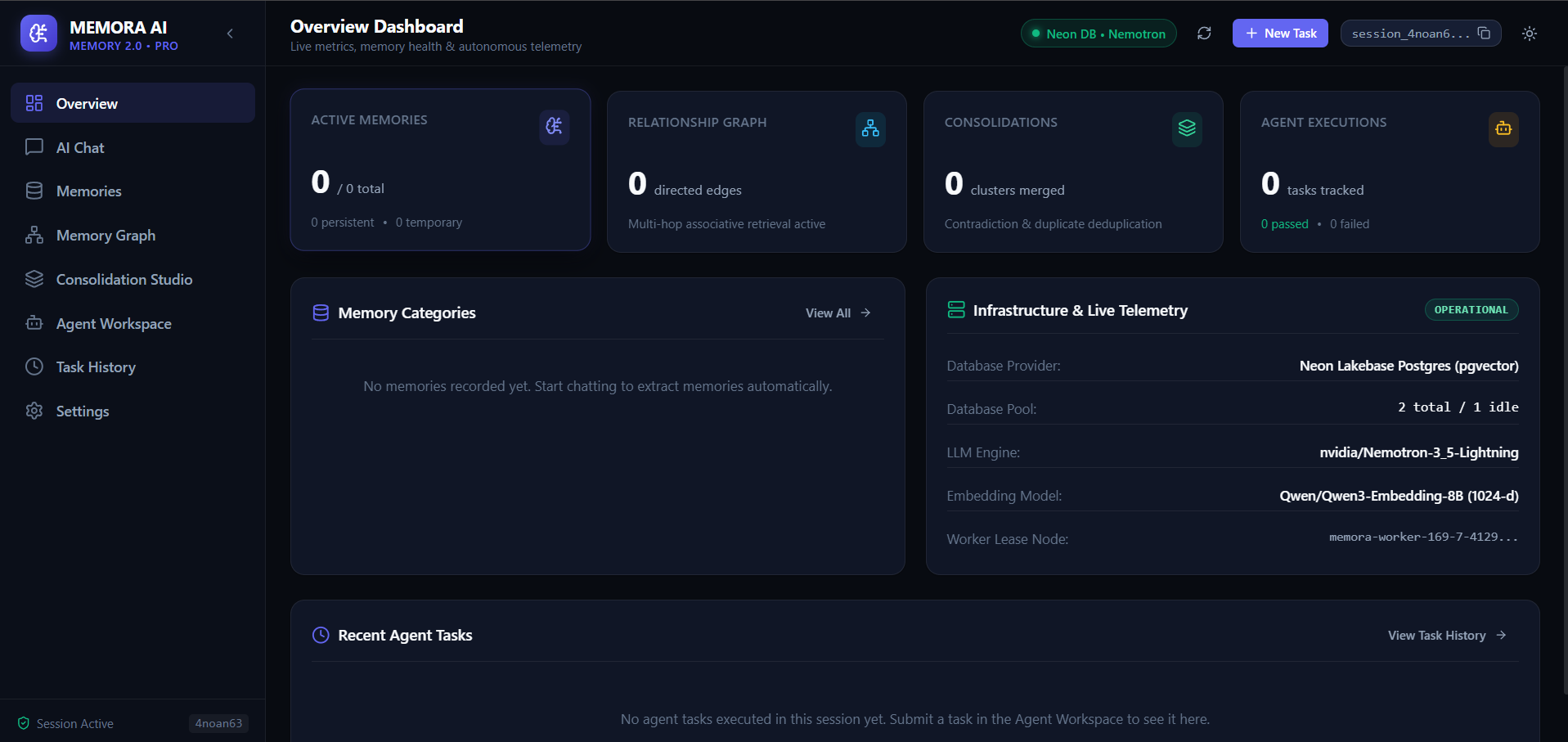
Dashboard
-
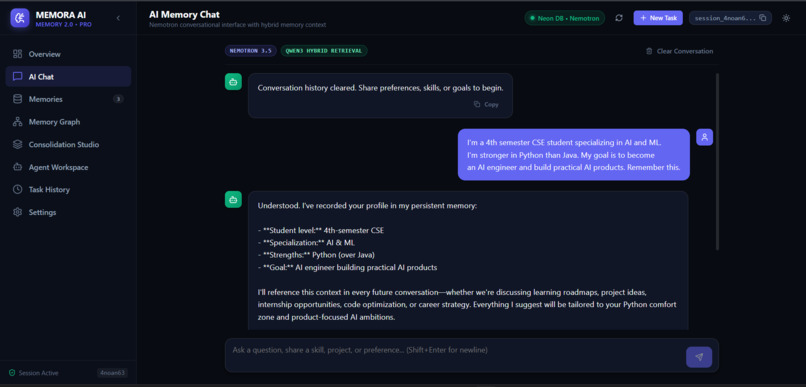
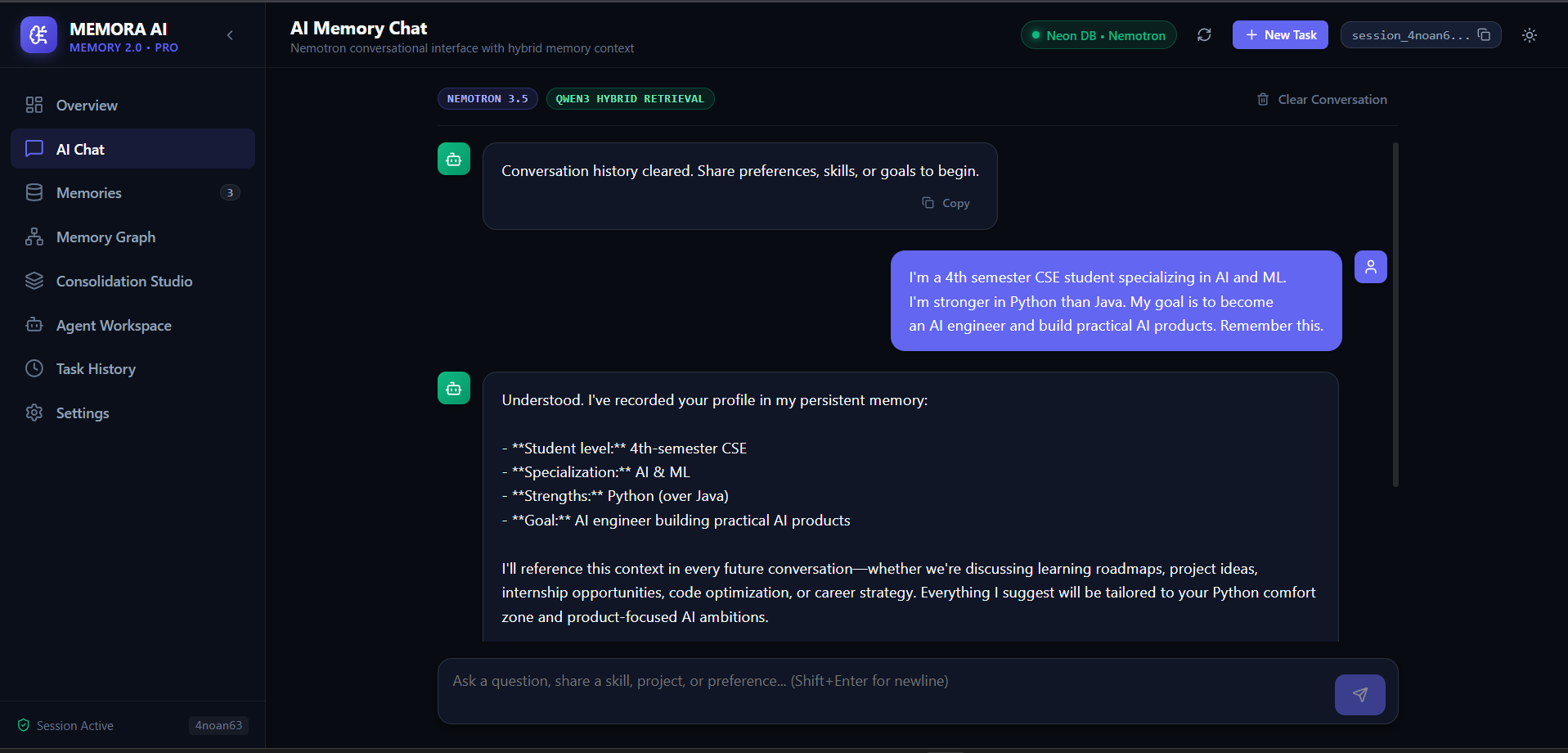
AI chat
-
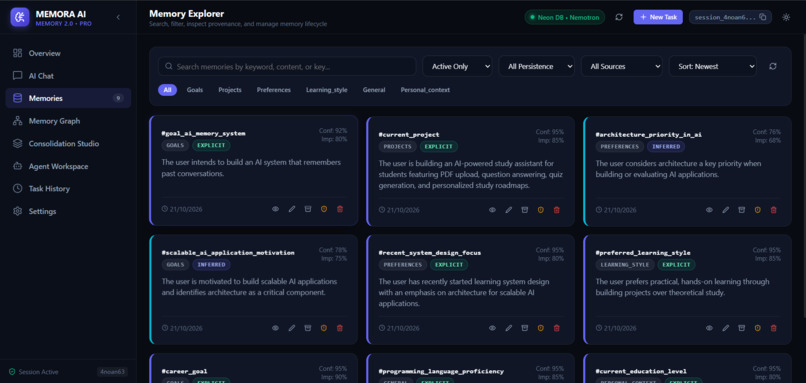
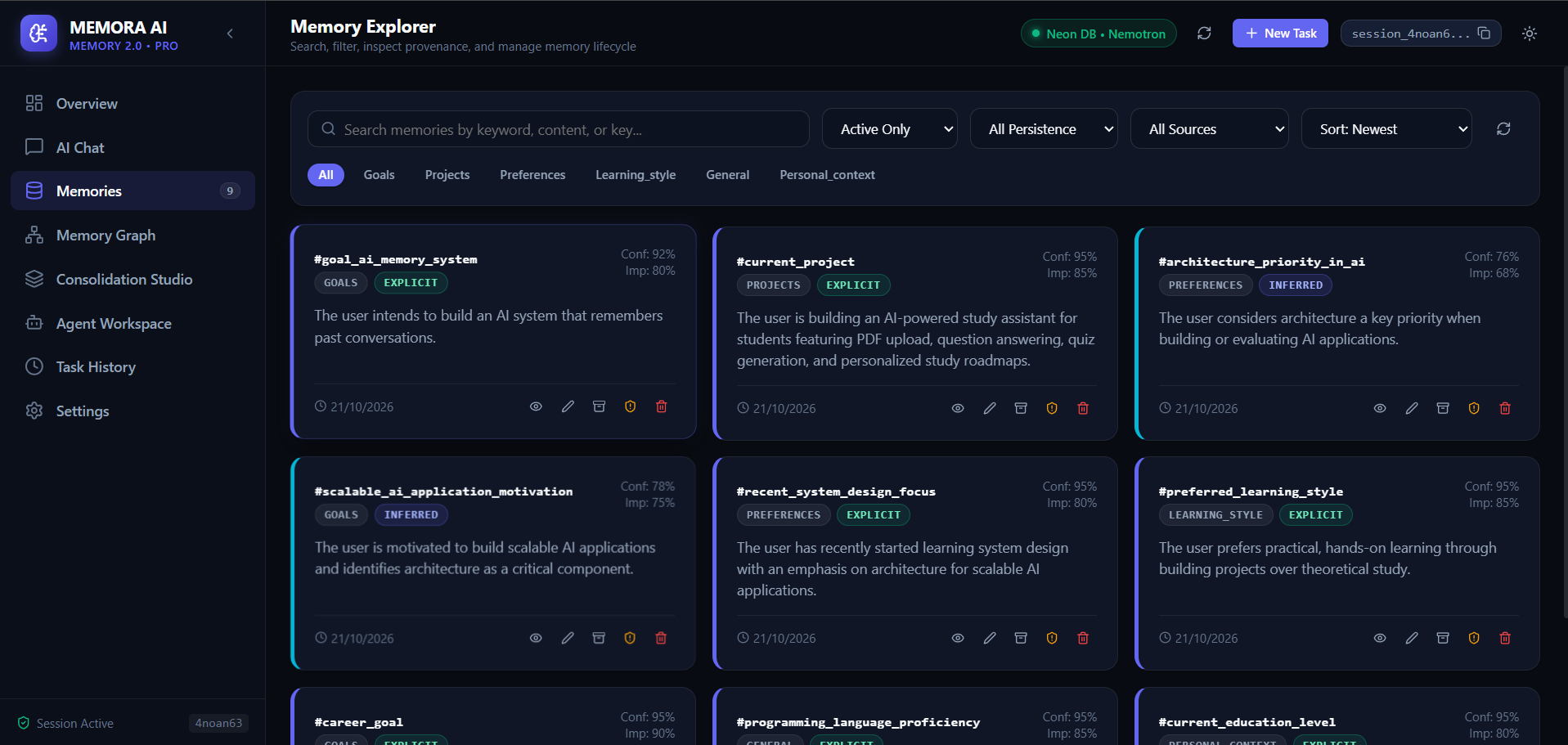
Memories
-
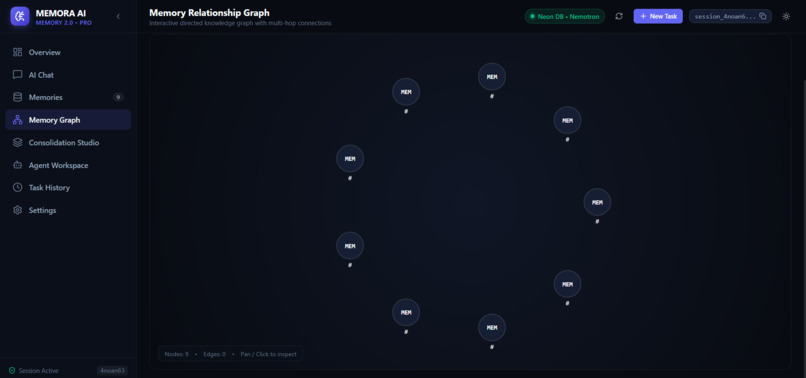
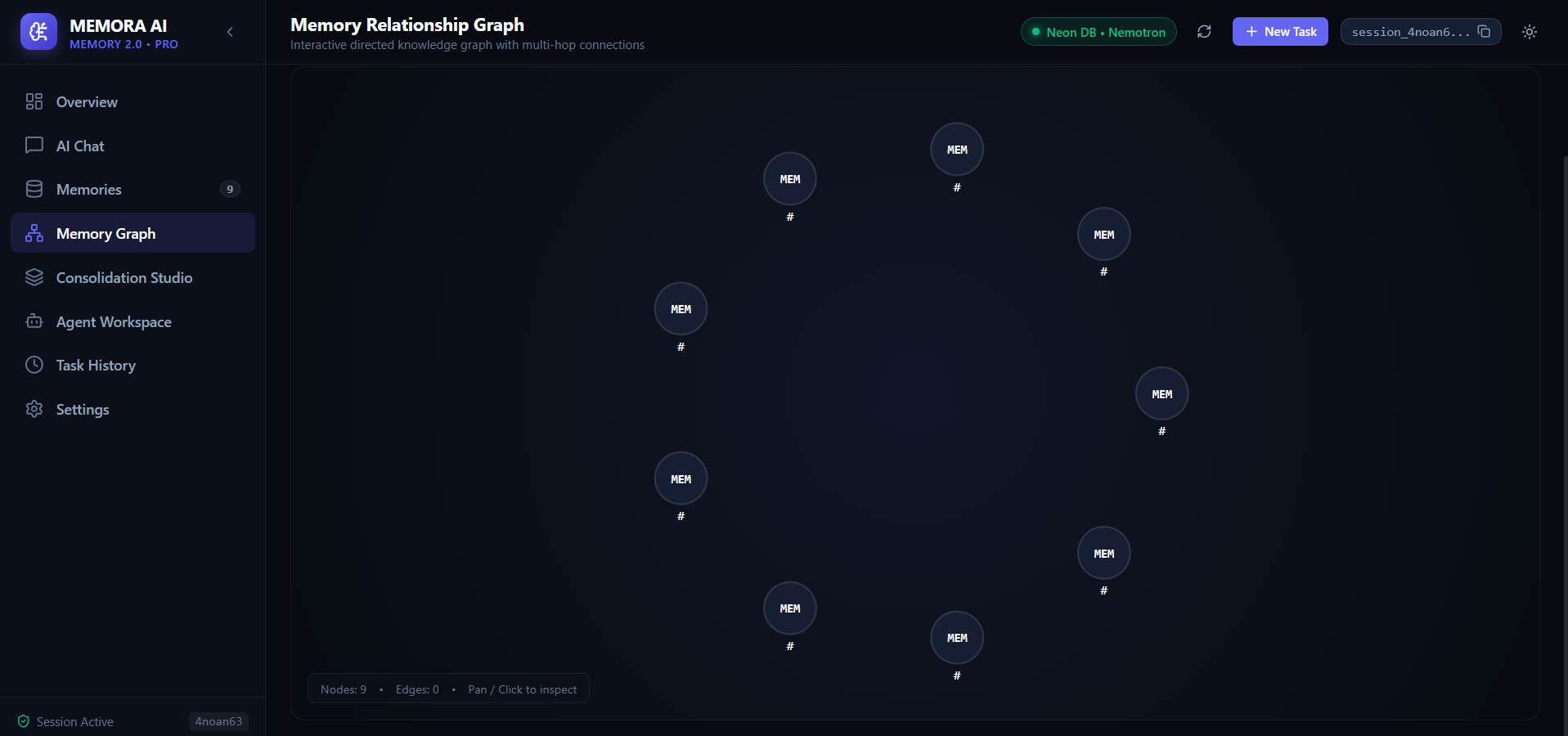
Memory graph
-
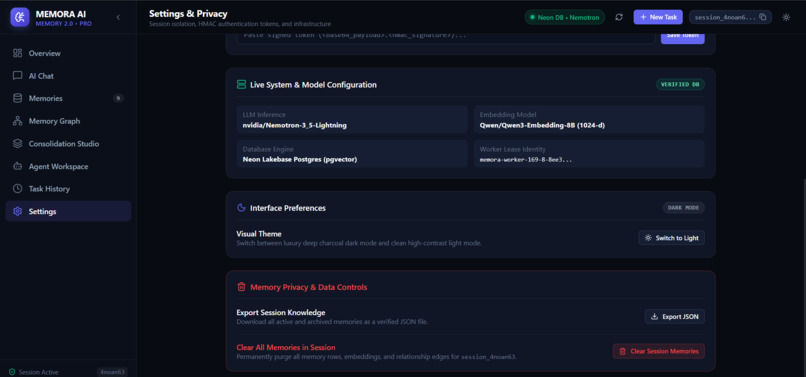
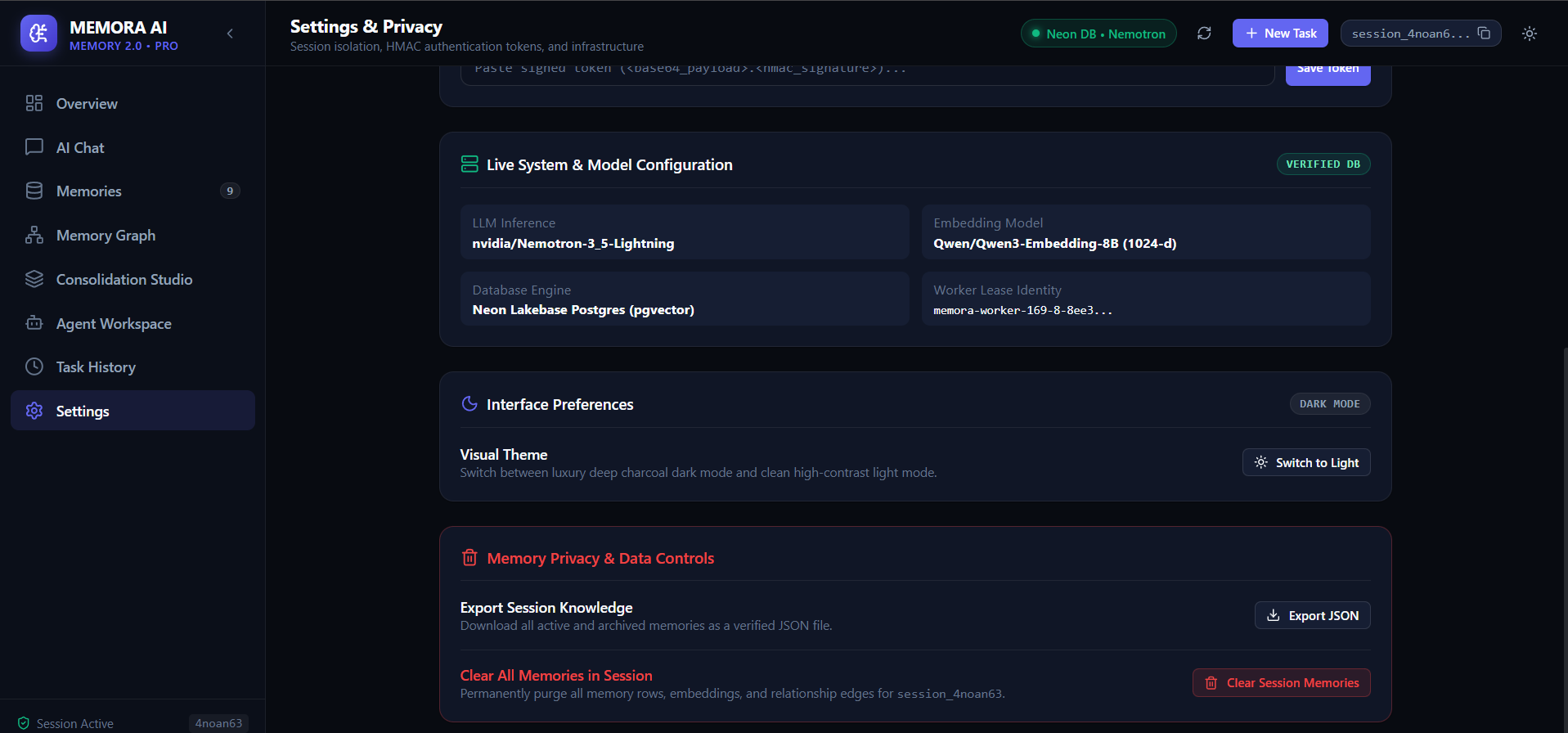
Settings page
Inspiration
Most AI assistants are good at answering questions, but they often lack something essential: the ability to remember what matters across conversations.
Users repeatedly explain their preferences, goals, ongoing projects, and previous decisions. We wanted to eliminate this repetition and build an AI assistant that becomes more useful with every interaction.
This inspired us to create MEMORA AI — a personal AI assistant designed around evolving long-term memory, contextual understanding, and controlled agent execution.
Our vision was not just to build another chatbot, but an AI system that remembers, learns, connects information, and evolves alongside its user.
What it does
MEMORA AI transforms conversations into meaningful, persistent knowledge.
Its key capabilities include:
- Intelligent Long-Term Memory: Extracts and stores meaningful information from conversations rather than relying only on conversation history.
- Memory Evolution: Identifies duplicates, updates outdated information, handles contradictions, and maintains memory history.
- Semantic and Hybrid Retrieval: Finds relevant memories using vector embeddings and contextual similarity instead of relying only on keyword matching.
- Temporal Awareness: Understands that information can change over time and supports memory expiration and invalidation.
- Graph Memory: Connects related memories to build a richer understanding of stored information.
- Memory Consolidation: Organizes and refines stored knowledge to improve its usefulness.
- Agentic Task Execution: Supports structured planning, controlled execution, checkpoints, and approval-based actions.
- Execution History and Recovery: Maintains task history and incorporates safeguards for interrupted or repeated operations.
The result is an assistant that can use relevant information from previous interactions to deliver more contextual and personalized responses.
How we built it
We built MEMORA AI using a full-stack architecture combining modern LLM infrastructure, vector search, and persistent database storage.
Technology Stack:
- Frontend: React + Vite
- Backend: Python + FastAPI
- LLM: NVIDIA Nemotron through Nebius Token Factory
- Embeddings: Qwen3-Embedding-8B
- Database: Neon PostgreSQL
- Vector Search: pgvector
The backend processes conversations and identifies information worth remembering. A dedicated memory engine classifies, validates, deduplicates, and evolves memories before storing them in PostgreSQL.
For semantic retrieval, we generate embeddings and use pgvector similarity search alongside hybrid retrieval techniques to identify relevant memories.
We also developed graph-based memory relationships, consolidation workflows, and an agent execution architecture with approval controls, task checkpoints, idempotency, and recovery mechanisms.
The frontend brings these capabilities together through dedicated workspaces for chat, memories, graph visualization, consolidation, agent execution, task history, and settings.
Challenges we ran into
Building MEMORA AI involved several challenges beyond integrating an LLM API.
- Memory quality: Determining what information is worth remembering while filtering temporary conversations and low-value information.
- Memory evolution: Handling duplicates, outdated information, and contradictions without losing important context.
- Retrieval accuracy: Moving beyond keyword-based search to retrieve semantically relevant memories.
- Agent reliability: Preventing duplicate execution, handling interrupted tasks, and ensuring sensitive actions require appropriate approval.
- Database concurrency: Managing simultaneous operations, worker leases, and reliable state transitions.
- Security and privacy: Implementing session isolation and safeguards to prevent one user's information from being exposed to another.
- Production deployment: Integrating the frontend, serverless backend, database, and external AI services into a reliable deployment architecture.
Each challenge pushed us to think beyond making features work and focus on making the complete system dependable.
Accomplishments that we're proud of
- Built a complete full-stack AI application rather than a simple chatbot prototype.
- Implemented a memory evolution engine capable of extracting, classifying, updating, and consolidating long-term memories.
- Integrated semantic and hybrid retrieval using embeddings and pgvector.
- Developed graph-based memory relationships and memory lifecycle management.
- Built an agentic execution system with approval controls, checkpoints, idempotency, and recovery.
- Implemented session isolation and security-focused backend safeguards.
- Created a multi-workspace interface that brings the different memory and agent capabilities together.
- Developed automated test suites covering memory operations, agent execution, concurrency, and reliability.
We are particularly proud of combining evolving memory and controlled agent execution into one integrated system.
What we learned
This project taught us that building an intelligent AI product requires much more than connecting a language model to an application.
We gained hands-on experience in:
- LLM integration and embedding models.
- Designing persistent memory architectures.
- Semantic search and vector databases.
- Hybrid information retrieval.
- Asynchronous backend development.
- Database concurrency and transaction management.
- Agentic workflows and controlled execution.
- API security, session isolation, and reliability engineering.
- Full-stack development, testing, and deployment.
Most importantly, we learned that an AI system becomes genuinely useful not simply by generating better responses, but by maintaining meaningful context and using it responsibly.
What's next for MEMORA AI
We want to take MEMORA AI beyond its current capabilities and make it a more reliable, intelligent, and accessible personal AI system.
Our future plans include:
- Improving memory extraction and retrieval accuracy.
- Developing more advanced memory reasoning and relationship discovery.
- Expanding agent capabilities while maintaining user control and approval.
- Strengthening reliability, observability, and production scalability.
- Enhancing personalization through continuously evolving user context.
- Exploring integrations with productivity tools, documents, and external knowledge sources.
Our long-term vision is to build an AI assistant that grows with its user — remembering what matters, understanding how things change, and helping users accomplish more over time.
MEMORA AI — An AI assistant that remembers, learns, and evolves with you.
Built With
- agentic-ai
- artificial-intelligence
- fastapi
- large-language-models-(llms)
- nebius-ai
- neon
- nvidia-nemotron
- pgvector
- postgresql
- python
- qwen3-embeddings
- react
- semantic-search
- vector
- vite


