🌱 Inspiration
Every day we create thousands of digital memories—ideas, notes, photos, documents, and reminders. Unfortunately, they become scattered across different applications and are often forgotten.
Most AI assistants focus on generating new information. I wanted to build something different: an AI that helps people remember their own information while keeping ownership of their data.
The design philosophy of Memora can be summarized as:
$$ \textbf{Human Memory} + \textbf{Privacy} + \textbf{Responsible AI} = \textbf{Memora} $$
Instead of replacing memory, AI should augment it.
🧠 What it does
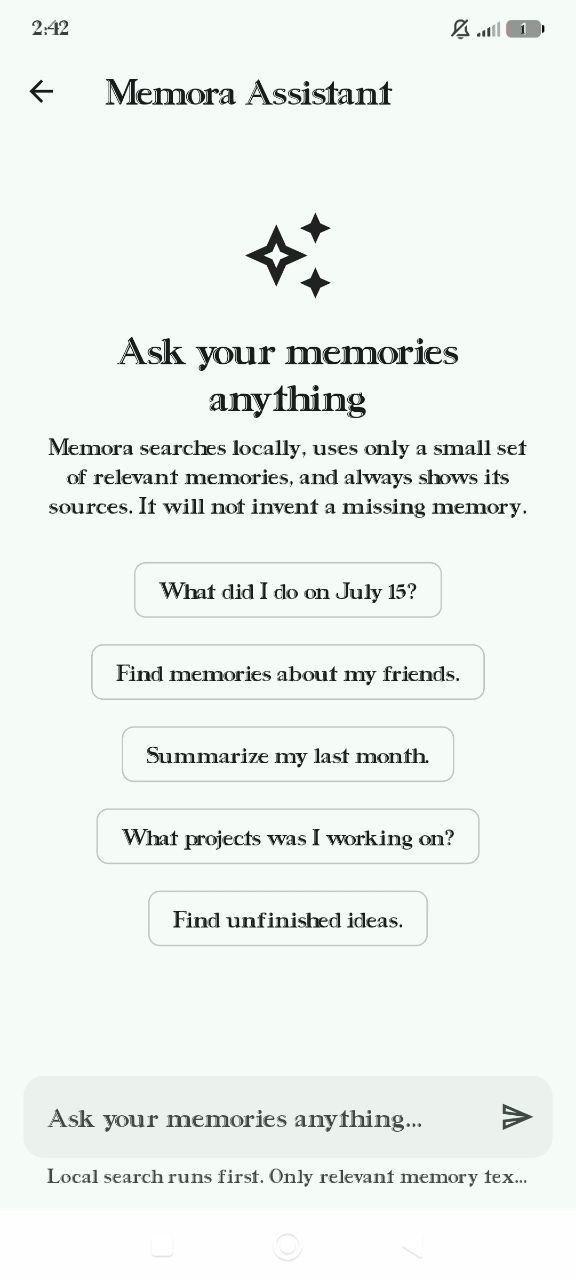
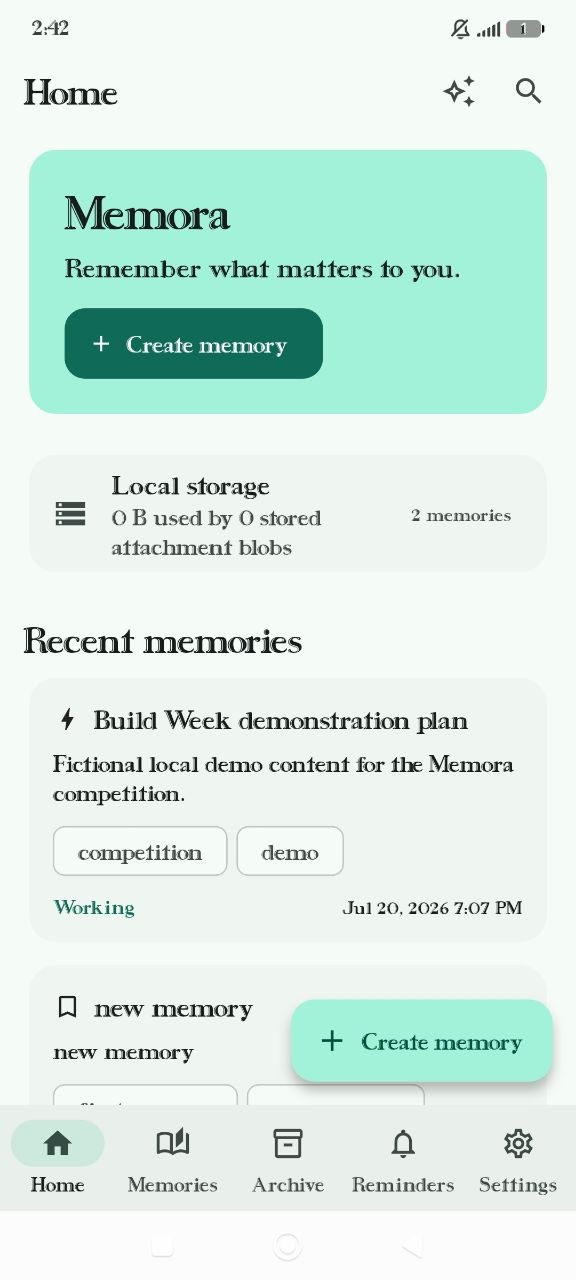
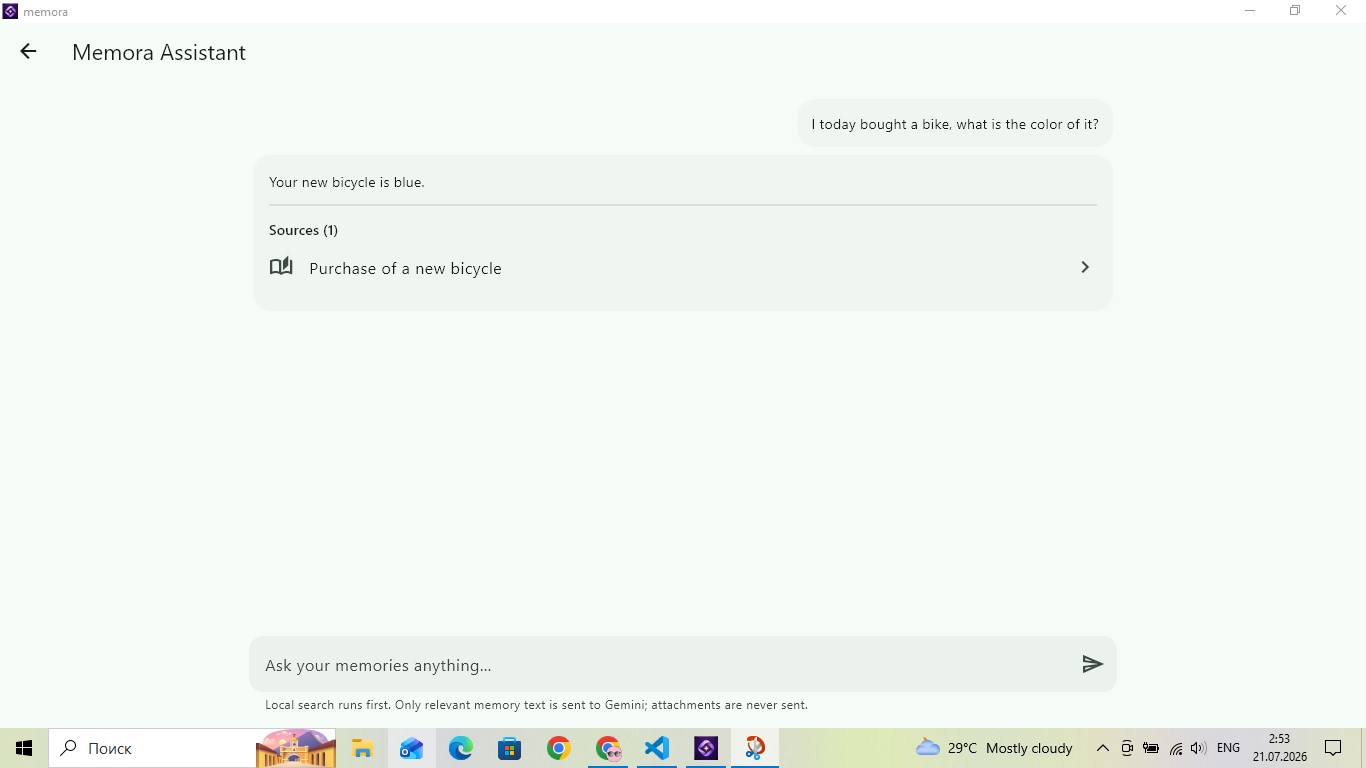
Memora is a local-first memory companion for Android and Windows.
It allows users to:
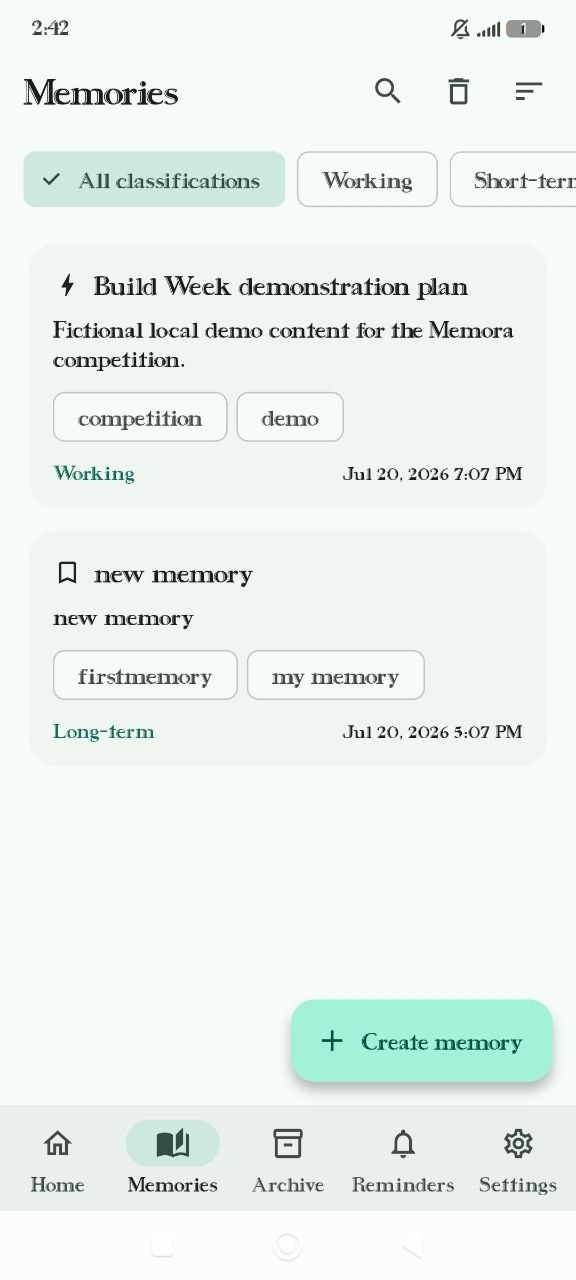
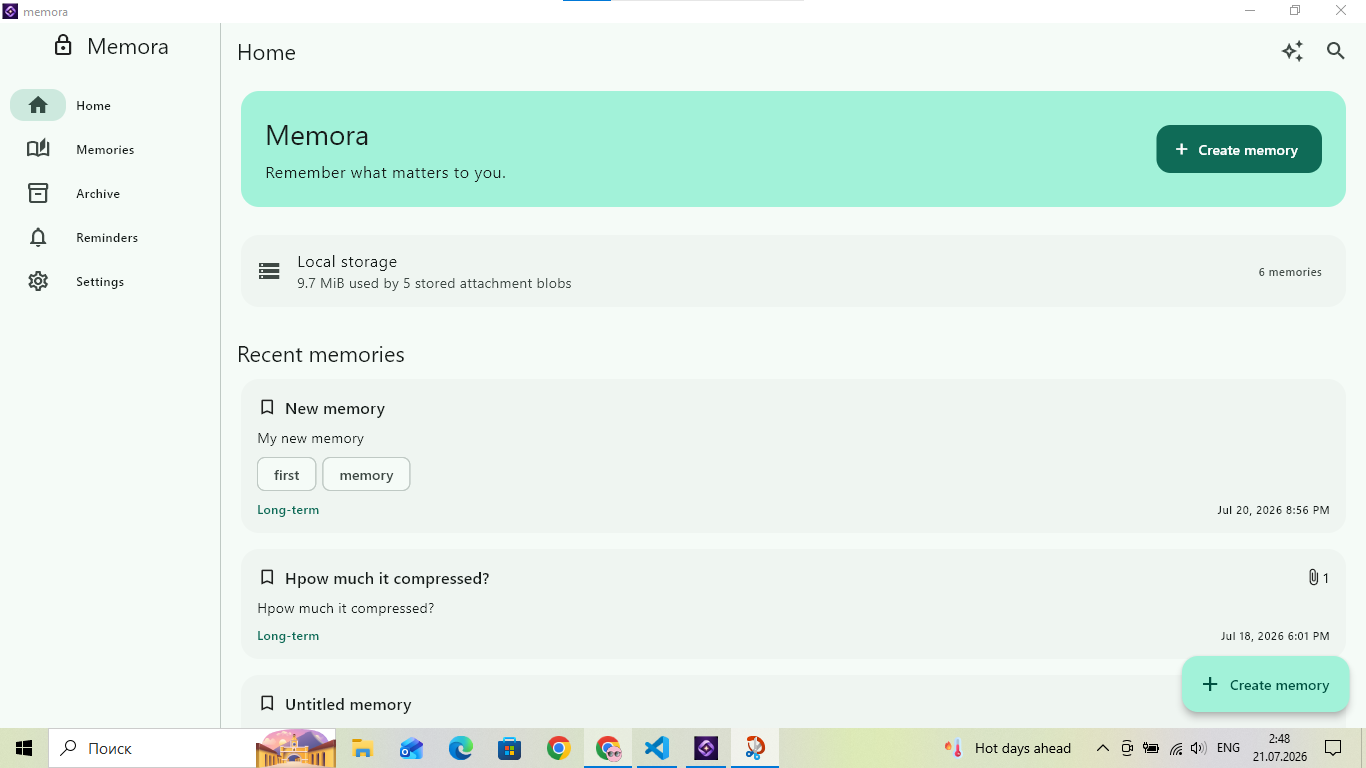
- 📝 Capture memories, notes, and ideas
- 📎 Store documents and attachments
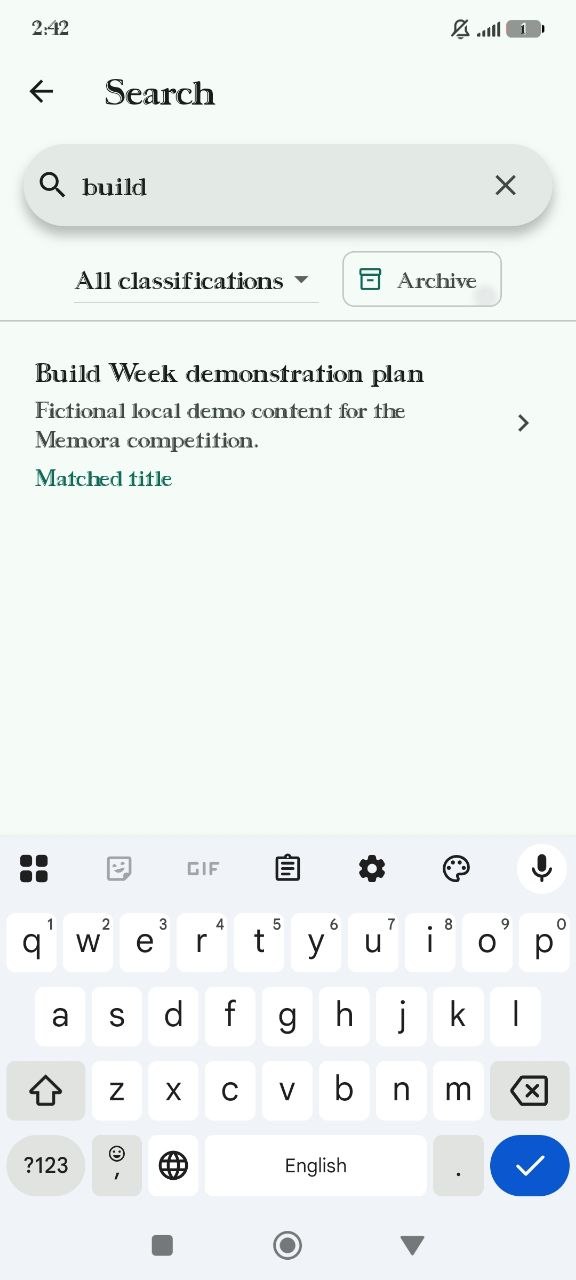
- 🔍 Search everything offline using SQLite FTS5
- 💾 Create portable backups
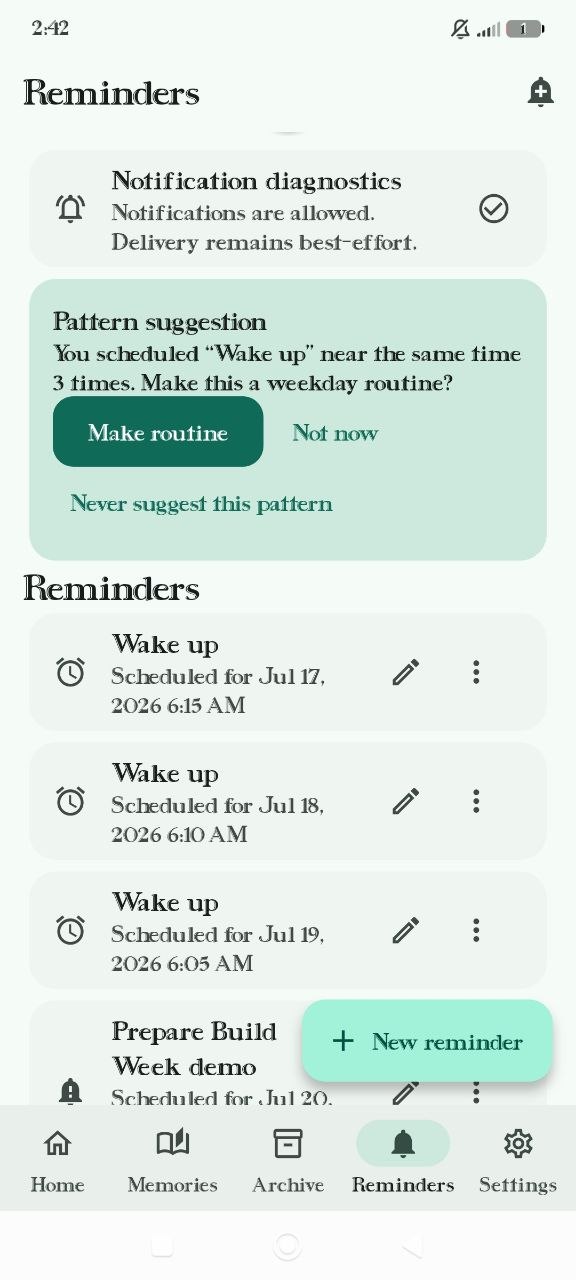
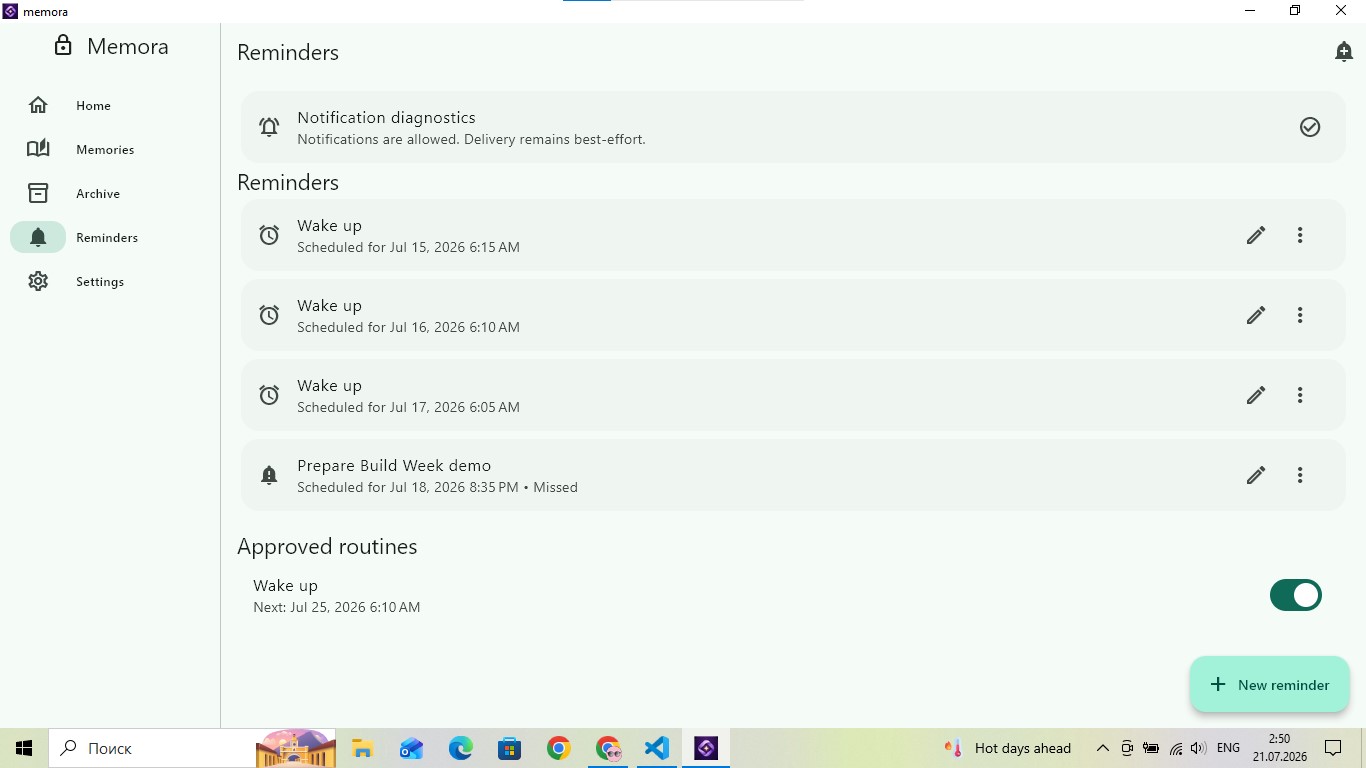
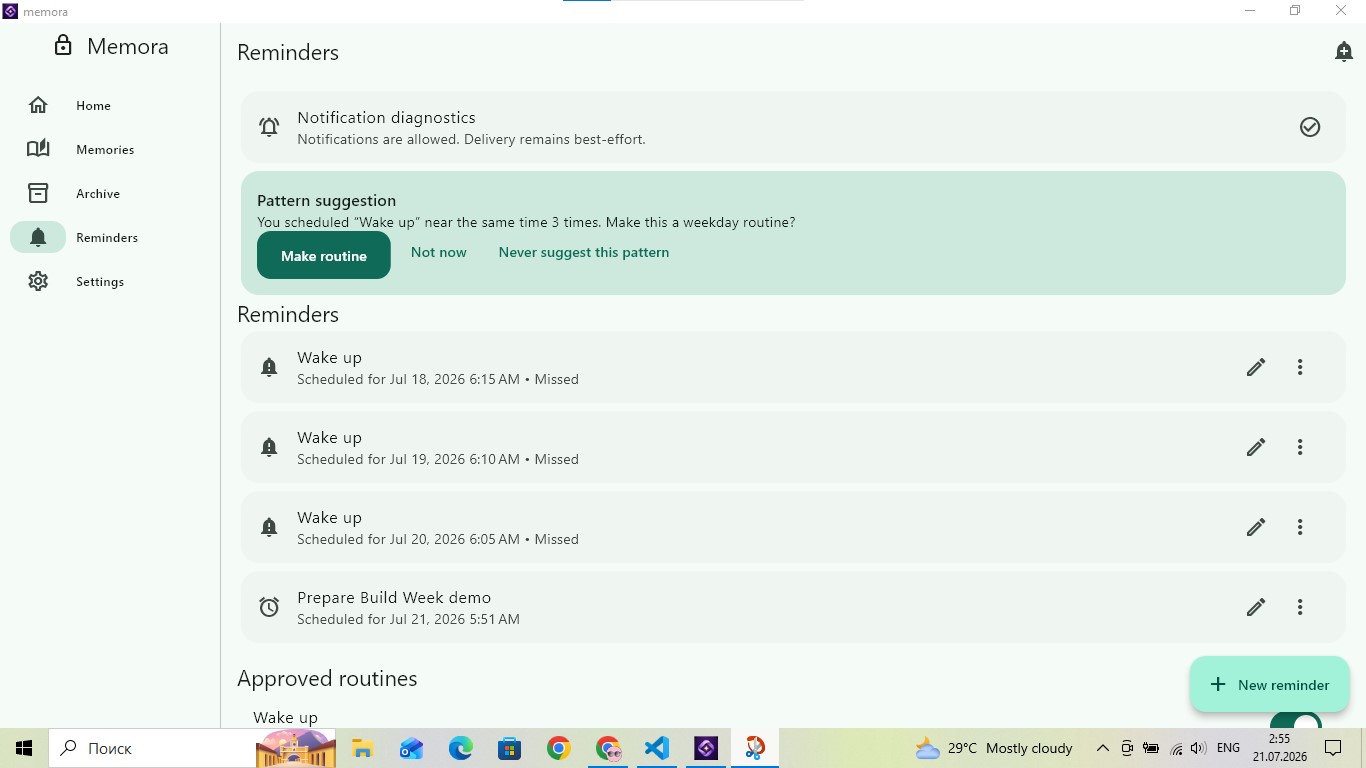
- ⏰ Manage reminders and recurring routines
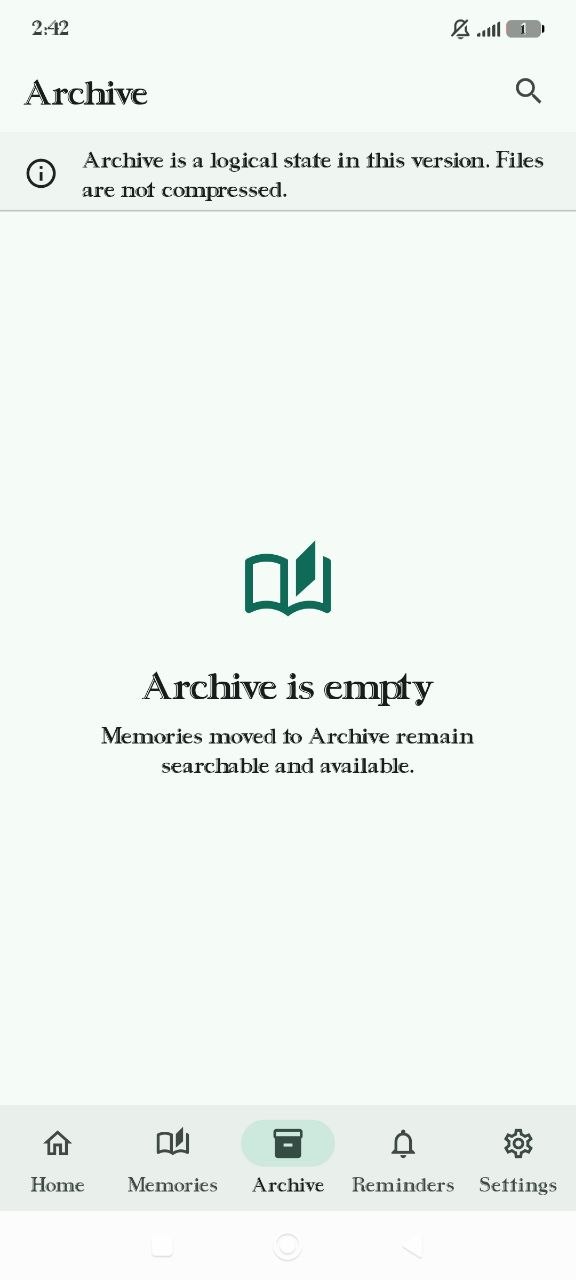
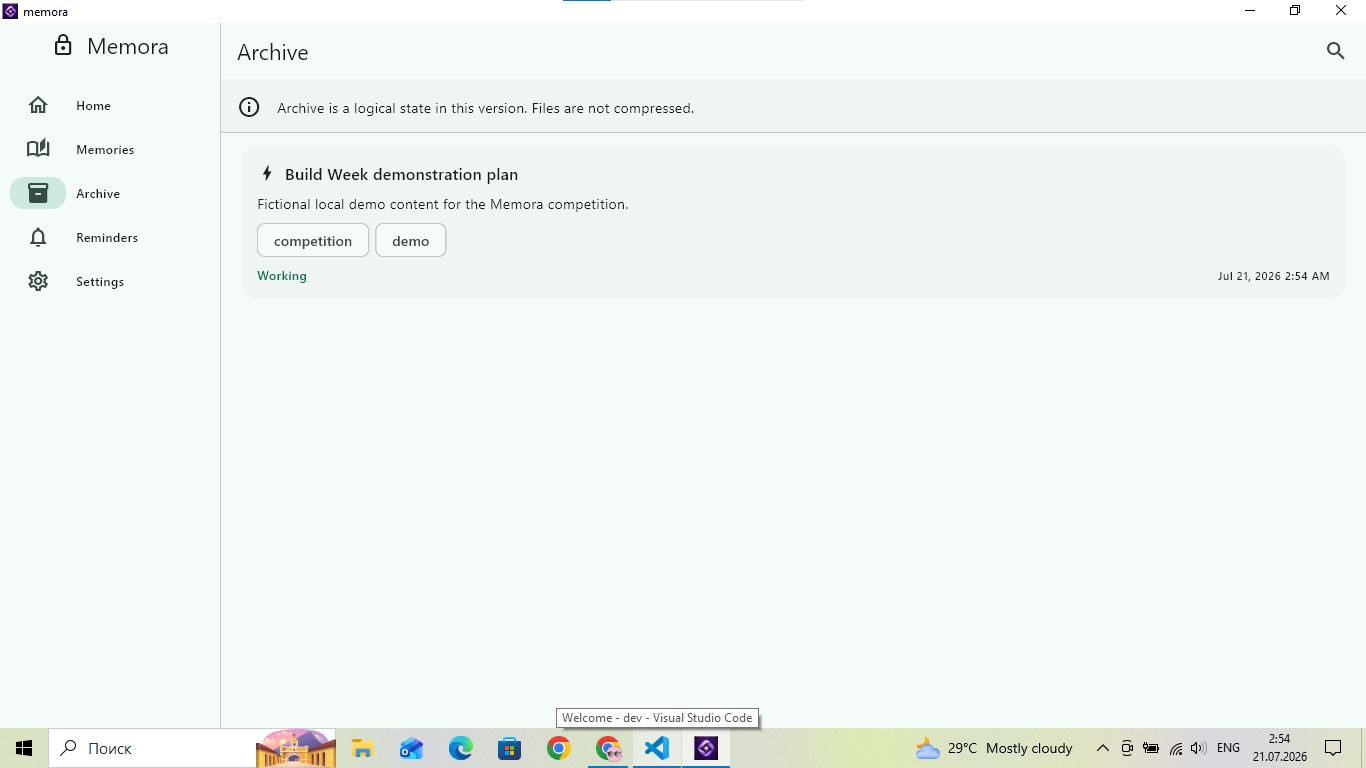
- 🗂 Archive and restore memories safely
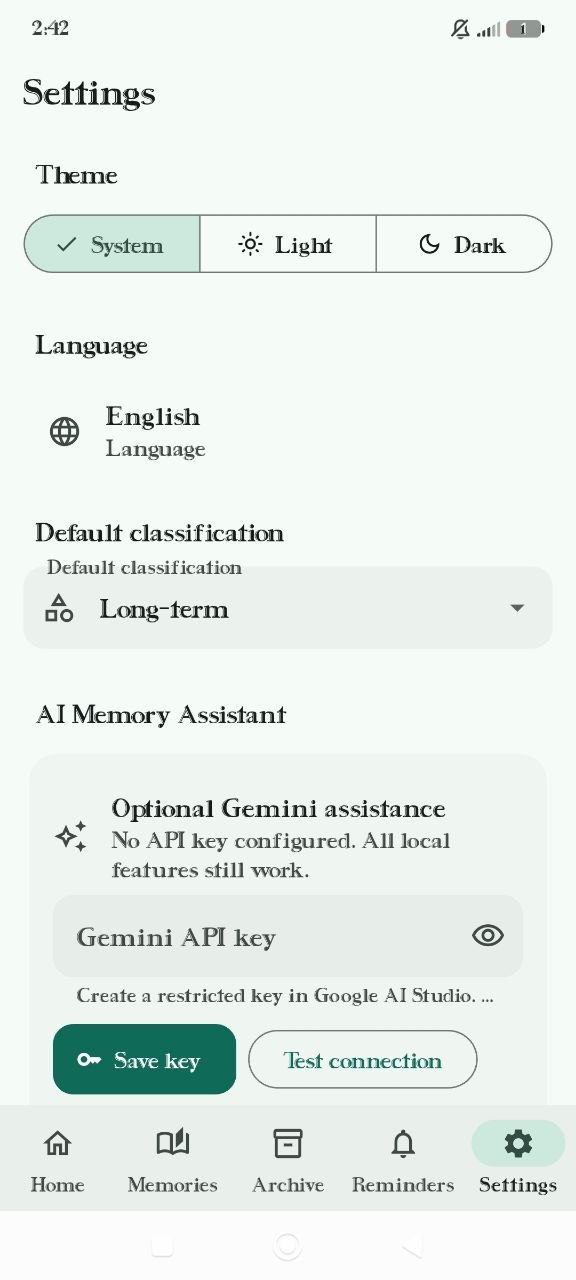
- 🤖 Organize memories using optional AI assistance
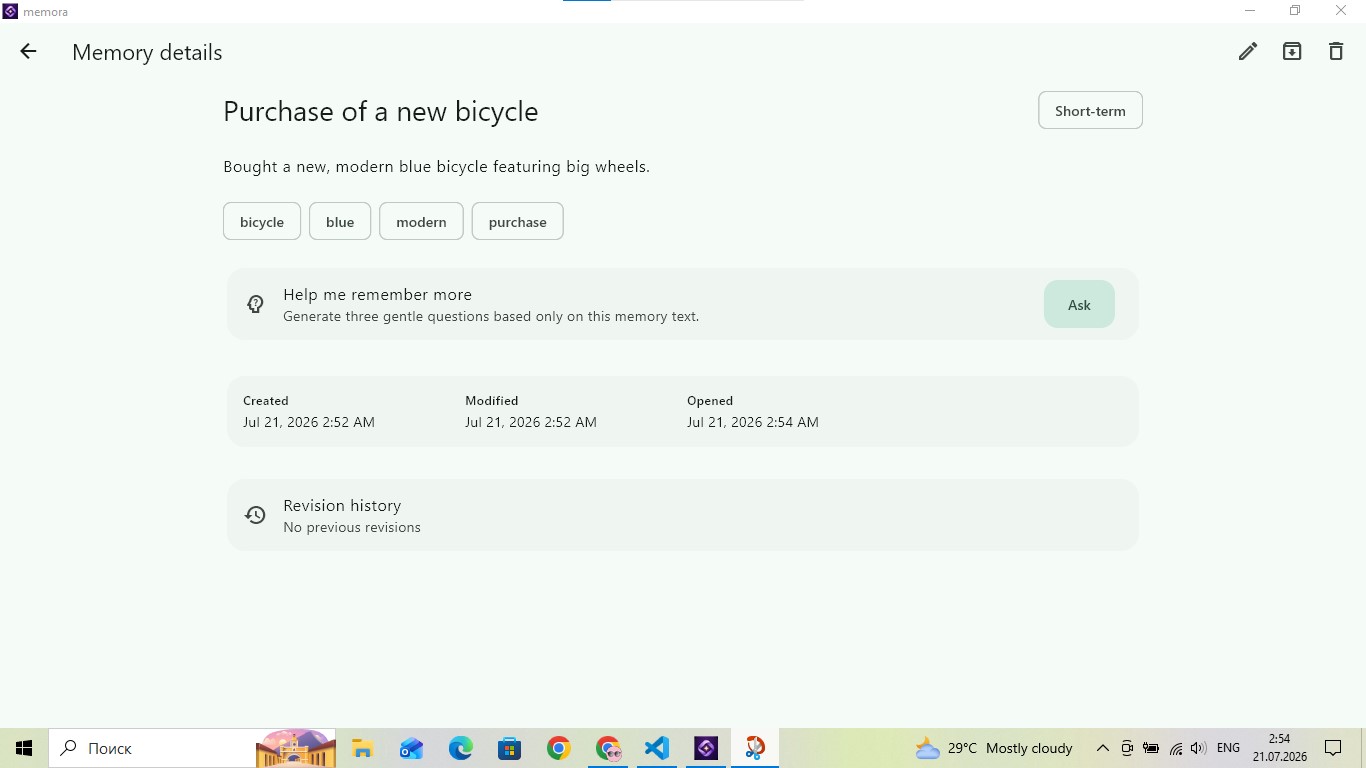
- 💭 Receive AI-generated reflection questions to recall forgotten details
The application works completely offline for its core functionality. AI is optional and only processes information the user explicitly chooses.
⚙️ How we built it
Memora was built using a single Flutter codebase targeting both Android and Windows.
Technologies
- Flutter
- Dart
- Riverpod
- Drift ORM
- SQLite + FTS5
- Material 3
- go_router
- Google Gemini API
A major architectural decision was limiting AI context.
Rather than exposing an entire database, Memora follows the principle
$$ \text{AI Context} \subset \text{User Memories} $$
Only the selected memory is sent to Gemini after explicit user consent.
Throughout development I also used OpenAI Codex and ChatGPT to assist with architecture planning, implementation, debugging, testing, documentation, and code review.
🚧 Challenges we ran into
The biggest challenge was balancing AI capabilities with user privacy.
It is easy to build an AI application that sends everything to a model. It is much harder to build one that remains genuinely useful while sharing as little information as possible.
Other challenges included:
- building a scalable local-first architecture
- implementing efficient offline search
- supporting Android and Windows from one codebase
- designing reliable reminder workflows
- keeping the project modular and maintainable
🏆 Accomplishments that we're proud of
We're proud that Memora is much more than an AI wrapper.
Highlights include:
- 🔒 Privacy-first architecture
- 📱 Cross-platform support
- ⚡ Offline-first experience
- 🔍 SQLite FTS5 search
- 🧠 Responsible AI integration
- 🧪 Automated testing
- 📚 Extensive technical documentation
- 🏗 Feature-oriented architecture
The application is designed so that the user's memories remain the product—not their data.
📖 What we learned
One lesson became very clear during development:
Better AI is not created by sending more information.
It is created by sending the right information.
Mathematically, the goal became minimizing unnecessary context while maximizing usefulness:
$$ \max(\text{Useful Response}) \quad\text{subject to}\quad \min(\text{Shared Data}) $$
This project also strengthened my understanding of:
- software architecture
- cross-platform development
- testing
- documentation
- responsible AI engineering
🚀 What's next for Memora
The Build Week version is only the foundation.
Future plans include:
- 🔐 End-to-end encrypted backups
- ☁️ Cross-device synchronization
- 🧠 Semantic memory retrieval
- 📅 Timeline visualization
- 🔗 Memory relationships
- 🔒 Biometric authentication
- 📷 Smarter media management
- ✨ Additional AI-assisted workflows
The long-term vision is simple:
$$
\lim_{t\rightarrow\infty}\text{Memora}
\text{A trusted lifelong memory companion} $$
A system that helps people preserve, rediscover, and better understand what matters most—while ensuring that their memories always remain their own.


Log in or sign up for Devpost to join the conversation.