-
-
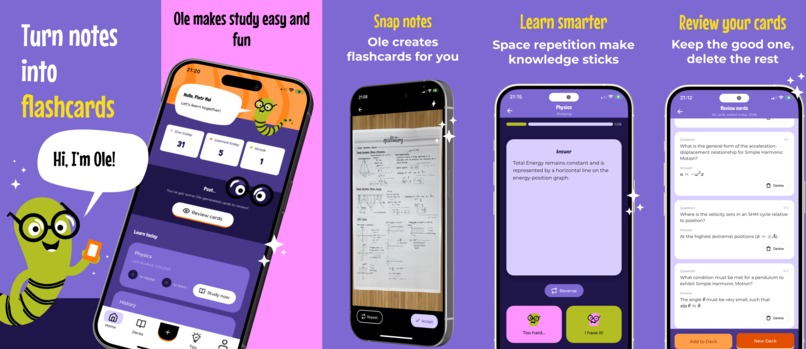
MemOle app promo
Inspiration
It all started when I saw my younger sister sitting at her desk, surrounded by stacks of handwritten flashcards. Thousands of them. She was spending hours writing instead of learning — and I couldn’t help but think: there has to be a better way.
At the same time, I had my own experience with spaced repetition while learning Italian through Konrad Jerzak vel Dobosz’s course. It worked — really well. I saw how much faster I could memorize and recall words. But the process of creating the cards was still slow and painful.
Then I tried a popular app from the App Store called Study Fetch. It had millions of downloads… and also millions of problems. The app was bloated with features, full of glitches, and the UX made even simple things frustrating. That’s when the idea for MemOle was born: a tool that turns notes into flashcards instantly, focuses on the essentials, and helps people actually learn.
Building the project
Building it was an adventure. Thanks to modern AI tools, I was able to develop features much faster than I could have on my own. What should have taken me months was reduced to weeks. But I also learned a hard truth: AI is not magic. It produces sloppy code, and every single line still has to be checked carefully.
Challenges and lessons learned
And then came the second big lesson: creating the app is only half the battle. The real challenge is marketing. How do you convince students to try yet another app? How do you stand out in a sea of tools?
Despite the struggle, I started to get traction. First users. First customers. Proof that the idea works.
That journey — from watching my sister waste time, to experimenting with spaced repetition myself, to finally building something simple, clean, and useful — is what shaped MemOle.
Built With
- firebase
- react-native
- revenue-cat
- tailwind
- typescript


Log in or sign up for Devpost to join the conversation.