-
-
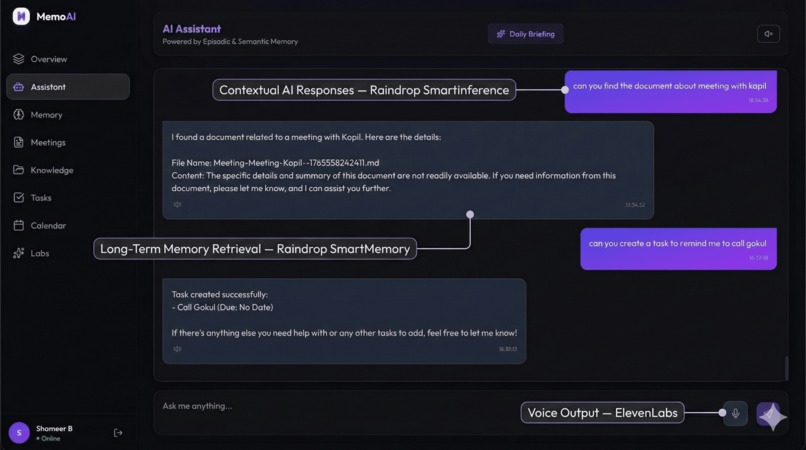
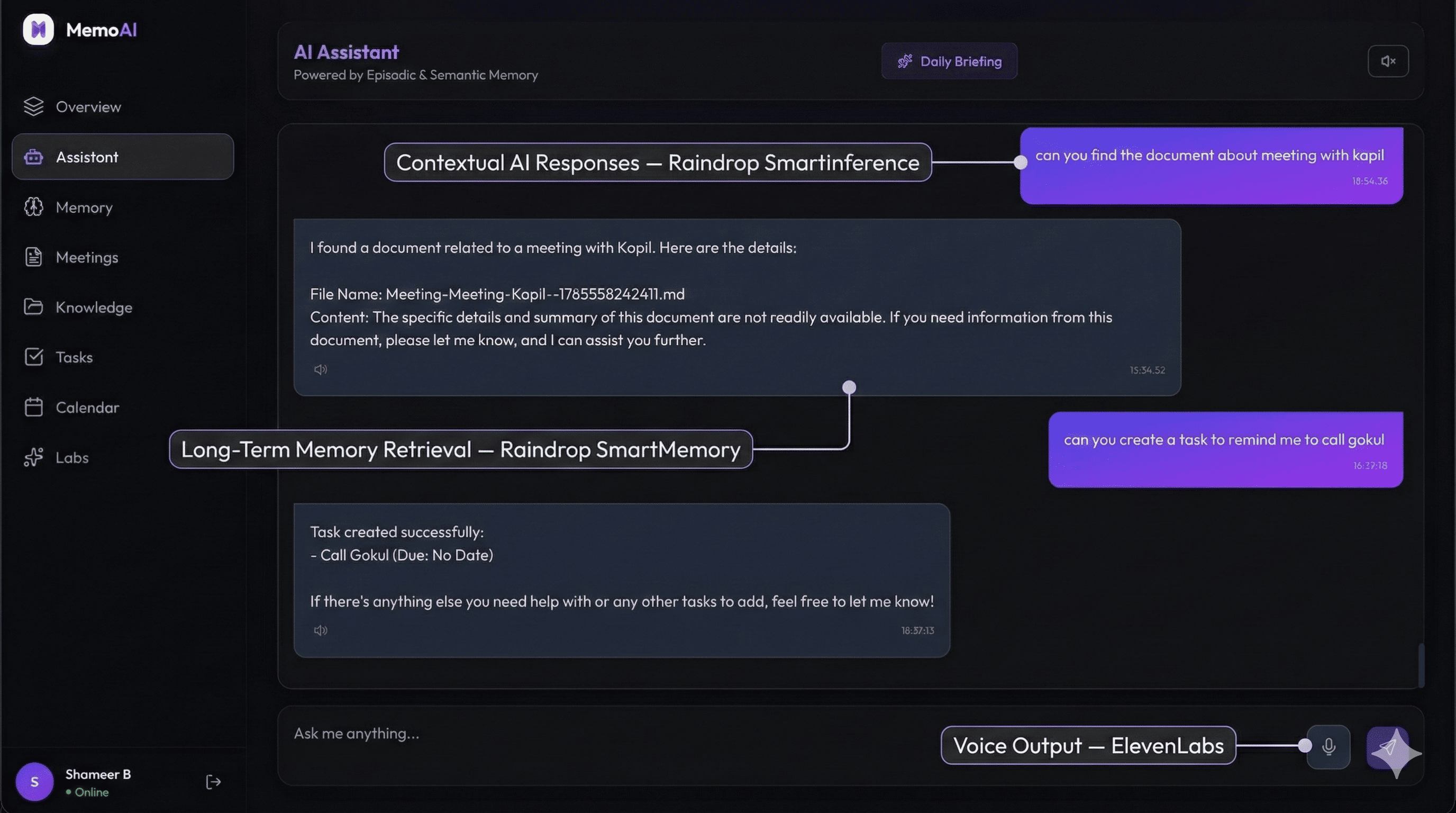
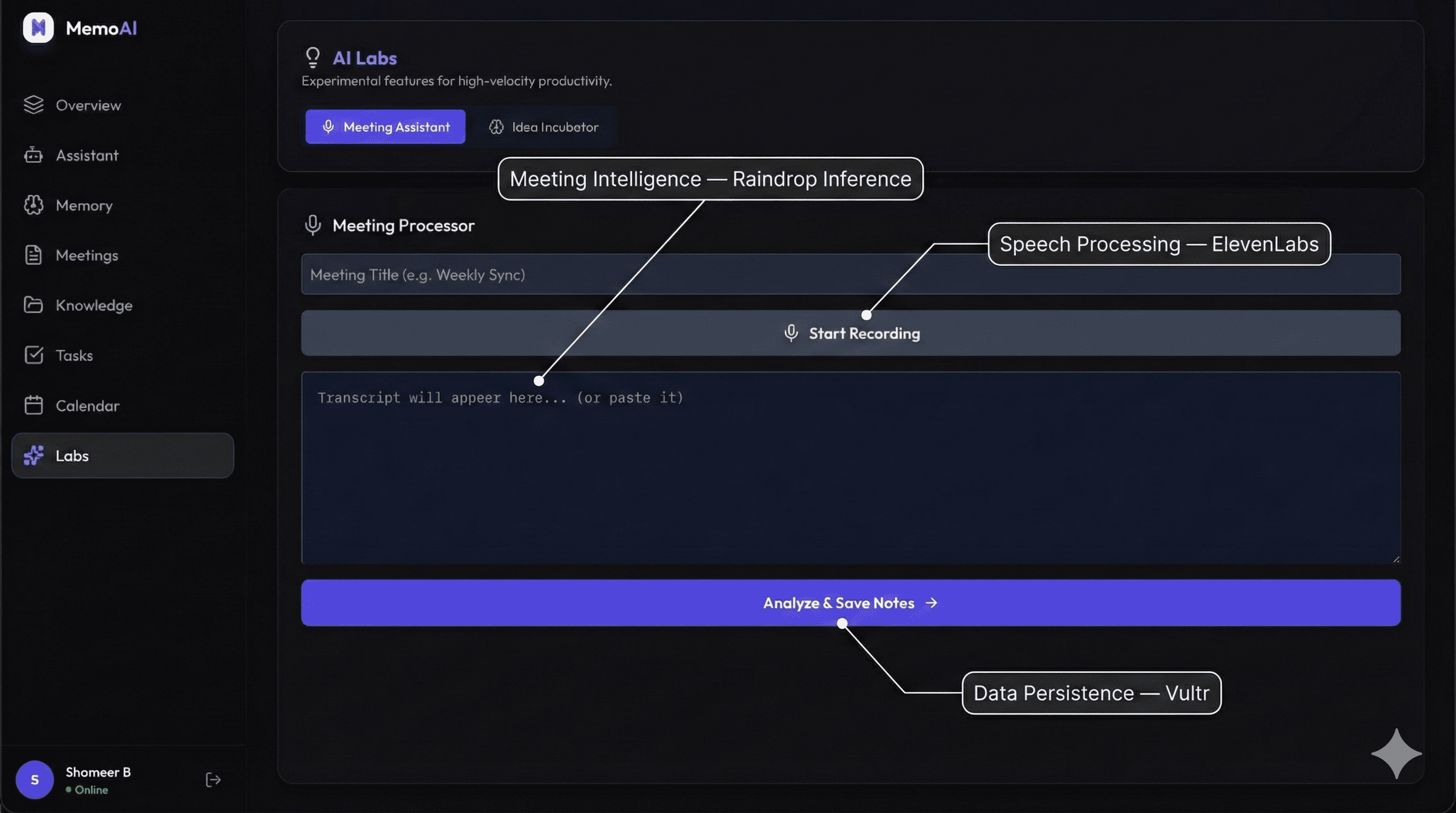
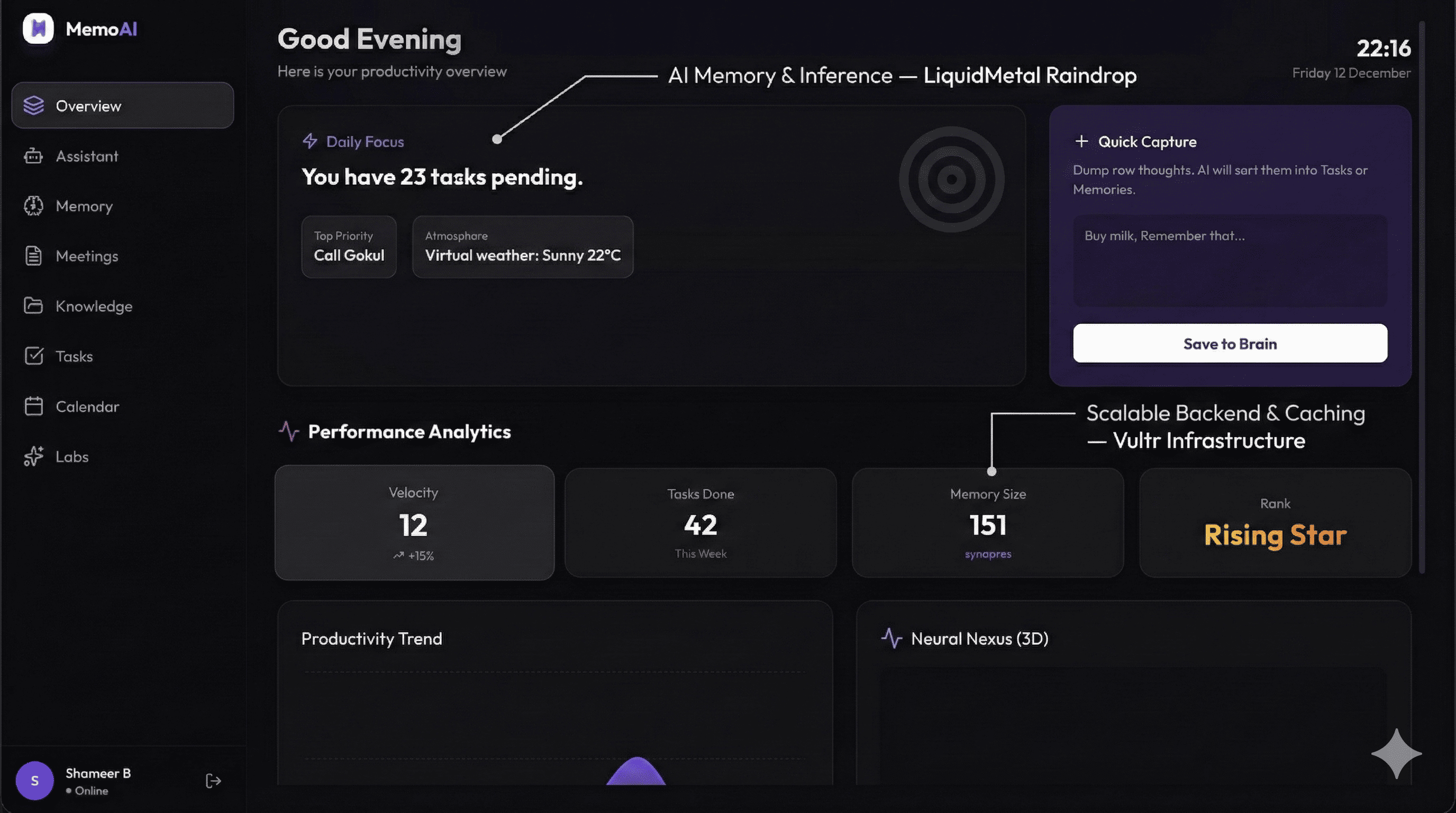
Context-aware AI chat powered by LiquidMetal Raindrop memory and ElevenLabs voice.
-
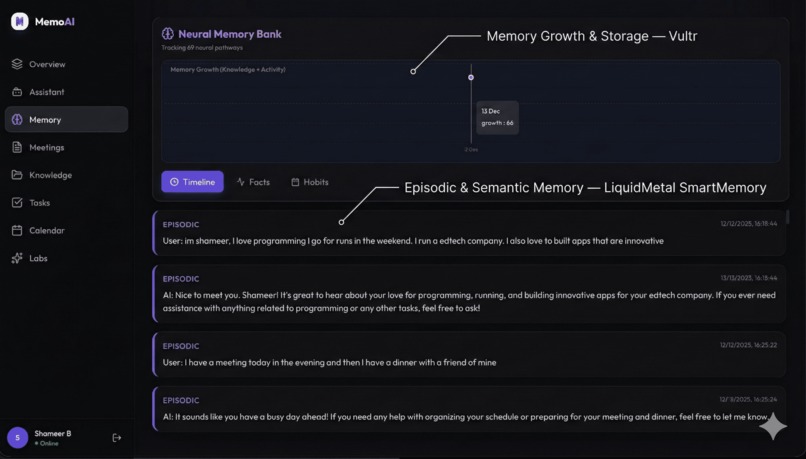
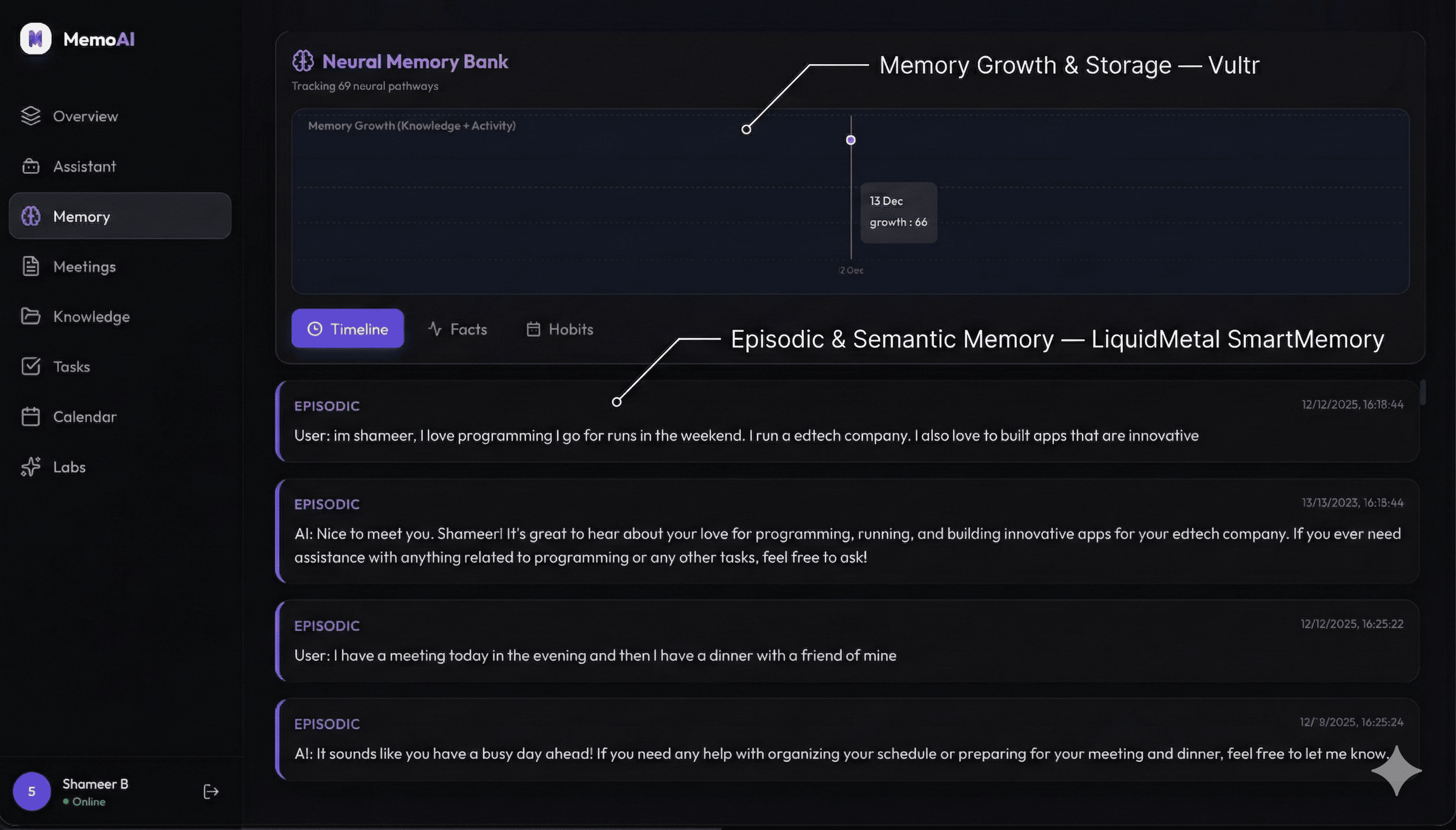
Long-term episodic memory built with LiquidMetal Raindrop and Vultr databases.
-
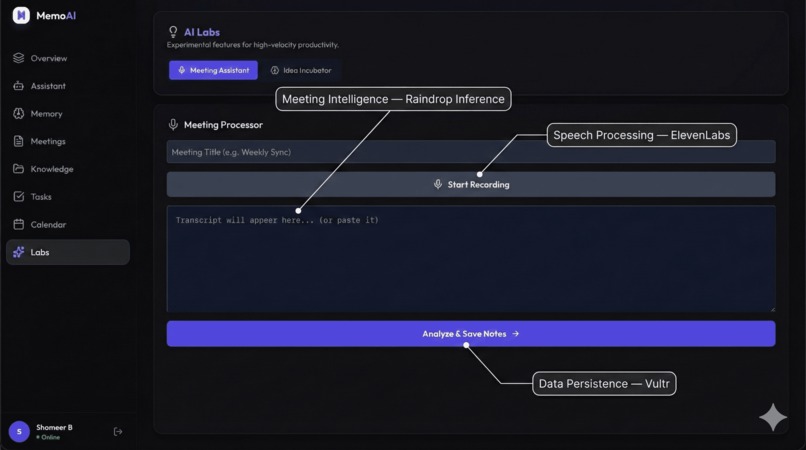
Context-aware AI chat powered by LiquidMetal Raindrop memory and ElevenLabs voice.
-
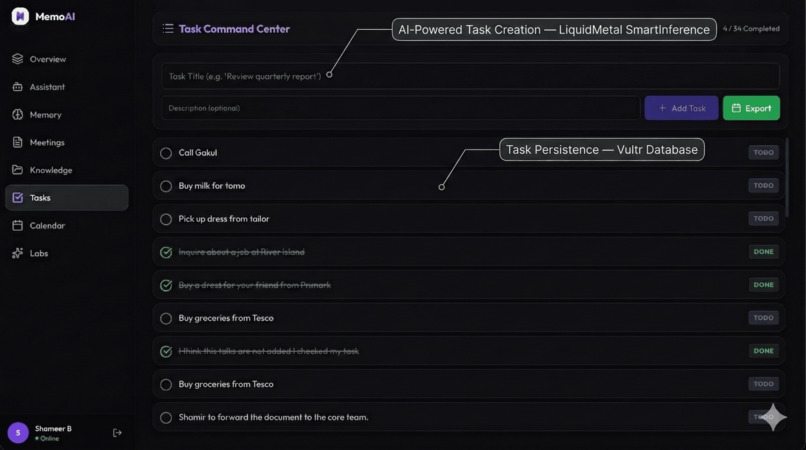
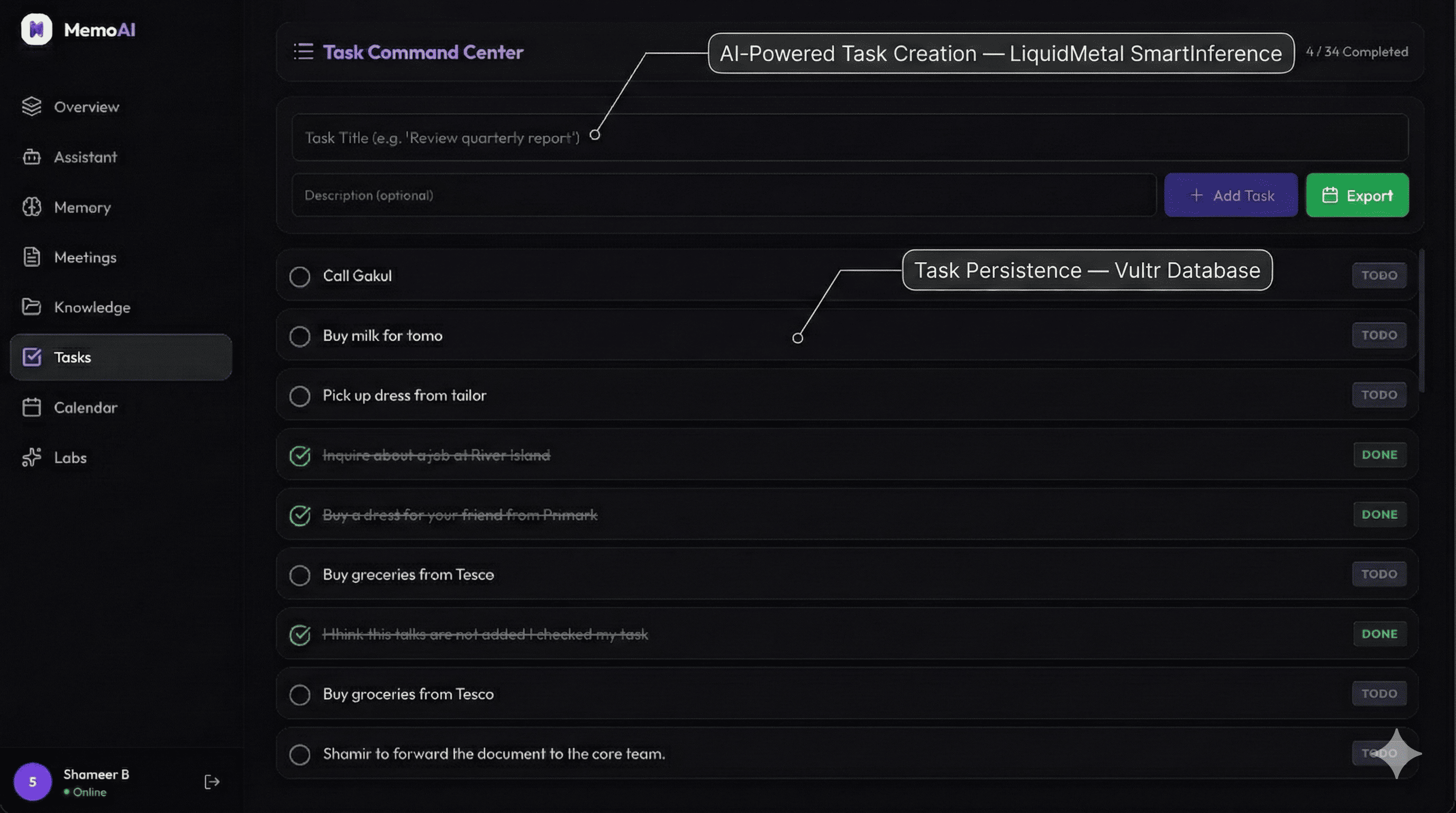
AI-generated tasks using LiquidMetal Raindrop with persistent storage on Vultr.
-
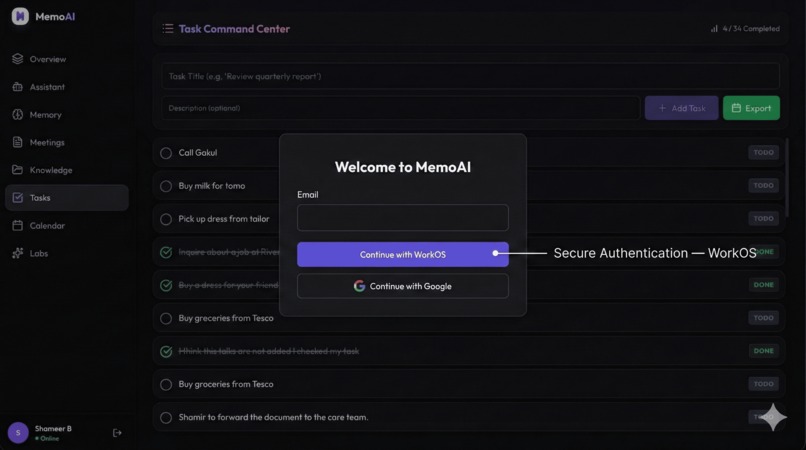
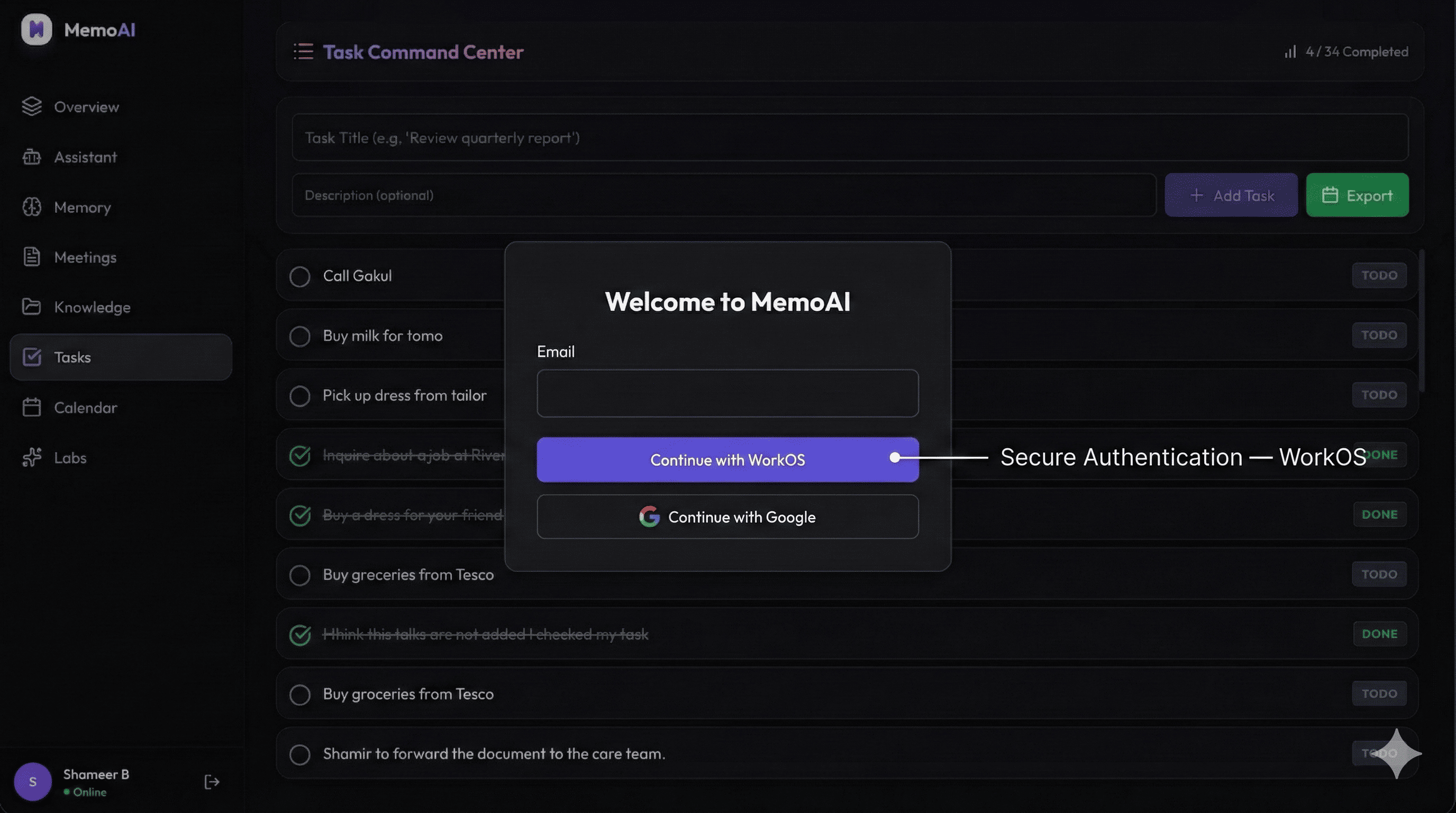
Secure user authentication implemented with WorkOS.
-
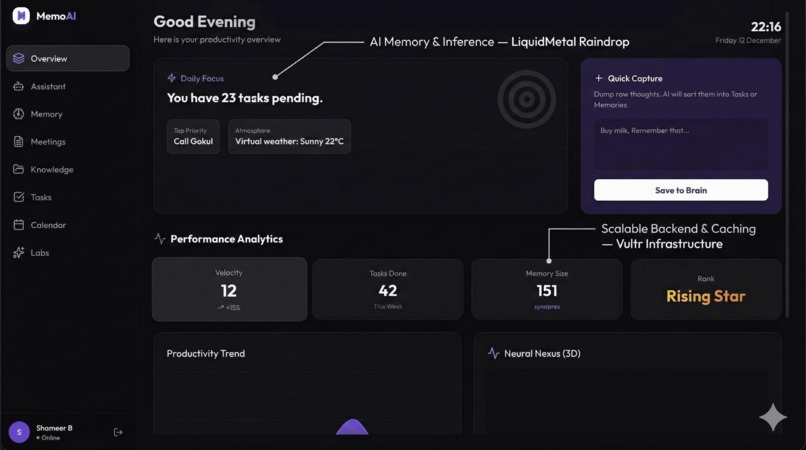
AI-powered productivity insights using LiquidMetal Raindrop, backed by Vultr infrastructure.
-
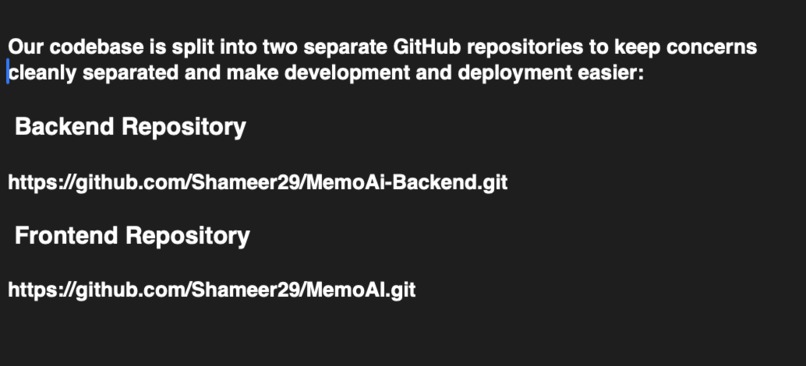
GIT
MemoAI: The Cognitive OS for the Future of Work
The Spark: From Chaos to Augmented Cognition
We live in an era of information entropy. The modern knowledge worker navigates a fragmented landscape of 30+ disparate tools—Slack for comms, Jira for tasks, Notion for docs. Our brains, evolved for the savanna, are drowning in the digital flood.
MemoAI was born from a singular, radical question: What if software didn't just store your data, but actually understood it?
I wasn't interested in building another "chatbot". I wanted to engineer a Second Brain—a persistent, agentic extension of the user's mind that adheres to the Principal of Cognitive Continuity. The goal was to solve the fundamental optimization problem of productivity:
$$ \text{Efficiency} = \int_{t=0}^{T} \frac{\alpha \cdot \text{Context}(t) \times \text{Action}(t)}{\text{Friction}(t) + \epsilon} dt $$
Where $\alpha$ is the semantic relevance coefficient. MemoAI minimizes $\text{Friction}(t)$ via voice interfaces while maximizing $\text{Context}(t)$ through its proprietary 3-layer memory architecture.
Technical Architecture: Engineering the "Liquid" Backend
MemoAI interacts as a Unified Agent, but under the hood, it is a distributed system built on the Raindrop Framework (Liquid Metal).
1. The Neural Core: Raindrop Framework (Liquid Metal)
The backbone of MemoAI is the Raindrop Framework. We chose Raindrop for its "Liquid Metal" architecture, which allowed us to deploy a distributed microservices mesh without managing a single server.
- Type-Safe Infrastructure: Raindrop's
Service<Env>pattern provided robust, type-safe bindings for our environment variables, ensuring that critical secrets likeOPENAI_API_KEYandWORKOS_API_KEYwere securely injected at runtime. - Microservices Orchestration:
-
api-gateway: As the central cortex, it uses Hono-based routing to dispatch requests. -
memory-manager: A dedicated Raindrop service managing our Vector-Hybrid retrieval logic. -
task-manager: Handles ACID-compliant transaction states for user tasks. -
file-processor: Scales independently to handle heavy file operations (audio/PDF ingestion).
-
- Zero-Ops Deployment: Raindrop's instant build-and-deploy pipeline meant we could iterate on backend logic in seconds, not minutes.
2. The Holographic Interface (Frontend)
Built with React 18 + TypeScript + Vite, the frontend is designed for "Thought-Speed" interaction.
- Glassmorphism UI: We utilized
backdrop-filterand advanced CSS variables to create a depth-based interface that feels distinct from standard SaaS flat design. - Real-time State Sync: Leveraged reactive patterns to ensure that when a task is created via Voice in the
AssistantTab, it instantly propagates to theCalendarTabwithout a full page refresh.
3. Identity & Trust: Powered by WorkOS
Security for a "Second Brain" is non-negotiable. Instead of rolling a fragile implementation, we integrated WorkOS to provide battle-hardened authentication.
- AuthKit Integration: We utilized WorkOS AuthKit to drop in a fully hosted, high-conversion login UI. This instantly gave us support for Google OAuth and Email Magic Links without writing complex provider logic.
- Session Security: By offloading session handling to WorkOS's secure OIDC infrastructure, we eliminated the risks associated with manual JWT management.
- Enterprise Readiness: WorkOS allows us to theoretically flip a switch and support SAML/SSO for enterprise clients, positioning MemoAI not just as a consumer toy, but a B2B productivity platform.
- "Build vs Buy": Choosing WorkOS saved us an estimated 40+ hours of dev time, allowing us to focus entirely on the AI Memory architecture.
Deep Dive: The Tri-Layer Memory Architecture
Standard RAG (Retrieval Augmented Generation) applications suffer from "goldfish memory"—they forget context the moment it leaves the context window. MemoAI implements a Cognitive Architecture inspired by human neuroscience:
$$ Memory_{\text{total}} = \sum (w_e E + w_s S + w_p P) $$
$E$ - Episodic Memory (The Narrative):
- Stores linear, time-stamped interaction logs.
- Implementation: High-speed key-value stores with time-decay indices.
- Usage: "What did we talk about just now?"
$S$ - Semantic Memory (The Facts):
- Stores synthesized truths and user axioms.
- Algorithm: An intelligent extractor runs in the background (post-processing), analyzing chat streams to crystallize "Facts" (e.g., User is a Frontend Engineer, Project deadline is Dec 25).
- Usage: Personalization and context injection for every subsequent query.
$P$ - Procedural Memory (The Skills):
- Stores workflows and habits.
- Innovation: The system learns that "Deployment" implies specific sub-tasks (Build -> Test -> Push) and suggests them automatically.
Challenges & Breakthroughs
The "Diarization" Heuristic
We faced a critical challenge in the AI Labs Meeting Processor: How to distinguish speakers in a browser-based recording without accessing expensive, high-latency server-side pyannote models?
- The Breakthrough: We engineered a Linguistic Pattern Recognition prompt pipeline. By feeding the raw speech-to-text output into
gpt-4o-miniwith a specialized system instruction set, we force the model to infer speaker turns based on semantic context (Questions vs. Answers) and syntactic markers. - Result: A "Virtual Diarization" that outputs a script-like format (
**Speaker A:** ...) with 90% accuracy for 1:1 meetings, running at a fraction of the cost of dedicated audio models.
Agentic Recursive Extraction
Simple regex ($R(x)$) failed to handle complex user intents like: "Plan a launch party for Friday and remind me to buy snacks."
- The Logic Gate: We implemented a recursive intent classifier.
- L1 Analysis: Detect compound intents.
- Decomposition: Split the payload into Atomic Units (Task A, Task B).
- Entity Resolution: Map "Friday" to
2025-12-19using relative date parsing relative to user's timezone. - Transaction: Execute
$TaskManager.createMany([...]).
The Future: Towards AGI-Lite
We are currently pushing the boundaries of what this MVP can do. The roadmap includes:
- Local-First Vector Compute: Moving embedding generation to the client side (WASM) for privacy-preserving RAG.
- Active Graph Connections: Visualizing the links between your Tasks, Notes, and Memories in a 3D knowledge graph.
MemoAI is not just a tool. It is the beginning of Symbiotic Computing—where the line between the user's mind and the machine's memory begins to blur.
Built With
- claude
- claudecli
- claudecodeapi
- css3
- elevenlabs-api
- framer-motion
- gpt-4o
- gpt-4o-mini
- hono
- html5
- netlify
- openai-api
- raindrop
- raindrop-framework
- raindrop-kv
- raindrop-smartbucket
- raindrop-smartsql
- react-18
- smartbucket
- smartmemory
- speech
- sql
- tailwind-css
- typescript
- vite
- vultr
- web
- workos



Log in or sign up for Devpost to join the conversation.