-

Concept illustration, not a product screenshot: everyday records connect to support future decisions.
-
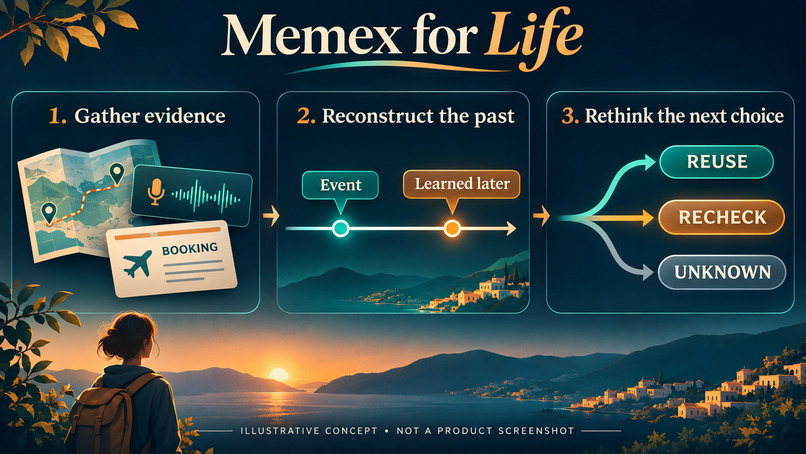
Illustrative concept, not a product screenshot: gather evidence, reconstruct the past, and rethink the next choice.

Inspiration
You can find the hotel. Can you remember why you chose it?
For a returning traveler, last year's booking is easy to find. The reason for choosing it may be scattered across a map, a voice note and later messages. Planning the next trip means rebuilding that context, then checking it against a different situation.
Memex for Life makes that the purpose of personal memory: not merely remembering the past, but using it responsibly.
What it does
Memex for Life is a Uliya Skill for a user-selected collection of everyday NAS records. Its central output is a Decision Replay, a concise, evidence-linked brief:
First, a Historical record preserves the choice and its recorded reasons. Then a Current check assigns each reason one status:
- Still supported: current evidence supports that specific criterion.
- Recheck: a new condition changes its relevance or contradicts it.
- Unknown: the evidence needed to assess it is missing or uncertain.
Consider this designed synthetic card, not a measured NAS result:
New arrival point; keep the access requirement, recheck the journey.
Historical record: Cedar Stay was booked [D1]. A voice note records two reasons: step-free entry and station access [A1].
- Still supported: a current-trip confirmation says the entrance remains step-free [D2]. This supports the entrance criterion, not accessibility everywhere in the building.
- Recheck: this trip arrives at a coach terminal [U1], making the recorded station-access reason worth reviewing. The archive does not establish the old trip's transport mode.
- Unknown: the terminal transfer and current room availability.
Next useful input: a current terminal-to-hotel transfer record or your acceptable transfer constraint. Coverage: three original sources fully read; the new-trip instruction is listed separately. No booking or save was performed.
The point is not to reject the hotel. It is to preserve a supported reason while making the unresolved part of the next choice precise.
If every source carrying the recorded reason is missing, the map cannot replace it as proof of motivation. If the current entrance confirmation is missing, that criterion becomes Unknown. Evidence changes the answer, not just its wording.
How we built it
The new Markdown Skill orchestrates registered Uliya file, document, photo and knowledge experts. It follows one bounded workflow:
RECOVER → RECONSTRUCT → RECHECK → PREVIEW → SAVE → VERIFY
Each material claim retains its source and locator. Event time is kept separate from when the workflow observed the evidence. User corrections and later evidence create explicit changes; earlier saved snapshots remain distinct from reconstructions produced afterward.
Saving is optional. The Skill previews the content and destination, requests permission, avoids overwriting previous versions and reads the result back before claiming a verified save. It uses supported expert workflows, without a custom runtime, external API or background watcher.
Why the NAS matters
The raw material already lives there. Documents supply confirmations, images supply visible context and supported audio supplies recorded reasoning. Saved briefs can sit beside those originals for a later session, rather than disappearing into a chat history.
This is not a claim that every model operation runs locally. Actual routing and permissions must be verified on the assigned device before processing private records.
What is different
General assistants can already compare choices. Memex proposes a repeatable evidence contract for that task: each reconsidered conclusion connects a recorded reason, a current condition and its sources, while prior knowledge remains distinguishable from later reconstruction.
The differentiator is not a longer answer. It is a small, inspectable result that separates historical evidence from current applicability, preserves uncertainty and does not turn one choice into a permanent preference.
Challenges
A later file is not automatically more authoritative. A request is not proof of completion. Several files may derive from the same original statement. An unread source can change the answer. A partial write can look successful until read-back fails.
These cases shape the workflow and its validation plan. The goal is not to hide uncertainty behind a polished response, but to make uncertainty useful to the person making the decision.
Current development status
This is a Round 1 Skill package and proposal. The initial Markdown workflow and supporting contracts are authored. The revision sharpens the Decision Replay experience and test specification.
NAS installation, media extraction and end-to-end behavior have not been validated. Illustrative cards and synthetic scenarios are not NAS runtime screenshots or measured results. Existing Memex application code is not included in the submitted package.
What's next
If selected, run C1: reconstruct from complementary booking, image and audio evidence, then R1: transfer by changing one current condition. Require historical claims to remain stable and each changed status to cite its evidence. Include a positive current-evidence control, not only unknowns. Remove all sources carrying motivation in an edge case and require abstention. Keep C2: temporal history and E1: conflicting or missing evidence as regressions.
Compare ordinary Uliya using unseen variants, identical original inputs and the same model. Measure supported claims, correct change attribution and appropriate abstention. Keep independent memory creation separate from shared-snapshot recall. Report failures and any lack of improvement.
AI assistance disclosure
OpenAI assistant supported research, drafting, Skill authoring and review. The package contains no prior Memex application code, bundled third-party model weights or real personal datasets.
