Inspiration
"I've spent my life adapting to unstable systems. Now I'm intentionally building stable ones."
That is the human origin of Memex Continuity Lab.
I did not begin as a software engineer, and I did not start Memex because I wanted another chatbot. I am a solo, architecture-first builder who learned software development through sustained collaboration with ChatGPT. At the beginning, that often meant copying instructions and code between ChatGPT, Terminal, and a 2018 Intel MacBook Pro, then returning with the result and learning one correction at a time. ChatGPT did not officially train or certify me. It became the interactive medium through which I learned how specifications, repositories, commands, state, tests, schemas, and proof fit together.
That collaboration produced far more than code. It produced creative worlds, coursework, consulting methods, operational systems, financial-simulation ideas, personal corrections, and years of unfinished but valuable thought. One verified ChatGPT export alone contains 497 conversations and 17,535 messages. The problem was no longer generating ideas. The problem was preserving their lineage, knowing which statements were mine, remembering which decisions had been corrected, and recovering the next valid action after a session or model lost context.
A raw export is not continuity. It is a crowded archive. Ordinary AI memory can also fail in two directions: it can forget, or it can confidently reconstruct a cleaner story that was never actually true. A repeated model suggestion can start looking like founder intent. An old plan can displace a later correction. A file can look like a finished feature even when nothing calls it.
I needed a system that could preserve meaning without silently rewriting it. The core idea became simple:
Memory is not the product. Governed continuity is the product.
What it does
Memex Continuity Lab is a local-first, human-governed agentic continuity stack. It has two connected jobs.
First, it recovers signal from a person's or organization's accumulated digital history while preserving source identity, corrections, conflicts, uncertainty, and privacy. Raw Markdown and source records remain evidence; structured JSON and database records act as control envelopes, not replacements for the original meaning. Material can remain an observation, inference, conflict, unknown, or candidate instead of being silently promoted into truth.
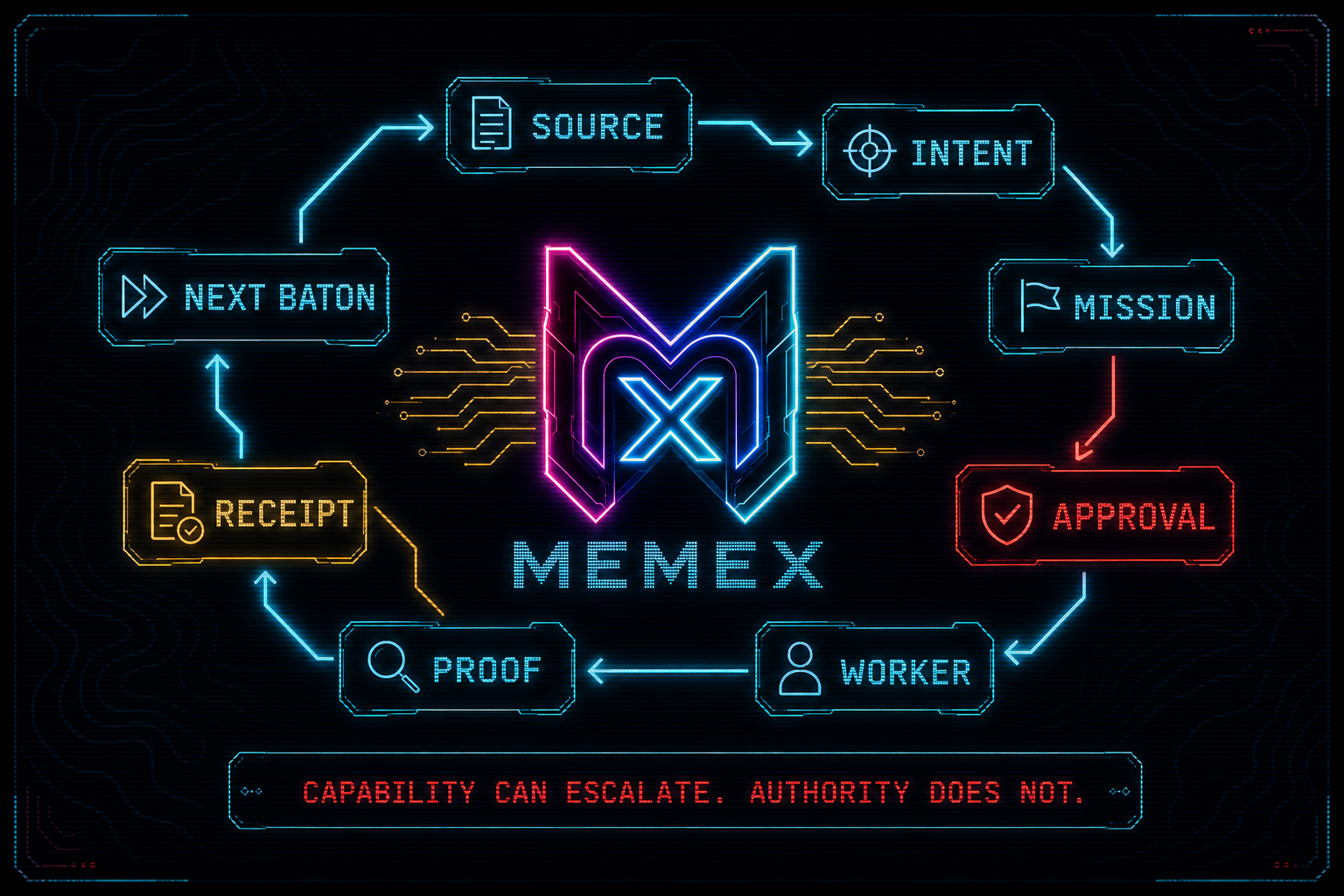
Second, it turns an accepted direction into bounded work:
conversation
  -> operational intent
  -> durable mission
  -> exact approval digest
  -> authority challenge
  -> bounded worker
  -> independent proof
  -> terminal state
  -> receipt and next baton
Every protected action is tied to the exact thing the human approved. A changed payload, forged approval, escaped path, or post-approval edit is held instead of guessed through. The next session or worker can resume from a content-addressed baton rather than asking the founder to reconstruct the entire state again.
Slack is the current conversational front door and founder cockpit. Memex can say what is observed, what is intended, what remains unknown, which work is blocked, and what exact approval would be required next. Slack is not the intelligence or authority boundary; it is one replaceable human interface over the governed spine.
The result is not unrestricted autonomy, consciousness, or a fictional digital employee. It is bounded agency with visible custody: who requested the work, what evidence was admitted, what authority was granted, which worker acted, what proof returned, and what should happen next.
How I built it
Memex is primarily a Python system. Its current stack includes FastAPI, Pydantic, Slack Bolt with Socket Mode, SQLite mission state, JSON and JSONL contracts, deterministic workers, synthetic fixtures, pytest, Ollama-hosted local models, Tailscale networking, and bounded cloud-model command-line lanes.
The private reference deployment runs across six very different machines: an NVIDIA gaming system, an Apple Silicon M1 system, a 2018 Intel MacBook Pro, and three recycled Windows i5 mini PCs. They do not pretend to be one pooled supercomputer or equally intelligent workers. Memex gives them role-badged, stateless assignments based on measured capability, while stronger models serve as bounded consultants or engineering workers when the task warrants escalation. Capability can escalate without silently escalating authority.
The source-recovery side follows a separate governed path:
exact source
  -> provenance and source influence
  -> discernment and semantic coordinates
  -> source-linked candidate
  -> human review or explicit hold
  -> receipt-backed admission
Memex existed before Build Week as a large private architecture, doctrine set, and collection of partially connected organs. Build Week did not replace that master plan. It forced me to make the real extension legible: inspect what was actually there, distinguish names from working circulation, connect a narrow end-to-end path, attack it with adversarial checks, and package only what another person could reproduce.
The live private Build Week working set grew across hundreds of files and more than 200,000 added lines spanning source code, tests, schemas, settings, documentation, and generated evidence. I do not present that as 200,000 lines of hand-written production code. The meaningful result is the opposite of a volume claim: a dependency-closed judge release whose manifest inventories 96 allowlisted files and preserves the verified core without exposing my private datascape, credentials, or unrelated pre-existing work.
How I used Codex and GPT-5.6
GPT-5.6 in Codex became the flagship engineering collaborator I could not hire as a solo founder. I used one long primary session to inspect and reconstruct the pre-existing repository, challenge assumptions, translate spoken founder direction into bounded plans, write and debug implementation, design adversarial tests, diagnose failed proofs, coordinate evidence, and compress the result into something another engineer can inspect.
The collaboration was intentionally asymmetric. I retained product meaning, founder worldview, privacy decisions, authority boundaries, corrections, and final approval. Codex accelerated repository analysis, implementation, test construction, Slack ingress repair, worker calibration, receipt verification, failure diagnosis, and sanitized release packaging. GPT-5.6 and Codex did not receive standing authority to promote private material, publish content, spend money, trade, or redefine Memex.
This project story also demonstrates the product. I did not ask a fresh model to invent a biography from memory. Memex reconstructed a source-witnessed founder continuity atlas from admitted local evidence, explicitly labeling observations, inferences, conflicts, and unknowns. I then used that candidate evidence with Codex to write this public account while keeping sensitive source material private.
The deterministic judge proof intentionally makes zero external model calls. That does not hide GPT-5.6's role. It separates the engineering collaborator from runtime authority and lets every judge reproduce the governed control loop without an API key, subscription, usage window, or cost.
Challenges
The hardest challenge was actuality. A file can exist without being reachable. A route can be reachable without being tested. A unit test can pass without proving a real mission. A receipt can exist without proving the action it describes. I had to stop treating architectural vocabulary as implementation evidence and build a language for presence, reachability, proof, circulation, acceptance, and remaining gaps.
The second challenge was source fidelity. My exports and backups contain exact duplicates, model-written suggestions, founder-authored doctrine, corrections, and later copies of earlier material. First-person text is not automatically my voice, and frequency is not authority. Memex had to preserve authorship, chronology, supersession, disagreement, and uncertainty instead of flattening them into a clean but false profile.
The third challenge was heterogeneous hardware and provider behavior. Local models vary dramatically in speed, context, and judgment. Authentication and model availability also differ across operating systems. During Build Week I attempted a remote Linux bootstrap for the mini PCs and reached a repeated GRUB/EFI failure. Rather than claim a migration that did not work, I archived the evidence, removed the unfinished boot route, returned the fleet to Windows, and moved Linux back to the roadmap. That failure reinforced a core Memex rule: preserve the baton, stop when the proof fails, and return to the actual objective.
The fourth challenge was releasing a private continuity system safely. The canonical repository is richer, but it contains founder material, machine-specific state, and unrelated intellectual property. The judge release therefore had to be allowlisted, secret-scanned, privacy-scanned, dependency-closed, and independently exercised from a clean environment.
Accomplishments
- The one-command proof completes 3 of 3 governed missions, executes each worker exactly once, reconciles 39 of 39 SQLite and JSONL receipt projections, and blocks forged approval, path traversal, and post-approval tampering.
- The proof uses synthetic fixtures, makes zero external calls, costs nothing to run, and requires no private account.
- The focused judge regression contains 19 passing tests.
- The sanitized package is dependency-closed, secret-scanned, privacy-scanned, and excludes the private founder datascape and production credentials.
- The live founder Slack DM path passed a provider-backed acceptance check while an informational question created no hidden mission or protected action.
- Memex reconstructed an exact 497-conversation, 17,535-message source chronology and produced a source-witnessed founder-atlas candidate without pretending that inferred groupings were original ChatGPT project folders.
- The submission clearly separates the pre-existing architecture, the tested Build Week extension, and the longer Personal Memex, Enterprise Memex, Creative Studio, security, and venture-workcell roadmap.
What I learned
Agentic quality is not the number of actions an AI can take. It is the quality of its stop conditions, evidence, handoffs, and ability to return control without losing state.
Continuity requires preserving uncertainty. If two sources or classifiers disagree, the system should retain that disagreement for review instead of flattening it into a cleaner but less truthful answer. Correction is not an embarrassment to erase; it is state-changing evidence.
I also learned that AI-assisted development can be a real path into engineering for someone without a conventional software background, but only if the collaboration produces inspectable state instead of dependence on confident prose. The model can translate, challenge, and accelerate. The human must still define purpose, correct meaning, and own consequential decisions.
Finally, smaller local models become far more useful when they receive narrow contracts, exact evidence, and explicit escalation paths. A heterogeneous home cluster can behave like one governed workforce without pretending every node has the same intelligence, speed, or authority.
What's next
The submitted package proves the governed core, not every product arc. My next work is to mature Personal Memex as an individual's continuity layer, Enterprise Memex as a permissioned organizational posture over the same spine, and Dreamscape/Creative Studio as the interface for turning source-grounded ideas into inspectable venture and creative artifacts.
I also want the system to be recoverable beyond any one computer: portable bootstrap, encrypted backup, security continuity, and evidence-bound restoration rather than a pile of irreplaceable machines or thumb drives.
The long-term goal is not to make Memex replace a person. It is to give a person or team durable operational continuity across time, models, tools, and machines, so their accumulated intelligence can become usable leverage without surrendering source custody or human authority.

Log in or sign up for Devpost to join the conversation.