-
-
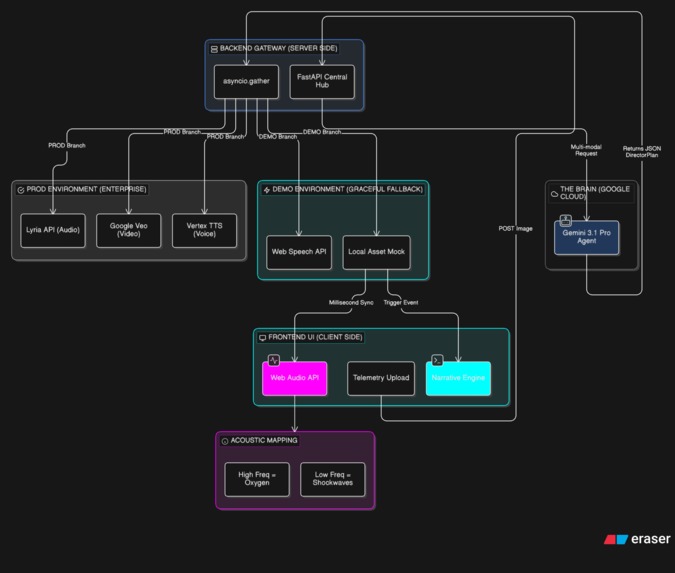
Architecture Diagram
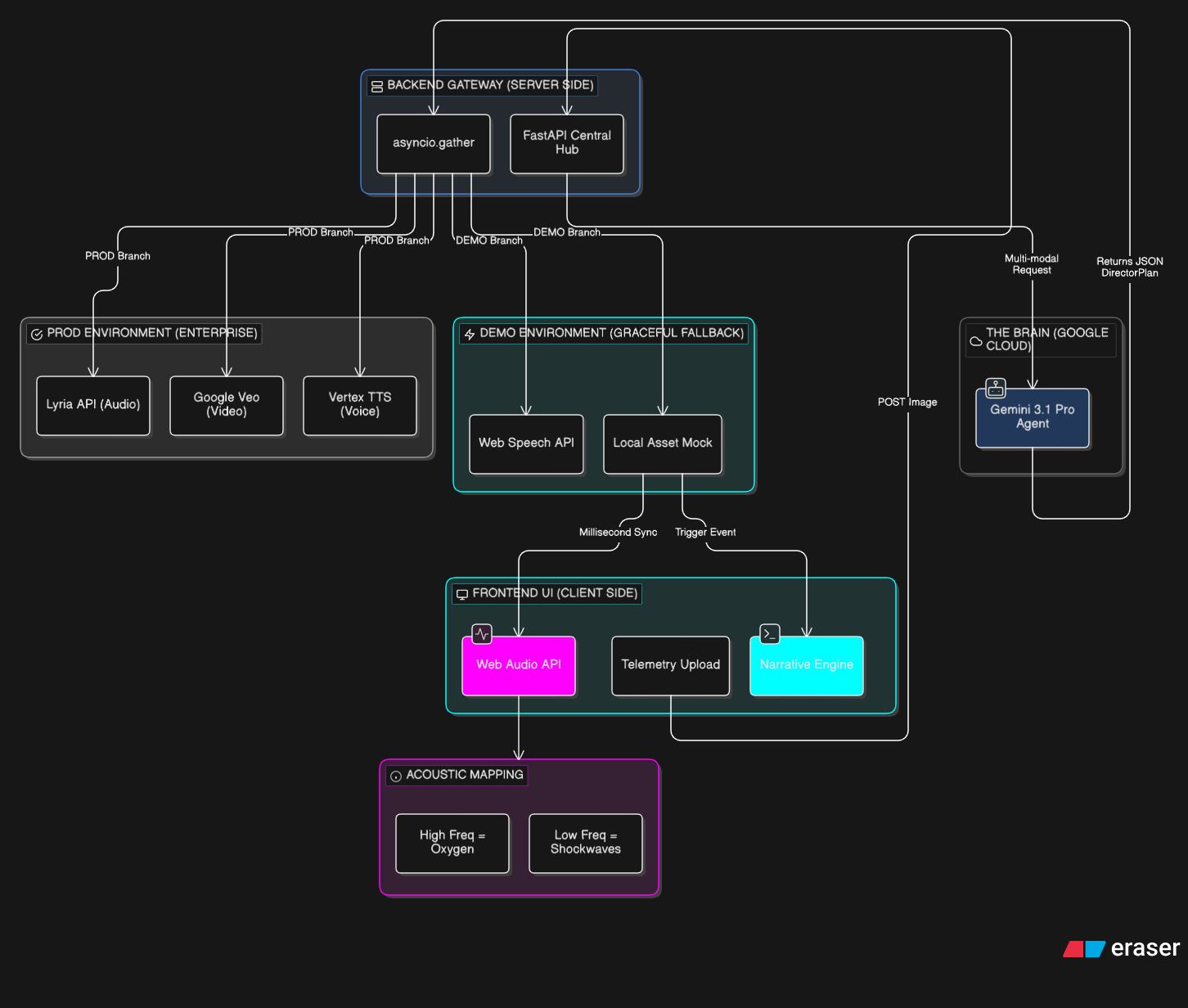
Echoes of the Cosmos: Bridging Astrophysics and AI Narrative
🌌 Inspiration
In astrophysics, we process massive amounts of silent, cold visual telemetry. A dying star expands at $v \approx 1,500 \text{ km/s}$, tearing through the interstellar medium with massive shockwaves, yet telescopes only provide silent pixels. Echoes of the Cosmos was born from a profound question: What if we could hear the data? We wanted to break free from traditional text-based AI chatbots and use generative AI as a bridge between hard physics and human perception.
🚀 What it does
"Echoes of the Cosmos" is an immersive multi-sensory dashboard that acts as a Creative Director for astronomical data.
- The Sight: A visual narrative engine highlights structures like high-energy oxygen cores versus expanding gas filaments.
- The Sound (Data Sonification): We perform a real-time mapping of physical phenomena to the acoustic spectrum.
- High-frequency pulses ($\uparrow f$) represent synchrotron radiation from central pulsars.
- Low-frequency timpani rolls ($\downarrow f$) represent the kinetic energy of shockwaves in heavy elements.
🛠️ How we built it
We architected a high-concurrency Agentic Workflow:
- The Central Hub: A FastAPI backend deployed on Google Cloud Run orchestrates user telemetry.
- The Director Agent: Gemini 3.1 Pro analyzes multi-modal inputs to output a structured
DirectorPlanJSON, containing millisecond-timed narrative and media prompts. - Acoustic Physics Engine: Our Vite/React frontend utilizes the Web Audio API to perform real-time Fast Fourier Transforms (FFT):
$$X(k) = \sum_{n=0}^{N-1} x(n) e^{-i 2\pi \frac{kn}{N}}$$
This drives the dynamic spectrum bars, allowing users to "see" the acoustic physics. Our backend is containerized using Docker and deployed on Google Cloud Run, leveraging its Auto-scaling and Scale-to-Zero capabilities to ensure cost-efficiency and high availability for processing heavy astrophysical telemetry.
- Cloud Infrastructure: The frontend is hosted on Firebase, ensuring a secure, scalable delivery of the cinematic assets.
🧠 Challenges we ran into
Our biggest hurdle was "millisecond-level audiovisual synchronization." Initially, asynchronous API responses caused the audio to drift. We solved this by implementing a Strict State Slave logic: the visual typewriter and video player are strictly indexed to the cosmicAudio.currentTime source of truth, ensuring the narrative always hits the beat.
🎓 What we learned
Through this project, I deepened my understanding of:
- Multi-modal LLM Orchestration: How to use Gemini not just for text, but as a decision-maker for media synthesis.
- Data Sonification Theory: The delicate balance between scientific accuracy and artistic immersion.
- Cloud Native Deployment: Managing containerized microservices on Google Cloud.
🏆 What we're most proud of
The Acoustic Physics Mapping. Seeing the cyan spectrum bars spike exactly during pulsar radiation explanations, followed by the fuchsia bars rumbling for gas shockwaves—all driven by real-time browser processing—proves that data visualization can successfully evolve into Data Sonification.
🔭 What's next for Echoes of the Cosmos
This architecture is domain-agnostic. We plan to scale this agentic workflow to:
- Medical Imaging: Sonifying MRI scans for anomaly detection.
- Climate Science: Creating "The Sound of Global Warming" using atmospheric datasets.
- Education: Helping visually impaired students "see" the universe through sound.


Log in or sign up for Devpost to join the conversation.